
Home / Products / Overhead power line masts
Product · Power engineering
Power Line Poles steel, multi-sided and standard
We manufacture steel structures for high-voltage transmission lines: standard unified poles and steel multi-sided poles. We design special power line poles for non-standard conditions.
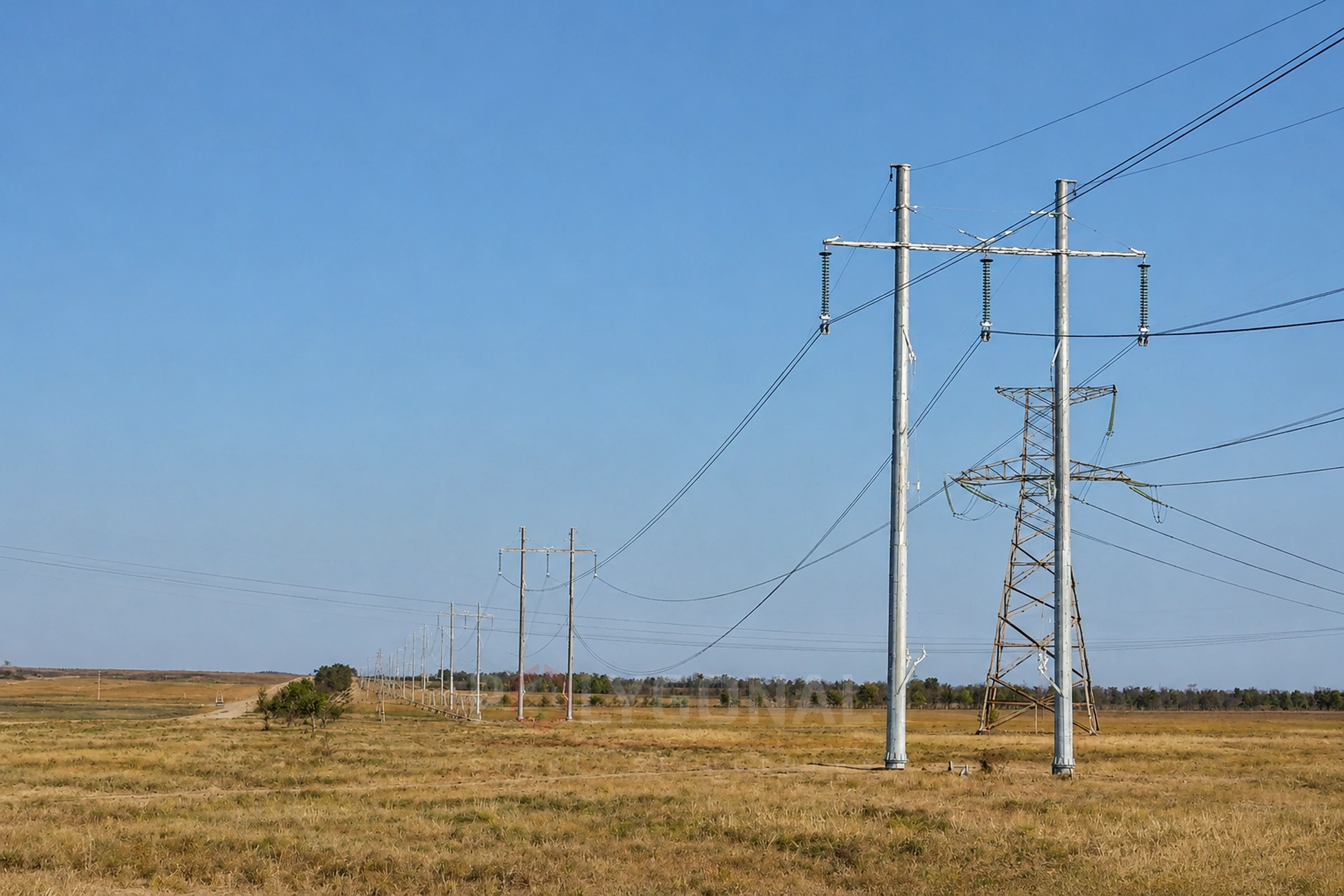
Types of power line poles
Design and manufacture follow the standards and regulations in force in Ukraine.
Multi-sided poles for 6–10 kV lines
Steel multi-sided bent shafts for medium-voltage lines.
Steel Multi-sided Poles for 35 kV Lines
Multi-sided pole types for 35 kV lines: how they are made and where they are used.
Steel Multi-sided Poles for 110 kV Lines
Multi-sided pole types for 110 kV lines: how they are made and where they are used.
Steel Multi-sided Poles for 220 kV Lines
Why multi-sided poles suit 220 kV lines in urban and restricted conditions, which types are made and how they are calculated.
Typical lattice poles 35–750 kV
Marks, height to the underside of the cross-arm and pole mass — without and with zinc coating.
Cable-to-overhead transition structures
To change an overhead 35–110 kV line over to a cable: moving a line out of industrial areas, crossing roads, railways and other structures. PO-KV mark.
Advantages of multi-sided power line poles
Pole reliability
Lines on multi-sided poles avoid the catastrophic failures typical of reinforced concrete poles (domino effect) and steel lattice towers (twisting shafts).
Pole durability
Galvanised steel multi-sided shafts last longer than wooden, reinforced concrete and lattice steel poles.
Vandal resistance
A solid shaft with no lattice members, the weak point of lattice structures.
Pole aesthetics
The shafts blend into urban and rural landscapes; zinc and paint coating in any colour keeps a neat look.
Easy transport
Multi-sided poles travel on standard trailers; concrete ones need special carriers and coupled platforms.
Simple installation
Poles are assembled from sections and erected by crane, or by helicopter in hard-to-reach places (mountains, rivers, forest).
Power line poles by voltage class
Steel multi-sided poles
| Voltage class | Poles | Conductors, wind and ice regions |
|---|---|---|
| 6–10 kV | single-shaft single-circuit: intermediate, anchor, angle-anchor (up to 60°), with disconnector, with cable joint | AC 50/8 to AC 120/19, SIP-3; wind I–III, ice I–III |
| 35 kV | double-circuit: intermediate, dead-end, angle-anchor (up to 79°) | up to AC 120/27; wind I–V, ice I–IV |
| 110 kV | single- and double-circuit intermediate (a raised double-circuit version is also available); single-circuit: anchor and angle-anchor (up to 45°) | up to AC 240/32; wind I–V, ice I–IV |
| 35–110 kV | PO-KV cable-to-overhead transition structure: 16-sided shaft, single- and double-circuit versions | wind I–V, ice I–VI |
| 220 kV | single-circuit angle-anchor on one shaft (dead-end, anchor, angle up to 60° and up to 20°); intermediate in three versions | AC 300/39, AC 400/51; wind and ice I–IV |
Typical lattice poles
| Voltage class | Height to the underside of the cross-arm, m |
|---|---|
| 35 kV | 10.0–19.5 |
| 110 kV | 10.5–67.5 |
| 220 kV | 10.5–79.0 |
| 330 kV | 10.7–81.0 |
| 500 kV | 17.0–100.0 |
| 750 kV | 20.0–45.0 |
Multi-sided poles are described for 6–220 kV lines and typical lattice poles for 35–750 kV; lattice heights are to the underside of the cross-arm, including height add-ons.
Overhead power line masts: technical specifications
Classification of line poles by purpose
By purpose, poles are suspension (80–90% of the poles on a line; they only support conductors and earth wires), tension (take the difference in conductor tension), angle (at turns of the route) and dead-end. Transposition poles and other details: Power Line Pole Types by Purpose; multi-sided against lattice and reinforced-concrete poles: Power Line Poles: Multi-sided, Lattice or Reinforced Concrete.
Input data for choosing a power line pole
The voltage class gives only the general frame. A pole is chosen from the line’s data: loads (weight of conductors and earth wires, wind, ice and, on tension, angle and dead-end poles, conductor tension), span length (calculated, there is no ready table by voltage — Distance Between Power Line Poles), wind and ice regions, terrain and the number of circuits (Double-circuit Power Line Poles).
Design, standards, foundations and installation
We design line poles and foundations individually for specific conditions. The calculation is based on the Rules for the Arrangement of Electrical Installations (PUE) in their current edition, DBN V.1.2-2:2006 (loads and actions) and DBN V.2.6-198:2014 (steel structures); galvanising follows DSTU EN ISO 1461:2024. A pole is fixed to its foundation through a flange with an embedded part or set directly in the ground; the type depends on the soil and the loads (Foundations for masts, towers and power line poles). We advise on assembly and installation; the installation itself is done by a specialised organisation to a work execution plan.
Production, quality control, lead time and prices
We bend shafts on a 2000 t press (sheet up to 25 mm thick and 12 m long), weld the longitudinal seam and the flanges, and galvanise in our own 13,000 × 1,600 × 3,200 mm bath; lattice structures of angle steel are also made in-house. Control: incoming metal, dimensions, welds (visual and ultrasonic inspection), zinc thickness.
Shop capacity is 500 t per month; for products not in stock the typical lead time is 3–4 weeks. More: Quality Control of Steel Structures and Hot-dip Galvanising.
Starting prices (incl. VAT, as of September 2026): multi-sided poles from UAH 55,000 each for 6–10 kV lines and from UAH 450,000 for 220 kV and above; typical lattice poles from UAH 110,000 per tonne (Power Line Pole Prices).
What determines the price of a power line pole
We calculate the price for a specific line. It depends on:
- voltage class and pole type: suspension, tension, angle, terminal;
- height, number of circuits and cross-arms;
- design loads: wind and ice regions;
- foundation and fixing type;
- coating (hot-dip galvanising), number of poles, delivery.
How to order power line poles
- Send the technical specification form for a power line pole (at the bottom of the page) or the initial data of the line: voltage, conductor type and cross-section, angles, region.
- We carry out the calculation and propose a design of poles and foundations.
- We calculate the price and lead time; after approval we manufacture and ship.
Power line, overhead line and high-voltage line: what the terms mean
A power line (ЛЕП in Ukrainian) carries electricity from power plants and substations to other substations and consumers. An overhead line (ПЛ) has its conductors in the open air, fixed to poles through insulators and fittings, instead of lying in the ground or in water as a cable.
A line above 1 kV is usually called high-voltage. The PUE (2026 edition), cl. 1.1.3, divide installations at that limit but do not define a “high-voltage line”. The classes of rated voltage in cl. 1.2.21 follow DSTU EN 60038: low up to 1 kV, medium above 1 up to 35 kV (including 6–10 kV lines), high above 35 up to 230 kV.
Power line voltage classes and the poles in our range
The rated voltage of a line is the voltage between phases. Power engineers usually distinguish medium voltage (6–35 kV), high voltage (110–220 kV) and extra-high voltage (330–750 kV); per PUE (2026 edition), cl. 1.2.21, extra-high starts above 230 kV, though some sources count 330 kV as high voltage.
For 6–10 kV lines we make steel multi-sided poles and steel cross-arms and caps for reinforced-concrete poles (overhead line fittings for 0.4–10 kV). For 35, 110 and 220 kV we make multi-sided and typical lattice poles; for 330, 500 and 750 kV, only typical lattice poles of angle steel.
Power line pole height: what it depends on and where to find the values by voltage
There is no single pole height. It depends on the voltage class (the higher the voltage, the greater the clearances from conductors to the ground and between them), the pole type (angle-anchor, intermediate or crossing) and the terrain.
Heights to the underside of the cross-arm for typical lattice poles of 35–750 kV are in the table on this page; the full height with an earth-wire peak is greater. Steel multi-sided poles for 6–10 kV are sized by the design. Table by pole type and a worked example: Transmission Pole Height by Voltage Class.
Articles about overhead power line masts
Typical Lattice Power Line Poles: Classification and Checks
Power Line Pole Types by Purpose: Suspension, Tension, Angle, Terminal
Power Line Protection Zone: Widths by Voltage Class
Distance Between Power Line Poles: What Determines the Span Length
Design of Power Line Poles and Foundations
Power Line Poles: Multi-sided, Lattice or Reinforced Concrete
Power Line Crossings with Roads, Railways and Pipelines under the PUE: Poles, Clearances, Guards
Transmission Pole Height by Voltage Class 35–750 kV: Table
Double-circuit Transmission Poles: What They Are and When to Use Them
Earthing of Overhead Line Poles above 1 kV under PUE:2026: Resistance, Down-Conductors, Electrodes and Acceptance
Power Line Pole Prices
Questionnaire: technical assignment form
Fill in the form and email it to us: we will prepare the KM-stage design documentation from it and calculate the price. The PDF is handy to print; the DOCX can be filled in on a computer.
Technical assignment form: overhead line pole
A questionnaire for preparing KM-stage design documentation for a steel polygonal overhead line pole: operating conditions, conductors, earth wires, insulator strings, clearances.
Power line poles: frequently asked questions
For what voltages do you make line poles?
Steel multi-sided poles for 6–10, 35, 110 and 220 kV lines, PO-KV transition structures for 35–110 kV lines and typical lattice poles from the catalogue.
What poles do you offer for 330, 500 and 750 kV lines?
Typical lattice poles of angle steel from the catalogue: angle-anchor, intermediate and, for 330 and 500 kV, crossing poles. Heights: Transmission Pole Height by Voltage Class.
How much does a multi-sided power line pole cost?
The price depends on voltage class, pole type and height, loads, coating and the number of poles. Send the line data or the technical specification form and we will calculate the price and lead time.
What types of poles are there by function?
Suspension (80–90% of the poles on a line), tension, angle and terminal poles. They differ in loads: tension poles take the difference in conductor tension, angle poles stand at route turns.
What poles are used on 10 kV and 6 kV lines?
Reinforced-concrete, wooden or steel multi-sided ones. Reinforced concrete is traditional for distribution networks; single-shaft steel poles suit tight sites where durability matters. We make steel multi-sided poles for 6–10 kV and steel structures for reinforced-concrete poles of 0.4–10 kV lines.
Overhead power line masts: related solutions
Substation gantries
Poles and structures for power lines and substations.
Overhead line fittings and crossarms (0.4-10 kV)
Cross-arms, clamps and brackets for 0.4–10 kV lines.
Antenna masts
Towers and antenna masts for telecom.
Hot-dip galvanising
Corrosion protection by hot-dip galvanising to DSTU EN ISO 1461:2024.
Steel structure design (structural and detail drawings)
Structural and detail drawings for your structures.
Custom steel fabrication
Fabrication of steel structures to drawings: cutting, bending, welding.
Need power line poles for your project?
Send us the line parameters: voltage, number of poles and route conditions. We will calculate the price and the manufacturing lead time.