
Product · Security
CCTV poles
We make steel poles for CCTV cameras at sites, roads and railway facilities: a shaft with a camera bracket and equipment mounts. We choose the height and bracket reach to suit your task. The price starts from UAH 12,000 each including VAT.
Where they are used
We choose the pole design by the field of view, the number of cameras and the site conditions.
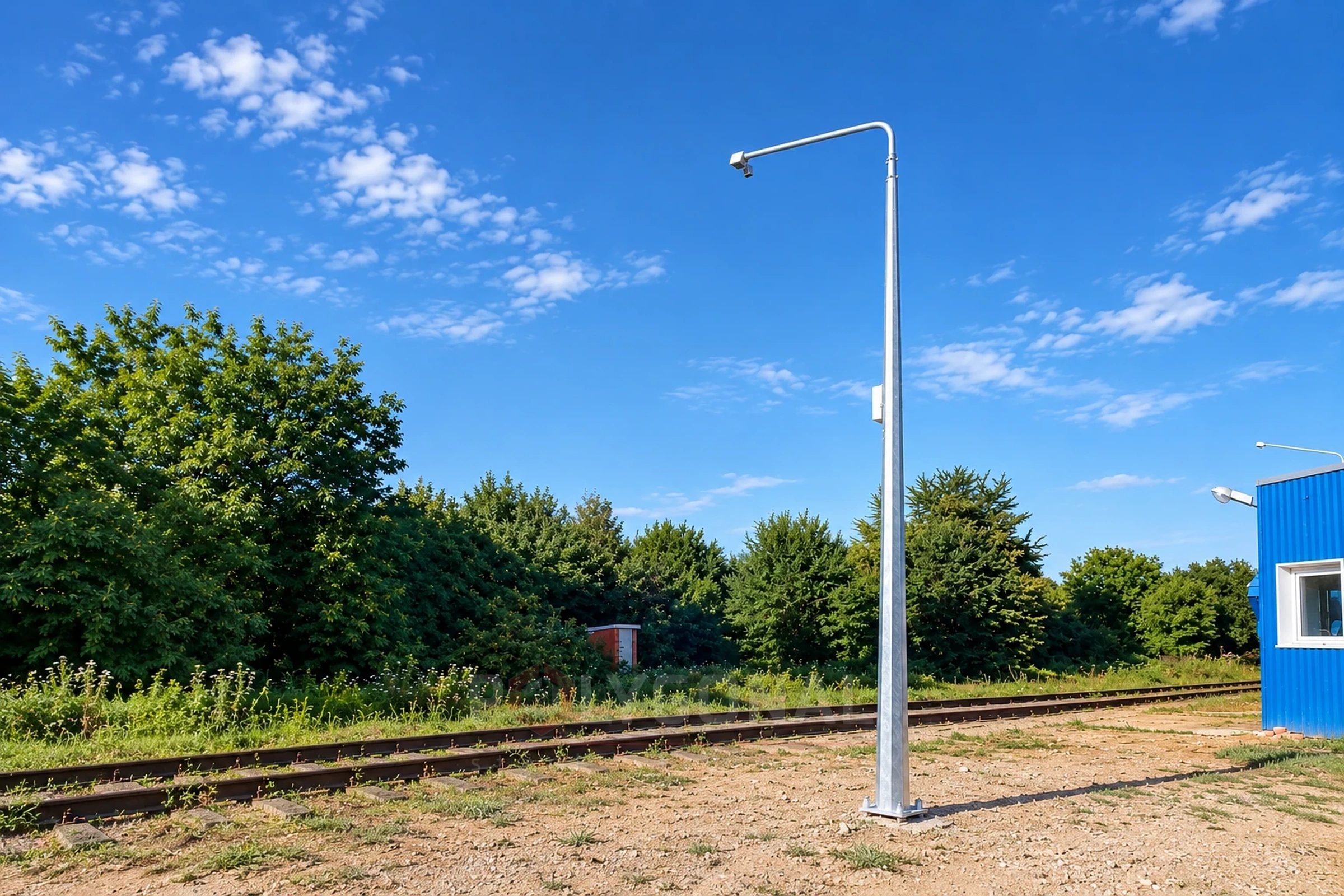
Poles with a bracket
A shaft with a curved bracket for mounting the camera.
Sites and roads
Poles for perimeter security, car parks, roads and junctions.
Railway facilities
Poles for cameras at railway and other transport facilities.
Combined poles
The pole can be combined with lighting or other equipment.
Advantages of CCTV poles
Corrosion protection
Hot-dip galvanised steel resists rain, snow and temperature swings.
Cable inside
The tubular shaft lets you run the cable inside rather than along the outside.
Height and reach to suit
Parameters are chosen by the field of view and the number of cameras.
Wind resistance
The shaft size is calculated for the wind region and the weight of the equipment.
Mounting to suit the site
The pole is fixed through a flange to a foundation with anchor bolts, or into the ground, depending on the site.
With lighting
The camera pole can be combined with lighting or other equipment.
Hot-dip galvanised poles
to DSTU EN ISO 1461:2024
CCTV poles: technical specifications
How to choose a pole
- height depends on the field of view and the camera mounting height
- bracket reach sets the camera position relative to the shaft
- the mass and area of the cameras and other equipment affect the shaft size
- the wind region and terrain type are taken into account in the calculation
Fixing to the foundation
The shaft is bolted to the foundation through a flange (anchor cage with anchor bolts) or set in the ground, depending on the site conditions.
Coating
Hot-dip galvanising to DSTU EN ISO 1461:2024, optionally with an additional paint coat in the colour you need.
What data we need to select a pole
The more precise your input data, the sooner we can calculate the shaft and quote the price. Gather it before you get in touch:
- the number of cameras, the mass of each one including its housing and bracket, and its sail area, meaning the surface the wind pushes on (the mass and dimensions of a camera are given in its data sheet);
- the camera model or its data sheet: the shape and reach of the bracket are chosen for the specific model;
- what each camera must cover (a perimeter, a car park, a road or a junction) and whether faces or licence plates must be recognised: this determines the camera mounting height and the bracket reach required (not only the overall pole height);
- any other equipment: a cabinet with switching and power equipment (on the pole or at its base), a luminaire or other devices;
- the town or city, to determine the wind region (the W0 values for regional centres and the guidance for other towns are in the article Wind Regions of Ukraine; if your town is not in the table, just name it in your enquiry);
- the site type (grounds, road, railway facility), the soil and whether a foundation is already in place.
If some of the data is not available yet, send what you have. How the height and rigidity of the shaft affect the camera image is explained in the article CCTV Poles: Height, Rigidity, Camera Mounting.
What to agree before ordering
Some decisions are hard to change once the pole is made, so it is better to settle them at the start:
- cable entry and openings: before the pole is made, decide where the power and signal cables will enter and where openings are needed for the cabinet and brackets. A hole drilled in an already galvanised shaft exposes bare steel, which is usually protected with a zinc-rich repair coating, so it is better to agree the hole positions in advance (on preparing a structure for galvanising, see Designing Steel Structures for Hot-dip Galvanising);
- anchor cage and foundation: the anchor cage with its bolts is cast into the foundation before the pole is erected, and the bolts must match the holes in the bottom flange of the shaft. Before the pole is installed the foundation must be ready, meaning finished, set out accurately for level and axis, and cured to the required strength;
- earthing and surge protection: the arrangement and the connection point are set by the design of the power supply and the CCTV system in accordance with the applicable rules, including the current edition of the Rules for the Arrangement of Electrical Installations (PUE);
- cabinet on a pole and sockets: under PUE (2026 edition), cl. 1.7.94, in networks up to 1 kV with a solidly earthed neutral, a metal cabinet that is operated directly from ground level must be connected to the PE conductor of the installation and to an equipotential bonding conductor. This conductor (black steel, at least 10 mm in diameter) is laid in the ground at a depth of 0.5–0.7 m and 1 m away from the cabinet, and where the ground is covered with asphalt or concrete the laying can be omitted. The clause names a cabinet on the facade of a building or on an overhead-line pole, so whether it extends to the cabinet of a CCTV pole is for the design to decide. Sockets with an operating current of up to 32 A, to which portable electrical equipment can be connected in the open air, must be protected by a residual-current device (RCD) with a rated residual current of not more than 30 mA (cl. 1.7.164);
- anti-vandal requirements: at sites with a higher risk of damage the cable entry and connections are placed inside the shaft, and the cabinet gets a reinforced lock; we agree the set of measures to suit the site;
- maintenance: plan how you will reach the camera for adjustment or replacement, since at height this needs a lift or another safe means of access.
Choosing the design to suit the type of site
The type of site shows what to pay attention to first:
- grounds and perimeters: a large area has to be covered without blind spots, so the main parameters are the camera mounting height and the bracket reach, while the number of poles depends on the length of the perimeter;
- roads and junctions: the cantilever of a traffic signal pole can also carry a road camera, and an example of the configuration is given in the article Cantilever Traffic Signal Poles: Reach, Height, How to Choose;
- railway or other transport facilities: the position of the pole and the requirements for it depend on the rules of the site owner, so say whose site it is and send the requirements you have;
- sites with lighting: a camera can share a pole with a luminaire, in which case the shaft is calculated for the complete set of equipment.
The cabinet and spare capacity for the future
The equipment of the pole (bracket, cabinet, cable entry) is described in detail in the article CCTV Poles: Height, Rigidity, Camera Mounting; here is only what is worth deciding before the order:
- a cabinet on the shaft sits next to the camera but adds mass and sail area at height, which the calculation must allow for;
- a cabinet at the base does not load the upper part of the shaft and is easier to service, but it needs its own space and protection against damage;
- if new cameras, radio equipment or a floodlight may be added later, say so right away: the shaft is calculated for the complete set of equipment, not only for the first camera.
How we work: from enquiry to installation
- You send the parameters or simply call us; leave blank whatever you do not know.
- We clarify the details, calculate the shaft and quote the price and lead time.
- We agree the height, the bracket reach, the cable openings and the method of fixing.
- We make the pole and check it during production (the incoming metal, dimensions, welds by visual and ultrasonic inspection, zinc thickness), then galvanise it in our own hot-dip galvanising bath. The typical lead time is 3–4 weeks if the item is not in stock.
- We ship the pole. Installation is carried out by our partner, a licensed building contractor (the installation procedure is described in the article Assembly, Erection and Installation of Multi-sided Poles, Masts and Towers).
Our products carry a 2-year warranty.
Looking after the pole after installation
For galvanised structures we recommend an inspection every year and after strong winds: this is a guideline, not a regulatory requirement. What to check:
- the base of the shaft, the flange and the anchor nuts: rust, a gap under the flange, loose nuts, cracks in the concrete;
- the welds and the edges of openings: cracks, rust streaks;
- the cable entry and the cabinet lock: whether the cabinet closes tightly, signs of water or of an attempted break-in;
- the coating: a thin, even grey film is normal, while a thick powdery white deposit and brown or red stains are a reason for a detailed inspection: this may be corrosion of the steel, but it may also be rust from non-galvanised parts, washed onto the coating by rain.
Poles in aggressive environments (near the sea, in an industrial zone, beside roads treated with de-icing agents) are inspected more often. Signs of wear are covered in the article Wear and Corrosion of Metal Poles: Signs, Inspection, Repair or Replacement, and the coating’s service life in the article Hot-dip Galvanising Service Life.
CCTV poles: frequently asked questions
What poles do you make for cameras?
Steel shafts with a camera bracket and equipment mounts, for sites, roads and railway facilities.
Can the cable run inside the pole?
Yes, the shaft is made of tube, so the cable can be routed inside.
What do I need to send for a price calculation?
The pole height, bracket reach, the number and mass of cameras, the wind region and the location. Leave blank whatever you do not know and we will clarify.
How is the pole fixed?
Through a flange onto a foundation with anchor bolts, or into the ground, depending on the site.
How long does it take to make a pole for cameras?
If the item is not in stock, the typical lead time is 3–4 weeks. For a custom order we give the exact lead time after the calculation.
Who installs the pole on site?
Installation is carried out by our partner, a licensed building contractor. If the pole is fixed by a flange, a finished foundation with an anchor cage must be in place before the installers arrive.
Can a hole be made in the pole after galvanising?
It can be drilled, but the bare steel in the wall of the hole is usually protected with a zinc-rich repair coating. It is therefore better to agree the positions and diameters of the openings for the cable, cabinet and brackets before the pole is made: then they are galvanised together with the shaft.
Can a camera be fitted to an existing lighting pole?
Only after a check calculation: such a pole is designed for its own load, while the camera and cabinet add mass and sail area at height. If there is no spare capacity, you need a new pole or a combined pole calculated for all the equipment.
How much does a CCTV pole cost?
From UAH 12,000 each including VAT, excluding delivery and installation; we set the height and equipment for the task.
CCTV poles: related solutions
Need CCTV poles?
Send us the parameters: height, number of cameras and location. We will calculate the price and the lead time.