
Home / Services / Rotor balancing
Service · Industrial equipment
Rotor balancing
We perform dynamic balancing of rotors and impellers of induced draft fans, fans and other industrial equipment to reduce vibration and protect bearings and rotating assemblies.
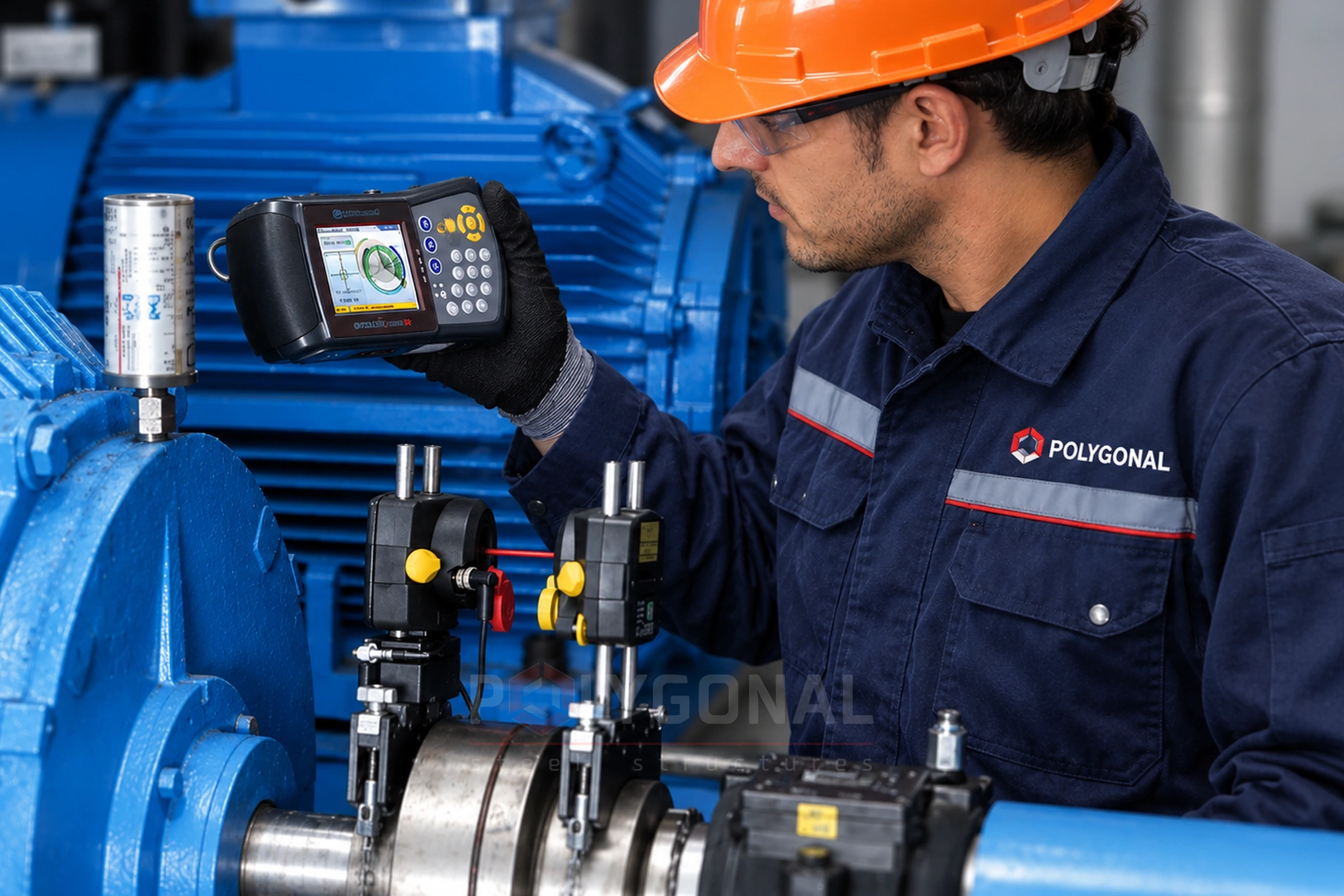
What we balance
An unbalanced rotor causes vibration, faster bearing wear and emergency shutdowns.
Induced draft fan impellers
Balancing of the impellers of induced draft fans and fan-exhausters.
Fans
Dynamic balancing of rotors of industrial fans.
Other rotors
Rotors of other industrial equipment, with the scope of work agreed in advance.
Advantages of timely balancing
Less vibration
Balancing lowers the vibration level of the equipment.
Longer life of assemblies
Less load on bearings and rotating assemblies.
Fewer emergency stops
Timely balancing prevents the consequences of rotor imbalance.
Induced draft fans and fans
We balance the impellers of induced draft fans and fan-exhausters, and the rotors of industrial fans.
Dynamic method
Unbalance is measured and removed while the rotor turns. Afterwards the rotor runs with minimal vibration.
Other rotors
We also take on rotors of other industrial equipment, with the scope of work agreed in advance.
Rotor balancing: technical specifications
What dynamic balancing is
Dynamic balancing means measuring and eliminating rotor imbalance during rotation. Afterwards the rotor runs with minimal vibration.
Signs of imbalance in an induced draft fan impeller
An unbalanced impeller shows itself first as vibration of the supports, but loose fixings and poor shaft alignment give similar readings, so one measurement is not enough. The other signs of imbalance in an induced draft fan and what to rule out before the work starts are set out in the article on the consequences of late balancing.
When to order balancing
Elevated vibration is not always caused by imbalance alone, but there are typical situations in which balancing should come first:
- after repair or replacement of an impeller or its blades and after installation of the unit, as the final operation of the repair work;
- when the blades wear unevenly through erosion, or when dust or other material builds up on them;
- when, during periodic monitoring, the vibration of the supports rises gradually compared with earlier measurements and the inspection finds no other cause, such as loose fixings or poor shaft alignment;
- when, after the impeller has been balanced on a balancing machine and the unit installed, vibration in the unit’s own bearings stays high because the conditions on the balancing machine do not reproduce service conditions.
The indicative vibration velocity levels used to assess the technical condition, and the consequences of running with elevated vibration, are described in the article Consequences of Late Balancing of Induced Draft Fan and Fan Impellers. The general criteria for evaluating machine vibration, including its change over time, are set out in the ISO 20816-1 standard.
What the customer should prepare
The fuller the initial data, the faster the scope of work can be agreed. It helps to collect:
- nameplate data: the type of machine, drive power, working speed, whether the drive speed is adjustable, as well as the type, dimensions and mass of the rotor;
- a description of the problem: when the vibration appears (at idle or under load) and whether it is constant or intermittent;
- results of earlier vibration measurements and records of past repairs and balancing;
- the condition of the impeller: blade wear, build-up, weld repairs and cracks, as well as photos of the impeller;
- access conditions: where the unit is located, whether the impeller can be reached to fit trial and correction weights, and for how long the unit can be stopped.
While the weights are being fitted, the unit must be stopped and isolated from all energy sources, and the area around it must be clear of foreign objects. The impeller is cleaned of build-up before balancing.
How the work proceeds and how the result is assessed
The usual order of work:
- clarifying the data and the scope of work;
- inspecting the rotor and eliminating the causes of vibration not related to imbalance: the impeller is cleaned, threaded connections are tightened, shaft alignment is checked, and loose parts and damage to bearings and couplings are identified; cracks in blades and discs are assessed first;
- measuring the initial vibration at the marked points and in the marked directions, at a working speed that does not fall within the machine’s resonance ranges;
- fitting a trial weight and measuring the change in vibration and phase angle;
- fitting correction masses: mass is mostly added, and material is removed only when adding mass is impossible;
- a check run and a comparison of the measured vibration before and after balancing.
The result is assessed by the reduction in vibration at the same measuring points. The level that can be reached depends on the condition of the impeller, bearings and foundation, so it is judged from measurements taken before and after the work. How the vibration parameters change during start-up and shutdown is also analysed: it helps to assess the stability of the rotor and the condition of the foundation. For more on the stages, the choice of speed and the trial weight, see the article Dynamic Balancing of Rotors in Their Own Bearings: Method and Stages.
Operating modes and measurement conditions
The result of balancing depends on how repeatable the vibration measurements are, so the unit’s operating modes are best agreed before the work starts:
- balancing is done at the working speed, and with an adjustable-speed drive at the highest working speed; a rotor with a large imbalance is balanced first at a lower speed and then at a higher one;
- at every start the same speed must be reached, and it must not fall within the machine’s resonance ranges, so the unit should be brought to the same mode every time;
- the measuring points and directions are marked once and used the same way at all starts;
- several starts and stops are needed (an initial measurement, a run with a trial weight, a check run), so they should be allowed for in the equipment’s operating schedule.
The dynamic influence coefficients show how the vibration of the supports responds to an added mass. Even for rotors of the same type they differ by more than 10%, because of measurement errors, thermal deformation of the rotors and errors in fitting the weights, so the measurements must be as repeatable as possible. For more on the choice of speed, see the article Dynamic Balancing of Rotors in Their Own Bearings: Method and Stages.
What to expect from the result
Balancing removes only the part of the vibration that is caused by rotor imbalance. The benchmarks are as follows:
- the article on the method states that after balancing in the rotor’s own bearings the vibration of the supports often falls 10–12 times, while in the fan tests in the article on the consequences it fell roughly 2–6 times;
- less vibration means smaller additional forces on the bearing supports, so bearing life increases.
These are benchmarks from the cases described, not a guarantee for a particular unit; the actual effect is judged from measurements before and after the work. Examples of measurements, the effect on the drive’s power consumption and the consequences of running with elevated vibration are in the article Consequences of Late Balancing of Induced Draft Fan and Fan Impellers.
What to do after balancing
A balanced state does not last: uneven blade wear, dust build-up and impeller repairs disturb the balance again over time. It is therefore worth organising follow-up monitoring:
- record the results: the measurements before and after balancing, the measuring points and mode, and the repairs carried out, for example in the unit log;
- measure the vibration periodically at the same points and compare it with earlier values; a gradual rise in vibration is a signal to check the impeller and, if necessary, repeat the balancing;
- after repair of the impeller or blades and after installation of the unit, check the vibration straight away, without waiting for the next scheduled inspection.
On vibration monitoring and condition-based maintenance, see the article Vibration Diagnostics and Process Accuracy Checks of Industrial Equipment.
Articles about rotor balancing
Dynamic Rotor Balancing: Method and Stages
Why a rotor balanced on a machine still needs balancing in its own bearings, and how the work goes: preparation, balancing and analysis of the results.
Consequences of Late Fan Impeller Balancing
What happens to induced draft fans and fans when their impellers are not balanced in time: where imbalance comes from, which vibration levels are permitted and what balancing achieves.
Industrial Equipment Maintenance and Repair
How maintenance and repair of equipment are organised: the planned preventive maintenance (PPM) system, types of repair, types of maintenance, the difference between planned and unplanned work, and how to choose the type of work for each unit. We do not repair equipment: our part is the vibration survey and rotor balancing.
Vibration Diagnostics and Process Accuracy Checks of Industrial Equipment
How a vibration survey shows the actual condition of rotary equipment, and how equipment and tooling are checked for process accuracy. We do not repair equipment: our part is the vibration survey and rotor balancing.
Rotor balancing: frequently asked questions
Why balance a rotor?
Imbalance causes vibration and faster bearing wear; balancing reduces both.
How many correction planes does an induced draft fan impeller need?
One or two, depending on geometry. A narrow, disc-like impeller usually gets by with one plane, while on a longer rotor the correction masses go in two planes. Two-plane balancing means measuring at both supports and, as a rule, one more start with a trial weight.
Can a rotor be balanced without taking it to a balancing machine?
Yes. Balancing in the rotor’s own bearings is done on site at the working speed, so the rotor does not have to go to a balancing machine. A rotor is balanced on a machine during manufacture and after repair, but machine conditions do not reproduce service conditions, so after installation it is balanced again in its own bearings. If the inspection reveals cracks or heavy blade wear, the integrity of the impeller is assessed first: repairing cracks by welding does not ensure long-term operation, so the impeller is replaced if necessary.
What if the vibration stays high after balancing?
It means the cause is not imbalance alone. According to the estimate in the article on the method of balancing in the rotor’s own bearings, only about half of vibration cases are caused by rotor imbalance; the rest are caused by poor shaft alignment, mechanical defects, electrical faults and the rotational speed coinciding with the natural frequency of the foundation. The overall condition of the equipment is then assessed; for vibration diagnostics and maintenance, see the article Vibration Diagnostics and Process Accuracy Checks of Industrial Equipment.
Is it enough to balance an impeller once?
Not always. The balance is disturbed when the blades wear unevenly, when dust or other material builds up on them or when the impeller is repaired. For this reason the vibration of the supports is monitored periodically at the same points and, if it rises gradually, the balancing is repeated.
Rotor balancing: related solutions
Need a rotor balanced?
Describe the equipment and the rotor. We will calculate the price and the lead time.