
Home / Services / Powder coating of steel structures
Service · Protective coating
Powder Coating of steel structures
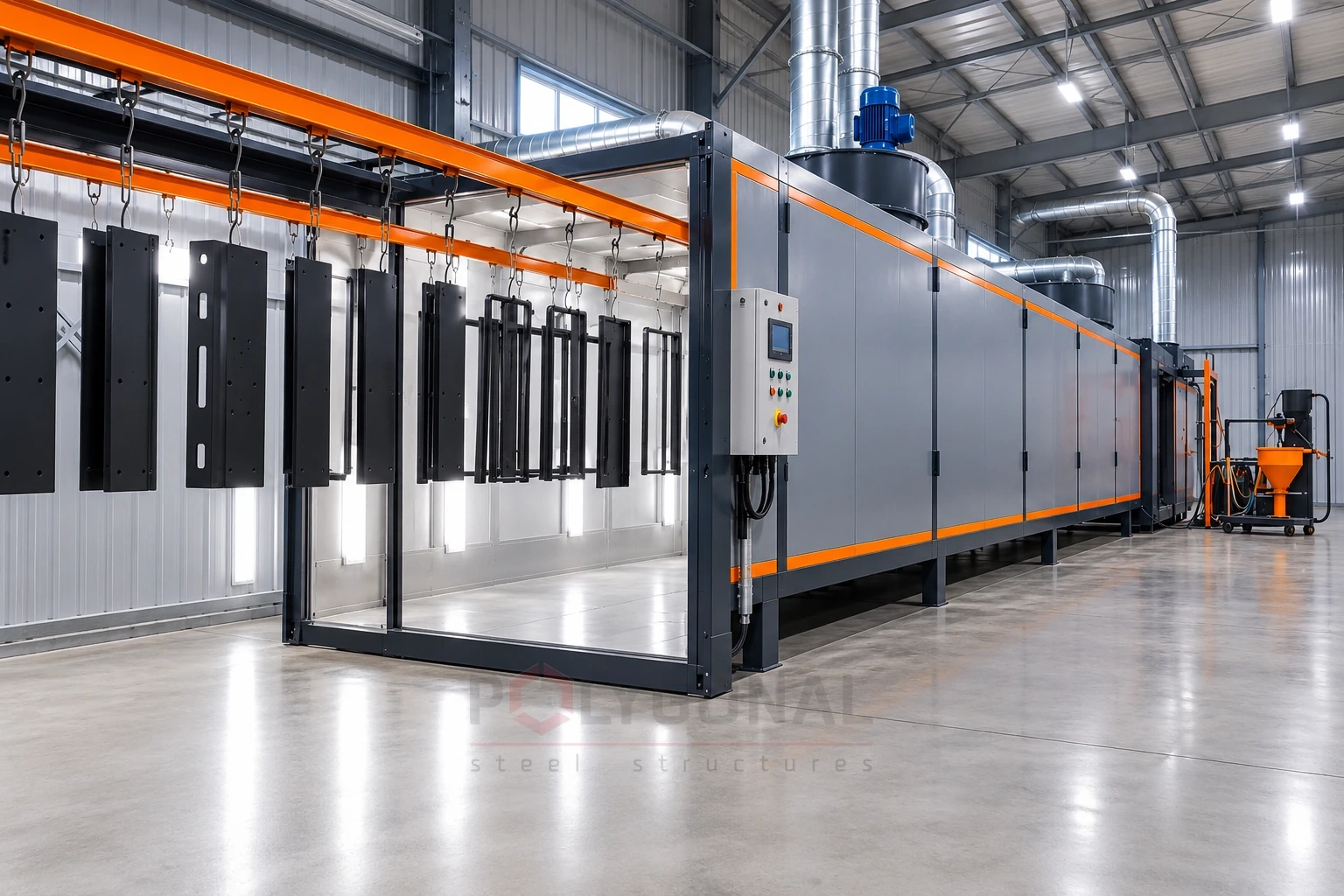
We can powder coat steel structures: poles and masts, frames, parts and galvanised products, if they fit the oven’s working chamber (6 m long, 1 m wide, 1.8 m high). Colour is set from the RAL catalogue (shade confirmed on request), and on zinc a duplex system is possible by prior agreement.
What can be coated
Steel products that can be prepared, safely heated in an oven and fitted into its working chamber: 6 m long, 1 m wide, 1.8 m high.
Lighting poles and masts
Shafts that fit the chamber (6 m long), brackets and flanges: a RAL colour blends the pole into its surroundings or makes it a landmark.
Structures and frames
Frames, platforms, ladders, railings and other welded products made to drawings.
Parts and components
Sheet parts after cutting, plates, flanges, housings.
Products after hot-dip galvanising
A powder coating over the zinc for demanding and highly visible structures.
Why entrust your coating to POLYGONAL
RAL colour
The shade is set from the RAL catalogue; gloss and texture depend on the powder available, confirmed when pricing.
Duplex with zinc
Zinc holds back corrosion at scratches and the paint protects the zinc: together they outlast either alone.
No solvents
The powder has no liquid solvent, so the solvent vapours of liquid paints are virtually absent.
Zinc and paint in one company
A duplex system is easier to agree with one company for both galvanising and coating.
Poles, frames, parts
We coat poles and masts, brackets and flanges, frames, ladders and railings, sheet parts and galvanised products.
Chamber 6 × 1 × 1.8 m
The oven takes items up to 6 m long, 1 m wide and 1.8 m high. We confirm the exact size from your drawing.
Powder coating
Quoted from your drawings
Powder coating: oven chamber and a comparison of coatings
Oven working chamber
| Parameter | Value |
|---|---|
| Height | 1.8 m |
| Width | 1 m |
| Length | 6 m |
Powder coating, zinc and duplex compared
| Criterion | Powder on steel | Hot-dip galvanising | Duplex |
|---|---|---|---|
| How it protects the steel | a barrier against moisture and air | a barrier plus sacrificial protection: zinc corrodes instead of steel | the paint protects the zinc, and the zinc stops corrosion under the film |
| Damage that reaches the steel | corrosion creeps under the film | the zinc around the damage keeps protecting the steel | the zinc stops corrosion creeping under the paint |
| Where it makes sense | mainly indoors and mild conditions where colour matters | outdoor structures, poles, towers | aggressive environments, demanding and visible structures |
The product must fit the oven’s working chamber; we confirm the exact permissible dimensions from the drawing. The coating system is chosen by the service environment and the project requirements.
Example: powder coating over hot-dip galvanizing (duplex)
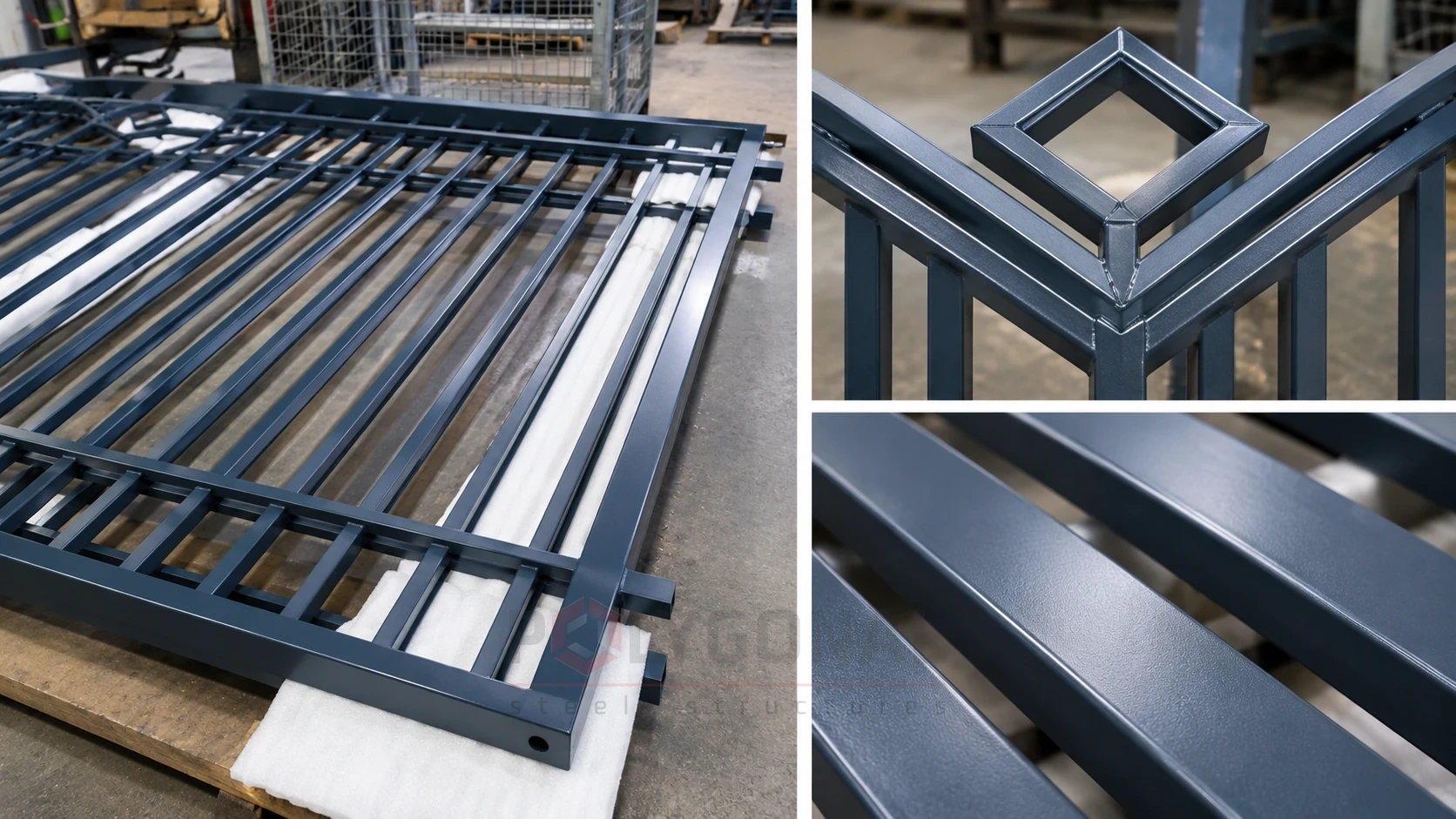
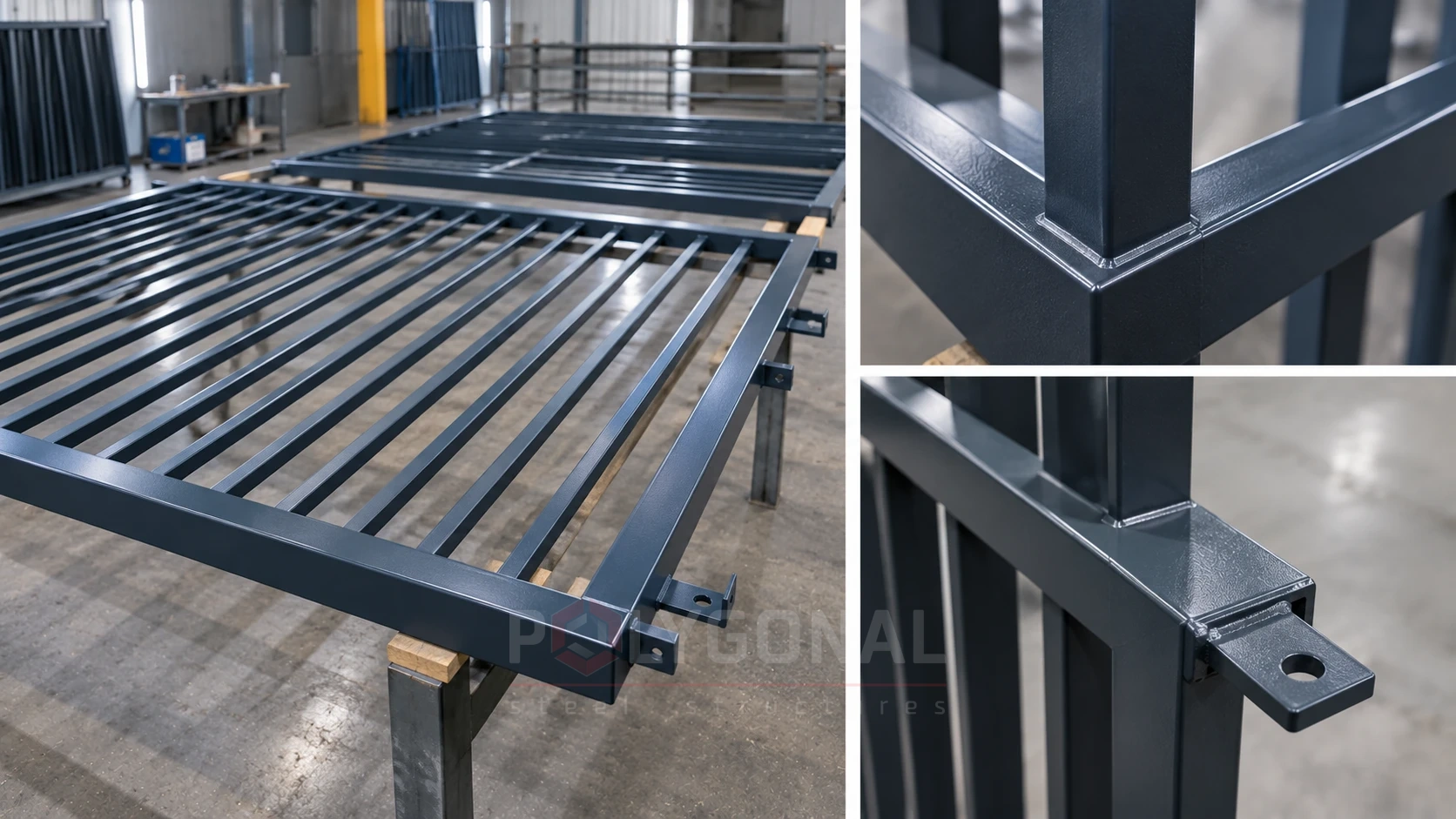
Powder coating of steel structures: process, preparation, requirements
How powder coating works
Powder paint is a dry powder of resin, pigments and additives. The steps:
- preparation: degreasing, removing rust, scale and old coatings, abrasive cleaning, phosphating if needed, then drying (moisture under the film causes defects);
- application: the powder takes an electric charge and settles on the earthed product;
- curing: in the oven the powder melts and chemically cross-links into a continuous film;
- cooling and inspection.
The powder is usually thermosetting: the hardened film cannot be re-melted, and the cure schedule is set by the powder manufacturer.
What powder coating offers and where it is limited
- a continuous, uniform film;
- the product must withstand heating: rubber seals, plastic and lubricants are removed;
- powder settles poorly in deep corners and cavities (the Faraday cage effect), so tubes are usually not coated inside: zinc protects them;
- sharp edges get a thinner film, so they are rounded;
- on bare steel, rust creeps under a damaged film, while in a duplex system the zinc holds it back.
Which colour and powder to choose
Colour is set from the RAL catalogue. RAL is a scale of shades, not a paint recipe: appearance depends on gloss, texture and substrate, so where an exact colour match matters, a colour sample is agreed (a RAL fan deck or the customer’s reference). Shade, gloss and texture availability is confirmed when we price the order.
Outdoors, polyester or polyurethane powders are used: epoxy fades in sunlight and turns chalky, so it is normally kept indoors.
How to coat galvanised steel (duplex)
A duplex system is hot-dip galvanising plus a powder coating. According to the American Galvanizers Association, depending on the environment such a combination can last 1.5 to 2.3 times the sum of the service lives of each coating alone. Read more: Durability of hot-dip galvanising.
Our own galvanising bath is 13,000 × 1,600 × 3,200 mm and there is no minimum order: Hot-dip galvanising. For the powder to hold on zinc:
- agree the coating before galvanising: passivation against white rust impairs adhesion, so it is left out where needed;
- grind off runs, drips, icicles and hard inclusions of zinc: they show through the film;
- on older zinc, remove dirt, grease and white rust; fresh zinc, once drips are ground off, only needs rinsing and drying;
- roughen the surface by light sweep blasting with a soft abrasive at an angle, or by phosphating: ordinary sand blasting removes too much zinc;
- pre-heat the product so that moisture and air leave the zinc pores, otherwise the film gets pinholes and blisters (outgassing);
- coat straight after preparation, before oxides form on the zinc again.
EN 15773, the European standard for duplex systems, lists what the customer, galvaniser and coater must agree.
How to prepare a product for coating
- no grease, rust, scale, paint residue, slag or weld spatter on the surface: powder reproduces every irregularity;
- edges are rounded and welds ground smooth;
- no closed cavities, and holes for air and liquid in hollow members: liquid from the pre-treatment baths trapped in an enclosed space boils in the oven and spoils the film;
- lap joints and narrow gaps are avoided: liquid from a gap later runs out as streaks. Small overlaps are sealed with a continuous weld around the contour, and on products to be galvanised larger ones are vented as in Designing for hot-dip galvanising;
- threads, bolt holes, earthing points and contact surfaces are marked on the drawing; they must be masked with plugs or heat-resistant tape, and we agree the masking with you.
What to include in your request
- a drawing or sketch with dimensions, weight and quantity;
- surface condition: bare steel, galvanised or already painted; whether duplex is needed;
- the RAL colour, preferred gloss and texture, and a colour sample if required;
- service conditions: outdoors or indoors, close to the sea, roads treated with de-icing salt or an industrial zone;
- areas not to be coated, the desired lead time, and the city and hand-over method.
We check the product’s dimensions against the oven’s working chamber (6 m long, 1 m wide, 1.8 m high), and confirm batch size and lead time after reviewing the drawings.
Powder coating: frequently asked questions
How does powder coating of metal work?
Dry powder paint is applied electrostatically and cured in an oven, with no solvents.
What size of product can be coated?
The product must fit the oven’s working chamber: 6 m long, 1 m wide, 1.8 m high. We confirm the exact permissible dimensions from the drawing.
Can galvanised steel be powder coated?
Yes, as a duplex system. The coating is agreed before galvanising; before the powder goes on, the zinc is cleaned, roughened and pre-heated.
Is a pole coated inside?
Usually not: powder penetrates cavities poorly. Inside, the pole is protected by zinc; coating the outside is agreed separately, by dimensions.
Which colour can I choose?
Colour is set from the RAL catalogue; gloss and texture depend on the powder available. We confirm the shade and powder when pricing; if the colour must match exactly, we recommend a sample.
What do I need to send for a quote?
A drawing or sketch with dimensions, weight and quantity, surface condition, RAL colour, service conditions and lead time. Leave out what you do not know.
Need your structures coated?
Send a drawing or sketch, the RAL colour and the quantity. We will quote the price and lead time.