
Home / Equipment & engineering / Hot-dip galvanising line
Equipment · For manufacturers
Hot-dip galvanising line
We design hot-dip galvanising lines for steel structures, by immersion in molten zinc: from the chemical preparation section to the galvanising furnace and the handling of articles. The composition and size of the equipment are chosen for your structures and output.
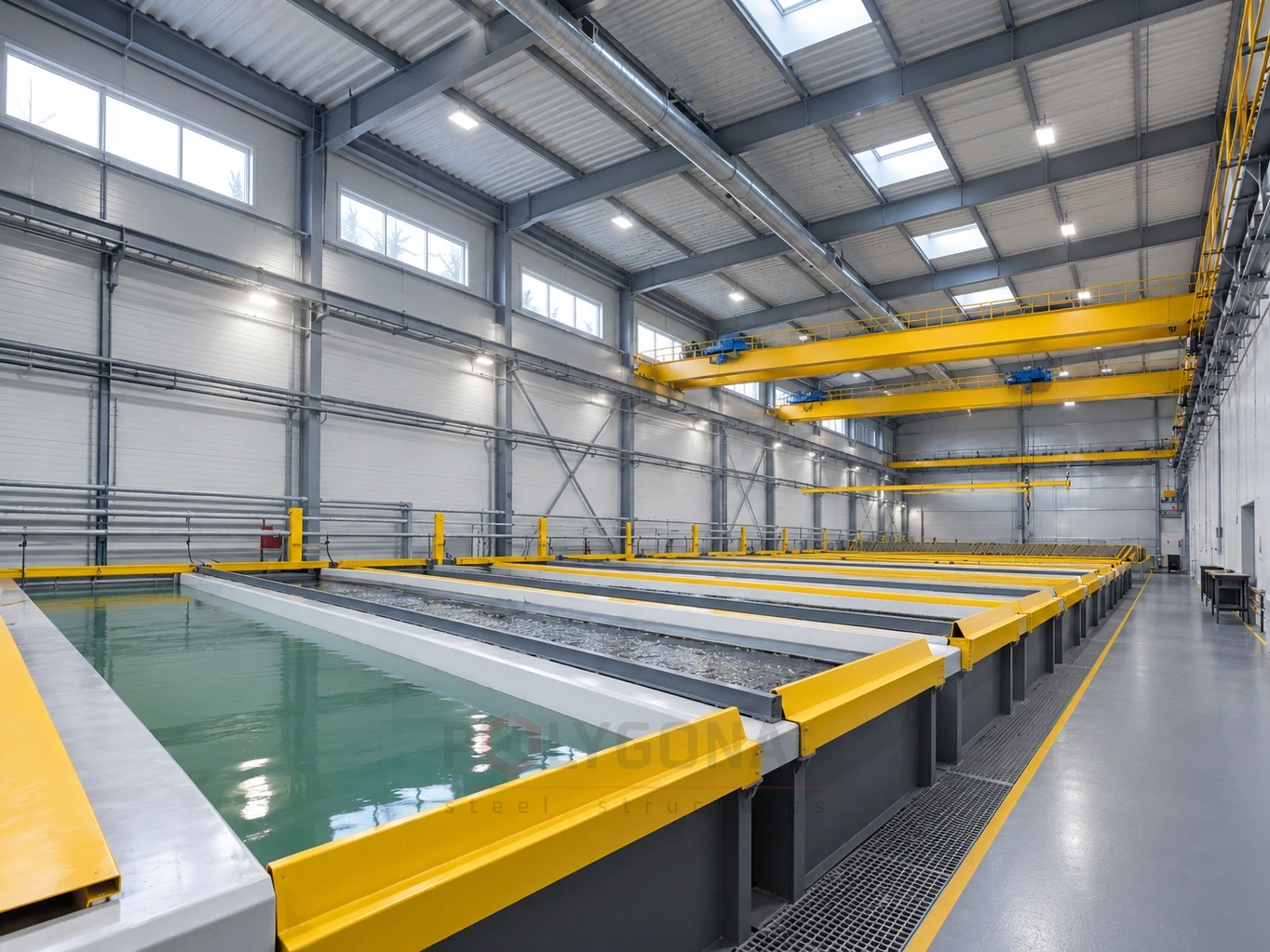
A hot-dip galvanising line is the set of plant equipment through which steel structures pass for chemical preparation, drying and immersion in molten zinc: tanks, a drying oven, a galvanising furnace and product handling.
What the line consists of
The main equipment of a hot-dip galvanising line; the number and size of the tanks are given as an example and change to specific requirements.
Chemical preparation section
Acid degreasing, pickling, rinsing, fluxing and cooling tanks with automatic heating.
Drying oven
Drying and preheating of the articles after fluxing before they are immersed in molten zinc.
Galvanising furnace
A horizontal furnace with a 12.5×1.6 m galvanising kettle, 3 m deep.
Handling of articles
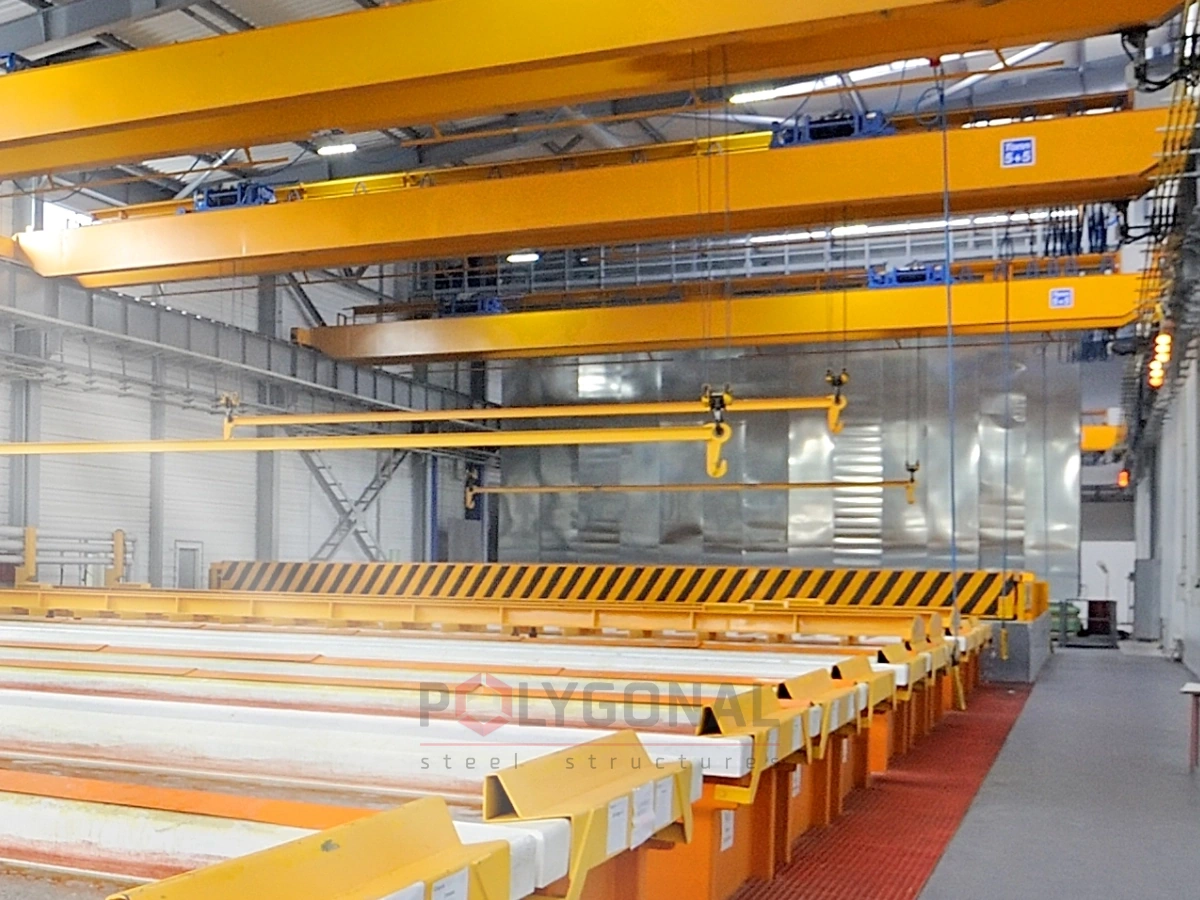
Double-trolley overhead cranes, rail carriages between bays and process tooling: cross-beams, hooks, wire loops.
Advantages of the line
Automatic control
The temperature of the solutions and of the molten zinc is monitored by thermocouples and a control system; readings are backed up by an independent thermocouple.
Heat recovery
Combustion gases from the galvanising furnace heat the drying oven and the chemical preparation tanks, so less gas is used.
Clean production
White-fume collection, and extraction and filtration of gases from the galvanising furnace.
One cycle without reloading
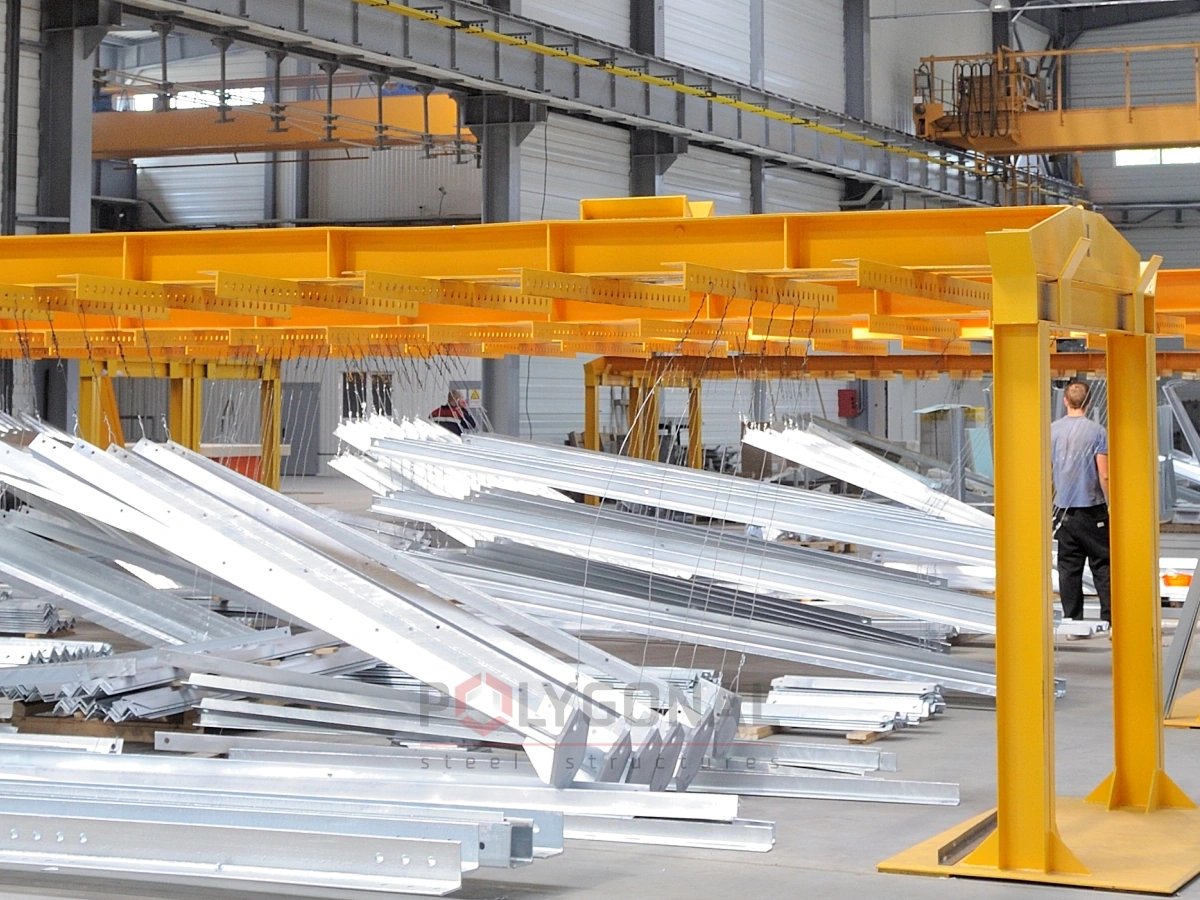
Parts on one cross-beam go through the whole cycle: hanging, chemical preparation, drying, galvanising, cooling, unhanging.
A complete plant
The line can be supplemented with a fastener plant, flux regeneration and zinc ash recovery that returns the zinc.
Long products
Long structures fit the 12.5 × 1.6 m kettle, 3 m deep. Loading is up to 15 t per hour.
Automatic temperature control
Readings duplicated by an independent thermocouple
Technical specifications
The main parameters of the line, given as an example; they change with your structures and output.
| Parameter | Value |
|---|---|
| Acid degreasing tank | 2 pcs, inner size 3×1.8×13 m |
| Pickling tanks | 7 pcs, 3×1.8×13 m |
| Rinsing tanks | 2 pcs, 3×1.8×13 m |
| Fluxing tank | 1 pc, 3×1.8×13 m |
| Cooling tank | 1 pc, 3×1.8×13 m |
| Galvanising kettle | 12.5×1.6 m, depth 3 m, mass 47 t |
| Kettle material | steel with low carbon and silicon content, 50 mm thick |
| Working melt temperature | 450 °C (the kettle withstands up to 480 °C) |
| Maximum load | up to 15 t of structures an hour |
| Tank heating | automatic system with a boiler, except the cooling tank |
| Handling | double-trolley overhead cranes, rail carriages |
| Coating | hot-dip galvanising to DSTU EN ISO 1461:2024 |
The exact configuration is set for your plant.
The line and galvanised products
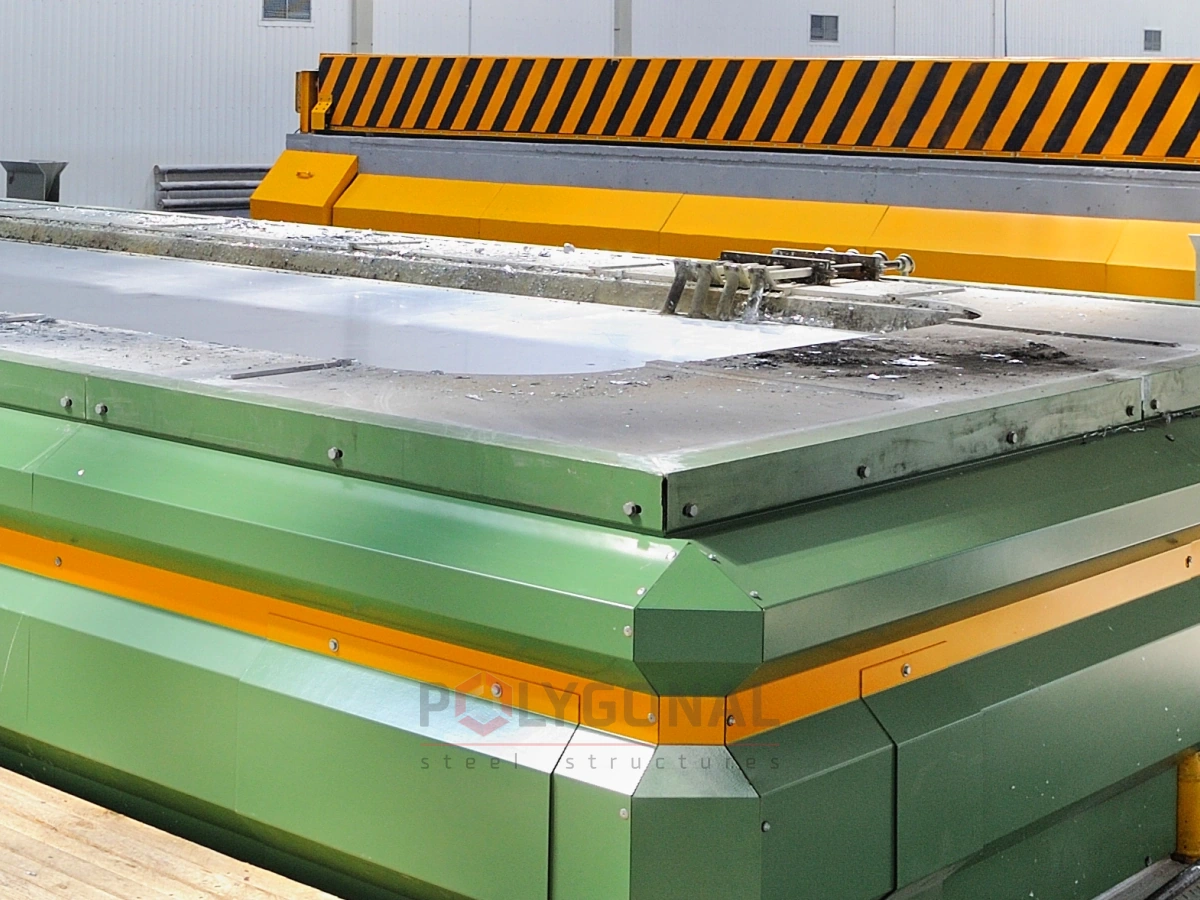
An example of a hot-dip galvanising line: chemical preparation baths, the galvanising furnace and finished galvanised articles. The coating is applied to DSTU EN ISO 1461:2024.
Hot-dip galvanising line: technical specifications
Chemical preparation section
The chemical preparation tanks are a steel structure with a special external and internal coating. All tanks except the cooling tank have an automatic heating system with a boiler: a temperature controller, thermocouples in housings, heat exchangers.
In the section the temperature, level and concentration of the solutions are monitored. The working level is kept 250–300 mm below the top of the tank, the concentration is checked daily by the plant’s chemical laboratory and the process chemist adjusts the solutions.
Drying oven
The drying oven dries the articles after fluxing and preheats them before immersion in molten zinc. It is heated by the combustion gases of the galvanising furnace; there is an additional natural gas burner and the temperature is regulated automatically. A chain conveyor moves the cross-beams along the oven.
Galvanising furnace
The horizontal furnace heats the melt and keeps it at working temperature. It consists of the furnace, the galvanising kettle, equipment for measuring and regulating temperature, a white-fume collection plant and a plant for recovering the waste gases.
The kettle is designed for molten zinc up to 480 °C: it is welded from sections of U-shaped steel profile with a double-sided weld, of steel with low carbon and silicon content 50 mm thick. The kettle is 12.5×1.6 m, 3 m deep and weighs 47 t. It is built into the furnace; the melt temperature is measured by thermocouples and regulated automatically both in the combustion chamber and in the kettle itself.
Handling and process tooling
Double-trolley overhead cranes move the cross-beams through the whole cycle, and rail carriages move them between bays. The process tooling (cross-beams, hooks, wire loops, stands for hanging and unhanging, a hydraulic lift for heavy parts) is inspected regularly, registered and checked for wear.
Each process operation is described in detail in the article “Process Operations on a Hot-dip Galvanising Line”.
Hot-dip galvanising equipment: a line for structures or a unit for fasteners
This page is about hot-dip galvanising by immersion in molten zinc, not electroplating or cold galvanising; the difference is explained in Hot-dip, Electro- or Cold Galvanising: Which to Choose. We offer two main types of hot-dip galvanising equipment: a line for long structures (its units are described above) and a unit for fasteners and small parts.
The most obvious difference is the furnace. The line has a gas-fired or electric furnace with a steel kettle. The unit for small parts is different: a gas-fired reverberatory furnace with a ceramic kettle. The zinc touches no metal parts, so the melt can be run at 460–480 °C, and the parts need less cleaning after centrifuging.
On the line, structures hang on crossbeams and overhead cranes carry them. Small parts go through in motorised polypropylene drums that turn as they are lowered and lifted, so that the liquids drain evenly. The unit’s preparation section is sized for both drums and material on crossbeams.
The unit’s preparation tanks have a load-bearing steel frame with an inner polypropylene tank 10 mm thick, and the pickling acid is 15–17% hydrochloric. The additives in the solutions are compatible with each other, so there is no rinse between degreasing and pickling.
After galvanising, baskets 500 mm in diameter and up to 500 mm high (up to 200 kg per basket) go into a centrifuge with a hydraulic lid and a system for collecting zinc drops. A tipper and a cooling cradle unload the parts into boxes once they have cooled in water.
Different units limit the output of the two layouts. On the line it is the hourly load on the melt, and its limit is given in the line’s specifications on this page. For the unit, the benchmark is the centrifuge: up to 2000 kg/h.
More on both layouts is in Hot-dip Galvanising Plant Equipment, and the temperatures and times of each operation on the line are in Process Operations on a Hot-dip Galvanising Line.
Articles about hot-dip galvanising line
Operations on a Hot-dip Galvanising Line
The order of operations on a hot-dip galvanising line for structures and the parameters of each: from hanging the parts on cross-beams to quality control of the zinc coating.
Hot-dip Galvanising Plant Equipment
What a galvanising plant consists of: the chemical preparation section, the galvanising furnace, plants for small parts, flux regeneration and zinc ash recovery.
Questionnaire: request for a hot-dip galvanising line
Fill in the form and email it to us: we will prepare a commercial offer for the line from it. The PDF is handy to print; the DOCX can be filled in on a computer.
Questionnaire: hot-dip galvanising line
A questionnaire for preparing a commercial offer for a hot-dip galvanising line: required equipment, production volumes, product sizes, building, utilities, site conditions.
Hot-dip galvanising line: frequently asked questions
What structures can be galvanised on the line?
Long steel structures that fit the 12.5×1.6 m kettle, 3 m deep. We choose the size and output for your products.
What is the temperature of the molten zinc?
The working temperature is 450 °C; the kettle is designed for melt up to 480 °C. An automatic system controls the temperature, backed up by an independent thermocouple.
How much metal can be galvanised in an hour?
It is not recommended to immerse more than 15 t of structures in the melt in an hour, so that the melt temperature does not fall below the process level.
What else belongs to a galvanising plant?
A plant for fasteners and small parts, flux regeneration and zinc ash recovery. This is described in the article on the plant equipment.
What equipment is needed for hot-dip galvanising?
It depends on what you galvanise: a line for long structures, a separate unit for fasteners and small parts. Either way you need preparation tanks and a furnace with a kettle for the molten zinc. The sections the plant needs depend on the annual tonnage, and the level of automation on the output and working pattern.
What equipment for galvanising steel do you offer?
Hot-dip galvanising lines for large structures, a separate unit with a ceramic kettle for fasteners and small parts, and flux regeneration and zinc ash recovery plants. Besides the equipment itself, we survey the site, design the plant, supervise installation, commission the line and train the staff. For a proposal, send the dimensions and weight of your largest article, a list of articles with the annual tonnage, and a description of the site.
What size of galvanising kettle is needed, and how do I work it out?
Work from the largest article together with its hanging gear: in length, width and depth it must fit the kettle with room to spare. An example kettle for the line is given on this page; for your articles we choose the size separately. If you mean galvanising your own articles rather than buying equipment, the hot-dip galvanising cost calculator will check whether they fit.
Do you supply galvanising equipment, or do you galvanise customers’ articles?
These are two separate lines of work. We offer equipment for galvanising plants to manufacturers, while galvanising customers’ articles is a service: we galvanise steel structures and other metalwork that is suitable for galvanising. You can estimate the cost in the calculator.
Hot-dip galvanising line: related solutions
Need a hot-dip galvanising line?
Send the dimensions of your structures and the output you need. We will prepare a proposal for a line or a turnkey plant.