
Home / Services / Abrasive blasting of steel structures
Service · Surface preparation
Abrasive blasting of steel structures
Abrasive blasting of steel structures: we clean the surface of rust, mill scale, old paint and contamination and prepare the metal for coating. We travel to your site and clean to the required grade under ISO 8501-1, so that paint, powder or primer lasts longer.
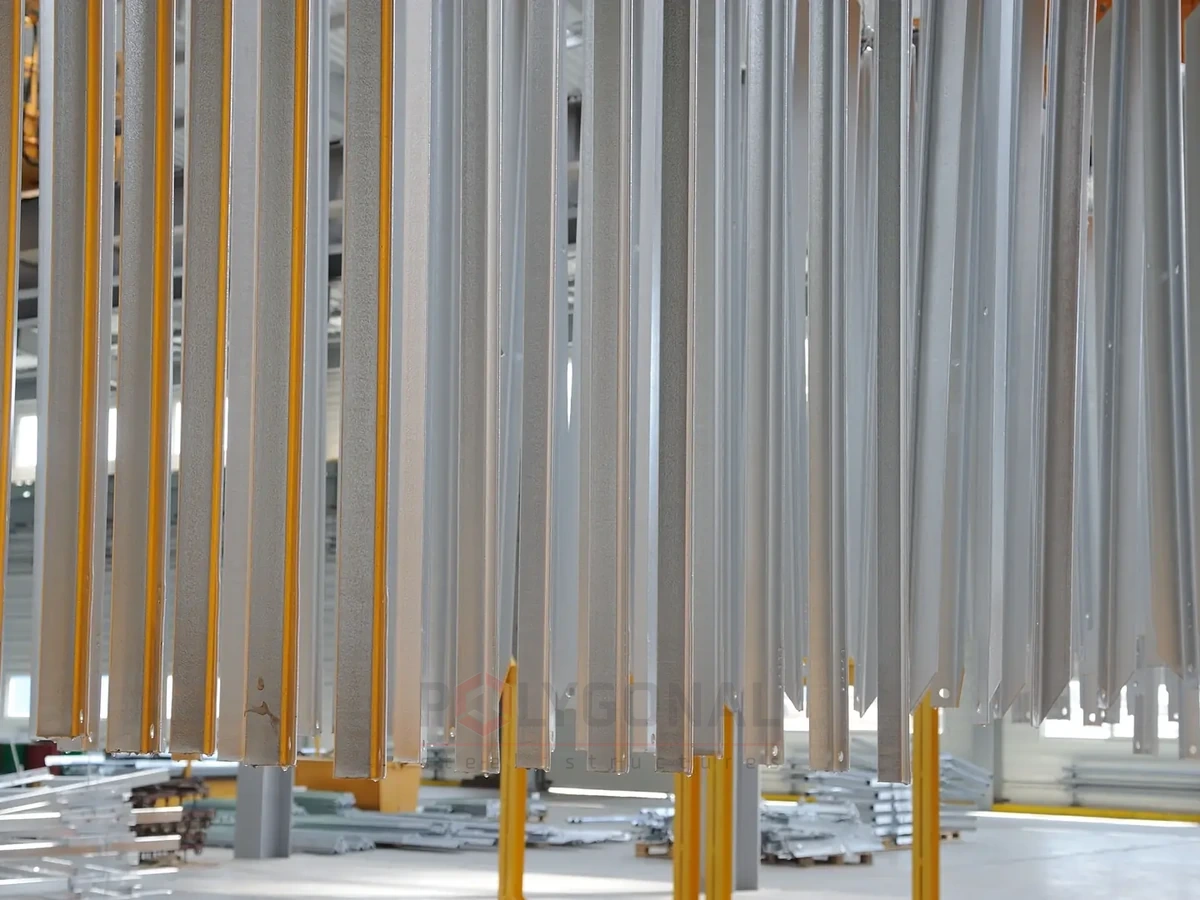
Abrasive blasting is the cleaning of metal of rust, mill scale and old paint with a jet of abrasive delivered under pressure. It prepares the surface for coating: the cleaning grade is judged under ISO 8501-1, and we carry out the work on your site.
What we clean
Steel structures that need preparing for a coating or freeing from rust and an old paint layer.
Load-bearing steelwork
Columns, beams, trusses, frames and platforms: cleaning before a protective coating is applied.
Poles, masts, flagpoles
Lighting poles, masts, flagpoles and other tall structures that need surface cleaning.
Sheet parts and assemblies
Sheet metal and parts after cutting, bending and welding.
Parts before powder coating
Metal products to be prepared for a powder coating, and structures after dismantling that carry rust and old paint.
Why order abrasive blasting from POLYGONAL
We travel to your site
We work at the customer’s site, where the structures stand.
Grade under ISO 8501-1
We clean to an agreed Sa grade. It is worth agreeing it with the coating manufacturer’s requirements before work starts.
Complex shapes and welds
Blasting reaches corners, welds and complex shapes that a brush or grinder cannot.
Control to the standard
Preparation quality is judged against the standard’s reference photographs, not by eye.
Preparation for any coating
Paint, powder, primer or zinc hold only on a clean, dry surface with the right roughness.
Blasting, coating, zinc
Powder coating and hot-dip galvanizing in the same company, so the stages are easier to agree.
Blasting on site
Surface preparation for coating
Cleaning grades under ISO 8501-1
Blast cleaning grades Sa
| Grade | What remains on the surface | When it is used |
|---|---|---|
| Sa 1 | Loose rust, dirt and flaking mill scale removed; tight mill scale, old paint and firm rust may remain | Secondary structures, auxiliary preparation |
| Sa 2 | Most of the mill scale and rust removed; shadows and stains possible | Moderate service conditions, if the coating requirements allow |
| Sa 2½ | Only barely visible traces in the form of a light tint or streaks remain | The main grade for most industrial coatings, including powder coating of load-bearing structures |
| Sa 3 | Clean metal with a uniform metallic sheen | Aggressive environments: marine and petrochemical sites, tanks |
The cleaning grade for your structure is set by the coating manufacturer and the project; we will help you choose it.
Abrasive blasting of metal: cleaning grades, preparation for coating, cost
Why blast before coating
Paint, a powder coating or primer holds only when the surface is clean, dry and has the right roughness. Rust and mill scale left under a coating keep corroding, so the coating peels off before its design life.
- rust, mill scale, old paint and grease are removed;
- the surface becomes uniform and gets the roughness the coating needs to bond;
- welds, corners and complex shapes that a brush or grinder cannot reach are treated;
- preparation quality is checked against a standard, not by eye.
The roughness (profile) of the surface matters as much as cleanliness. The coating manufacturer sets the value required.
Cleaning grades under ISO 8501-1
Cleaning quality is judged under the international standard ISO 8501-1: the surface is compared with reference photographs. The blast cleaning grade is written as the letters Sa and a number, and the table below shows what remains on the surface at each grade.
If a coating manufacturer requires a particular grade, departing from it may release the manufacturer from responsibility for the coating’s service life. So the cleaning grade should be agreed before work starts.
Blasting, powder coating and galvanizing
- Before powder coating of load-bearing structures, grade Sa 2½ is usually required. We apply powder coating in our own oven: powder coating;
- before hot-dip galvanizing, metal is usually cleaned by pickling, and blasting is used to remove old paint, mill scale and weld traces. Hot-dip galvanizing is carried out to DSTU EN ISO 1461: hot-dip galvanizing;
- if paint is to be applied over zinc as well, the zinc surface is lightly treated with an abrasive for better adhesion, without removing the zinc.
Which abrasives are used
The choice of abrasive depends on the cleaning grade required, the metal thickness, the roughness and safety requirements. In practice quartz sand, aluminium oxide, garnet, slag abrasives and steel shot are used. Quartz sand produces a lot of dust and is dangerous to breathe, so its use is restricted.
How we work
- request: you send drawings or photos of the structures, the area or mass, the cleaning grade required and the coating that follows;
- quote: we assess the scope of work and give you the cost and lead time;
- preparation: we inspect the structures for defects and fence off the work zone;
- cleaning: blasting to the agreed grade;
- inspection: checking cleanliness and roughness, removing dust;
- coating: where needed, priming or painting without delay, so that rust does not form on the cleaned steel;
- handover: we hand the work over to the customer.
What the cost depends on
The cost of blasting depends on the area and mass of the structures, the cleaning grade, the complexity of the shapes, the type of abrasive, where the work is done and how urgent it is. We quote on request, from drawings or photos.
Safety
Blasting creates a lot of dust and noise. For safety, a helmet with a clean-air supply, protective clothing and hearing protection are used, and the work area is ventilated or fenced off.
Frequently asked questions about abrasive blasting
Can metal be painted without blast cleaning?
It can, but the quality and service life of the coating will be lower: rust and mill scale under the paint keep corroding. For critical structures, cleaning to a standard is required.
Which cleaning grade should I choose?
For most industrial structures and powder coating, Sa 2½ is the target; an aggressive environment needs Sa 3. The final requirement is set by the coating manufacturer and the project, and we will help you choose the grade.
Where do you carry out blasting?
We travel to your site and work at the customer’s premises.
Do you combine blasting with powder coating?
We blast on your site, and we powder coat in our own oven, whose chamber measures 6 × 1 × 1.8 m. How to combine the stages for your part is agreed when we quote.
How soon must the coating be applied after cleaning?
As soon as possible: rust forms on freshly cleaned steel within hours. The permissible time depends on humidity and the coating manufacturer’s requirements.
Is blasting harmful?
The dust is dangerous, quartz dust especially, so protective equipment, ventilation and modern low-dust abrasives are needed.
What should I send for a quote?
Drawings or photos of the structures, the approximate area or mass, the cleaning grade required and the coating after cleaning (painting, galvanizing or none).
Need abrasive blasting of steel structures?
Send drawings or photos, the area or mass, the cleaning grade required and the coating that follows. We will calculate the cost and lead time.