
Home / Services / Sheet metal bending
Service · Metalworking
Sheet metal bending
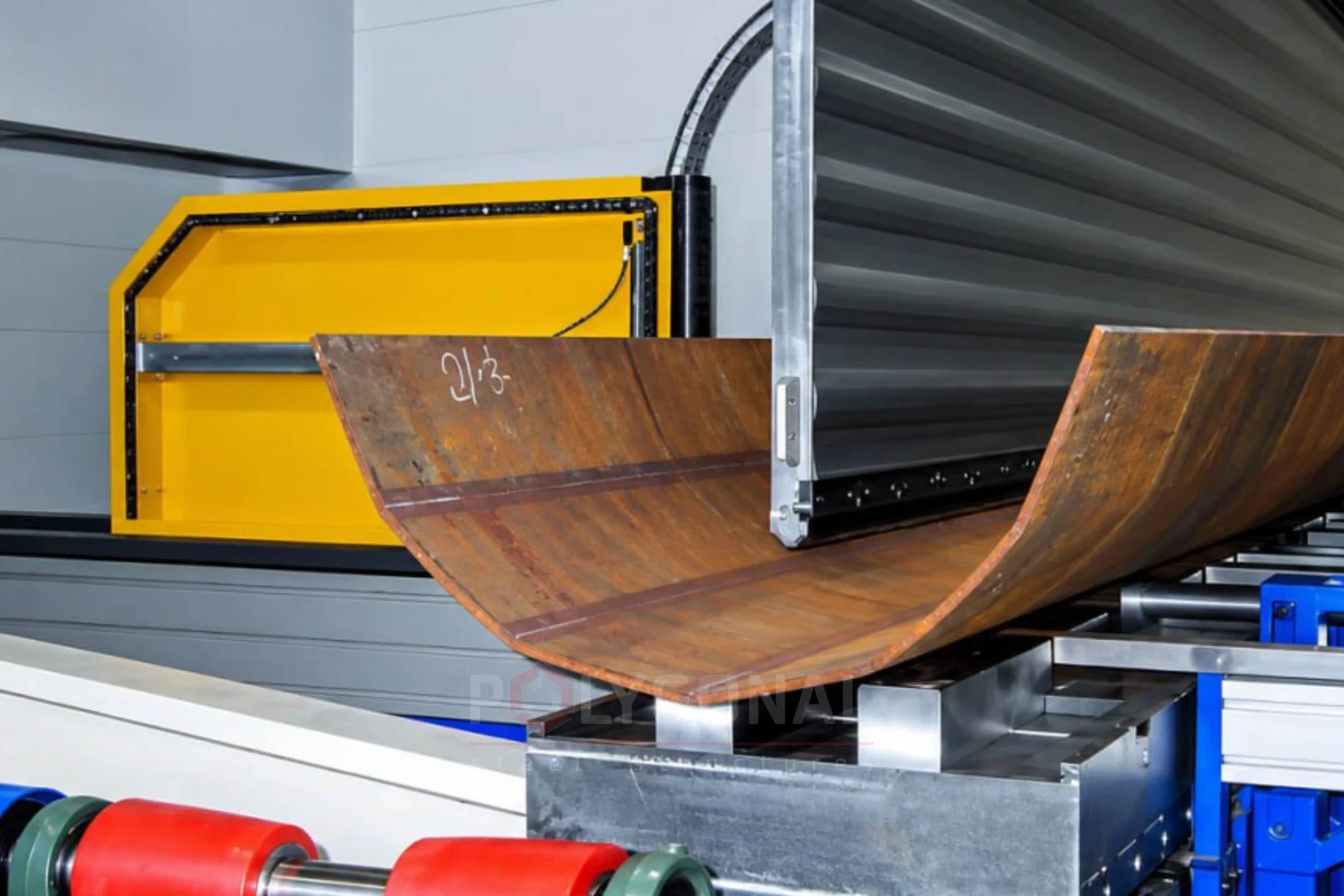
We bend sheet metal on a hydraulic press with a 12 m bend length and 2000 t of force. It takes sheet up to 25 mm thick and up to 12 m long.
Who and what we bend
We work for defence, heavy engineering, mining and power companies that use thick, high-strength sheet.
Thick sheet
Sheet up to 25 mm thick. Parts like these could not be bent until recently.
Long parts
Sheet up to 12 metres long is bent in a single pass.
Defence industry
We can suggest design changes that cut welding and make the part lighter and stronger.
Engineering and power
Parts for heavy engineering, mining and the power sector.
Advantages of sheet metal bending
2000 t press, 12 m
Specialised hydraulic press with a bend length of 12,000 mm.
Bending accuracy
Linear sensors and servo valves under CNC control keep the upper table parallel, with a parallelism error of 1%.
Quick set-up
You enter the angle and bend parameters; retraction, back gauge and bend rotation are then set automatically.
Less welding
A part that is bent rather than welded has fewer seams. That means less distortion and fewer areas to inspect.
Sheet up to 25 mm
We bend sheet up to 25 mm thick, including parts that could not be bent until recently.
For heavy industry
Parts for heavy engineering, mining and the power sector.
2,000 t press
Bending length 12,000 mm
Press specification
| Parameter | Value |
|---|---|
| Force | 2000 t |
| Bend length | 12,000 mm |
| Press throat | 2000 mm |
| Cylinder stroke | 250 mm |
| Distance to table | 975 mm |
| Approach speed | 70 mm/s |
| Working speed | 8 mm/s |
| Return speed | 80 mm/s |
| Table width | 550 mm |
| Weight | 160,000 kg |
| Maximum sheet | up to 25 mm thick, up to 12 m long |
Data from POLYGONAL technical documentation.
Bending methods and work stages
An angle can be produced in two ways, and the choice sets the tooling, the force and the accuracy. The second block shows how an order goes from drawing to shipment.
Air bending (free bending) and bottoming
These are differences between the methods themselves; for a particular part we agree the radius and tolerances against your drawing. The crowning system and the CNC Delem controller are described under “How the press works” below.
| Feature | Air bending | Bottoming |
|---|---|---|
| How the angle is formed | the punch enters the die to a set depth, and the tools do not touch each other | the punch presses the sheet into the die, and the angle follows the die shape |
| Tooling | universal: one set bends different angles and profiles | a separate set for each angle and sheet thickness |
| Force | lower, so narrow punches and complex profiles can be used | about 20% more than in air bending for the same thickness and angle |
| Bend radius | depends on the metal, its thickness and the die opening | set by the shape of the tooling |
| Angle accuracy | depends on the accuracy of the punch stroke, the deviation of the sheet thickness from nominal and springback | slightly better than in air bending |
| Limits | crowning is needed along the whole length to compensate for deflection | sheet up to 5 mm and angles up to 90° |
Order stages
| Stage | What happens |
|---|---|
| Drawing or sketch | we study the part and suggest where welding can be replaced by bending |
| Calculation | force, die opening, radius, springback compensation; cost and lead time |
| Edge preparation | burrs are removed, and the hardened zone left by thermal cutting is better ground off: a crack can start from it |
| Program | the angle and parameters are entered in the controller; incorrect values are rejected by the system |
| Bending | sheet up to 12 m is bent in a single pass |
| Dimensional check | we check the part against the drawing |
| Next | welding if needed, hot-dip galvanising in our own bath of 13,000 × 1,600 × 3,200 mm, and shipment |
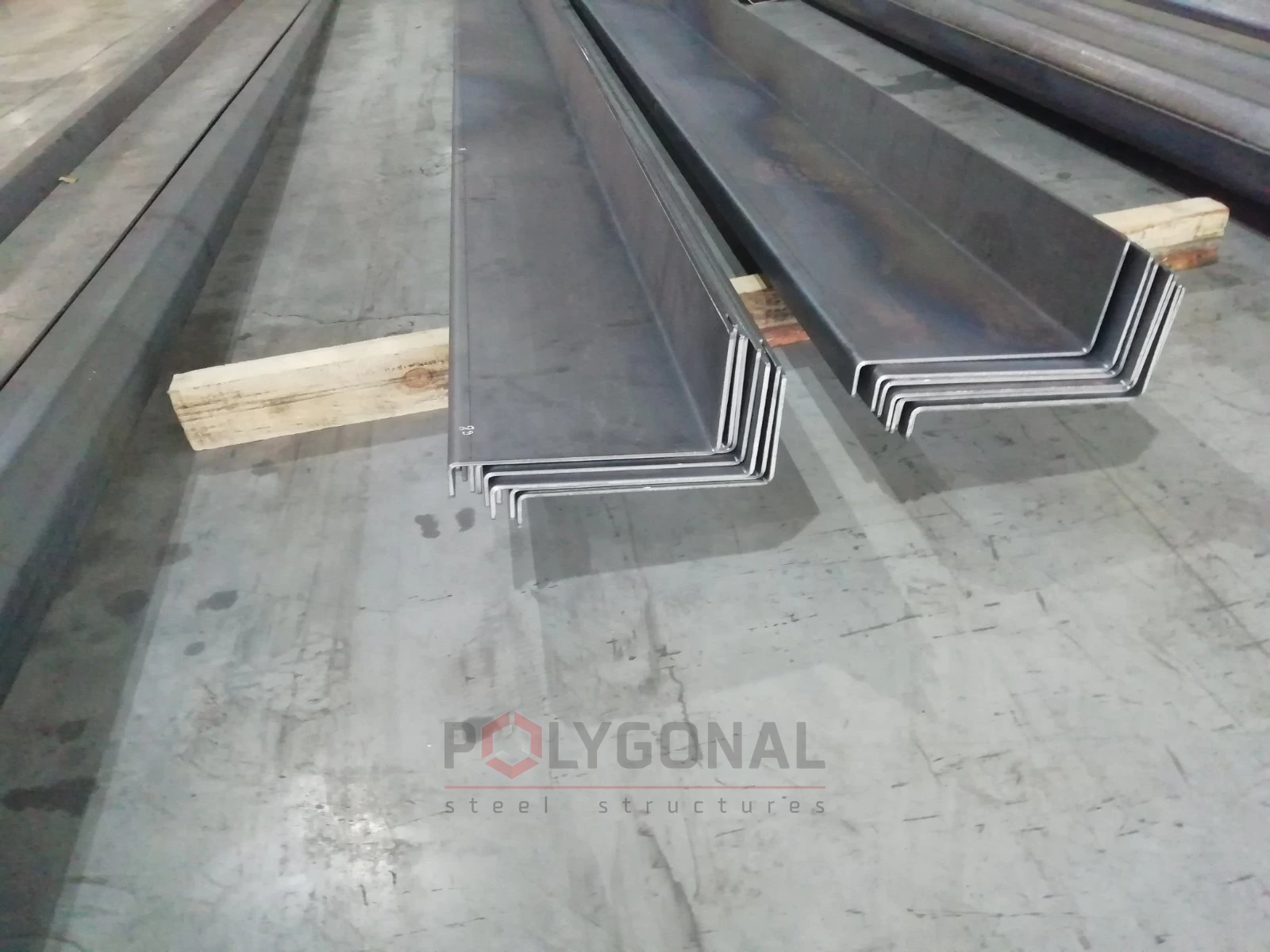
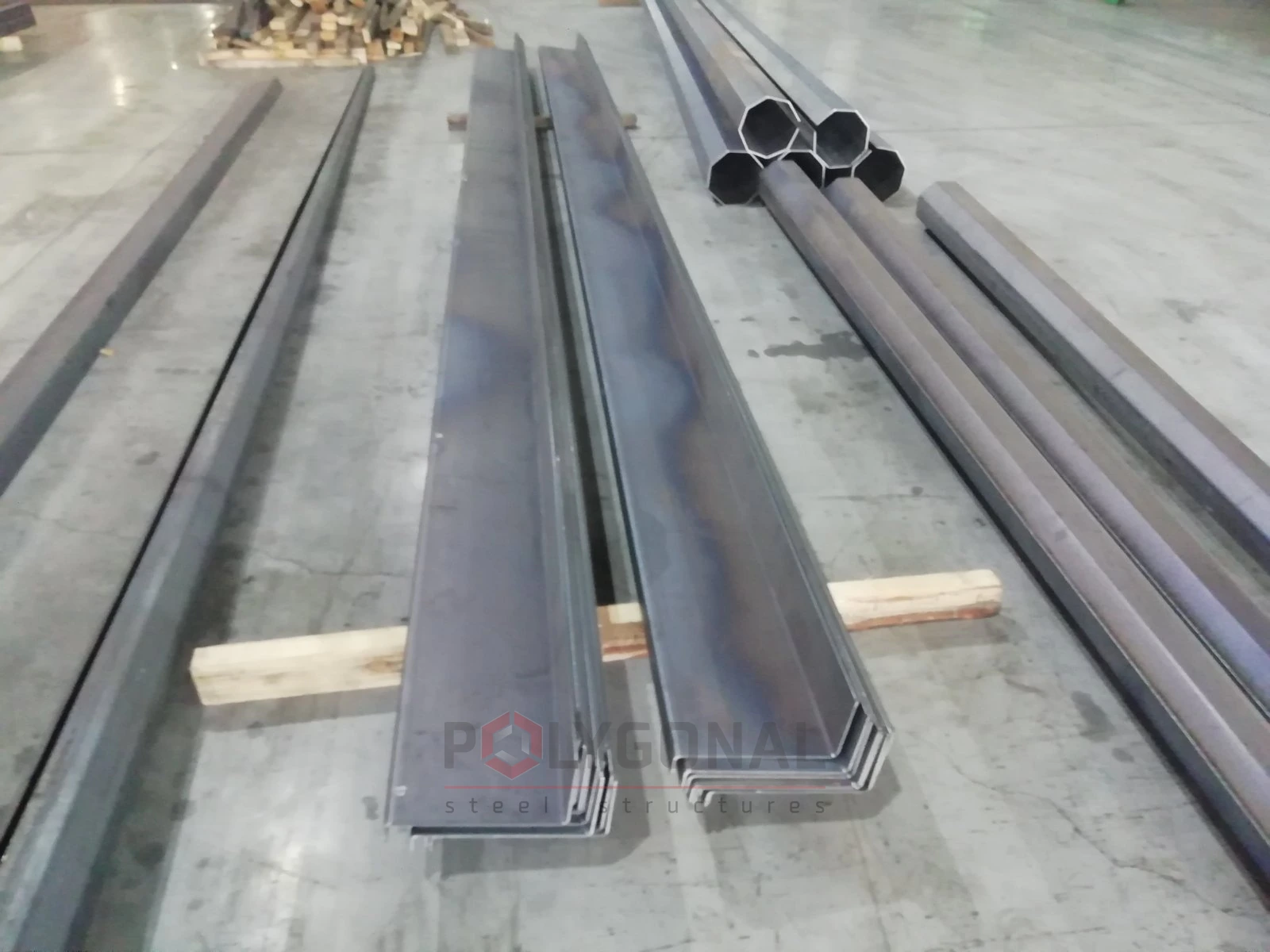
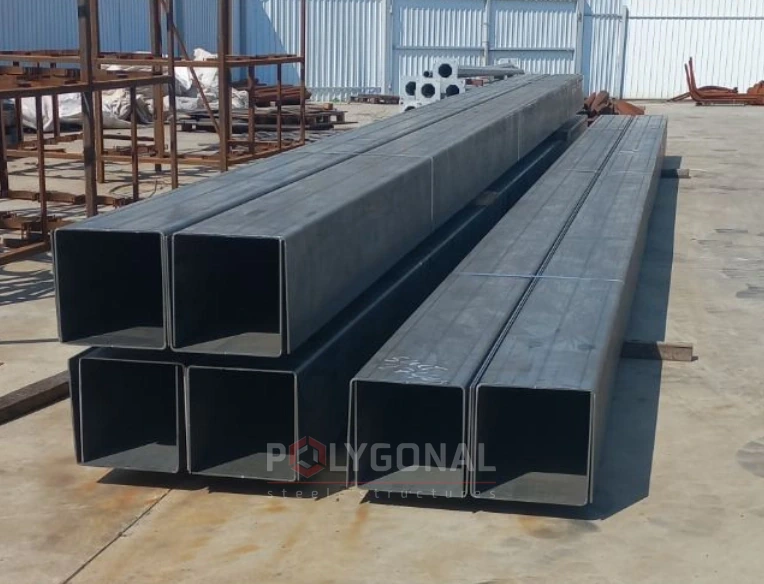
Bending service examples
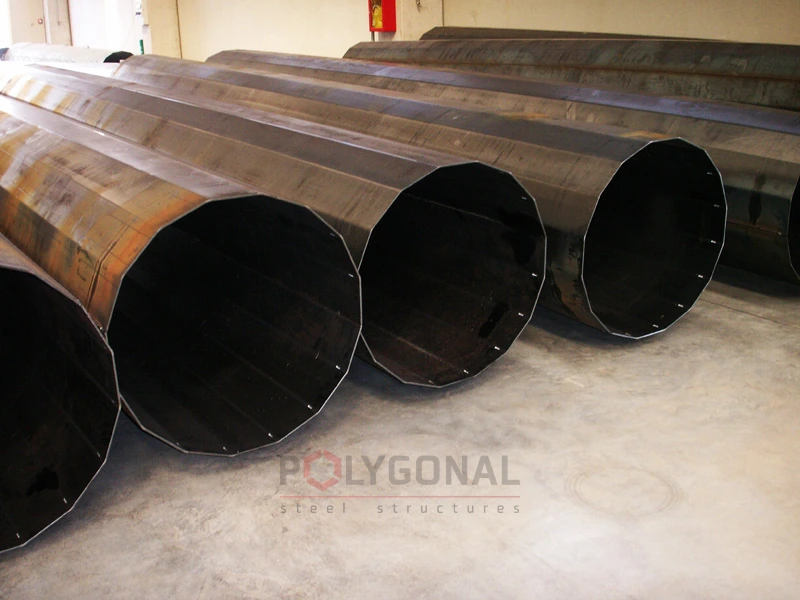
Sheet metal bending: technical specifications
How the press works
The press frame is made of normalised steel, which makes it rigid and strong.
The hydraulic cylinder rods are solid metal, machined on a CNC machine, induction-fitted and chrome-plated.
The bending unit runs on 4 guides, so its vertical motion is precise.
The lower table consists of 3 guides and has a crowning (anti-deflection) system. An independent motor and hydraulic pump drive a block of hydraulic cylinders that compensates for deflection. The CNC Delem controller determines the amount of deflection and controls the compensation automatically.
All characteristics can be tailored on request.
What sheet metal bending is
Bending changes the shape of a sheet: one part of it is turned relative to another through a given angle. The deformation has to be calculated for the bend to come out right.
When a part is bent instead of welded it has fewer seams, so there is less heat distortion and fewer zones to inspect.
Control
The CNC controller sets three speeds for the upper table: fast approach, bending speed and return stroke.
The bending programme can be previewed on screen in 2D or 3D. If a parameter is incorrect or out of range, an error message appears and the operation will not start.
What the price of bending depends on
There is no single price list: we price from the drawing. The price is affected by the thickness and grade of the steel, the length of the sheet, the number of bends, the size of the blank and the number of parts in the order. We do not quote figures without a drawing or a sketch.
Bending, welding and galvanising with one contractor
We do all the operations at our own production site: bending, welding and hot-dip galvanising. After bending the part does not have to go to another contractor, and our galvanising bath measures 13,000 × 1,600 × 3,200 mm with no minimum order.
For holes and the placement of joints see the article Designing structures for hot-dip galvanising.
Sheet metal bending: frequently asked questions
How thick and how long a sheet can you bend?
Up to 25 mm thick and up to 12 metres long.
How many tonnes of force does your press have?
2000 tonnes. The bend length is 12,000 mm.
What should I send you to get a price?
A drawing or sketch of the part, plus the material, sheet thickness and length, and quantity. Leave blank anything you are unsure of and we will sort it out with you.
Can you change my design so that it needs less welding?
Yes. We can propose a redesign in which bending replaces welding where possible. The part comes out lighter, stronger and cheaper.
How does air bending differ from bottoming?
In air bending the angle is set by how deep the punch enters the die: one tool bends different angles and less force is needed. In bottoming the sheet is pressed into the die, the force is about 20% higher and a tool is needed for each angle. That method suits only sheet up to 5 mm and angles up to 90°, so for thick sheet air bending is the one that applies.
Can the part be galvanised straight after bending?
Yes, we galvanise in our own bath of 13,000 × 1,600 × 3,200 mm, with no minimum order. A part up to 12 m long usually fits if its cross-section fits the width and depth of the bath.
Sheet metal bending: related solutions
Presses
Production equipment: cutting and welding lines, presses.
Machining and tooling
Machining of parts and tooling.
Steel structure design (structural and detail drawings)
Structural and detail drawings for your structures.
Custom steel fabrication
Fabrication of steel structures to drawings: cutting, bending, welding.
Plasma and laser cutting of sheet metal
Plasma and laser cutting of sheet metal: sheets up to 2 × 12 m.
Need a sheet or a part bent?
Send a drawing or sketch and tell us the material and quantity. We will work out the price and the lead time.