
Home / Products / Lightning protection masts and air-termination rods
Product · Protection
Lightning protection masts
We design and manufacture lightning protection masts and air-termination rods on bent multi-sided shafts: neat, corrosion-resistant, with room for lighting fixtures. Prices start from UAH 15,000 each including VAT.
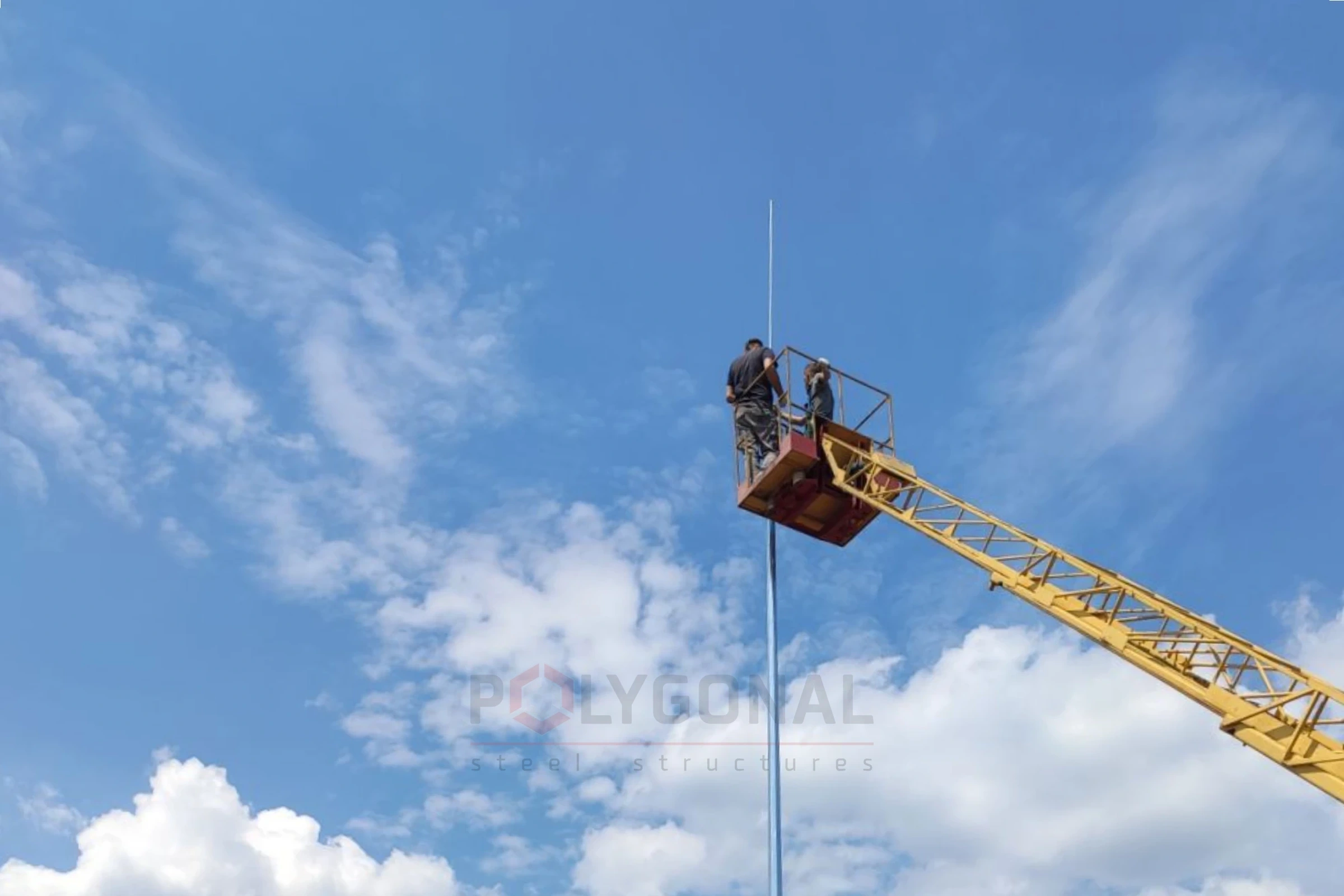
Types of lightning protection masts
Air-termination rods intercept strikes and lead the current to earth, protecting buildings and structures from direct hits; surge protection of the power supply network is separate.
Lightning masts on multi-sided shafts
A shaft with an air-termination rod and a foundation anchor cage. MO range (5–40 m).
Combined lightning masts
An air-termination rod that also serves as a lighting pole or a telecom tower.
Air-termination systems for industrial sites
A design that accounts for the industry, type of facility and local conditions; earthing, measurements, documentation.
Advantages of lightning protection masts
Neat appearance
A bent multi-sided shaft looks tidy and fits the architecture of the site.
Corrosion resistance
Hot-dip galvanising to DSTU EN ISO 1461:2024 protects against corrosion for 20+ years; painting by agreement with the customer.
Combined solutions
One shaft can serve as a lightning mast, a lighting pole or a telecom tower.
Room for fixtures
Lighting fixtures can be mounted on the shaft.
Heights of 5–40 m
MO-range lightning masts on multi-sided shafts run from 5 to 40 m. Catalogue standard masts run from 6 to 40 m.
Matched to the site
Substations, industrial sites and warehouses, tank farms, filling stations, biogas plants. The design follows the type of site and local conditions.
Hot-dip galvanising — 20+ years
Protection to DSTU EN ISO 1461:2024
Industrial sites protected by masts
Masts up to 40 m high protect large open areas against direct lightning strikes. Examples of sites and what the design has to settle:
| Site | What the design considers |
|---|---|
| Substations and open-air switchyards | Height of the equipment and gantry posts, site size, safe distances to live parts, bonding of the mast earthing to that of the substation. |
| Production sites and warehouses | Height of buildings, pipe racks and equipment; a mast beside a structure or apart from it; the option of combining it with area lighting. |
| Tank farms, filling stations, biogas plants | Layout of tanks, gas holders, breather valves and loading points; explosion-hazard zones and the distances from them to the mast. Annex D of DSTU EN 62305-3 covers structures at risk of explosion: air terminations and down conductors are placed, where possible, at least 1 m from the hazardous zone; type B earthing is preferred. |
Dimensions and scope of application (catalogue)
Data from the catalogue “Structures for outdoor lighting” (2023). Material: steel S245, S255 (DBN V.2.6-198:2014); coating: hot-dip galvanising to DSTU EN ISO 1461:2024. The products are certified.
MO: multi-sided lightning rods, 5–40 m high
Designation example: a multi-sided lightning rod 12 m high — MO-12 TU U 25.1-39573934-002:2018. Wall thickness 3 mm.
| H, m | ∅b, mm | W, mm | v, mm | Wp, mm | B, mm | D×n, mm | Anchor cage |
|---|---|---|---|---|---|---|---|
| 5.5 | 170 | 500 | 90 | 600 | 190 | М20/4 | ФПО-800-1 |
| 6 | 170 | 500 | 90 | 600 | 190 | М20/4 | ФПО-800-1 |
| 7 | 170 | 500 | 90 | 600 | 190 | М20/4 | ФПО-800-1 |
| 8 | 170 | 500 | 90 | 600 | 190 | М20/4 | ФПО-800-1 |
| 9 | 206 | 500 | 90 | 600 | 220 | М24/4 | ФПО-1000-1 |
| 10 | 206 | 500 | 90 | 600 | 220 | М24/4 | ФПО-1000-1 |
| 11 | 206 | 500 | 90 | 600 | 220 | М24/4 | ФПО-1000-1 |
| 12 | 206 | 500 | 90 | 600 | 220 | М24/4 | ФПО-1000-1 |
| 14 | 206 | 500 | 90 | 600 | 220 | М24/4 | ФПО-1000-1 |
| 15 | 206 | 500 | 90 | 600 | 220 | М24/4 | ФПО-1000-1 |
| 20 | 305 | 500 | 140 | 600 | 390 | М30/6 | ФПМ-390-900 |
| 25 | 362 | 500 | 140 | 600 | 460 | М36/6 | ФПМ-460-1040 |
| 30 | 414 | 500 | 140 | 600 | 500 | М30/12 | ФПМ-500-900 |
| 35 | 550 | 500 | 140 | 600 | 640 | М30/16 | ФПМ-640-900 |
| 40 | 600 | 500 | 140 | 600 | 710 | М36/16 | ФПМ-710-1040 |
Completed projects
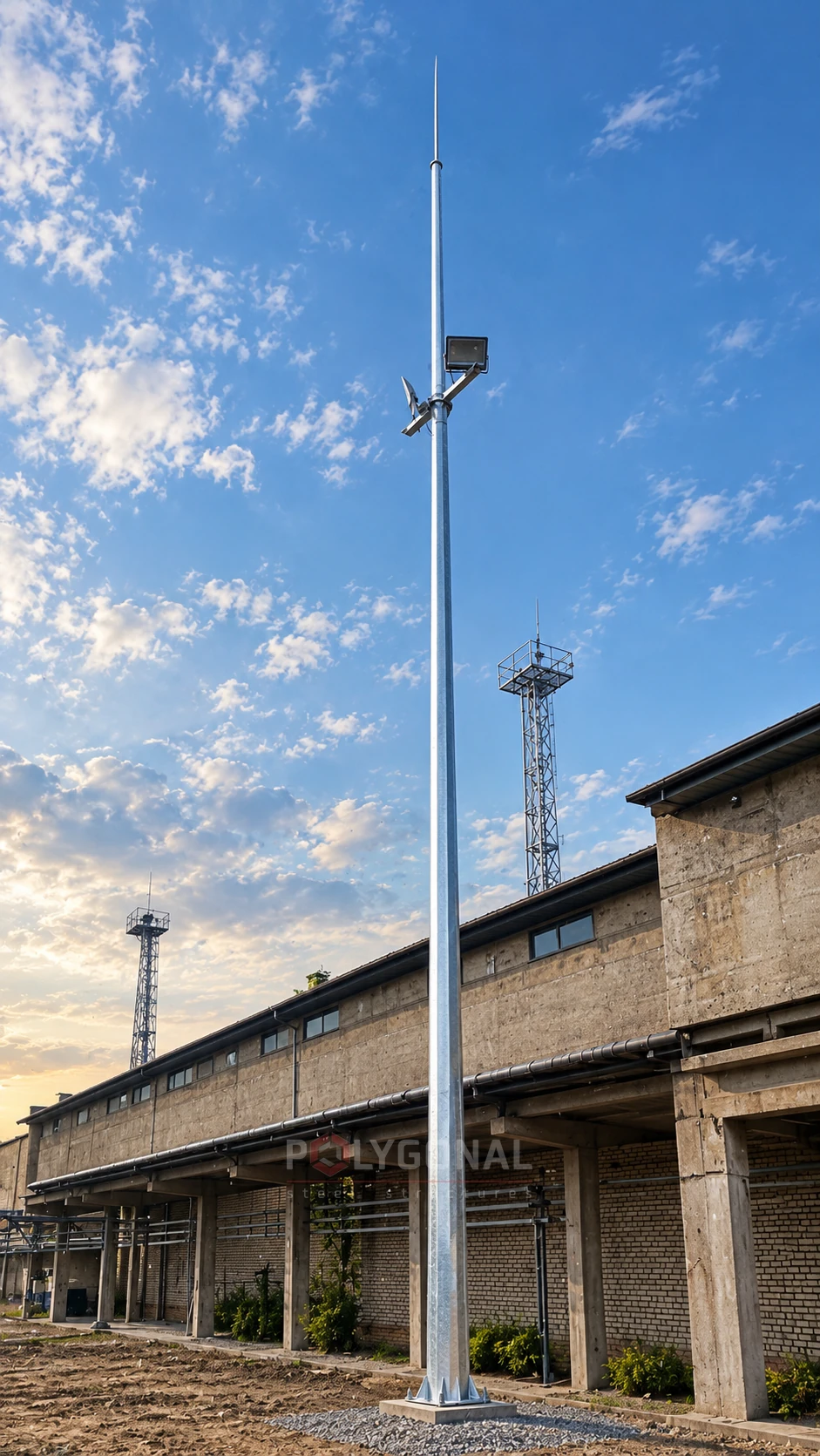
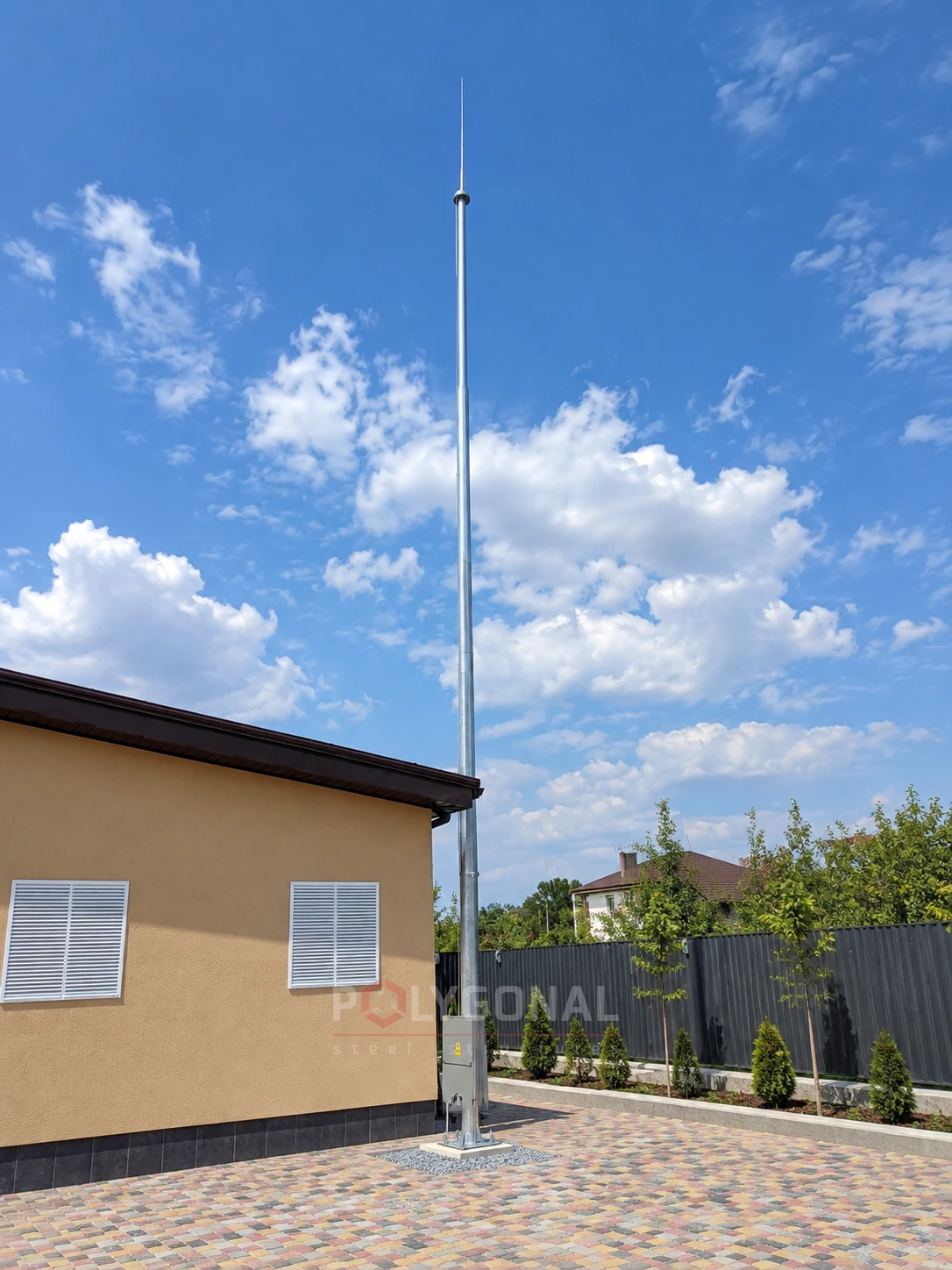
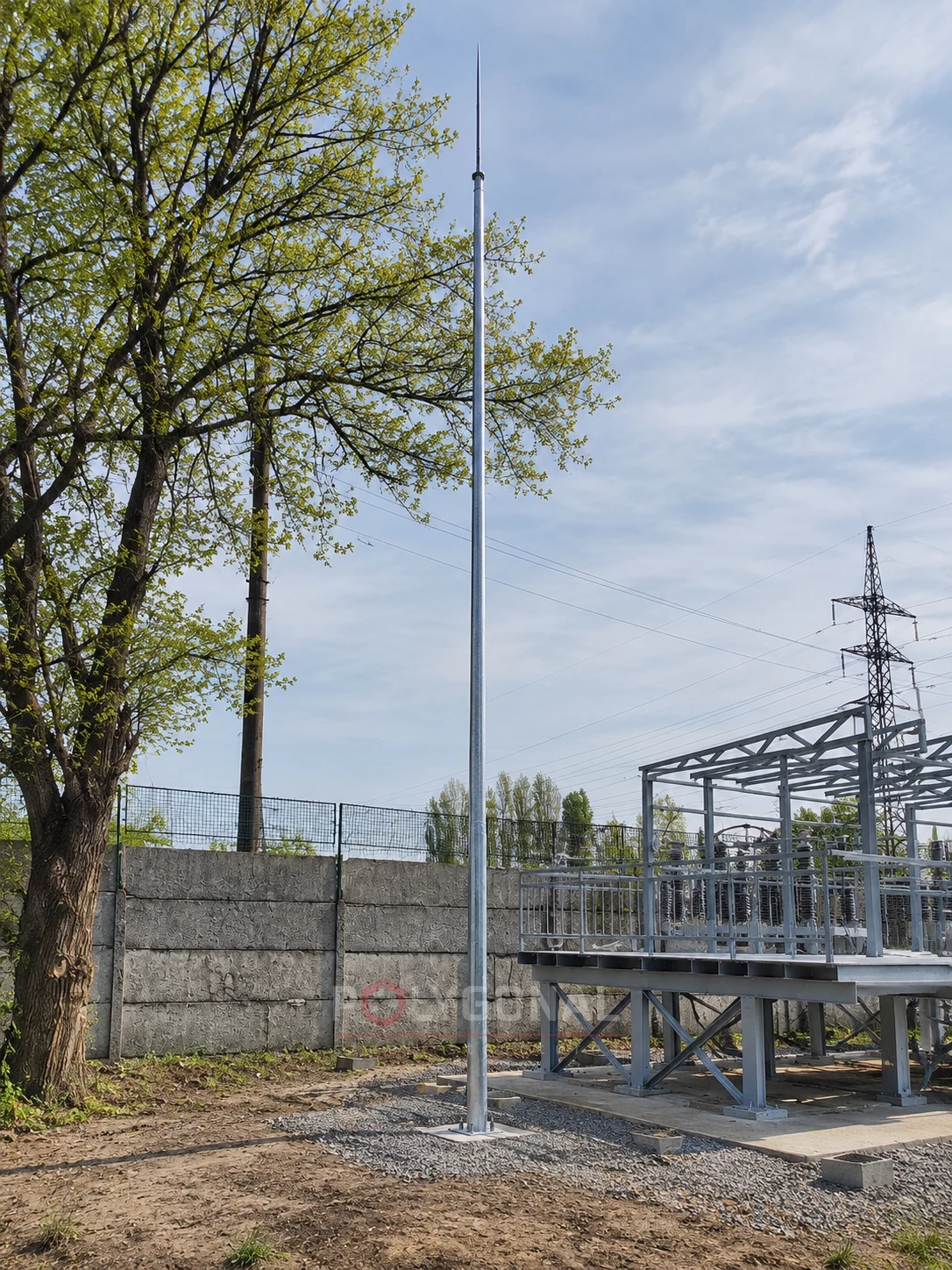
Lightning protection masts and air-termination rods: technical specifications
Stages of making air-termination systems for industrial sites
- a design reflecting the specifics of the site and national standards
- choosing the location for the fullest protection
- manufacture of steel structures on special equipment
- manufacture of an earthing system designed for high currents
- low-resistance connection of the earthing to the lightning protection system
- measurements (continuity, earth resistance; impulse measurements where needed) and documentation
How mast height and the number of masts are determined
- the height and number of masts follow from a protection zone calculation to DSTU EN 62305-3; the rolling sphere method also suits complex facility geometry;
- the sphere radius depends on the lightning protection system (LPS) class (I–IV; class I is the highest level): Table 2 of DSTU EN 62305-3 sets the largest radius at 20, 30, 45 and 60 m respectively; the higher the level, the smaller the radius and the closer the masts stand;
A worked example (a single 6 m mast, class III: protection radius about 22.4 m at ground level) and a comparison of the methods are in Calculating a Lightning Rod’s Protection Zone.
Which standards apply
The design follows the DSTU EN 62305 series: Part 2, risk assessment and the protection class; Part 3, protection against physical damage: the external system (air terminations, down conductors, earthing), the internal one (equipotential bonding, separation distance), inspection and maintenance, touch and step voltages; Part 4, electrical and electronic systems inside the facility. Editions are updated, so check the current ones before starting a design. On the withdrawn DSTU B V.2.5-38:2008, see Lightning Protection Norms.
What determines the price of a lightning protection mast
The price depends on shaft height, type of facility, wind region, additional equipment (lighting, antennas), earthing system, coating and installation (its cost is calculated separately each time; installation is carried out by a licensed construction partner company).
How to order a lightning protection mast
- Specify the height, type of facility, wind region and any additional equipment.
- We propose a design and agree the coating.
- We calculate the price and lead time.
What the standard says about an air-termination shaft
DSTU EN 62305-3:2021 on a steel shaft as air termination and down conductor; the design decides whether a given shaft qualifies:
- down conductor (cl. 5.3.5 a): reliable electrical continuity between parts (cl. 5.5.3: for example welding or bolts; as few joints as possible) and at least the minimum cross-section from Table 6, 50 mm² for hot-dip galvanised steel;
- shaft wall as air termination (cl. 5.2.5, Table 3): galvanised or stainless steel at least 4 mm thick where puncture or local overheating must be prevented; 0.5 mm is for sheet only, and only if puncture, overheating and ignition of material beneath do not matter; the table covers sheet and pipes, so a multi-sided shaft is judged by analogy;
- top rod (Table 6, note c): round section, at least 176 mm² (about 15 mm in diameter, our own calculation), or, where mechanical stress such as wind loading is not critical, 9.5 mm in diameter and 1 m long; informative Annex E finds a blunt tip useful;
- copper parts above unprotected galvanised steel cause severe zinc corrosion even without contact (informative cl. E.5.6.2.2).
Articles about lightning protection masts and air-termination rods
Lightning Protection Norms: Why the Old Standard Was Withdrawn and What Applies Now
The old Ukrainian lightning protection standard was withdrawn in 2019, but references to it still appear online. We explain which document applies now and how the approach differs.
Calculating a Lightning Rod’s Protection Zone: Methods and an Example
DSTU EN 62305-3 sets out three methods for positioning air terminations to achieve the required protection zone. We explain each method, give a parameter table by lightning protection system (LPS) class, and a worked example for a single rod air termination.
A Steel Mast as Air-Termination and Down-Conductor per DSTU EN 62305-3
What DSTU EN 62305-3:2021 requires and recommends when a steel shaft or mast serves as an air-termination and down-conductor, and where it gives no direct rule and only an analogy is left. This is a reference on the standard only; a specific mast is defined by its design.
Lightning Protection Inspection and Maintenance: Intervals, Checks, Records
Over a few years, corrosion, weather and lightning strikes wear down a lightning protection system (LPS). For mast owners, in short: what is inspected under DSTU EN 62305-3, how often, and which records are kept.
Lightning protection masts: frequently asked questions
Why is an air-termination rod needed?
To protect buildings and structures from direct lightning strikes: it intercepts the discharge and leads the current via a down conductor to the earthing system. Surge protection of electrical networks is separate.
Can a lightning mast be combined with a lighting pole?
Yes. We can design and make combined lightning masts that also serve as a lighting pole or a telecom tower.
What coating do the shafts have?
Painting or hot-dip galvanising to DSTU EN ISO 1461:2024 by agreement with the customer; galvanising protects against corrosion for 20+ years.
What mast height should be chosen for an industrial site?
It follows from the protection zone calculation, which accounts for the LPS class, the facility’s height and size and the mast positions. A large area usually needs several masts. We propose a mast structure from your input data; an engineer calculates the protection zone to the standard.
Is installing a mast enough to protect a facility?
No: a mast is only the air termination with its supporting structure. External protection also includes a down conductor (the steel shaft itself can serve, if its joints are reliable, its cross-section meets Table 6 of DSTU EN 62305-3 and the design provides for it) and an earthing system; surge protection of electrical and electronic systems inside the facility is handled separately (DSTU EN 62305-4).
What conditions are the typical TP-M6M40.20.01 catalogue masts (6–40 m) intended for?
The typical solution in the catalogue TP-M6M40.20.01, with heights of 6, 10, 15, 20, 25, 30, 34.6 and 40 m, is intended for wind regions 1–4, seismic intensity up to 6 points and temperatures from −40 to +40 °C. For other conditions we calculate the mast individually.
How often is a lightning mast inspected?
After installation the system is inspected (cl. 7.3), including conductor continuity and earth resistance (informative cl. E.7.2.4). Informative Table E.2 gives maximum intervals: classes I–II, visual every year and full every 2 years; classes III–IV, every 2 and every 4 years; critical situations (table notes: for example sensitive internal systems, office and commercial buildings, crowded places), full yearly; explosion-risk structures, visual every 6 months. Extra inspections: after repairs, changes and any known strike. Annex E text advises a visual check at least yearly, which for classes III–IV is more often than the table; the table applies where the authorities set no special requirements; a maintenance programme or an insurer may call for a full test yearly.
How much does a lightning protection mast cost?
MO series masts on multi-sided shafts (5–40 m) start from UAH 15,000 each, combined masts (10–40 m) from UAH 30,000 (including VAT, excluding delivery and installation).
Lightning protection masts and air-termination rods: related solutions
Need lightning masts or air-termination rods?
Send us the site parameters and the desired height. We will work out the price and lead time.