
Home / Services / Technical inspection
Service · Inspection
Technical inspection
We carry out technical inspection of buildings, structures and steel structures: we assess the technical condition, determine the load-bearing capacity and issue a report with recommendations.
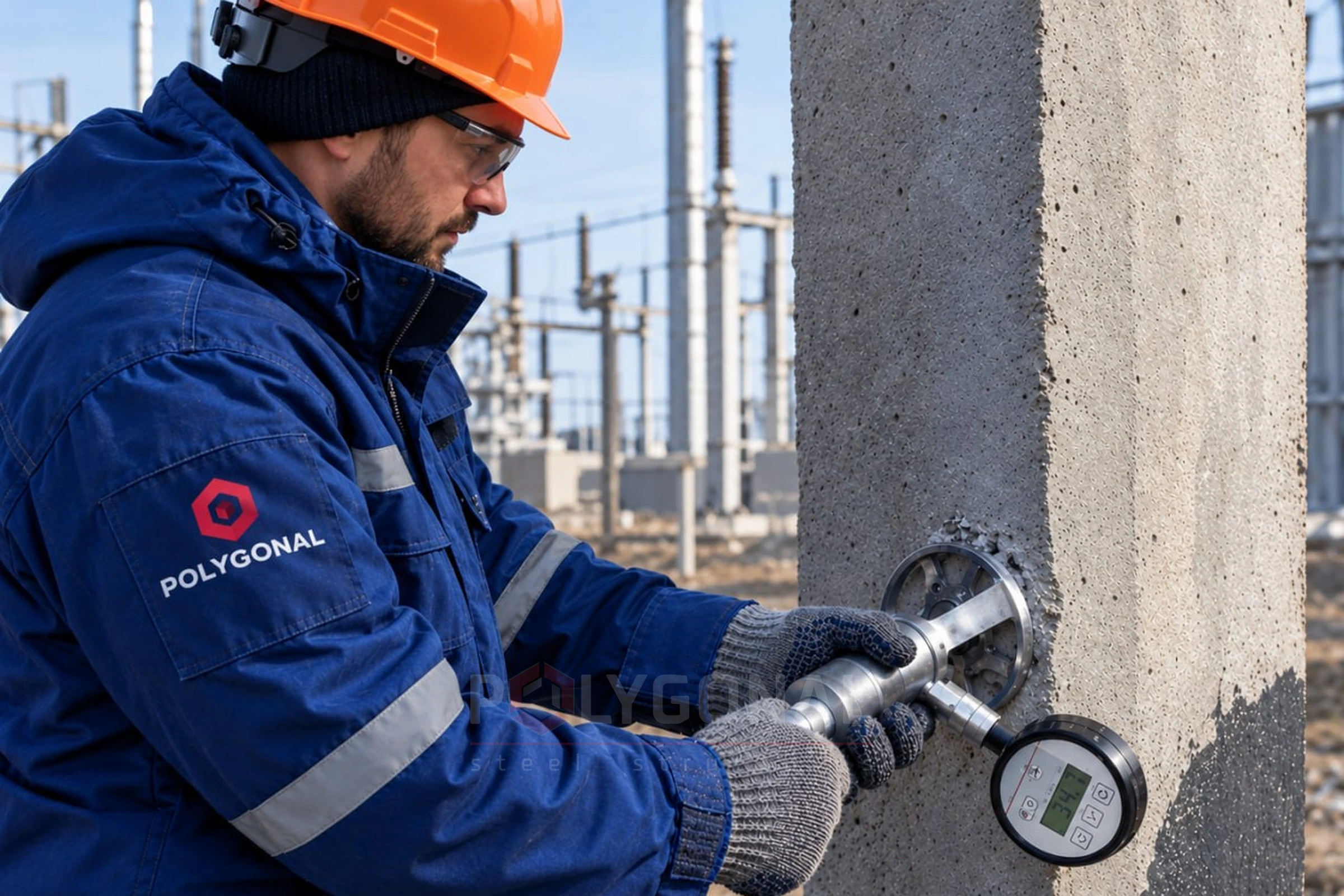
What the service includes
Inspection follows the current regulations and methods.
Survey and inspection
Visual survey, detection of damage and defects, monitoring of the condition of structures.
Condition assessment
Determining the technical condition category of a building or structure and its degree of wear.
Load-bearing capacity calculation
Verification calculations of structures taking into account the actual condition and refined steel properties.
Object passport
Drawing up the passport after a scheduled inspection and amending it later.
Advantages of technical inspection
Engineering experience
We inspect steel structures, including poles, towers and industrial structures.
A report with recommendations
We issue a report and recommendations on repair, strengthening or further operation.
In-house design
If needed we design the strengthening and manufacture the structures.
Prompt work
We agree the scope and timing to suit your site.
Load-bearing capacity
Verification calculations that take into account the actual condition of the structures and refined steel properties.
Object passport
After a scheduled inspection we draw up the object’s passport and amend it later.
Technical inspection: technical specifications
Regulatory basis for inspection
The procedure for inspecting objects already accepted for operation is set by Resolution No. 257 of the Cabinet of Ministers of Ukraine of 12 April 2017, how to draw up the results by the Methodology approved by order No. 144 of the Ministry for Development of Communities and Territories of 6 August 2022, and the technical methodology for assessing condition by DSTU 9273:2024, “Guidelines for inspecting buildings and structures to determine and assess their technical condition. Mechanical resistance and stability”. Only certified specialists with a qualification certificate matching the object’s consequence class (CC1-CC3) may carry out an inspection — see Who May Conduct a Technical Building Inspection.
How an inspection runs
An inspection has three stages: preparation, a preliminary and/or main (detailed) inspection, and a final document. The preliminary inspection is a visual examination with measurements and recording of defects; a main inspection is ordered when defects are found that could reduce the strength, stability or stiffness of structures, and it adds instrumental measurements and verification calculations.
The outcome depends on the grounds: after a scheduled inspection it is the object passport (drawn up from the report); after an inspection because of defects or damage, or before a major repair, reconstruction or restoration is designed, it is a report with recommendations. We agree the stages and the scope of work with the customer in the technical specification; an inspection from photographs or drawings alone, without examining the object on site, is not allowed as a general rule. More in Inspection Procedure and Passportisation.
Technical inspection of buildings and structures: when it is needed and what it ends with
For facilities in consequence classes CC2 and CC3 an inspection is mandatory; in other cases it is carried out at the owner’s decision (for example, before heavier equipment is installed) or where the law or a contract requires it. The designer sets the timing of scheduled inspections in the design documentation, but the first one must take place no later than the end of the warranty period, and the interval between inspections may not exceed 10 years.
An unscheduled inspection is carried out, among other cases, when defects, damage or deformations turn up during a routine inspection or maintenance; when the facility has been subjected to an impact the design did not foresee, such as an emergency event; and when the actual condition of the structures must be known before a major repair, reconstruction or restoration is designed. The full list of grounds is in Who May Conduct a Technical Inspection of Buildings and Structures.
The consequence class is stated in the design documentation. If a facility was accepted for operation before 10 June 2017 and its class was never determined, it is established during the inspection and entered in the passport. What the report and the passport contain is covered in Inspection Procedure and Passportisation, and what the price depends on in Technical Inspection Cost: What It Depends On.
Technical condition assessment of buildings and structures: how it is done and what the categories mean
The condition of structures is assessed in two ways: the defects and damage found are compared with the permissible values in the codes or the design, or calculation is used to check their effect on load-bearing capacity, for which the actual loads and material properties are first established on site. More in Diagnostics and Assessment of the Technical Condition of Building Structures. For steel structures, including poles and towers, the grade and properties of the steel are also established where needed and the actual thickness of the members is measured; signs of wear on metal poles are covered in Wear and Corrosion of Metal Poles.
From the survey, the measurements and the verification calculations, the structures are assigned a technical condition category. A scale of four categories is often used:
- I, normal: there are no defects that hinder operation or reduce load-bearing capacity;
- II, satisfactory: the load-bearing capacity is adequate, but there are defects that may reduce durability, so the structure needs protecting;
- III, unfit for normal operation: the structure is overloaded or its defects point to reduced load-bearing capacity; its integrity can be kept during strengthening;
- IV, unsafe: the integrity of the structure cannot be kept during strengthening, so people are moved out of the danger zone and the structure is unloaded at once.
The condition of a building as a whole is set by the worst category among its load-bearing and enclosing structures.
Routine inspection of buildings and structures at an enterprise: how it differs from a technical inspection
A routine inspection and a technical inspection do not replace each other: the routine one notices changes in the condition of the structures, while the technical one establishes their cause and effect on load-bearing capacity, so defects, damage or deformations found in a routine inspection are grounds for a technical inspection.
A routine inspection is ongoing, mostly visual monitoring that the owner arranges with their own staff or outside contractors (for example, the enterprise’s maintenance service); the result is a record of the changes found. A technical inspection goes deeper: a qualified specialist carries it out, usually with measurements and verification calculations, and it ends with a passport or a report.
Routine inspections are regular and also follow events that may have damaged the structures (a windstorm, fire, heavy rain or snowfall, an accident); structures in an aggressive environment, under heavy load or vibration are inspected more often. How to organise supervision and what documents the facility needs are covered in Supervision and Monitoring of the Condition of Buildings and Structures.
During a routine inspection, attention goes to:
- column bases, foundations and areas of increased moisture;
- cracks, both new ones and those that are growing, including in welds;
- deflections, tilts and other deformations;
- corrosion and the condition of the protective coating;
- loose bolted connections and fixings.
Articles about technical inspection
Technical Inspection of Buildings: Procedure and Passport
Who is responsible for the inspection, which documents are needed, what stages it consists of, what goes into the report and how the object passport is drawn up.
Diagnostics of Structural Condition
How the technical condition of existing structures is assessed: the methods, the diagnostic procedure, and the condition categories for structures and for the building as a whole.
Building Condition Monitoring: Inspections and Records
How to organise systematic monitoring of the condition of industrial buildings and structures: who is responsible, what inspections there are, how often to inspect structures and what documentation is needed.
Cracks in Structures: Assessment and Repair
Why cracks appear, how they are classified and measured, and the ways of repairing cracks and strengthening damaged structures.
Who May Conduct a Technical Inspection of Buildings and Structures
Technical inspection of buildings and structures follows DSTU 9273:2024, but the right to carry it out is set by separate state regulation: certification of specialists by the object’s consequence class.
Technical Inspection Cost: What It Depends On
The cost of a technical inspection is worked out individually for each object — there is no universal fixed price. We explain the factors that affect it so you understand what the calculation is based on.
Steel Properties in a Technical Inspection
Why steel properties are refined during an inspection, which tests are run, how samples and specimens are taken and how the design properties are assigned from the results.
Wear and Corrosion of Metal Poles: Signs, Inspection, Repair or Replacement
A metal lighting pole or mast usually gives warning signs — corrosion at the base, cracks in welds, tilt, loose fastening — but some defects under soil, concrete or coating show up only during an inspection. We explain what to look for, how poles are inspected, and when to repair and when to replace.
Technical inspection: frequently asked questions
What is a technical inspection?
A set of works to assess the technical condition of a building or structure: survey, detection of defects, verification calculations and a report with recommendations.
What does the customer receive?
A report with a conclusion on the condition of the structures and recommendations on repair, strengthening or further operation; after a scheduled inspection, also an object passport.
What do I need to send for a price calculation?
The type and location of the facility, the available documentation, the purpose of the inspection and deadlines. Leave blank whatever you do not know and we will clarify.
Do you design strengthening?
Yes. We design the strengthening and manufacture the required structures.
When does a building or structure need a technical inspection?
Scheduled: when an inspection falls due. Unscheduled: if defects, damage or deformations turn up in a routine inspection, after an emergency event, or before a major repair, reconstruction or restoration is designed. A scheduled inspection ends with a passport for the facility, an unscheduled one with a report containing recommendations.
Is a technical inspection mandatory, and how often is it done?
For facilities in consequence classes CC2 and CC3 it is mandatory; in other cases it is done at the owner’s decision or where the law or a contract requires it. The first inspection must take place no later than the end of the warranty period, and the interval between inspections may not exceed 10 years.
Technical inspection: related solutions
Need a technical inspection?
Describe the facility and the purpose of the inspection. We will calculate the price and the lead time.