
Home / Equipment & engineering / Presses
Equipment · For manufacturers
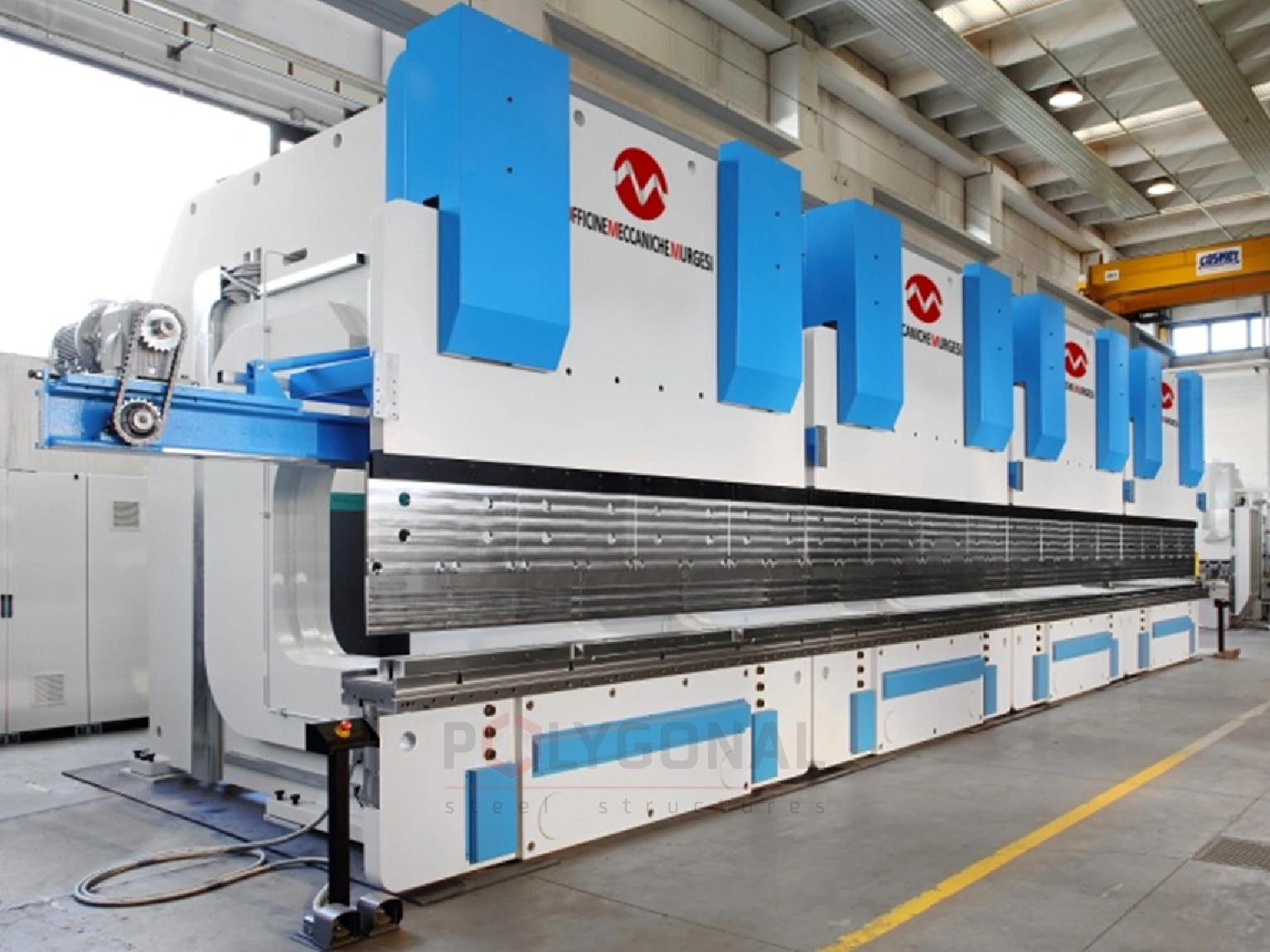
Sheet Metal Bending Press
We offer hydraulic sheet bending presses designed specifically for multi-sided poles: they are not universal presses. The line is operated by two operators, and a 16-sided pole takes up to 3.3 minutes.
What the presses are for
The presses bend flat trapezoids step by step, forming tapered and pyramidal multi-sided poles.
Multi-sided lighting poles
Poles for street, road and park lighting.
Telecom and power line poles
Shafts of telecom towers and power line poles.
Floodlight masts and other structures
Masts, flagpoles and other products made of sheet metal.
Advantages of the presses
Simple foundation
Installing 4 presses instead of 2 needs no massive foundation, and the equipment can be moved later.
DELEM control
Synchronised presses with the DELEM control system can drive up to 16 axes at once.
Even load
8 hydraulic cylinders instead of 4 distribute the load evenly.
Deep throat
Throat depth of 1250–2000 mm; the trapezoid need not be turned during bending. Manual operation is possible.
Fast production
Up to 3.3 minutes per 16-sided pole. The line is operated by two operators.
Easy pole removal
The unloading system can push the pole out in both directions.
Up to 3.3 min per 16-sided pole
The line is run by two operators
Technical specifications
| Parameter | Value |
|---|---|
| Operating staff | 2 people |
| Maximum sheet width | 2000–2500 mm |
| Sheet length | 4000–16000 mm |
| Sheet thickness | 3.0–25.0 mm |
| Material | hot-rolled steel, free of oxides and oil on the surface |
| Yield strength / tensile strength | 350 N/mm² / 500 N/mm² |
| Press force | 1250–2000 t |
| Throat depth | 1250–2000 mm |
| Hydraulic / pneumatic pressure | 150 bar / 6 bar |
| Power supply | 380 V / 50 Hz / three-phase |
Data from POLYGONAL technical documentation; the exact configuration is set for your production.
Presses: technical specifications
How the press works
The press is designed so that the trapezoid does not have to be turned during bending: the throat is deeper than standard, so a partially bent trapezoid can be bent further.
To bend poles from sheet up to 2000 mm wide (pole diameter up to 650 mm) a press throat of 1250 mm is needed. For sheets up to 2500 mm the throat is increased.
Equipment manufacturer
We represent the manufacturer of these presses, Officine Meccaniche Murgesi, in Ukraine. Send your requirements for a press or a line and we will prepare an offer.
How to choose a press for your poles
The presses we offer are chosen for the heaviest products in the range, not the typical ones. Before you send an enquiry, determine:
- the range of pole diameters and lengths: the sheet width depends on the diameter and the number of blanks per pole (it is determined by the larger base of the trapezoid), and the throat you need depends in turn on the sheet width. A pole up to Ø650 mm is made from one blank, up to Ø1250 mm from two shells, and large diameters from three or four blanks;
- the greatest sheet thickness: with the die opening unchanged, the required force grows in proportion to the square of the thickness, but for thicker sheet a wider die opening is usually chosen, so the growth is less steep, though still substantial. The bend length and the strength of the steel matter too; this is a rough estimate, and the exact force depends on the tooling and the bending method. The presses we offer deliver a force of 1250–2000 t;
- the grade and condition of the metal: the press is designed for hot-rolled steel with a surface free of oxides and oil (yield strength 350 N/mm², tensile strength 500 N/mm²); stronger steel needs more force or a smaller permissible sheet thickness, so state the grade in your enquiry;
- the annual volume and the rest of the line: cutting, welding, galvanising.
Typical mistakes are choosing a press by force alone, forgetting the throat and the sheet width, and judging a workshop’s capacity by the press alone. The pace is set by the slowest stage in the flow, so output is calculated for the whole line.
The blank and the press’s place in the line
The press bends flat trapezoids, so the result depends on the blank. Accuracy is built in earlier, at cutting: according to the technical documentation of the trapezoid cutting line we offer, the cutting tolerance is ±3 mm on length and ±1 mm on the bases (blank cutting and positioning).
The automatic marking and positioning system is designed for sheet 3.0–12.0 mm thick weighing up to 2400 kg; heavier sheets are moved by the plant’s overhead crane. For thick-walled poles the set of stages is agreed separately.
After the press, the bent blanks go to welding. In the line we offer, the accumulation system holds a buffer of 5 to 23 poles, depending on the diameter, so if the press stops, welding continues while the buffer lasts (welding lines).
What to send for a proposal and how an order proceeds
Send what you already know; leave blank any items you do not know and we will clarify them:
- the list of poles: diameters, length, sheet thickness;
- steel grades and the source of the metal (sheet or coil);
- annual output, workshop floor area, crane and power supply;
- whether you need other stages of the line.
Then come a site visit, equipment selection, design and supply, installation supervision, start-up and staff training; we state lead times after the visit and the calculation. The general procedure is in the article How to launch multi-sided pole production.
Do you need only a sheet or a part bent, rather than equipment to buy? That is a separate service on our own 2000 t press (sheet up to 12 m long and up to 25 mm thick), distinct from the presses we offer to manufacturers: bending on a 2000 t press.
Presses: frequently asked questions
What sheets can be bent?
Width 2000–2500 mm, length 4000–16000 mm, thickness 3.0–25.0 mm, hot-rolled steel free of oxides and oil.
What pole diameter can be made?
From a sheet up to 2000 mm wide, up to 650 mm in diameter (a throat of 1250 mm is needed).
How long does it take to make a pole?
Up to 3.3 minutes per 16-sided pole. The line is operated by two operators.
Is a heavy foundation required?
No. Installing 4 presses instead of 2 does not need a massive foundation.
How much does a press for multi-sided poles cost?
The price depends on the press force (1250–2000 t), sheet size and line configuration. Send your requirements and we will prepare an offer.
What does the required press force depend on?
On the sheet thickness (with the die opening unchanged, in proportion to its square; for thicker sheet a wider die opening is usually chosen), the bend length, the strength of the steel and the die opening. That is why a press is chosen for the thickest and strongest sheet in the range, while the exact force depends on the tooling and the bending method. The presses on offer deliver a force of 1250–2000 t.
Is the sheet thickness limit the same for the press and for the automatic marking system?
No. The press bends sheet 3.0–25.0 mm thick, while the automatic marking and positioning system is designed for 3.0–12.0 mm; for thick-walled poles the set of stages is agreed separately.
What data is needed to select a press?
The list of poles (diameters, length, sheet thickness), steel grades, annual output, workshop floor area, crane and power supply. Leave blank what you do not know.
Presses: related solutions
Need a press for multi-sided poles?
Send us the product parameters and the required output. We will prepare a proposal.