
Home / Equipment & engineering / Multi-sided pole production lines / How to Launch Multi-sided Pole Production: Equipment, Workshop, Staff
Multi-sided pole production lines
How to Launch Multi-sided Pole Production: Equipment, Workshop, Staff
What it takes to launch multi-sided pole production: products, line composition, workshop, staff, start-up stages and cost drivers. For investors and producers who are expanding.
Contents
- Who benefits from in-house multi-sided pole production
- What you will make: products and pole range
- What the line consists of
- What workshop and utilities are required
- How many people and what skills you need
- How start-up runs and what sets the lead time
- What drives the cost of a line and a workshop
- What mistakes occur during start-up
- What to prepare for a request
Who benefits from in-house multi-sided pole production
A line of your own is justified when there is a steady flow of orders or a clear sales plan. It suits:
- an investor entering the market and building a workshop from scratch;
- a metalworking company adding its own poles to cutting, welding or galvanising;
- a pole maker that is increasing capacity or automating a manual stage;
- a galvanising plant that wants its own products, not only to coat other people’s work.
For single poles or a one-off batch a line is unlikely to pay back: ordering steel fabrication is simpler. We make bent poles and masts and galvanise in our own bath, so we know the process inside out. For manufacturers we offer multi-sided pole production lines and turnkey factory engineering.
What you will make: products and pole range
A bent multi-sided shaft is the basis for lighting poles, floodlight masts, power line poles, telecom towers, traffic signal poles and flagpoles (multi-sided pole technology). In Ukraine, demand is usually tied to lighting, power networks and telecom, and several product lines reduce dependence on one market.
The range sets the line composition: diameter, wall thickness and length decide the machines, so first list the products and the yearly quantity.
| What you will make | What it means for the line |
|---|---|
| Lighting poles and small masts, diameter up to 650 mm | single-seam blank, welding line up to Ø650 mm, plate 3–10 mm |
| Power line poles and telecom towers, diameter up to 1250 mm | two shells, two-seam machine up to Ø1250 mm, plate 3–8 mm |
| Heavy poles and towers, diameter 1200–2900 mm | 3–4 blanks, a group of four welding machines, plate up to 32 mm for welding, press up to 25 mm |
| Round tapered lighting poles from pipe | seamless pole line: pipe Ø76–245 mm, pole length 3500 to 15 000 mm |
The parameters come from the documentation of the equipment we offer.
What the line consists of
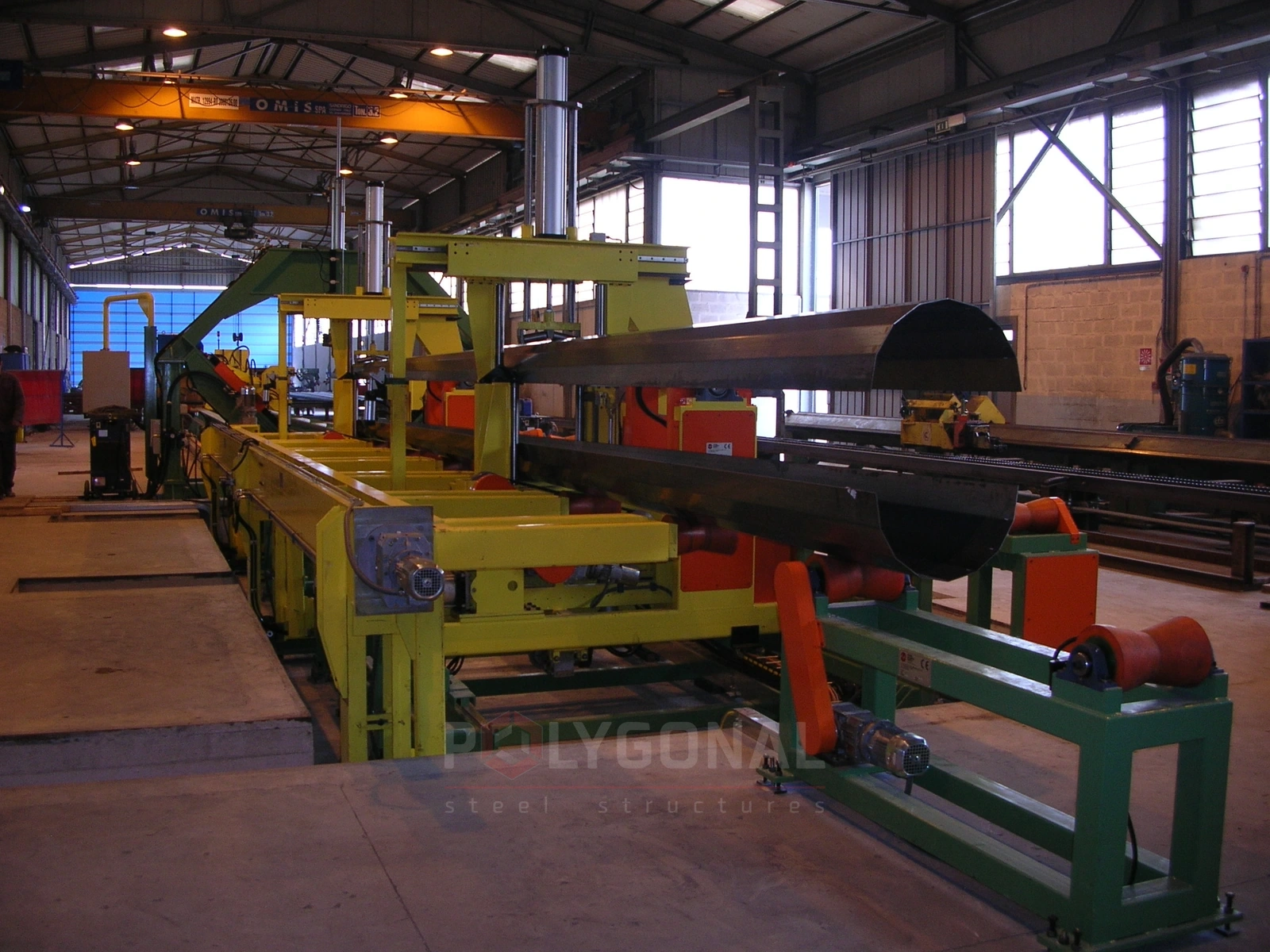
The blank takes the same route for most poles: coil or plate, trapezoid, bending, longitudinal seam, hatches and flanges, galvanising. We offer the stages separately or as a line:
- cutting and marking — the cutting and positioning line;
- bending — hydraulic presses;
- the seam and accumulation of blanks — welding lines;
- hatches, plates, flanges and seamless poles from pipe — the robotic cell;
- galvanising — the hot-dip galvanising line.
Mind the wall thickness: automatic marking is rated for plate 3.0–12.0 mm thick, the press bends up to 25.0 mm and the Ø1200–2900 mm welding line takes plate up to 32 mm, so for thick-walled poles the configuration of the stages is agreed separately.
| Stage | Key parameters |
|---|---|
| Cutting trapezoids | strip 3–8 mm, width up to 2100 mm, plate length 4000–16000 mm, one trapezoid a minute |
| Hydraulic press | 1250–2000 t, throat 1250–2000 mm, plate 3.0–25.0 mm, up to 3.3 min per 16-sided pole |
| Accumulation system | holds 5 to 23 poles; welding goes on while the press is stopped |
| Robotic cell | hatches up to 660 × 350 mm, plates and flanges on poles Ø100–650 mm |
| Galvanising line | chemical preparation, drying oven, galvanising furnace; up to 15 t of structures an hour |
What workshop and utilities are required
Floor areas depend on the line composition, so we give no figures without a calculation. A pole is laid out lengthwise along the process flow: workshop length is set by the longest section (blanks in the lines we offer are 4000–16000 mm) plus accumulation and storage. Longer poles are assembled from sections on a telescopic joint; a section must fit the press, the galvanising bath and the workshop.
Plan separately for galvanising waste: spent flux, ash and hard zinc. Flux regeneration and ash recovery units are available for flux and ash (galvanising plant); the handling of other spent solutions must be provided for in the workshop design.
| Resource | What to consider |
|---|---|
| Power and air | 380 V, 50 Hz, three-phase; hydraulics 150 bar, pneumatics 6–8 bar (compressed air is needed) |
| Cranes | the marking stage is rated for plate weighing up to 2400 kg; heavier plates are moved by the shop crane |
| Gas and extraction | the galvanising furnace can be gas-fired or electric (set by the design); extraction, filtration and white-fume collection are needed, plus a gas supply for a gas-fired furnace |
| Foundation | according to the press documentation a massive foundation is not required, but floor bearing capacity and equipment anchoring are checked by calculation when the workshop is designed |
How many people and what skills you need
Automation reduces the number of operators but not the need for process engineers, welders and inspectors. According to the equipment documentation, the stages are staffed by:
- trapezoid cutting line — 2 people (control; loading coils and unloading bundles);
- press — 2 operators, marking and positioning — 1;
- welding up to Ø1250 mm — 2 operators for two-shell poles, 1 for single-seam ones; the Ø1200–2900 mm line — 1;
- seamless pole line — 1 operator; the accumulation system needs no separate operator.
Off the line you need a process engineer, a welding engineer, inspectors (welds, dimensions), a maintenance mechanic, an electrician, riggers, crane operators and, in the galvanising shop, a process chemist and a lab technician. The DSTU EN ISO 3834 series (quality requirements for fusion welding) can guide welding production. Plan maintenance before start-up; for how maintenance and repairs are organised, see the article on equipment maintenance. Staff training is part of our offer.
How start-up runs and what sets the lead time
Our offer has four steps:
- site survey: we visit the customer and assess the conditions on site;
- equipment selection for your products and output;
- design of the workshop or line and supply of the equipment;
- supervised installation, start-up and staff training.
We do not give lead times in advance: they depend on the line composition and the readiness of the building and utilities, and are set after the survey and calculation. Before moving to series production, run a trial batch through the full cycle, including galvanising.
If you have no galvanising shop yet, at the start the products can be galvanised by an outside plant, including ours: hot-dip galvanising has no minimum order. The bath measures 13 000 × 1 600 × 3 200 mm (length × width × depth) and limits the size of a product; longer poles are galvanised in sections.
What drives the cost of a line and a workshop
We do not publish the price: it depends on the input data, and we calculate it on request. The factors:
- the product range: diameter, length, wall thickness;
- yearly output and the number of shifts;
- the level of automation: manual, semi-automatic or robotic stages;
- the set: blanks and bending, welding, a galvanising shop of your own;
- the scope of services: design, supervised installation, start-up, training.
Besides the equipment, the budget includes the building, utilities, a crane, the first stock of metal, product documentation and staff training.
What mistakes occur during start-up
- equipment is bought before the range is defined: the line turns out redundant or unable to make the ordered pole;
- output is calculated from the press alone, although the slowest stage sets the pace;
- galvanising is left for later: a section must fit the bath and be suitable for galvanising — designing for hot-dip galvanising;
- the metal is not matched to the process: the press is rated for hot-rolled steel free of oxides and oil, and silicon and phosphorus affect the zinc coating;
- documentation is not prepared: KM and KMD drawings, wind load calculations and a metal specification are needed before the first batch — steel structure design;
- inspection is underestimated: without incoming metal inspection, ultrasonic testing of welds and zinc thickness measurement, the customer finds the problems — quality control.
What to prepare for a request
Send what you already know; leave blank anything you do not know and we will clarify.
- the list of products: diameters, length, plate thickness;
- yearly output and working pattern;
- floor space and building: dimensions, crane, power, gas;
- steel grades and the source of metal (coil or plate);
- whether you need a galvanising shop of your own;
- automation requirements, timing, location.
Send the request via the Contact page.
Updated:
Launching pole production: frequently asked questions
What does a multi-sided pole production line consist of?
Trapezoid cutting, a press, welding machines, a hatch and flange area and a galvanising shop; the composition is chosen for your products.
What equipment is needed for lighting poles?
For diameters up to 650 mm: trapezoid cutting, a press, a single-seam welding line, a hatch and plate area, galvanising.
Can I start without a galvanising shop of my own?
Yes: at the start the products can be galvanised by an outside plant, including ours, with no minimum order; the bath measures 13 000 × 1 600 × 3 200 mm, and longer poles are galvanised in sections.
How much does it cost to launch pole production?
We do not publish the price: it depends on the range, output, automation and the state of the workshop; we will calculate it on request.
How long does it take to launch a line?
We give lead times after the site survey and calculation; the offer includes design, supervised installation, start-up and training.
Related products: Multi-sided pole production lines · Turnkey factory engineering · Presses · Hot-dip galvanising line
More on this topic: Trapezoid Cutting Line and Blank Positioning · Welding Lines for Multi-sided Poles · Seamless Pole Line and Robotic Cell
Get a quote for your requirements
Send us your requirements — we will calculate the price and lead time.