
Home / Equipment & engineering / Multi-sided pole production lines / Welding Lines for Multi-sided Poles
Multi-sided pole production lines
Welding Lines for Multi-sided Poles
Welding equipment for pole production lines: what it welds, the diameters and thicknesses it covers, and how the accumulation conveyor system works.
Contents
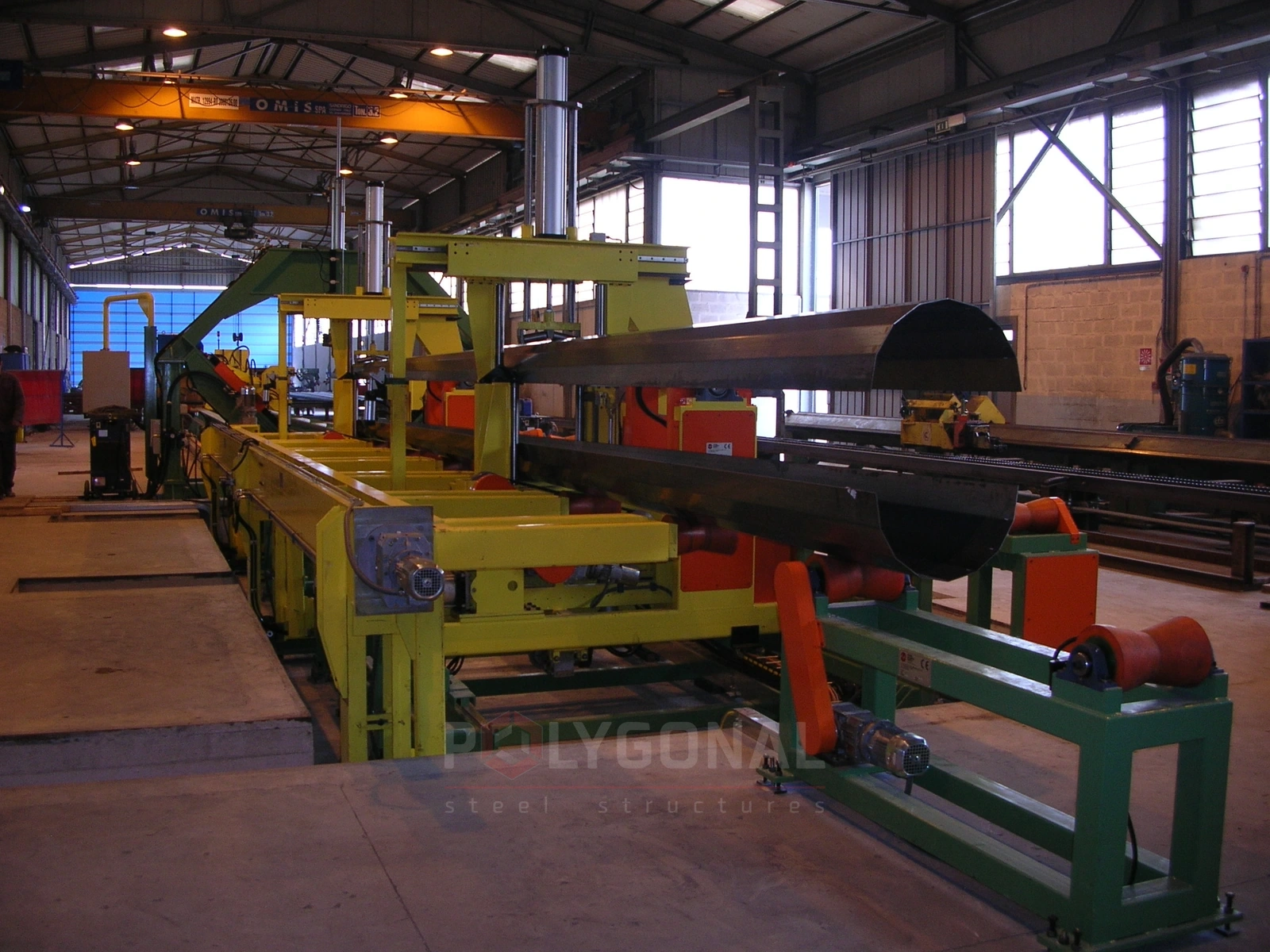
The accumulation conveyor system
The accumulation conveyor carries the bent blank from the press brake to the welding machines automatically and builds up a buffer of blanks on the way. If the press is switched off, the welding machine keeps working without any loss of output.
After the press, a lifter moves the blank onto the drive rollers of a moving roller table, and the table unloads it at a position that depends on diameter. A single-seam pole up to Ø650 mm (one blank) goes onto a chain conveyor. Half-blanks for poles up to Ø1250 mm go to the two assembly positions of the welding line. Blanks for poles above Ø1250 mm go onto a nine-roller output roller table.
The buffer holds 5 to 23 poles. A special device lifts the pole off the chain accumulation conveyor and loads it onto the welding machine by itself, so no separate operator is needed for this.
Welding line for poles up to Ø650 mm
Multi-sided poles travel from the press brake to the welding line automatically. Line data: blank length 4000–16000 mm; minimum top diameter 60 mm (depends on thickness); maximum bottom diameter 650 mm; thickness 3 to 10 mm; section circular or polygonal; taper 7–14%; power supply 380 V, 50 Hz, three-phase; welding by MIG-MAG or SAW.
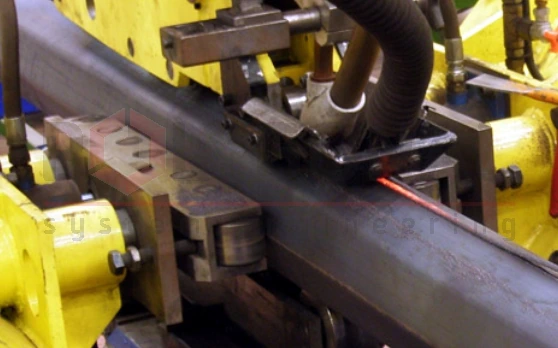
The lifter’s gripper puts the pole on the guide device with its edges vertical, so nobody has to turn the pipe by hand. The device clamps the pole with tongs, adjusts its position when needed and carries it under the welding machine. The machine has one vertical and two inclined cylinders and a horizontal pusher. The top and side pushers are controlled by position and pressure, according to the resistance the pole puts up, which keeps the geometry accurate and prevents deformation.
Automatic “levelling of the pipe” during welding is done by a high-frequency induction heating system with no open flame. Welding can start from the top of the pole or from the base. The machine welds conical and pyramidal poles with a continuous seam and the required fusion, and even with full penetration; a feed system running at constant speed keeps the weld uniform.
The automatic machine takes poles up to 650 mm in diameter. Larger pipes are made from two blanks and welded on another machine, because of the coil sizes available on the market and the way the plate is nested.
Pole production lines
Welding machine for poles up to Ø1250 mm
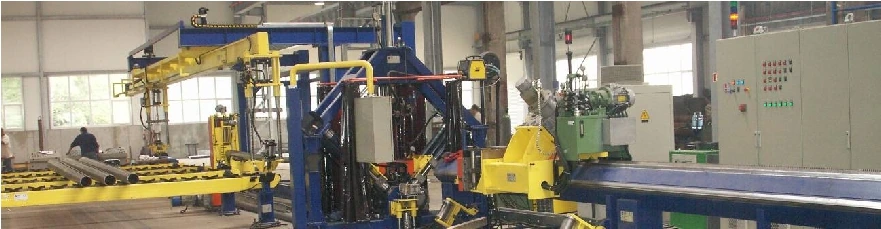
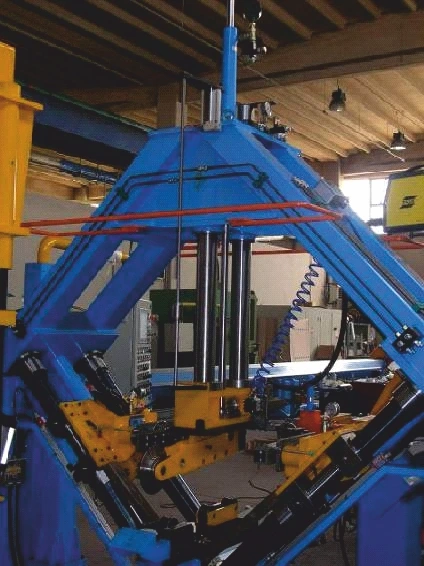
On conveyors and accumulation tables, poles go from the press brake to the welding machine automatically. Machine data: 2 operators for poles made of two shells and 1 for single-seam ones; pole length 4000–16000 mm; plate thickness 3–8 mm; minimum diameter 90 mm (single-seam) or 190 mm (two-seam); maximum diameter 1250 mm; section polygonal or circular; taper up to 25%; MIG-MAG welding; power supply 380 V, 50 Hz; hydraulic working pressure 150 bar, pneumatic 8 bar.
On a multi-sided power line pole or telecom tower up to 8 mm thick inclusive, the machine welds two seams, left and right, at once in a single pass. At 10 to 12 mm it assembles the two shells and welds only the root (a third clamping device is compulsory). Full penetration then takes a second pass with the seam vertical, made outside this line.
Two blanks are assembled automatically in about 30 seconds. Welding is horizontal and both seams are made together, so the pole does not need to be turned over. The machine welds a pipe of any diameter, from the top or from the base, and also accepts blanks with a minimum top diameter of 150 mm and single-seam poles.
Pole production lines
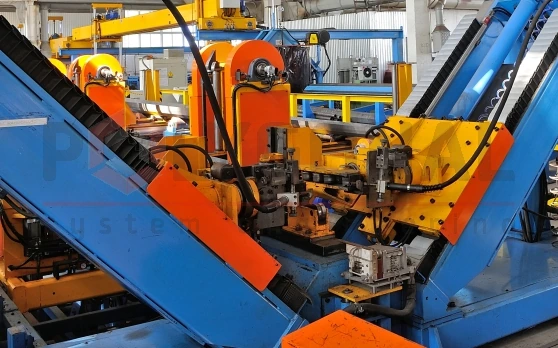
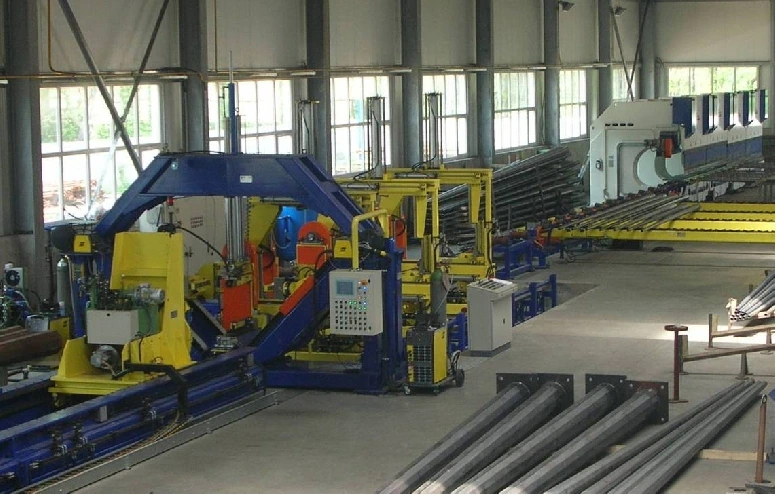
Welding line for poles up to Ø2900 mm from three and four blanks
We offer a line for making multi-sided poles from three and four blanks, with automatic assembly and welding to full penetration. It is meant for conical and multi-sided poles, mainly power line poles and telecom towers. Diameter goes up to 2900 mm, and welding can start from the top of the pole or from the bottom. The line is a group of four welding machines; on each of them assembly and welding follow one another.
Poles from 1000 to 2900 mm in diameter and 12–30 mm thick are made from several blanks, because of the thickness, the weight and the plate sizes available on the market. Splitting into 4 blanks suits both transport and nesting of the plate. The assembly system needs no overhead crane or special tools, so operations go faster and are safer.
Line data: pole diameter 1200 to 2900 mm; length 6.5–12.5 m; plate thickness up to 32 mm; any taper; automatic assembly and butting of the blanks, with no human involvement; butting tolerance about ±0.3 mm; “top-bottom” welding, from the top of the pole or from the base; MIG/MAG/SAW for thick plate. Side pressure is variable and depends on the pole’s resistance (diameter and thickness): the machine calculates the acting force and adjusts it so that the joint is made without distorting the shape.
One operator runs the line, setting the pole length, top and bottom diameter and thickness, and monitoring the process.
Updated:
Welding lines for multi-sided poles: frequently asked questions
How many poles does the accumulation conveyor hold?
5 to 23, depending on diameter. While there is a buffer, the welding machine keeps working without loss of output, even when the press is switched off.
Why is a pole above Ø1250 mm made from several blanks?
Because of the thickness, the weight and the plate sizes on the market. For Ø1200–2900 mm, splitting the pole into 4 blanks makes both transport and nesting easier.
Can the machine weld both seams in one pass on poles up to Ø1250 mm?
Yes, up to 8 mm thick inclusive: the left and right seams are welded together. At 10–12 mm the machine first welds only the root, and full penetration takes a second pass.
Related products: Multi-sided pole production lines · Presses
More on this topic: Trapezoid Cutting Line and Blank Positioning · Seamless Pole Line and Robotic Cell · How to Launch Multi-sided Pole Production: Equipment, Workshop, Staff
Get a quote for your requirements
Send us your requirements — we will calculate the price and lead time.