
Home / Equipment & engineering / Multi-sided pole production lines / Trapezoid Cutting Line and Blank Positioning
Multi-sided pole production lines
Trapezoid Cutting Line and Blank Positioning
How blanks for multi-sided poles are prepared: cutting coil steel into trapezoids, slitting coils and automatic positioning and marking before bending.
Contents
The trapezoid cutting line
The line cuts coil steel into flat trapezoid sheets, which are then bent on a hydraulic press as part of lighting pole production. Coils of various widths and thicknesses go in, levelled trapezoids come out.
Main parameters:
- strip thickness 3 to 8 mm, strip width up to 2100 mm;
- plate length 4000–16000 mm;
- output: 1 trapezoid a minute;
- material: hot-rolled steel, yield strength 350 N/mm², maximum tensile strength 500 N/mm²;
- power supply 380 V, 50 Hz, three-phase;
- cutting tolerances: length Lmax ±3 mm, bases Bmax and bmin ±1 mm; maximum edge curvature of the blank G = L/3000;
- a crew of two: one operator at the controls, one loading coils and unloading the bundles of trapezoids.
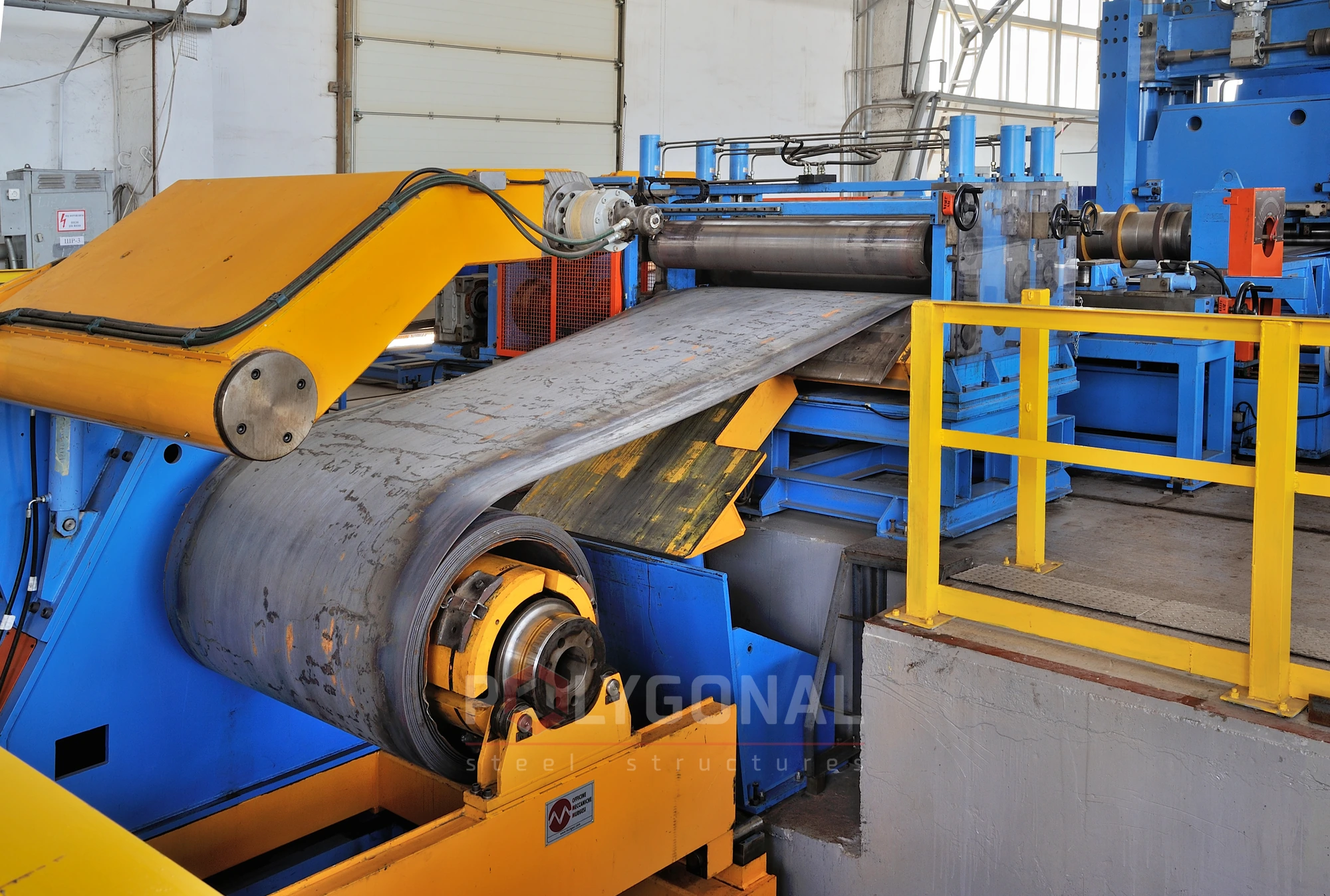
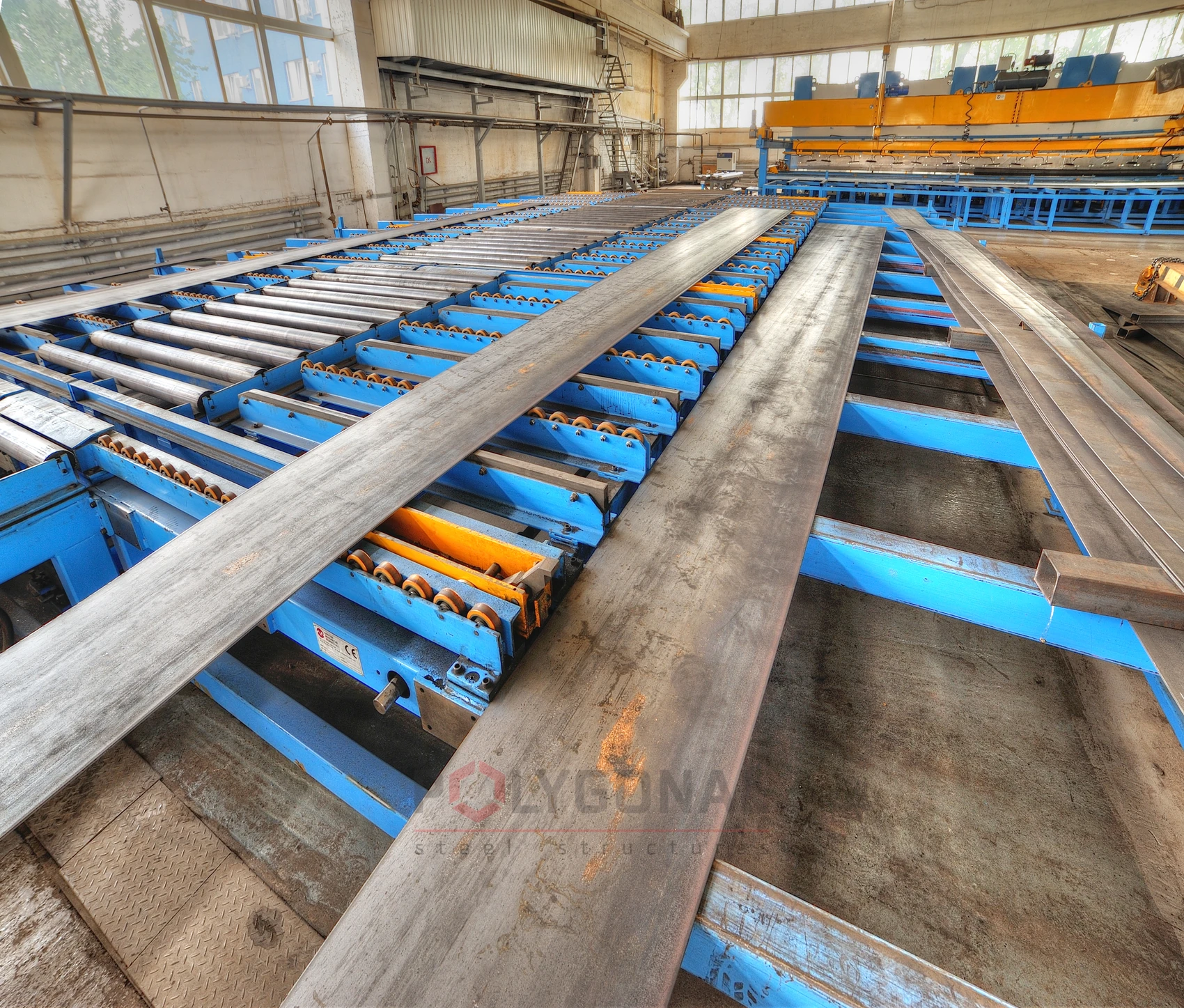
The coil goes onto the loading support car, which feeds it to the uncoiler. A pressure roller keeps the coil from opening up on its own, and a wedge table slides under the strip and guides it to the first pair of drive rolls of the leveller. Next to the pull rolls, a photoelectric centring device reads the position of the edges and shifts the uncoiler along two guides until the strip’s axis matches the axis of the line (coils of different thickness telescope differently).
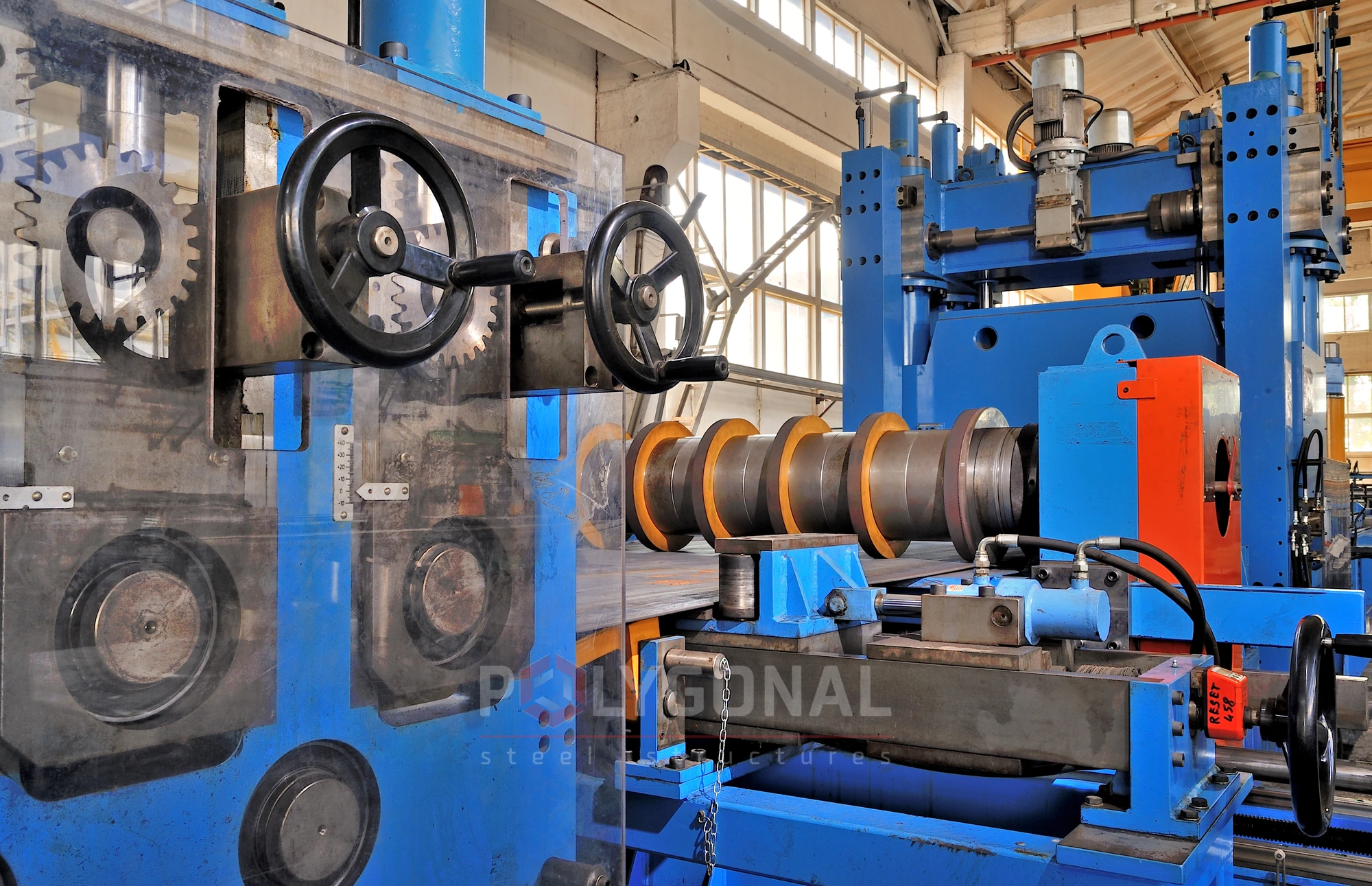
Edge trimming discs cut off the edges, and the trim goes to a scrap winder. The levelling machine flattens the strip and a hydraulic guillotine cuts it into trapezoids. The cutting angle is set by an electric drive on a graduated scale, so plate of any taper can be produced. Behind the guillotine, a roller conveyor with five centring devices delivers the plate to the next machine.
Pole production lines
The coil slitting line
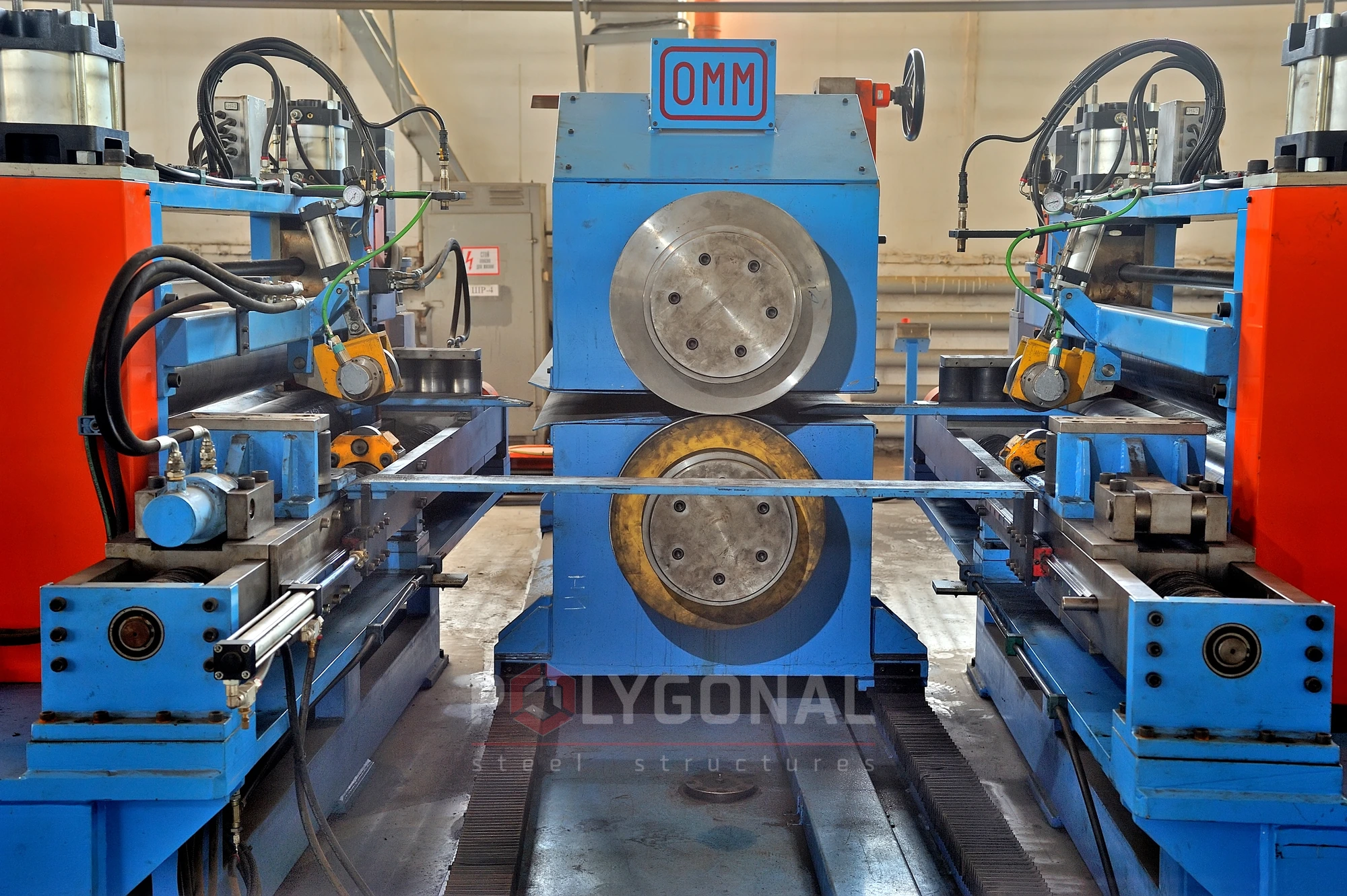
POLYGONAL offers an automatic line for slitting coil metal lengthwise, with a simple interface. The coil is loaded on a coiler-uncoiler, two hydraulic devices centre the strip, and circular (disc) shears slit it. The cutting unit is adjusted to the required coil width with a set of spacers, and the same unit trims the edges of the strip (about 10 mm). A centring device then keeps the coils winding onto the mandrel accurately. The coil steel goes on to further processing, so the strip has to be flat and the cut clean.
Main parameters: strip thickness 1.5 to 4 mm; maximum outside coil diameter 2000 mm, maximum coil weight 30 000 kg; working speed 100 m/min. One operator runs the line. It has real-time monitoring and tele-service over the internet or GSM.
The automatic workpiece positioning and marking system
A press brake with an automatic positioning and marking system takes in cut trapezoid sheets and turns out conical and pyramidal blanks bent lengthwise. One operator runs it. Sheet width is 2000–2500 mm, length 4000–16000 mm, thickness 3.0–12.0 mm, maximum weight 2400 kg (heavier sheets are moved with the plant’s overhead crane). The steel is hot-rolled, free of oxide and grease, with a yield strength of 350 N/mm² and a tensile strength of 500 N/mm². Hydraulic pressure is 150 bar, pneumatic pressure 6 bar.
The line is fully automatic. The operator only places a bundle of trapezoid sheets on the accumulation table with the chain conveyor, using a forklift or crane, and keys in the input data: sheet thickness, trapezoid length, sizes of the larger and smaller bases, number of bends.
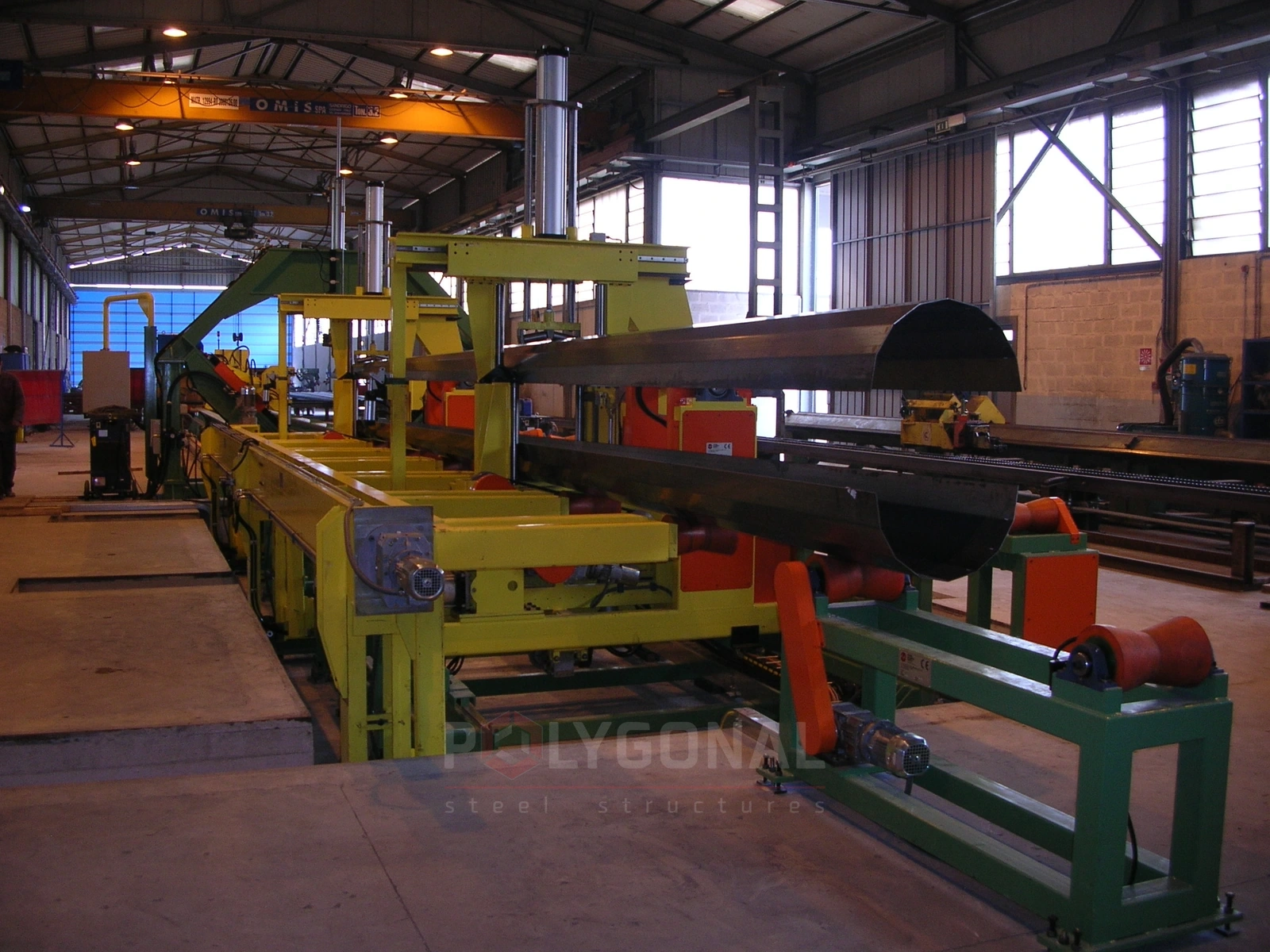
A pneumatic beam with vacuum suction cups on an overhead crane then carries the trapezoids between the accumulation, marking and positioning zones. The cups hold the sheet even in a power cut and can rotate to suit the shape of the trapezoid.
In the marking zone, centring devices align the sheet and marking devices read its size on both sides. For the number of bends set, they then apply centre-punch marks with compressed air. Before each bend, cameras read the marks and position the sheet accurately, so every bend is made from marks put on beforehand.
Checklist for choosing a cutting line
Check three parameters against your products:
- thickness: the cutting line takes strip 3–8 mm thick and marking takes sheet 3.0–12.0 mm thick; for thicker walls the configuration of the stages is agreed separately;
- width: a trapezoid is no wider than the strip (up to 2,100 mm); the maximum sheet width for marking and the press is 2,000–2,500 mm and depends on the throat: up to 2,000 mm needs a 1,250 mm throat, and for sheets up to 2,500 mm the throat is increased, so check a trapezoid wider than 2,000 mm against the press throat;
- weight: a coil on the slitting line up to 30,000 kg, a sheet at the marking stage up to 2,400 kg, and heavier sheets are moved by your shop’s overhead crane.
Common mistakes
- relying only on “one trapezoid a minute”, although the pace of the flow is set by the slowest stage;
- leaving no room for coils, bundles of trapezoids and the scrap winder.
The composition of the whole line is covered in the article on launching production.
Updated:
Cutting and positioning line: frequently asked questions
What is the output of the trapezoid cutting line?
One trapezoid per minute. The strip is 3 to 8 mm thick and up to 2100 mm wide.
How many people does it take to run the cutting line?
Two: one runs the controls, the other loads coils and unloads the trapezoid bundles.
How is a sheet marked before bending?
With centre-punch marks applied by compressed air. Marking devices read the sheet’s size on both sides, then cameras read the marks to position the sheet accurately for each bend.
What is the maximum edge curvature of a blank after cutting?
According to the rated data of the cutting line we offer, the maximum edge curvature of the blank is G = L/3000, where L is the blank length in mm. For example, 2 mm for a blank 6,000 mm long and 4 mm for one 12,000 mm long.
When is a separate slitting line needed?
When you slit wide coils into strips of the required width yourself. The line works with strip 1.5–4 mm thick, so by its rated parameters it does not suit strip thicker than 4 mm (the cutting line takes up to 8 mm). If the metal arrives at the required width, a separate slitting line is not needed.
Related products: Multi-sided pole production lines · Presses
More on this topic: Welding Lines for Multi-sided Poles · Seamless Pole Line and Robotic Cell · How to Launch Multi-sided Pole Production: Equipment, Workshop, Staff
Get a quote for your requirements
Send us your requirements — we will calculate the price and lead time.