
Home / Services / Plasma and laser cutting of sheet metal
Service · Metalworking
Plasma and Laser Cutting of sheet metal
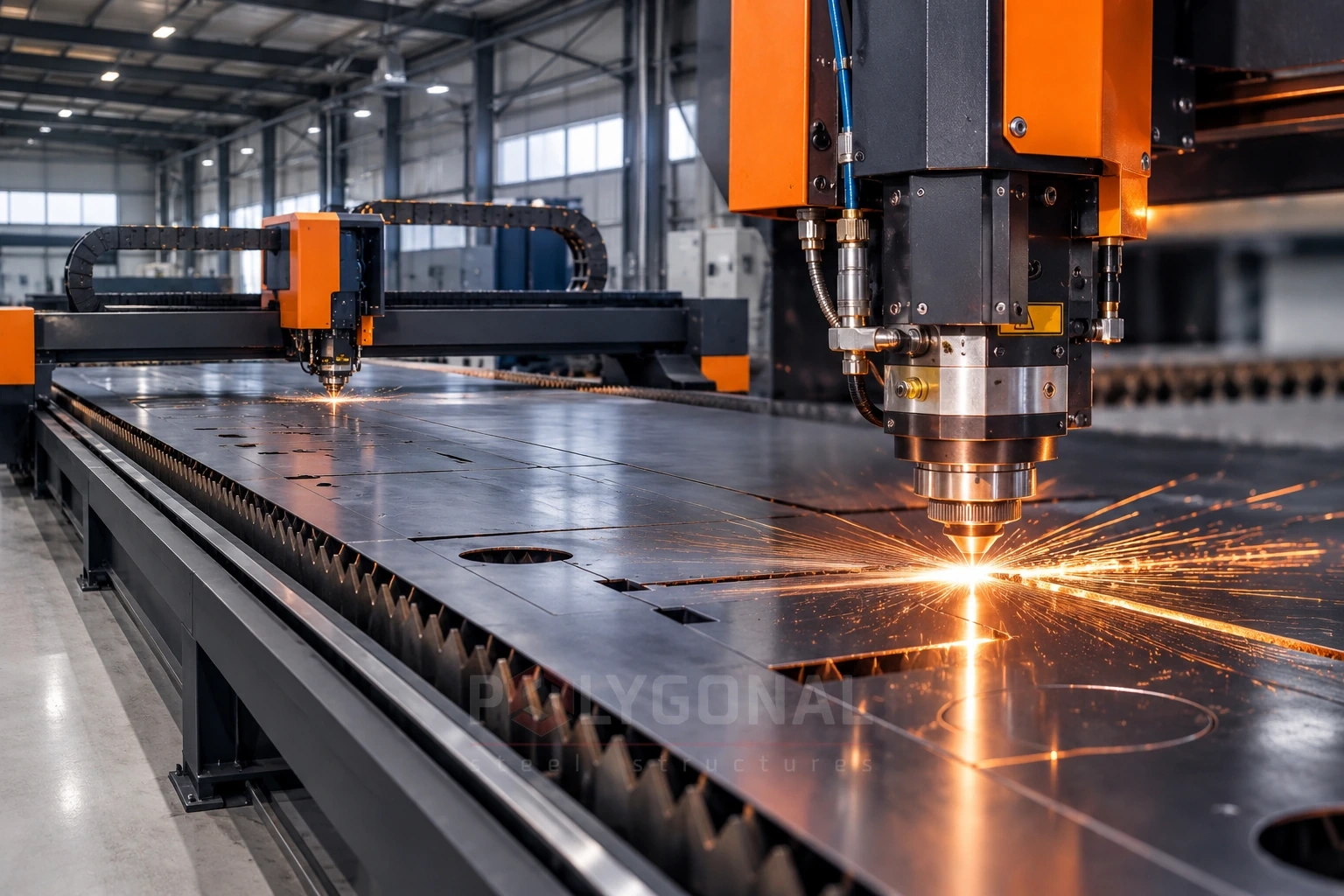
Metal cutting to order: we have a laser machine (sheets up to 2 × 12 m, 6 kW) and a plasma machine (sheets up to 2 × 6 m, 300 A power source) for cutting sheet steel. We help you choose the process and plan the next operations: bending, welding, galvanising or powder coating.
Parts that suit cutting
Typical sheet-steel parts for poles, structures and bending, and parts to the customer’s drawings.
Parts for poles and masts
Flanges, base plates, stiffeners and gussets for multi-sided poles, masts and gantries.
Blanks for bending
Sheet blanks of the required shape and size for bending on a press.
Parts for steel structures
Elements of frames, platforms and ladders that are later welded into a structure.
Parts to the customer’s drawings
Flat sheet-steel parts cut to your drawing or sketch: with holes, slots and cut-outs.
Why order cutting from POLYGONAL
Plasma and laser
Two technologies in one company: we pick the one that suits the thickness, outline and edge requirements.
From sheet to coating
Cut parts can be bent on a press, welded, galvanised in our own bath or powder coated: one contractor for the whole chain.
Galvanising know-how
We know what galvanising requires of a part, so at the design stage we point out where vent holes and clipped corners are needed.
KM and KMD drawings
If there is no drawing, we develop KM and KMD drawings to order.
Sheets up to 2 × 12 m
The laser cuts sheets up to 2 × 12 m, the plasma machine up to 2 × 6 m.
Parts for poles and masts
Flanges, base plates, stiffeners and gussets for multi-sided poles, masts and gantries.
Plasma and laser
Sheet steel cutting
Our machines and a comparison of the processes
Our machines
| Parameter | Plasma cutting | Laser cutting |
|---|---|---|
| Maximum sheet size | 2 × 6 m | 2 × 12 m |
| Power or source current | 300 A source | 6 kW |
Plasma and laser cutting compared
These are general differences: the result also depends on the machine type, the gas and the cutting parameters.
| Criterion | Plasma cutting | Laser cutting |
|---|---|---|
| Sheet thickness | From thin to very thick; at its best on thick plate | Best on thin and medium sheet; the limit depends on power |
| Edge and accuracy | Wider kerf, looser tolerances, a bevel and a rounded top edge are possible | Narrow kerf, higher accuracy, a smoother edge close to a right angle |
| Heat-affected zone | Noticeable; thin sheets tend to warp | Narrow; less distortion, especially on thin sheet |
| Small features | Small holes and narrow bridges come out worse; a hole may be tapered | Small holes, narrow slots, complex outlines |
| Cost | Usually more economical for thick plate and simple outlines | Usually more economical for thin and medium sheet and complex outlines |
We confirm the maximum thickness and the tolerances for your material when pricing.
Plasma and laser cutting: choosing the process and preparing parts
How does plasma metal cutting differ from laser cutting of sheet?
In a plasma torch an electric arc turns a stream of gas into plasma: it melts the steel, and the jet blows the melt out of the cut. Only electrically conductive materials can be cut this way, steel included.
In laser cutting a focused beam melts the metal along a narrow line, and an assist gas blows the melt away. The cut is narrower and the heat-affected zone is smaller. With oxygen the metal also burns and the edge keeps oxides; nitrogen leaves the edge oxide-free. The table below compares them.
Which process should you choose for your part?
- thick plate: usually plasma, because it is economical at large thicknesses and accurate enough for most such parts;
- thin and medium sheet, a complex outline, many holes, narrow slots: usually laser, because the cut is narrower, the edge is smoother and the sheet warps less;
- the edge will be painted, galvanised or welded: say so in the enquiry, because the cutting parameters decide whether an oxide film stays on the edge;
- both would do: we compare accuracy, edge condition and cost and recommend the better one.
What should you include in a cutting enquiry?
- a drawing of the outlines, best in DXF or DWG at a scale of 1:1 without extra lines, or a sketch with dimensions and hole diameters;
- the size of the sheet or blank (maximum: laser 2 × 12 m, plasma 2 × 6 m);
- the steel grade, the sheet thickness and the number of parts;
- edge and accuracy requirements: critical dimensions and, if the design refers to it, the ISO 9013 cut quality class (squareness and roughness);
- what happens to the parts next: bending, welding, galvanising, powder coating;
- the desired lead time and the delivery address.
No drawings? A sketch is enough, and structural (KM) and detail (KMD) drawings can be ordered from us: Steel structure design.
How should parts be prepared if they will be galvanised after cutting?
So that pre-treatment solutions, air and zinc can flow through the part, prepare cut parts by these rules:
- finish the edge: after thermal cutting the steel in the heated zone can harden and change composition, and oxide forms on the edge, so the zinc layer comes out thin or poorly bonded; bring the edge to clean metal and break sharp edges;
- crop the corners of stiffeners and gussets, and where that is impossible, put a hole as close to the corner as possible: air escapes and zinc drains;
- in plates and flanges that close a hollow section, provide holes for air and zinc;
- size bolt holes with the coating in mind: zinc reduces the diameter, so agree the size and tolerance before cutting;
- avoid narrow gaps between overlapping parts; vent hole sizes and lap-joint rules are in the article Designing for hot-dip galvanising.
What happens to the parts after cutting?
- edge preparation: slag and burrs should be removed after cutting and, before painting or galvanising, the oxide film too: after oxygen cutting it can adhere poorly, and paint or powder flakes off with it;
- bending: we bend sheet up to 25 mm thick and up to 12 m long on a 2000 t press, more in Sheet metal bending; dress edge defects in the bend zone before bending, since they can start a crack;
- welding: the parts are assembled into units and structures, see Steel fabrication;
- hot-dip galvanising in our own bath of 13,000 × 1,600 × 3,200 mm: Hot-dip galvanising;
- powder coating: the parts are degreased and prepared, the powder is applied and baked; sharp edges take a thinner coat, so they should be rounded off.
If a part is galvanised and then painted (a duplex system), say so in the enquiry: surface preparation is agreed separately.
Sheet steel cutting: frequently asked questions
How does plasma cutting differ from laser cutting?
Plasma melts the metal with an electric arc, laser with a focused beam. Laser gives a narrower kerf and a smoother edge, while plasma suits thick plate.
What sheet thickness and size can you cut?
The maximum sheet size is 2 × 12 m on the laser and 2 × 6 m on the plasma machine. We confirm the maximum thickness, which depends on the process and the steel grade, for your order: send a sketch with the thickness and sheet size.
What should I send for a cutting quotation?
A drawing of the outlines (best in DXF or DWG) or a sketch with dimensions, the steel grade, the thickness, the quantity and the edge requirements.
Can the parts be bent, galvanised or painted after cutting?
Yes. We bend sheet on a 2000 t press, galvanise in our own 13,000 × 1,600 × 3,200 mm bath and offer powder coating.
Does the edge need finishing after cutting?
It depends on the next operations. Before galvanising and painting the edge should be brought to clean metal and sharp edges broken, because it can carry a hard layer and an oxide film. State your edge requirements in the enquiry.
What does the cost of cutting depend on?
On the thickness and steel grade, the length of the cut, the number of piercings and parts, the complexity of the outline and the edge requirements. We quote from your drawing.
Need parts cut from sheet?
Send a drawing or a sketch, the steel grade, the thickness and the quantity. We will suggest the process and quote the cost.