
Home / Products / Telecom masts
Product · Telecom
Telecom Towers multi-sided and lattice, up to 70 m
We design and manufacture steel load-bearing structures based on bent multi-sided shafts: antenna poles, towers and masts for cellular base station equipment (what people usually call cell towers). Installation is carried out by a licensed construction partner company.
Types of telecom and cell towers
We design each tower individually for the coverage area and the operator’s needs.
Multi-sided telecom towers
Cellular towers up to 70 m high with an equipment platform.
Combined towers
With lighting fixtures, video equipment, lightning rods and lightning protection cables; can also serve as catenary supports.
Tower installation
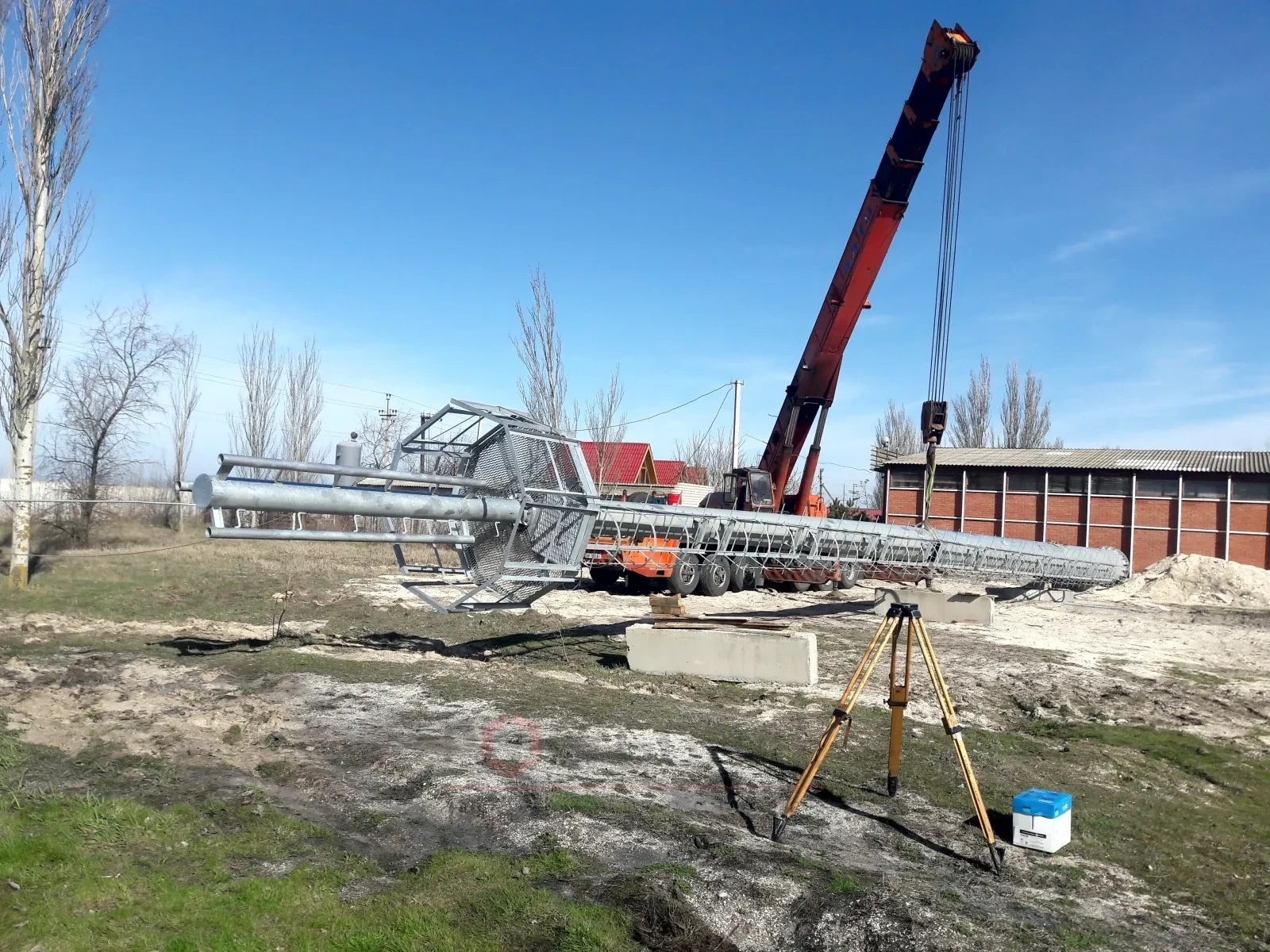
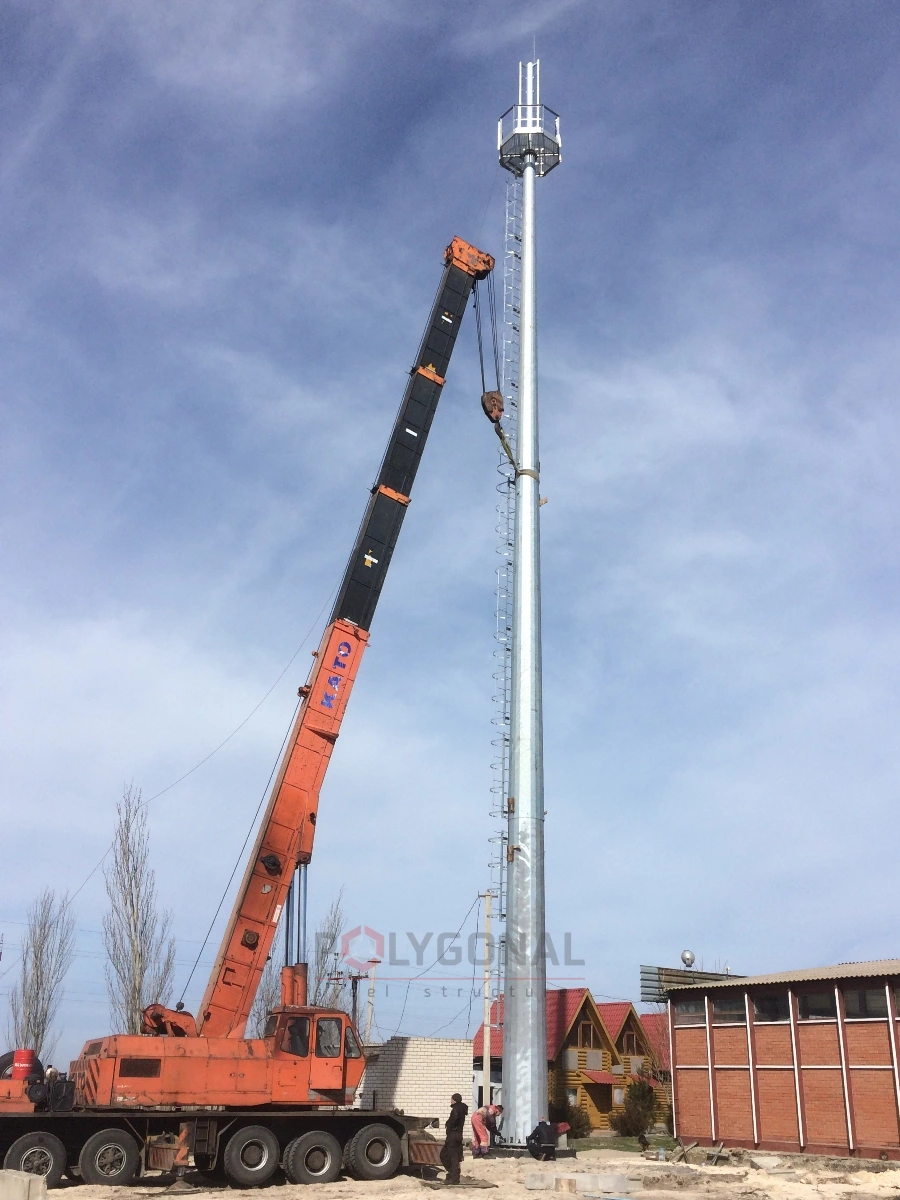
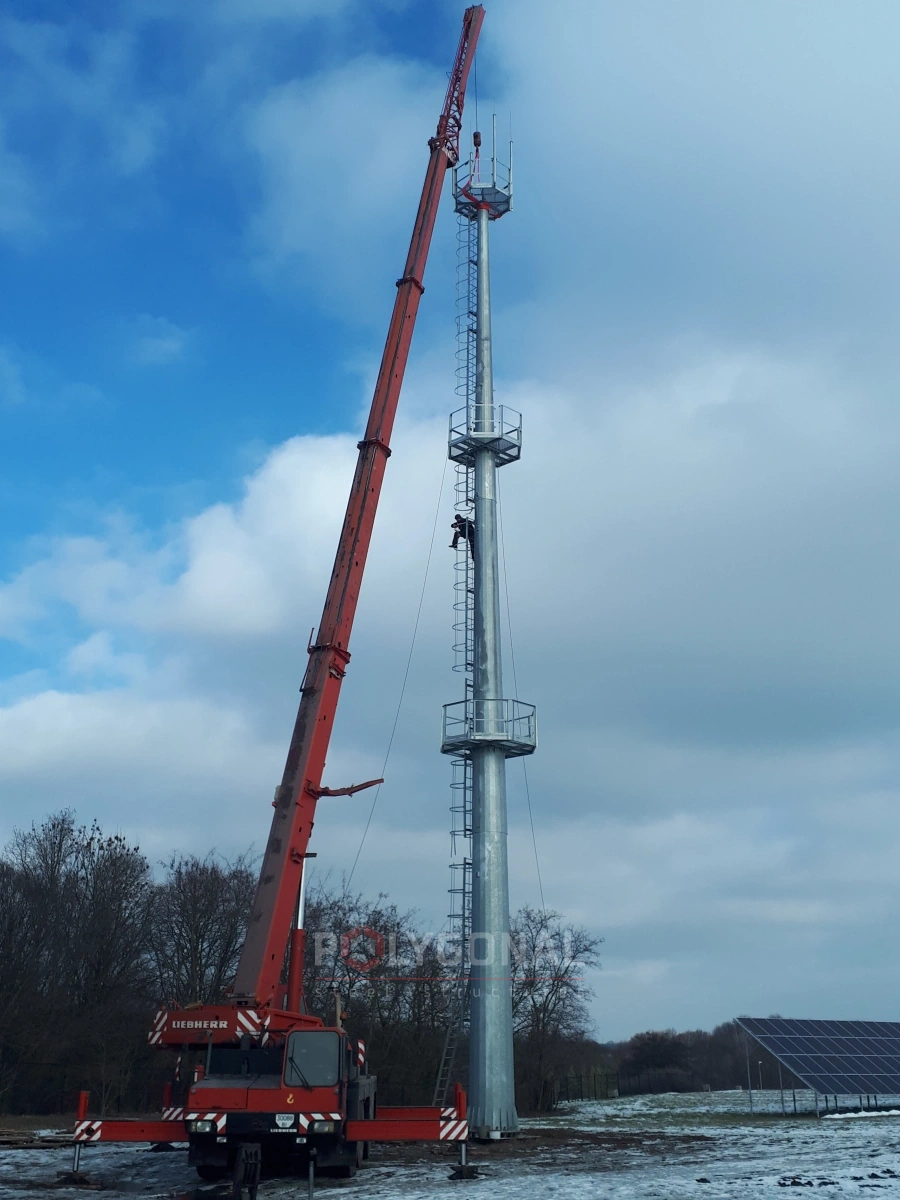
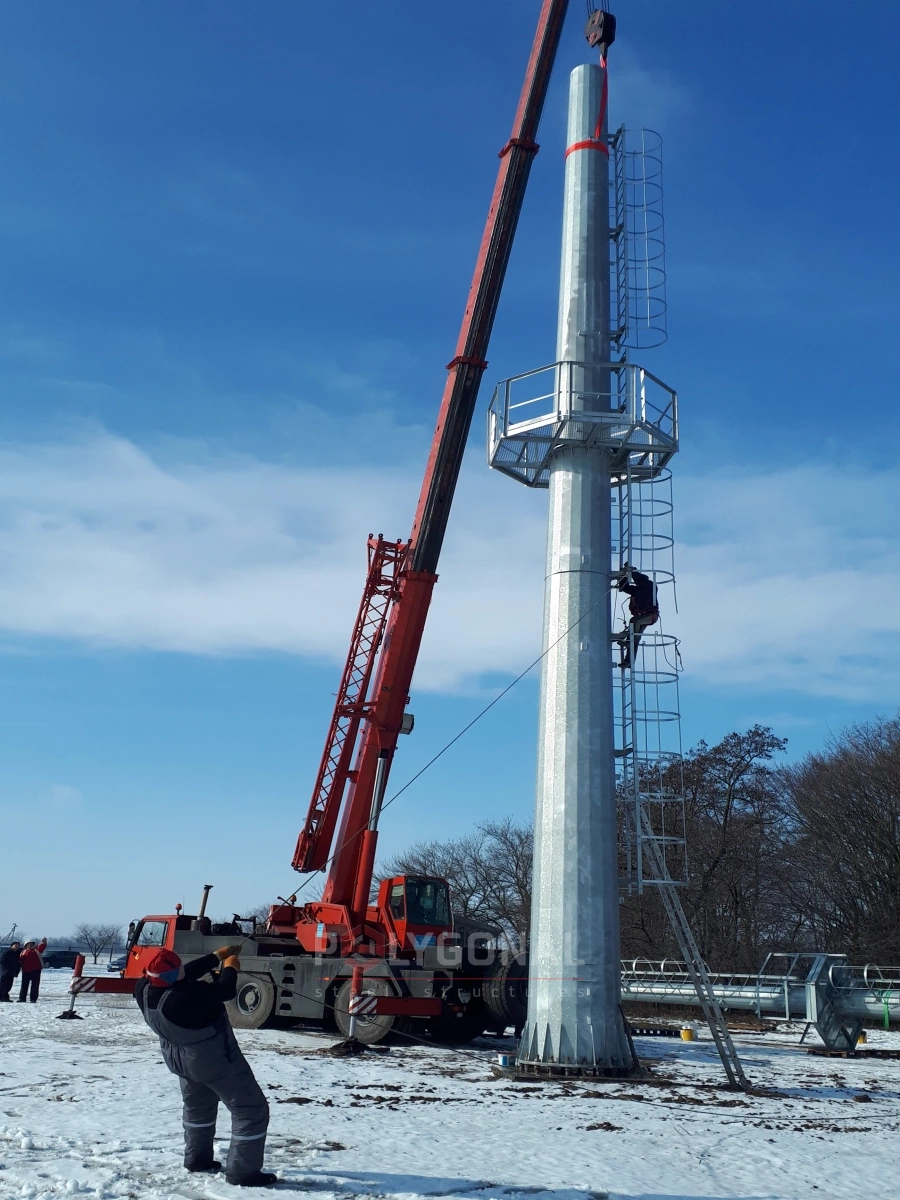
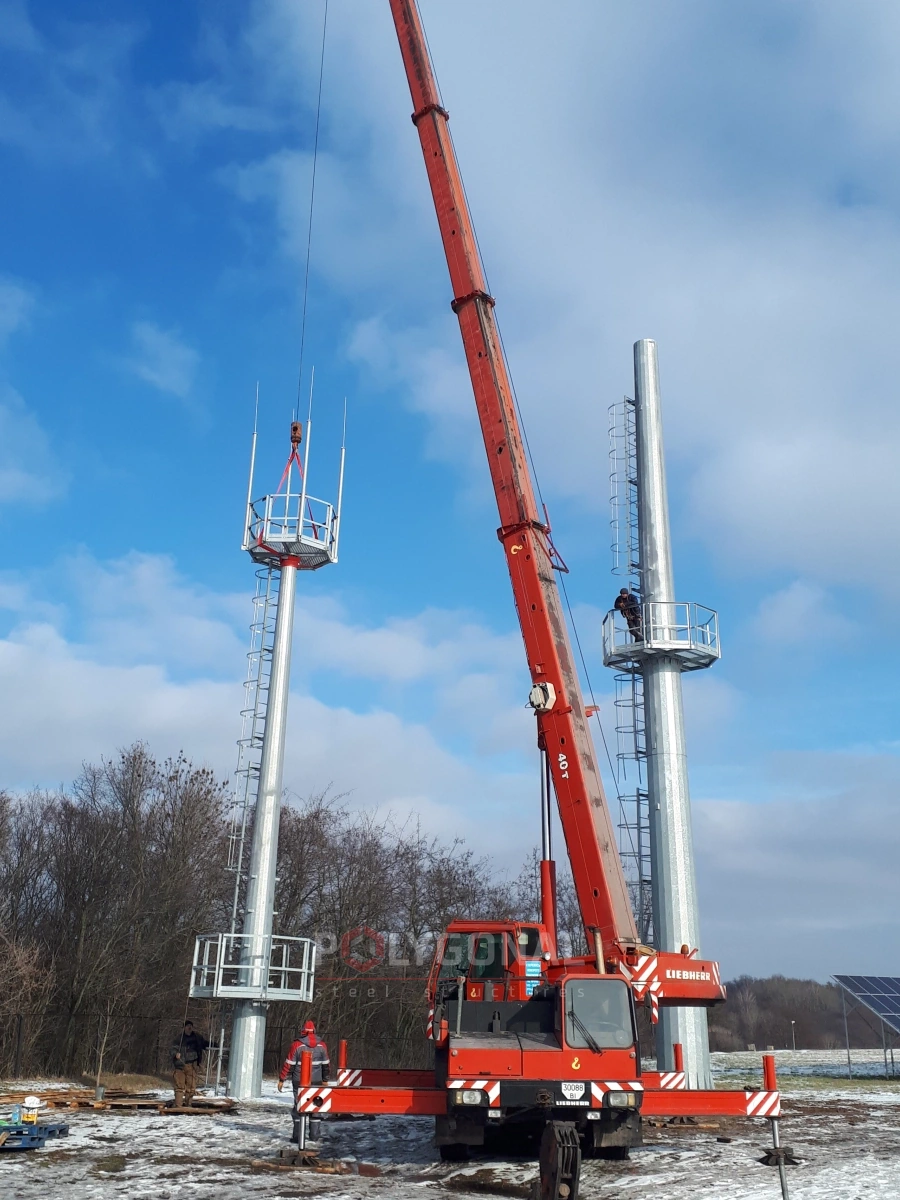
A licensed construction partner company installs towers in sections or from the horizontal position, including in mountains and dense urban areas.
Advantages of multi-sided telecom towers
Individual approach
Designed to current standards and your specification; we help you choose the tower type.
Easy servicing
Rest platforms every 10 m with a lockable hatch, ladders with guards and an anti-vandal hatch at the start of the ladder.
Fast installation
Installation in large sections, by extension in the vertical position or as a whole from the horizontal position.
All of Ukraine
A licensed construction partner company erects the tower at the address you specify anywhere in the country.
Up to 70 m
Multi-sided cellular towers up to 70 m high with an equipment platform.
Combined towers
A tower can carry lighting fixtures, video equipment, lightning rods and lightning protection cables.
Rest platforms every 10 m
A lockable hatch and a caged ladder
Types of Telecom Towers: Dimensions and Range of Use
Polygonal cellular communications towers and combined 3G towers. Symbols: H is pole height; ∅a top diameter; ∅b bottom diameter; W and v the height and width of the hatch; Wp the distance from the hatch to the base; B the centre-to-centre distance between the holes of the base flange; n×d the number and diameter of the anchors; N the axial force at the base of the pole; M the design moment at the base.
Polygonal cellular communications towers: pole dimensions
| H, m | ∅a, mm | ∅b, mm | W, mm | v, mm | Wp, mm | B, mm | n×d |
|---|---|---|---|---|---|---|---|
| 25 | 300 | 820 | — | — | — | 930 | 20×М36 |
| 30 | 350 | 730 | 995 | 220 | 500 | 840 | 12×М36 |
| 30 | 300 | 920 | — | — | — | 1030 | 20×М36 |
| 35 | 400 | 920 | — | — | — | 1040 | 20×М42 |
| 40 | 400 | 1100 | — | — | — | 1230 | 20×М42 |
Polygonal cellular communications towers: range of use
The 400–600 Pa columns give the maximum equipment area (m²) in the corresponding wind zone.
| H, m | Equipment mass, kg | N, kN | M, kN·m | 400 Pa, m² | 450 Pa, m² | 500 Pa, m² | 550 Pa, m² | 600 Pa, m² |
|---|---|---|---|---|---|---|---|---|
| 25 | 340 | 52 | 840 | 3.4 | 2.9 | 2.4 | 1.9 | 1.4 |
| 30 | 200 | 35 | 346 | 3.0 | 2.5 | 2.0 | 1.5 | 1.0 |
| 30 | 320 | 65 | 1113 | 3.2 | 2.7 | 2.2 | 1.7 | 1.2 |
| 35 | 300 | 68 | 940 | 3.0 | 2.5 | 2.0 | 1.5 | 1.0 |
| 40 | 300 | 70 | 1203 | 2.8 | 2.3 | 1.8 | 1.3 | 0.8 |
Combined 3G cellular towers: pole dimensions
| H, m | ∅a, mm | ∅b, mm | W, mm | v, mm | Wp, mm | B, mm | n×d |
|---|---|---|---|---|---|---|---|
| 8 | 200 | 500 | 500 | 120 | 500 | 620 | 12×М27 |
| 8 | 240 | 600 | 500 | 120 | 500 | 720 | 12×М30 |
| 12 | 220 | 560 | 700 | 140 | 500 | 700 | 16×М27 |
| 12 | 260 | 660 | 700 | 140 | 500 | 800 | 13×М33 |
| 27 | 300 | 1020 | 700 | 180 | 500 | 1140 | 20×М30 |
| 27 | 320 | 1100 | 700 | 180 | 500 | 1220 | 20×М36 |
Combined 3G towers: range of use
For all sizes: wind pressure 400–600 Pa, terrain type 1, seismicity up to 9. The towers can also serve as contact-network poles.
| H, m | Contact-network pull P, kg | Equipment mass, kg | N, kN | M, kN·m |
|---|---|---|---|---|
| 8 | — | 240 | 12.8 | 84 |
| 8 | 2500 | 240 | 12.8 | 284 |
| 12 | — | 270 | 25.8 | 164 |
| 12 | 2500 | 270 | 25.8 | 464 |
| 27 | — | 300 | 46.8 | 730 |
| 27 | 2500 | 300 | 46.8 | 1030 |
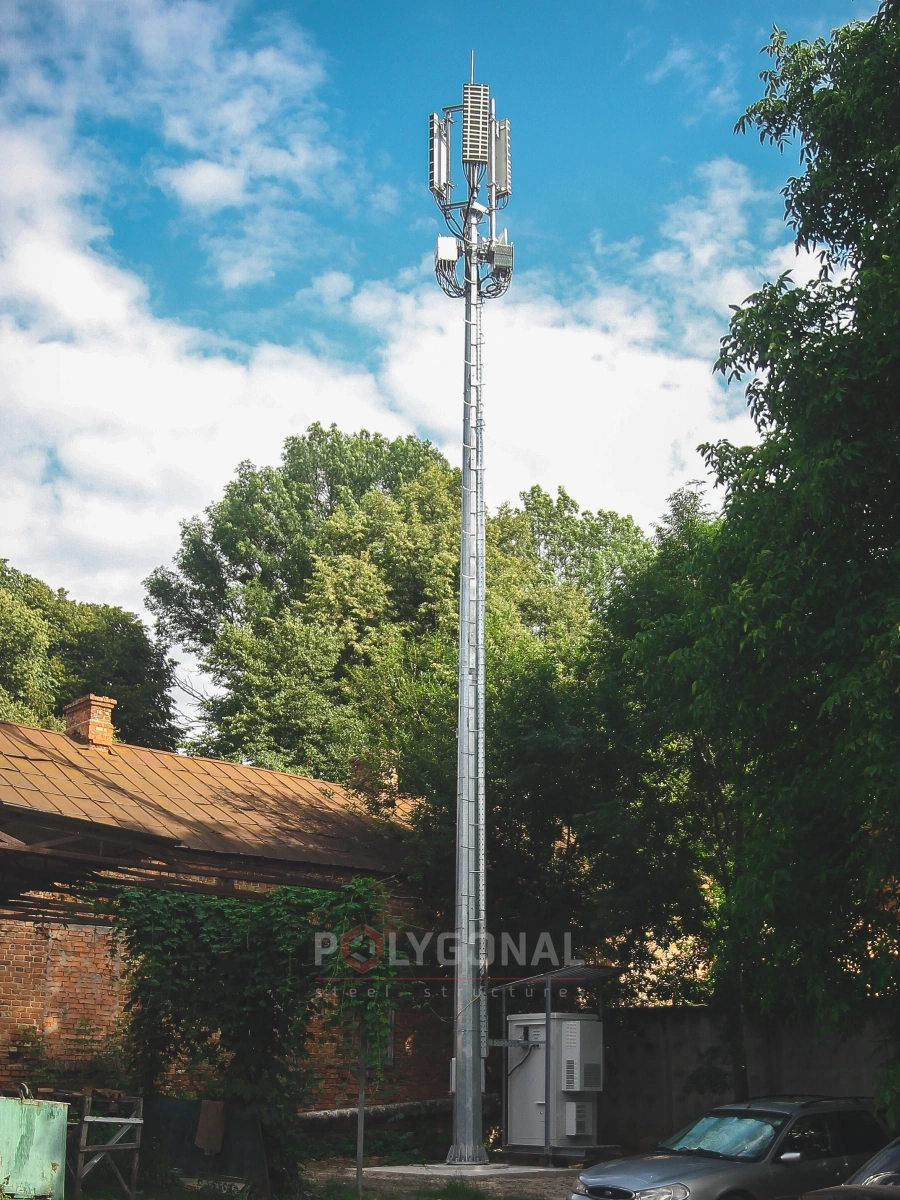
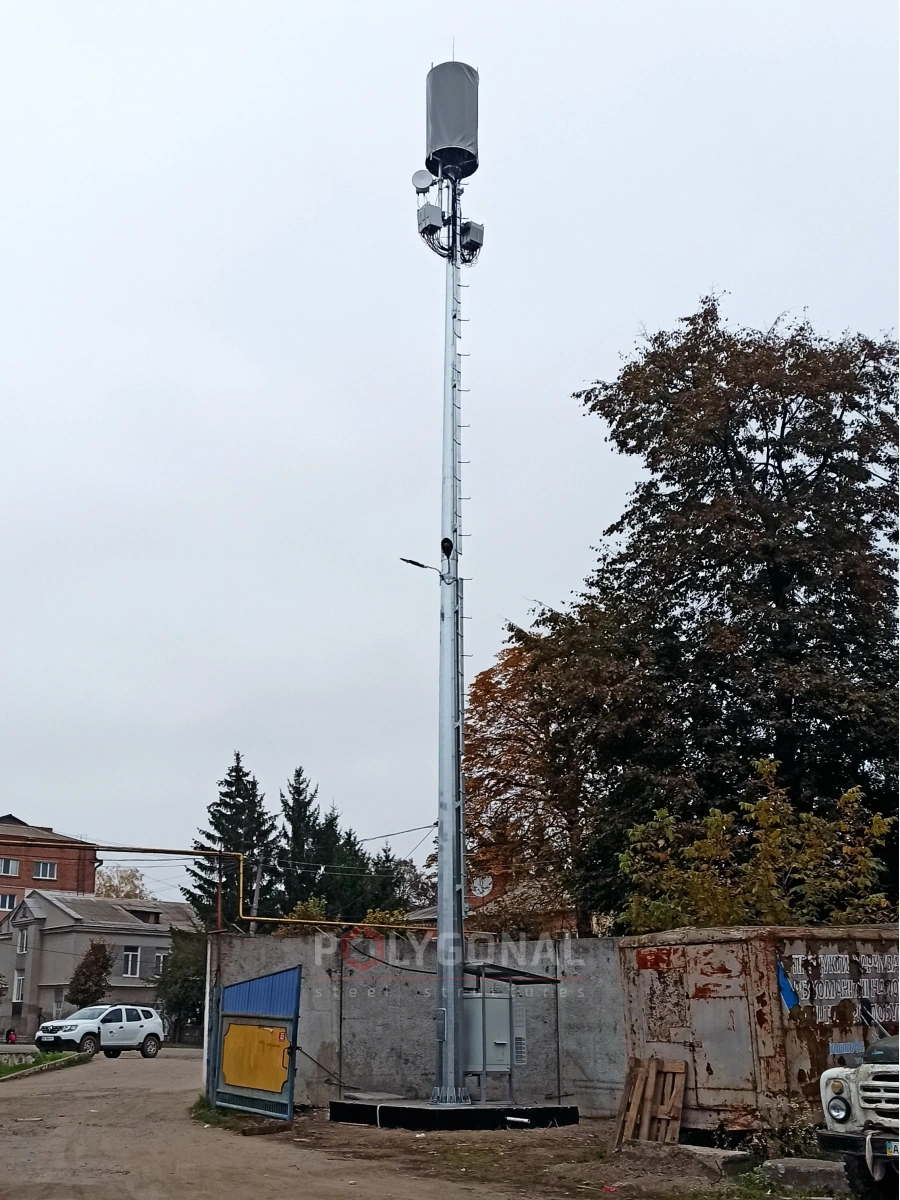
Examples of completed projects
Advanced telecommunications solutionsCustom innovative poles for reliable communication
Send the equipment parameters and the wind region, and we will propose a size and the lead time.
Request a quoteInstallation process
Telecom masts: technical specifications
Tower equipment
Towers can be designed up to 70 m high. The standard set includes:
- an equipment platform
- rest platforms every 10 m with a lockable hatch
- a ladder with a guard for servicing and an anti-vandal hatch at the start of the ladder
Installation
The tower can be erected in large sections built up vertically, or raised whole from a horizontal position — in mountainous terrain, in densely populated areas, on industrial sites with dense buildings and at existing sports facilities.
Why bent multi-sided shafts
Bent multi-sided shafts were first used for power line poles and later also for telecom towers.
Foundations
The structure is fixed to a foundation through a flange with an embedded part or set in the ground; the foundation type depends on the soil and the loads. More in the article Foundations for masts, towers and power line poles.
What determines the price of a telecom tower
We calculate the price for a specific tower. It depends on:
- tower height (up to 70 m) and type of structure;
- number, weight and area of antennas, number of operators;
- wind region and location;
- platforms, ladders, lighting and lightning protection;
- foundation, coating, installation (its cost is calculated separately each time; installation is carried out by a licensed construction partner company).
How to order a telecom tower
- Send the technical specification form for a telecom tower (at the bottom of the page) or the initial data: height, list of antennas, location.
- We propose a design and agree the loads.
- We calculate the price and lead time and manufacture; if needed, installation is carried out by a licensed construction partner company.
What a cell tower is and what types there are
A cell tower, or telecom tower, is a tall steel structure that holds the antennas of a mobile base station at the height they need; the operator puts the equipment in a cabinet or shelter at the foot of the tower or on its equipment platform. The tower is calculated for the loads from antennas, wind and ice, and the sway of its top must stay within what the radio equipment tolerates.
By structure, cell towers come in three types. A multi-sided tower (monopole) is a single bent shaft made of sections on one foundation: it takes up little ground, so it suits a tight plot and built-up areas. A lattice tower (antenna mast) is a three-dimensional framework of legs and bracing on a wide base; our range is on the page Antenna Masts. A guyed mast is a slim shaft that needs free ground around it. On a tight plot with a tower up to 40 m, start with a multi-sided one; for taller towers and many antennas, compare it with a lattice tower. How the types differ is explained in Telecom Tower Types: Multi-sided, Lattice, Guyed Masts.
How tall is a mobile network tower and what decides it
The height is set not by the coverage radius but by the antenna centre heights from the operator’s radio planning. Above the top antenna the design leaves room for a lightning rod and obstruction lights. A selection usually starts from our standard ranges:
- up to 25 m: a 25 m multi-sided tower, combined 3G towers of 8 and 12 m;
- 27–45 m: a combined 3G tower of 27 m, multi-sided towers of 30, 35 and 40 m, lattice antenna masts from AO-29 to AO-42.5;
- 50–70 m: an individual multi-sided tower design, or a lattice antenna mast from the AO series.
These are guide figures; other heights are made to the technical specification, and the calculation sets the final height, sections and foundation. What height depends on (coverage zone, terrain, obstacles, number of operators) is covered in Height of a Telecom Mast or Tower: How to Determine It and Choose the Structure.
What goes into the design of a telecom tower
A tower is designed for a specific plot and its equipment. The main loads are wind (which depends on the wind region and the height), ice, and the self-weight of the structure and equipment. The design needs the number of antennas and the weight, area and mounting height of each, because these set the base moment and the sway of the top. Wind pressure W0 for regional centres is in the article Wind Regions of Ukraine.
Besides the loads, the design fixes a reserve for the next operator (a spare level and a load-bearing margin), the soils and foundation type (a geotechnical survey is needed; see the Foundations section and the article Design of Telecom Towers and Antenna Masts), the plot size, seismicity, marking and approvals under current aviation regulations, and the crane access that decides the installation method.
Articles about telecom masts
Design of Telecom Towers and Antenna Masts
Polygonal antenna poles, towers and masts for cellular communications, together with their foundations, are designed for the specific conditions. Here is what source data is needed, what features the structure has and what foundations are used.
Height of a Telecom Mast or Tower: How to Determine It and Choose the Structure
Telecom tower height follows from several inputs: radio planning, terrain, antenna count and loads. We show how it is determined and which structure suits which height.
Telecom Tower Types: Multi-sided, Lattice, Guyed Masts
Cellular and radio antennas are mounted on multi-sided towers, lattice towers and masts (all of them are what people call cell towers). We compare them to help you choose a type for your site and equipment.
Questionnaire: technical assignment form
Fill in the form and email it to us: we will prepare the KM-stage design documentation from it and calculate the price. The PDF is handy to print; the DOCX can be filled in on a computer.
Technical assignment form: telecom tower (antenna pole)
A questionnaire for preparing KM-stage design documentation for a steel polygonal antenna pole. Fill it in and send it to us; we will calculate the price and lead time.
Telecom towers: frequently asked questions
What do I need to send for a price calculation?
A technical specification: height, number and weight of antennas, wind region, terrain type and location. Guide prices (incl. VAT, as of September 2026): multi-sided towers from UAH 130,000 per tonne, combined towers with lighting and video from UAH 140,000 per tonne (Multi-sided Poles: Technology, Applications, Price).
How much does a telecom tower cost?
The price depends on height, antenna loads, wind region, equipment and installation (its cost is calculated separately each time; installation is carried out by a licensed construction partner company). Send the initial data or the technical specification form and we will calculate the price and lead time.
Who installs cell towers?
A licensed construction partner company installs them anywhere in the country, while we design and manufacture the tower. The installation methods are described in the Installation section above. The foundation with the anchor cage must be ready before the installers arrive: completed, aligned and having gained its strength (the procedure is in Assembly, Erection and Installation of Multi-sided Poles, Masts and Towers).
Can another operator’s antennas be added to the tower later?
Yes, if the design has the margin: new antennas add weight, windward area and base moment, so the shaft, joints and foundation are checked first. Mention a second operator at the start so that a spare level and a reserve go into the original design.
Telecom masts: related solutions
Antenna masts
Towers and antenna masts for telecom.
Lightning protection masts and air-termination rods
Lightning protection for masts and towers.
Hot-dip galvanising
Corrosion protection by hot-dip galvanising to DSTU EN ISO 1461:2024.
Steel structure design (structural and detail drawings)
Structural and detail drawings for your structures.
Overhead power line masts
Same technology: multi-sided steel shafts with hot-dip galvanising.
Need a telecom tower?
Send us the specification: height, equipment and location. We will calculate the price and the lead time for manufacture; installation is carried out by a licensed construction partner company.