
Home / Products / Telecom masts / Telecom Tower Types: Multi-sided, Lattice, Guyed Masts
Telecom masts
Telecom Tower Types: Multi-sided, Lattice, Guyed Masts
Cellular and radio antennas are mounted on multi-sided towers, lattice towers and masts (all of them are what people call cell towers). We compare them to help you choose a type for your site and equipment.
Contents
- Main types of structures
- Comparison of tower types
- Multi-sided towers: features
- Typical heights of cellular towers
- What to consider when choosing
- How to order a telecom tower
- Choosing a tower type in four steps
- Common mistakes when choosing a tower type
- Lightning protection of a tall tower: what changes from 60 m
- Antennas, luminaires and cables on the tower
- A metal tower as a natural down-conductor
Main types of structures
- multi-sided tower (monopole): one shaft of bent steel sections with flanged or telescopic joints, a foundation under a single pole;
- lattice tower: a spatial structure of sections (three- or four-sided), a wide base;
- mast: a slim shaft (pipe or lattice), often guyed; needs a large area for the guy anchors.
Comparison of tower types
| Criterion | Multi-sided tower | Lattice tower | Guyed mast |
|---|---|---|---|
| Footprint | small: one shaft and foundation | larger: a wide base | large: guys at a considerable distance |
| Height | up to 70 m in our designs | can be taller | depends on the design |
| Installation | in sections or whole from a horizontal position | assembly of many elements | lifting and adjusting the guys |
| Look in urban areas | compact, aesthetic | bulkier | depends on conditions |
| Vandal resistance | closed profile, anti-vandal hatch | open elements | guy control needed |
| Antenna servicing | caged ladder, rest platforms | ladder along the structure | depends on the design |
Multi-sided towers: features
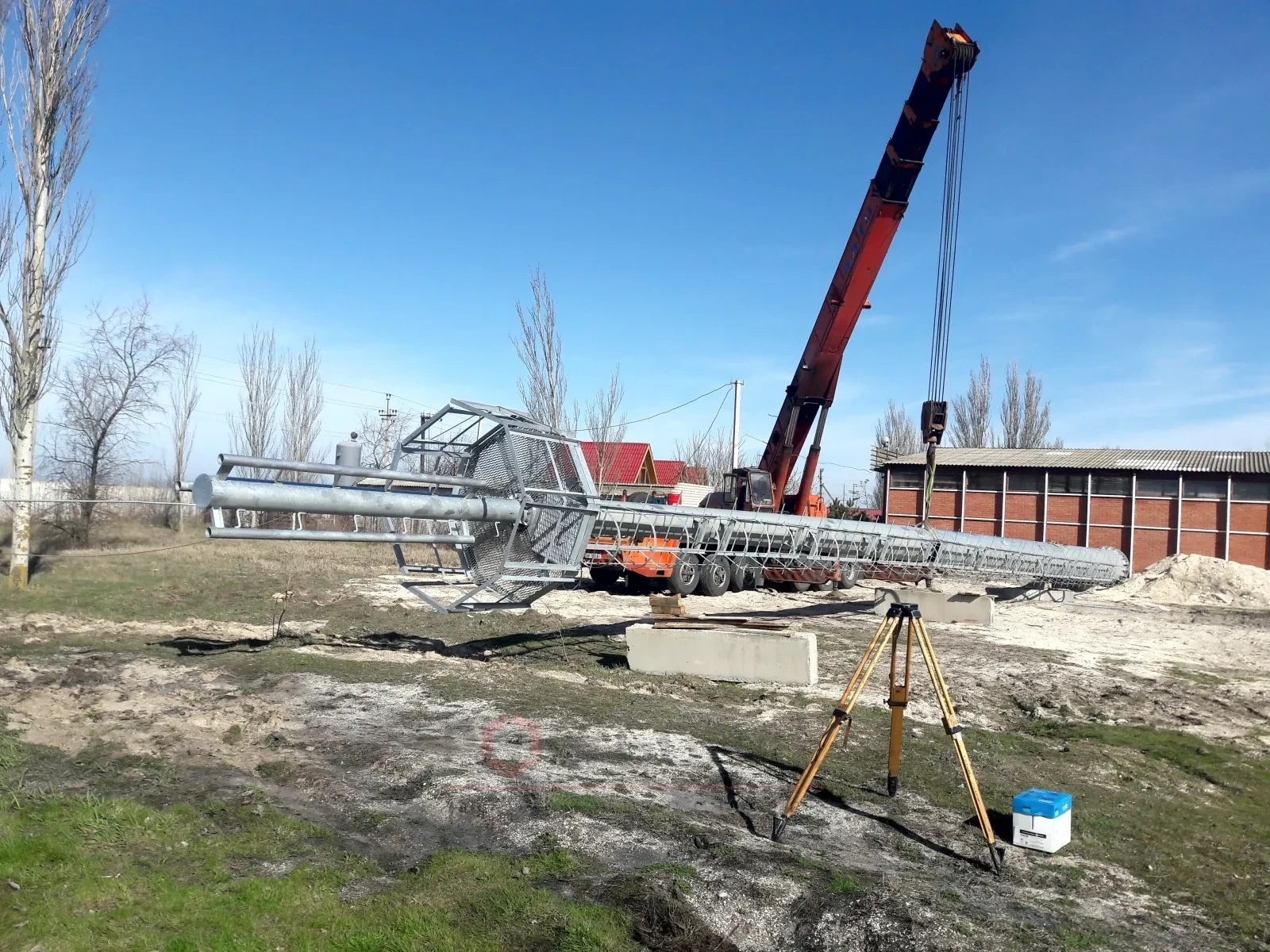
Multi-sided telecom towers are made of bent steel sections, usually up to 12 m long, convenient for transport. The sections are joined telescopically or by flanges. Standard equipment: a technological platform, rest platforms every 10 m with a lockable hatch, a caged ladder and an anti-vandal hatch. Lighting, an air-termination rod and CCTV can be added.
Installation is possible in large sections built up vertically or whole from a horizontal position: this lets towers stand in mountainous areas, in dense development and on industrial sites. More in the article Design of telecom towers.
Typical heights of cellular towers
In our range, multi-sided cellular towers are made 25, 30, 35 and 40 m tall; for smaller sites — combined 3G towers, which can also double as catenary poles — 8, 12 and 27 m. Greater heights, up to 70 m, are possible for individual projects. The required height is driven mainly by the number of operators and the mounting height their antennas need above obstacles within the coverage radius. Full pole dimensions and wind-region loads are on the Telecom Towers page.
What to consider when choosing
- the required height and number of operators: they determine the number of antennas and the load;
- the area and characteristics of the plot: is there room for a wide base or guys;
- wind region, ice, soil and foundation;
- requirements for appearance, lightning protection and lighting;
- construction and operating time and cost.
How to order a telecom tower
Send the height, the list of antennas (number, size, weight, mounting height), the location and survey results if any, or fill in the technical specification form for a telecom tower. We propose the structure and calculate the foundation, price and lead time. If needed, a licensed construction partner erects the towers across the whole country.
Choosing a tower type in four steps
| Step | What to find out | What it means |
|---|---|---|
| 1. Height and antennas | The mounting height, the number of operators, the weight and area of the antennas | Up to 40 m, consider a multi-sided tower first; above 40 m, or with many antennas, compare with a lattice one |
| 2. Site | Room for a wide base or guys | On a tight plot, one shaft on one foundation is the right fit; a roomy plot also lets a lattice tower be compared |
| 3. Access and installation | Crane access, mountainous terrain, dense development | A multi-sided tower can be erected whole from a horizontal position |
| 4. Calculation | Wind region, ice, soils | Both options are calculated and compared for foundation and lead time |
Common mistakes when choosing a tower type
- choosing by mounting height without taking the weight and area of the antennas into account: they determine the load on the shaft;
- leaving no free level for the next operator: extra antennas need a verification calculation;
- choosing a guyed mast for a tight plot: guys need room around the mast and checks of their tension.
Lightning protection of a tall tower: what changes from 60 m
DSTU EN 62305-3:2021 sets no height limit for a structure (cl. 1), but from 60 m the pattern of strikes changes. Below that mark, low-amplitude strikes to vertical side surfaces are improbable enough that they need not be considered (cl. 5.2.3.1): the top of the structure and its horizontal projections are protected to the class of lightning protection system (LPS) set by the risk assessment under EN 62305-2.
From 60 m, side strikes are possible, especially to sharp points, corners and edges (cl. 5.2.3.2). Their share is only a few percent of all flashes (Annex A, cl. A.2), but electrical and electronic equipment on outer walls can fail even from lightning with a low peak current, and on a tower the equipment is outside anyway. So the upper part gets an air-termination system: typically the top 20 % of the height, but only the part above 60 m. The system is laid out to at least lightning protection level (LPL) IV, that is, not milder than class IV, especially at corners, edges and significant projections (for example, platforms).
| Tower height | Side strikes | What is protected |
|---|---|---|
| Below 60 m | low-amplitude: not considered | the top and horizontal projections, by LPS class (cl. 5.2.3.1) |
| 60–75 m | possible | the upper part from the 60 m mark to the tip |
| Above 75 m | possible | typically the top 20 % of the height |
For a 70 m tower, 20 % of the height is 14 m, but the zone stops at 60 m, so the section from 60 to 70 m counts. Our own inference from cl. 5.2.3.2 and informative Annex E (cl. E.5.2.3).
Antennas, luminaires and cables on the tower
Antennas, luminaires and other metal equipment of the tower go inside the volume protected by the air-termination system. For the mesh method this is a direct condition (Annex A, cl. A.3 d). Informative Annex E (cl. E.5.2.4.2.5) explains why: a direct strike to a rooftop superstructure with electrical equipment can destroy it and damage the connected electronics. The annex recommends extending the rule that keeps rooftop superstructures in the protected zone to elements on vertical surfaces the rolling sphere can touch. It was written for building rooftops, so for a tower it is a principle by analogy.
Informative Annex E (cl. E.5.2.4.2.6) allows an isolated or a non-isolated external LPS for an antenna; in the non-isolated case the antenna mast is bonded to the air-termination system. The same annex (cl. E.4.2.2.2.4) advises agreeing with the antenna installers whether antenna masts and conductive cable screens are isolated from the LPS or connected to it, along with the antenna cable routes and the installation of surge protective devices (SPDs). For rooftop antennas with a non-isolated LPS the annex recommends bonding the antenna cable sheath to the air-termination system and the main bonding bar.
Power and communication lines entering the structure join the lightning equipotential bonding: conductors are connected directly or through an SPD (live conductors only through an SPD), and cable screens and metal ducts are bonded near the entry (cl. 6.2.3 and 6.2.5). Bonding the conductors of shielded lines and lines in metal ducts is not obligatory if the screen or duct cross-section is at least the minimum calculated under Annex B.
A metal tower as a natural down-conductor
A steel tower can be the down-conductor itself. Under cl. 5.3.5 a), metal structures may be used as natural down-conductors if the electrical continuity between their parts is reliable (cl. 5.5.3) and the cross-section is at least the one given in Table 6 (hot-dip galvanised steel: 50 mm²).
Joints deserve separate attention in the design. Among reliable joints cl. 5.5.3 lists welding, brazing, bolts and self-tapping screws, and advises keeping their number along a conductor to a minimum. Whether a flanged or telescopic joint gives enough contact is for the lightning protection design to decide.
Informative Annex E (cl. E.4.3.7) says bolted steel parts of a building frame may be regarded as electrically connected if the bolts are tightened as mechanical strength requires: lightning current pierces a thin coat of paint on the contact surfaces. Contact can be improved by cleaning the surfaces under bolt heads, nuts and washers. For a tower this is only an analogy. More on cl. 5.3.5, 5.5.3 and joints: A Steel Mast as Air-Termination and Down-Conductor per DSTU EN 62305-3.
Updated:
Telecom tower types: frequently asked questions
What’s better on a tight plot: a multi-sided tower or a guyed mast?
A multi-sided tower — it only needs a foundation under a single shaft, while a guyed mast needs a substantial area around it for the guy anchors.
What is the maximum height of a multi-sided telecom tower?
Up to 70 m in our range; typical heights for cellular communications are 25, 30, 35 and 40 m.
Can several operators share one tower?
Yes, the number of antennas and operators on a tower is one of the main inputs for calculating the required height and structural load.
What’s in a multi-sided tower’s standard equipment?
A technological platform, rest platforms every 10 m with a lockable hatch, a caged ladder and an anti-vandal hatch; lighting, an air-termination rod and CCTV can be added.
Which tower is less vulnerable to vandalism?
The multi-sided one — thanks to its closed profile and an anti-vandal hatch at the base, unlike the open members of a lattice structure.
Does the foundation depend on the tower type?
Yes. A multi-sided tower stands on one foundation, a lattice tower is fixed by a flange on each leg, and a guyed mast also needs guy anchors. In every case the foundation type and size are set by the soil and the load.
When should I choose a lattice tower instead of a multi-sided one?
Usually when the height is above 40 m, there are many antennas or the site is roomy: in such cases a lattice tower is compared with a multi-sided one, and calculating both options decides. The lattice lets the wind through, but the base is wider and there are many members.
Does a telecom tower need a separate air-termination rod?
Not always. Where no licensing authority, insurer or customer requires a lightning protection system, the risk assessment under EN 62305-2 decides whether one is needed (informative Annex E, cl. E.4.2.1). Where it is needed, the air-termination is laid out so that the antennas and other equipment stay in the protected volume, and the steel tower itself can serve as the down-conductor given reliable joints and sufficient cross-section (cl. 5.3.5).
From what height are side strikes taken into account?
From 60 m. Below it, low-amplitude side strikes are not considered (cl. 5.2.3.1); above it, the upper part is protected (cl. 5.2.3.2).
Related products: Telecom masts · Antenna masts · Hot-dip galvanising
More on this topic: Design of Telecom Towers and Antenna Masts · Height of a Telecom Mast or Tower: How to Determine It and Choose the Structure
Get a quote for your requirements
Send us your requirements — we will calculate the price and lead time.