
Home / Products / Brackets, caps and crossarms
Product · Lighting
Brackets, caps and crossarms
We make brackets for luminaires, as well as caps and crossarms for floodlights on lighting columns and floodlight masts. Steel S245, hot-dip galvanising, marks per the catalogue.
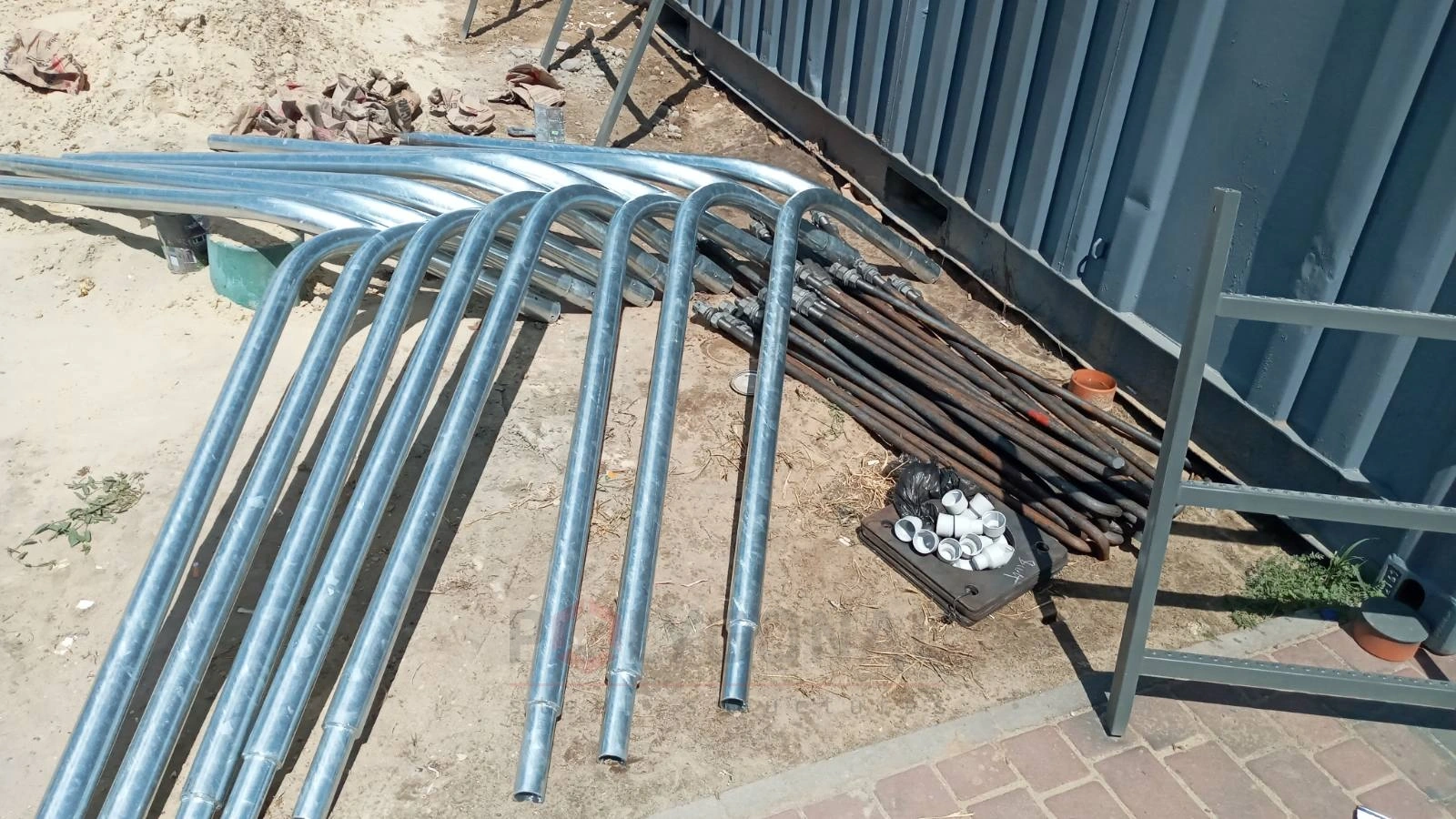
Types of brackets, caps and crossarms
The KO, KP, OG and TR series. The mark encodes the shape, the number of arms, the height, the reach, the pole top diameter or the fixing method.
KO brackets
For luminaires on lighting columns: three shapes (KO1, KO2, KO3), 1 to 4 arms, a diameter of 48 mm per the catalogue.
KP brackets (park)
For a pole top diameter of 60 mm, 1 to 3 arms; types KP1–KP7 differ in shape.
OG caps and TR crossarms
For 1 to 8 floodlights on one pole: a cap (a frame or a cantilever) or a crossarm (a bar).
Floodlight mast crowns
A crown with platforms for floodlights: fixed, or mobile (PMK), which a winch lowers.
Advantages
1 to 8 floodlights on one pole
The catalogue marks of caps and crossarms cover groups of 1 to 8 floodlights on one pole.
Hot-dip galvanising
Brackets, caps and crossarms are hot-dip galvanised to DSTU EN ISO 1461:2024.
Steel S245
Made of steel S245 to DSTU 8539:2015.
To fit your pole
We check the catalogue diameters (48 mm for the KO series, a 60 mm pole top diameter for the KP series) against the pole top and the luminaire seat; non-standard layouts are designed individually.
KO and KP brackets
KO brackets take 1–4 arms, diameter 48 mm. Park KP brackets take 1–3 arms, for a pole top of 60 mm.
Mast crowns
A crown with platforms for floodlights: fixed, or mobile (PMK), which a winch lowers.
Hot-dip galvanising to DSTU EN ISO 1461:2024
Steel S245, DSTU 8539:2015
Articles and catalogues
Detailed tables and a worked calculation.
Brackets, Crossarms and Caps for Lighting Poles: Types and Marking
Types and marks of KO, KP, OG and TR, tables, and how to choose by the number of floodlights.
Floodlight Masts with a Mobile Crown (PMK)
A floodlight mast crown: how a mobile one differs from a fixed one.
PM Floodlight Masts 12–20 m: Dimensions, Anchor Cages and Scope of Application
PM masts 12–20 m: dimensions, anchor cages, scope of application.
Lighting Pole Selection Calculator by Luminaire Area and Mass
A calculator that picks suitable poles by luminaire area and mass.
Catalogue: outdoor lighting structures
The catalogue “Structures for outdoor lighting”: brackets, caps, crossarms.
Marks and designations
The series we make and how to read their designations.
| Series | Purpose | Example of a designation |
|---|---|---|
| KO | A bracket for luminaires on lighting columns: shapes KO1–KO3, 1 to 4 arms, a diameter of 48 mm per the catalogue | KO1-2-0.5-1 |
| KP | Park brackets: 1 to 3 arms, for a pole top diameter of 60 mm, types KP1–KP7 | KP1-2-60 |
| OG | A cap for fixing 1 to 8 floodlights on one pole: a polygonal frame (OG1–OG5) or a cantilever frame (OG6–OG10) | OG1-60-f |
| TR | A crossarm for fixing 1 to 6 floodlights on one pole: a straight bar | TR1-60-f |
Data from the catalogue “Structures for outdoor lighting”.
KO brackets
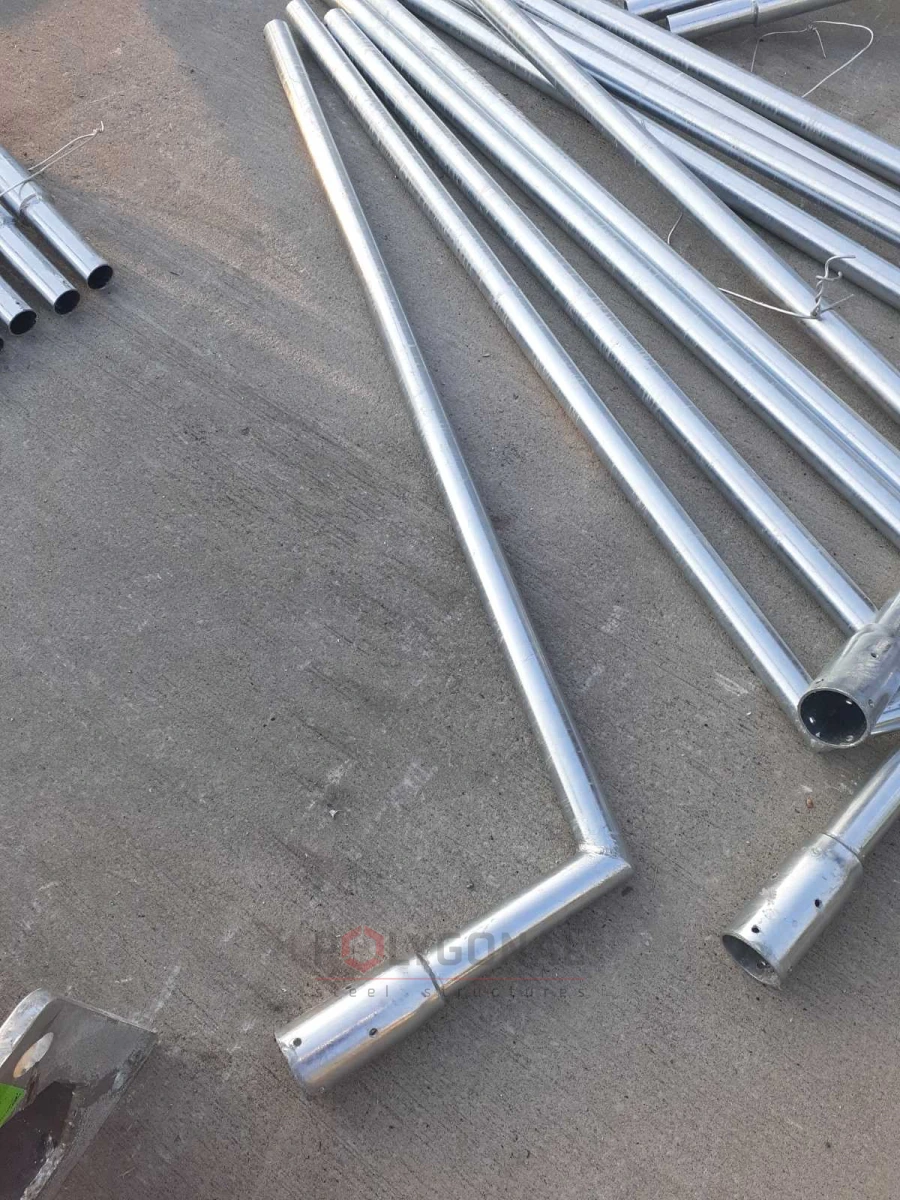
Bracket KO1-0.5-1
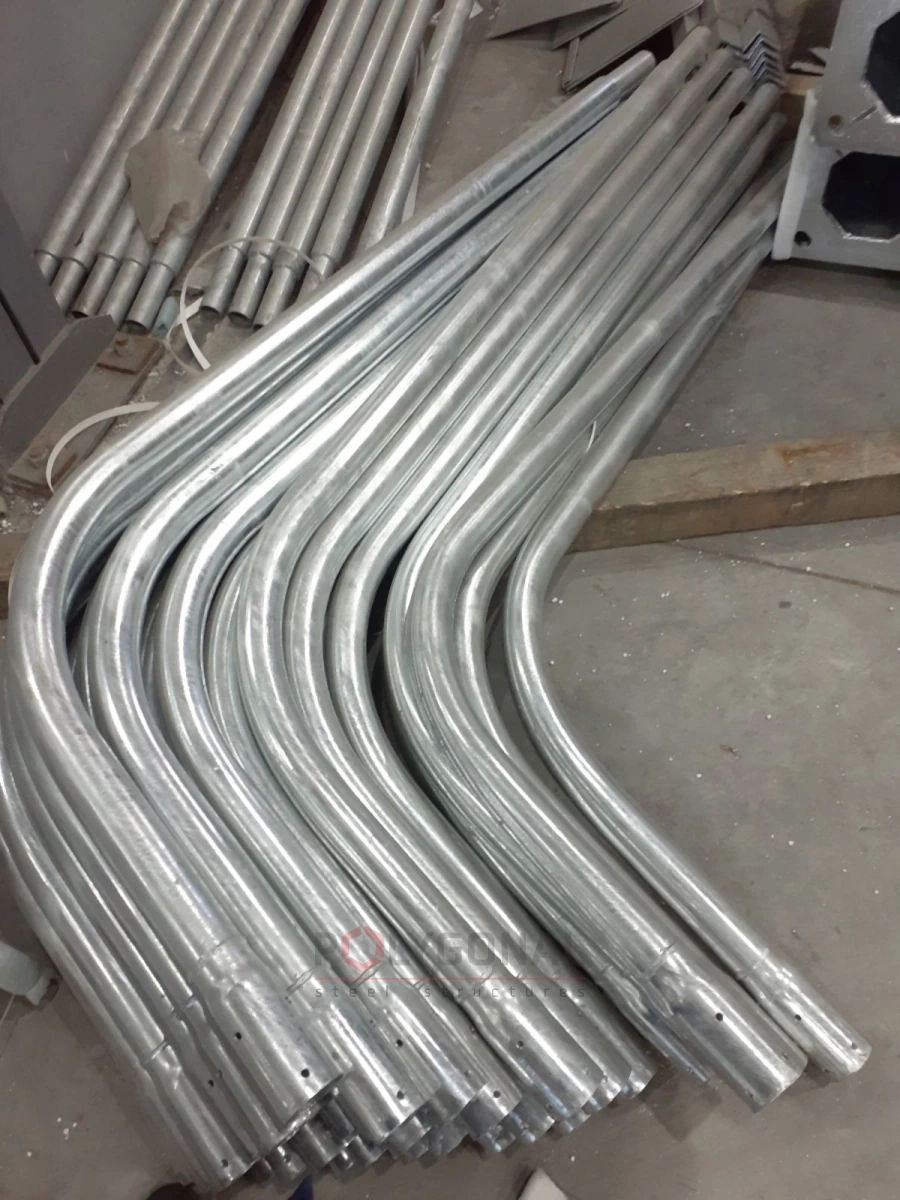
Bracket KO2-1-1-1.5
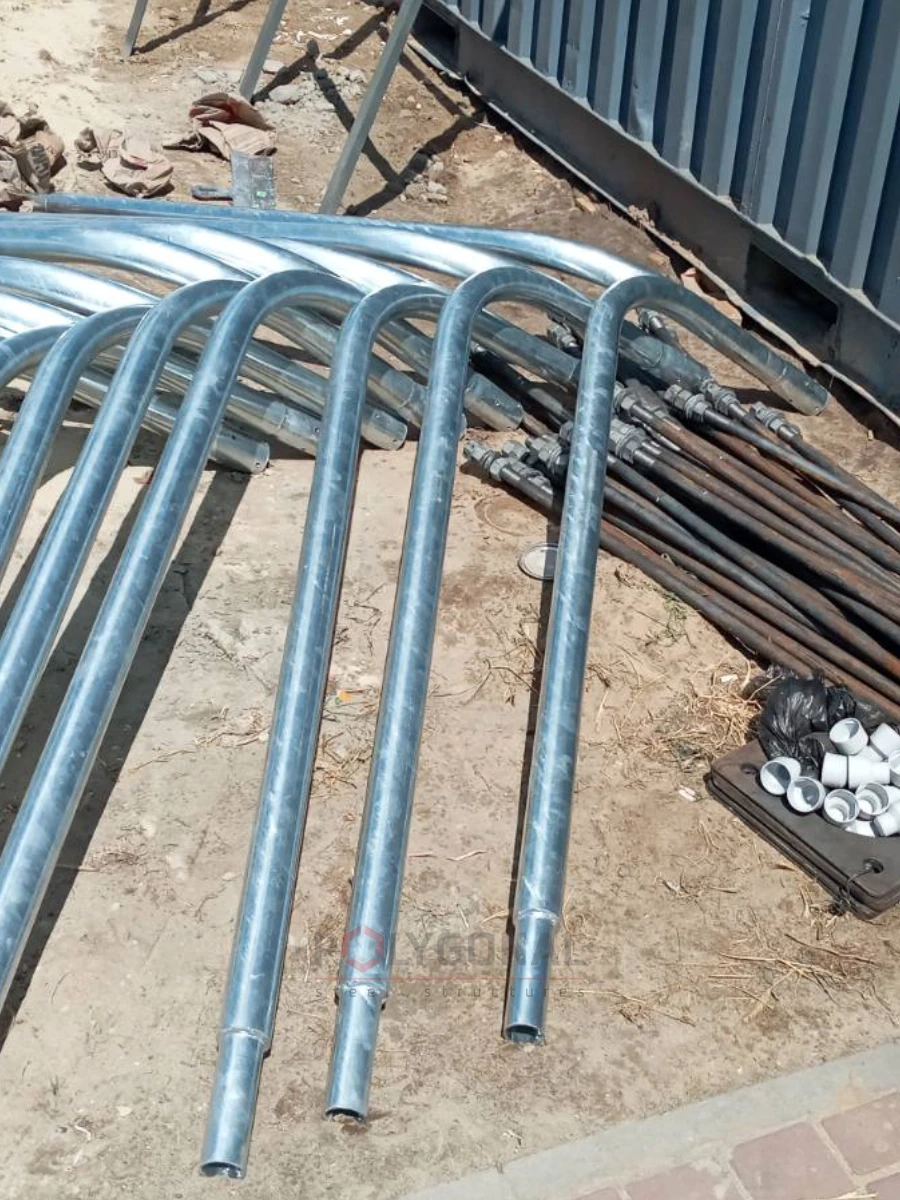
Bracket KO2-2-1-1.5 (120°)
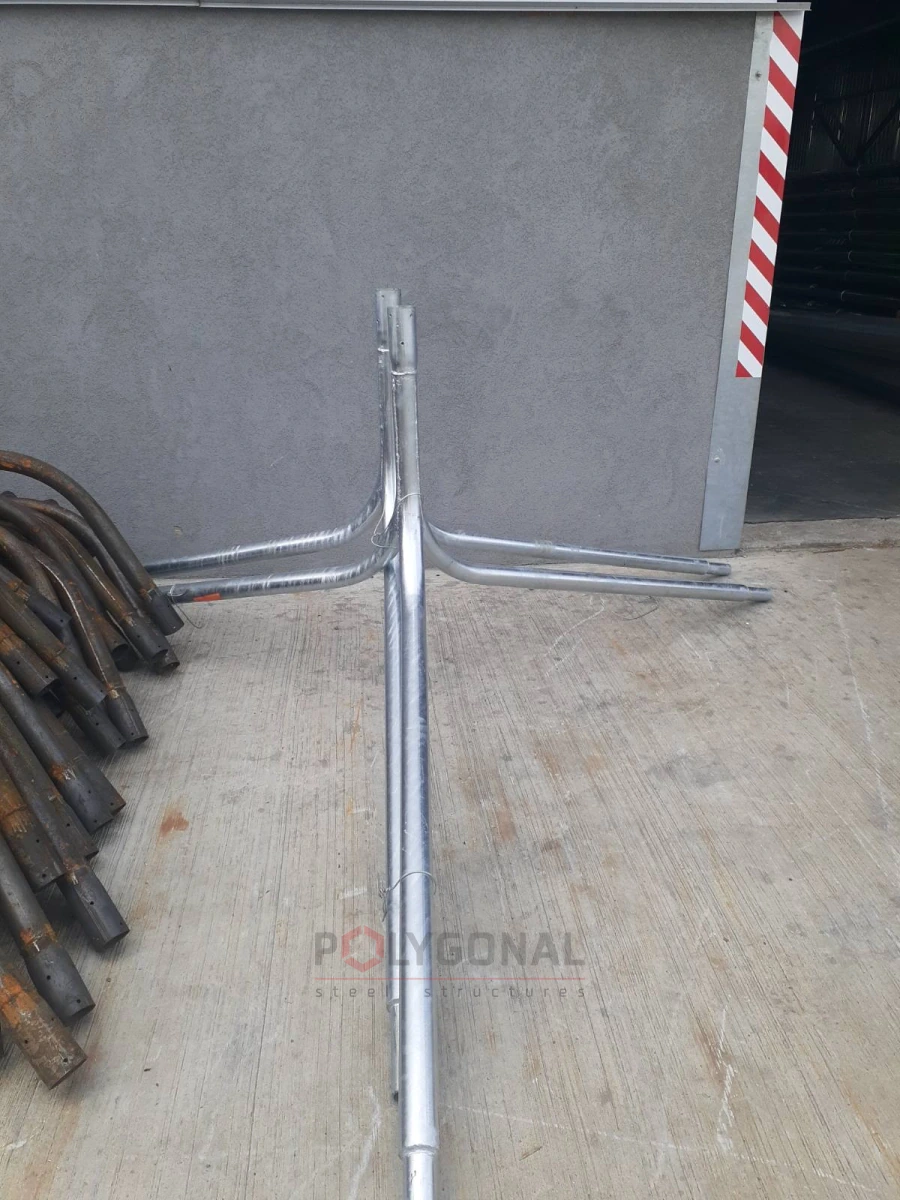
Bracket KO2-3-1-1.5
Crossarms
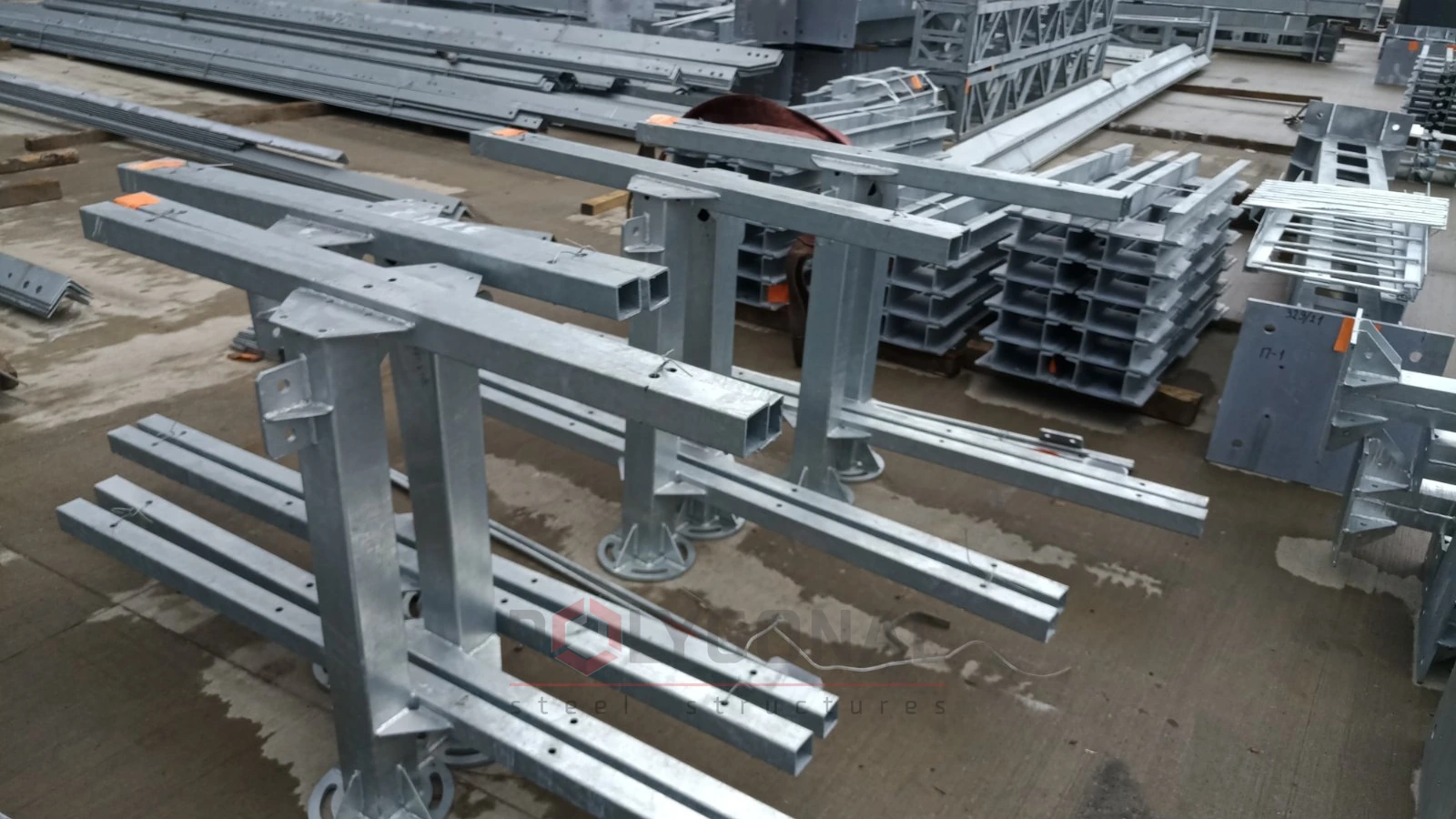
Crossarm TR8-f
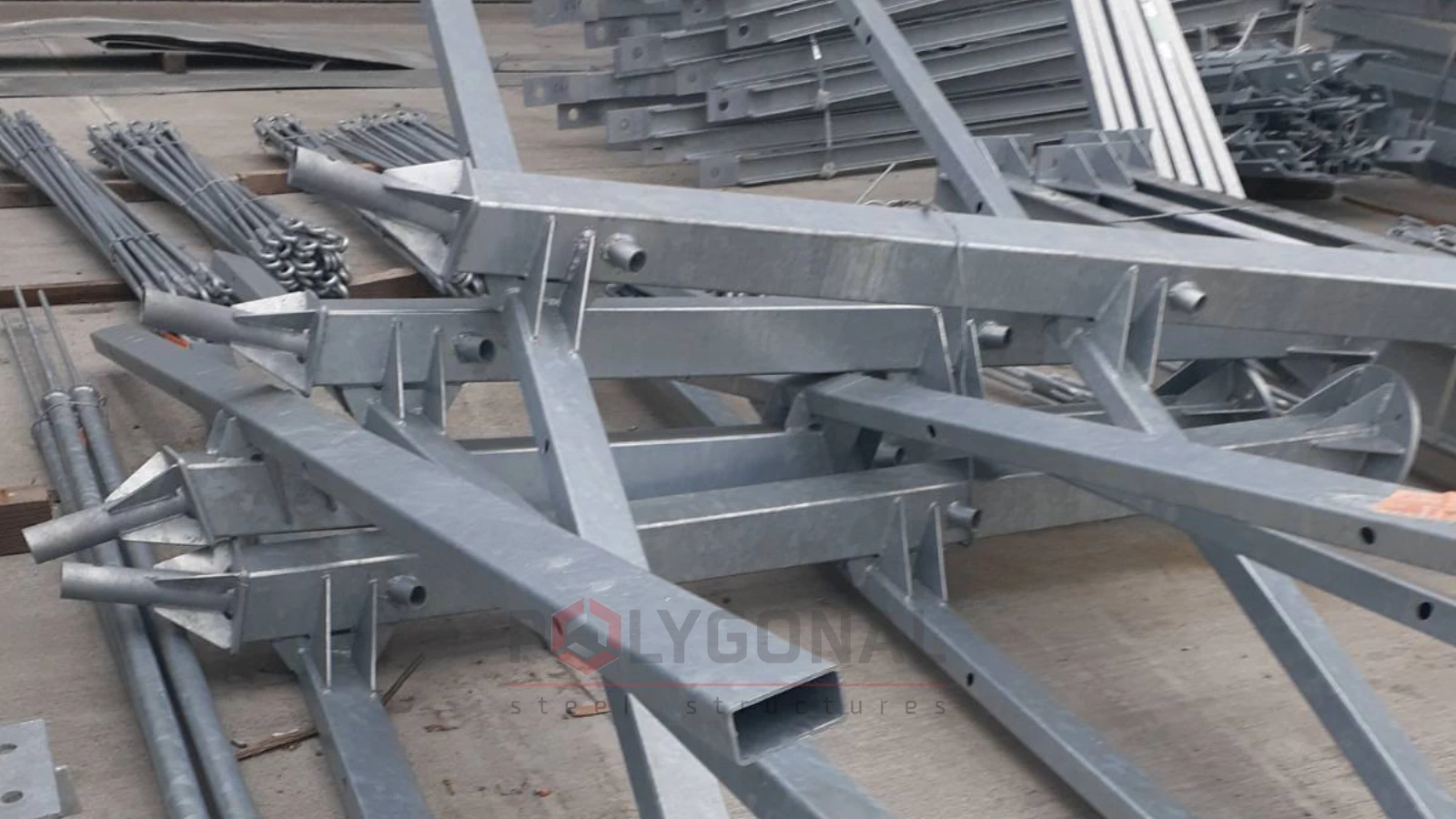
Crossarm TR9-f
Brackets, caps and crossarms: what to know
How to read the mark
- KO: shape type, number of arms (luminaire mounting points), bracket height (m), reach (m), for example KO1-2-0.5-1;
- KP: type, number of arms, pole top diameter in mm, for example KP1-2-60;
- OG and TR: type, pole top diameter in mm, fixing method, for example OG1-60-f or TR1-60-f.
The KO mark table and the choice of OG and TR by the number of floodlights are in the article Brackets, Crossarms and Caps for Lighting Poles: Types and Marking.
Cap or crossarm
OG1–OG5 caps are polygonal frames: the floodlights face different ways, so the light goes around the pole. OG6–OG10 are cantilever frames for 1–4 floodlights. A TR crossarm is a straight bar: the floodlights stand in one row (two rows on TR8 and TR9) and light one side. The table for choosing by the number of floodlights is in the article on marking.
What to state in a request
To select an item, send the mark (or the number of arms or floodlights and the layout: light around the pole or to one side), the pole top diameter, the mass and area of the luminaires from their data sheet, the pole series and height, and the wind region. For OG and TR, add the fixing method (“f” or “t”) and, if the zinc is to be painted over, the colour. The full list is in the article section “What to state in a request for a bracket, cap or crossarm”.
Questions about brackets, caps and crossarms
Which bracket fits my pole?
It depends on the series and the number of luminaires. Per the catalogue, the KO series has a diameter of 48 mm and the KP series a pole top diameter of 60 mm; we check both against the pole and the luminaire seat. Send the number of luminaires and the pole top diameter, and we will select the mark.
What is the difference between a cap and a crossarm?
In how the floodlights are arranged. On OG1–OG5 caps they face different ways around the pole; on crossarms they usually stand in one row and light one side. The choice depends on the number of floodlights and on where the light has to go.
How many floodlights can be put on one pole?
The catalogue gives 1 to 8 floodlights per cap or crossarm. Whether the pole itself can carry that many comes out of a calculation of mass, area and wind region. If you need more, look at a floodlight mast: the masts of our unified PMV range carry up to 16 floodlights.
What do the letters “f” and “t” in a mark such as TR1-60-f mean?
The letter “f” or “t” at the end of a mark is how the cap or crossarm is attached to the pole. We will determine which one you need once we know how the top of your pole is made.
How much do KO and KP brackets for lighting poles cost?
From UAH 1,000 including VAT (as of September 2026). We quote the exact price after calculation, based on the mark and quantity; send the mark or the pole and luminaire parameters.
Brackets, caps and crossarms: related solutions
Need brackets, caps or crossarms?
Send the mark or the parameters of the pole and luminaires (the pole top diameter, the number of arms or floodlights). We will calculate the price and the lead time.