
Home / Equipment & engineering / Hot-dip galvanising line / Hot-dip Galvanising Plant Equipment
Hot-dip galvanising line
Hot-dip Galvanising Plant Equipment
What a galvanising plant consists of: the chemical preparation section, the galvanising furnace, plants for small parts, flux regeneration and zinc ash recovery.
Contents
What we offer
POLYGONAL offers a wide range of engineering services for the design and commissioning of plants for hot-dip galvanising of steel structures by immersion in molten zinc. In design we use lines based on gas and electric furnaces with a steel kettle, or reverberatory furnaces with a ceramic kettle. Our offer covers: a site visit at the customer’s; advice on selecting equipment; a full plant design; supervision of installation of the line’s equipment; commissioning and training.
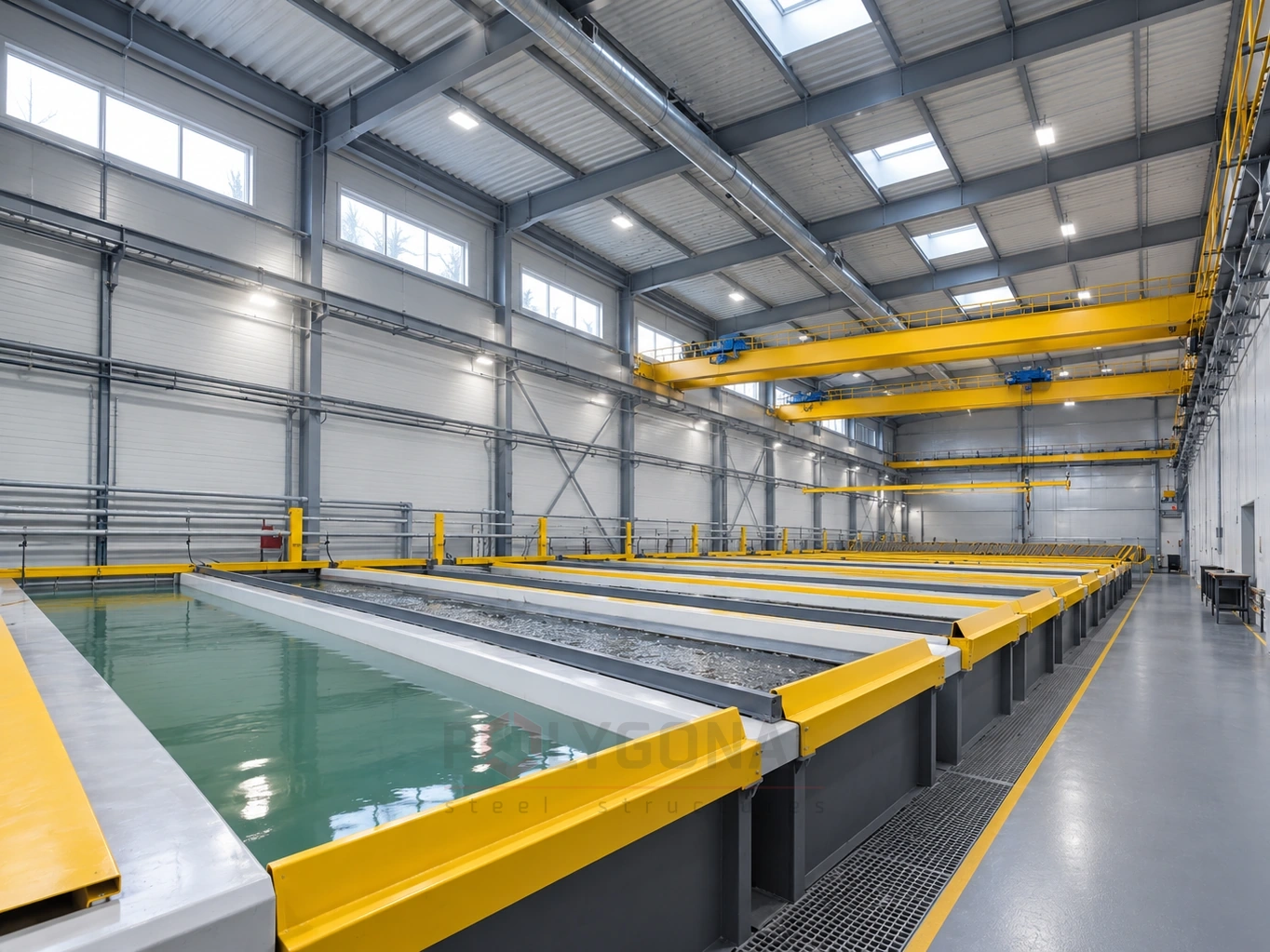
Galvanising line for structures
The chemical preparation tanks are a steel structure with a special external and internal coating. All tanks except the cooling tank are fitted with an automatic heating system with a boiler (temperature controller, thermocouples, heat exchangers). The drying oven dries and preheats the articles after fluxing before they are immersed in the melt: it is heated by the flue gases of the galvanising furnace with extra heating by a natural gas burner, its temperature is controlled automatically and the crossbeams move on a chain conveyor.
The horizontal galvanising furnace heats the melt and keeps it at working temperature: a metal shell with insulating brickwork, inside which is the kettle, while the cavity between the kettle and the insulation is the combustion chamber. The kettle for molten zinc, which withstands up to 480 °C, is made of several sections of U-shaped steel profile welded with a double-sided weld, of steel with low carbon and silicon content 50 mm thick; as an example, the kettle size is 12.5 × 1.6 m, depth 3 m, weight 47 t. The temperature is measured by thermocouples that pass the signal to temperature controllers, which switch the burner ramps in the combustion chamber and in the kettle zone on and off. Galvanising fumes are caught and removed by a gas extraction and filtration unit; the heat of the furnace flue gases is returned to heat the chemical preparation tanks. The crossbeams are moved by double-trolley overhead cranes and, between bays, by rail cars.
In the chemical preparation section the temperature, level and concentration of the solutions are monitored: an automatic system regulates the temperature from thermocouple readings, the working level of solutions is kept 250–300 mm below the top of the tank, and the concentration is checked daily by a laboratory technician and adjusted by the process chemist. Only authorised staff may handle reagents. The process operations are: hanging parts on the crossbeams, degreasing, pickling, rinsing, fluxing, drying the flux, galvanising, cooling, checking the quality of the coating and dispatching the articles.
Routine care of the galvanising furnace: checking the zinc level (best 100–150 mm below the top edge of the kettle; when it falls to 150 mm, ingots are added), cleaning the melt and the surface of the kettle of ash and dross, and checking the melt temperature (set at 450 °C) against a second thermocouple independent of the control system. Scheduled maintenance: removing hard zinc from the kettle (after galvanising 300–400 t of product; the layer of hard zinc must not exceed 100 mm), checking the lead cushion at the bottom of the kettle (about 100 mm), cleaning the walls and sides of the kettle, checking instruments and chemical analysis of the melt for aluminium, lead and iron.
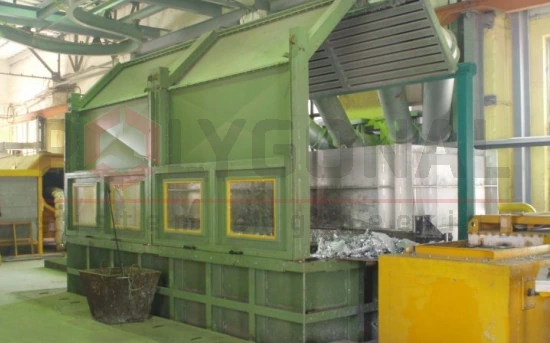 Galvanising plant for fasteners and small partsA unit based on a reverberatory gas furnace with a ceramic kettle: the zinc does not touch metal parts, so it works at up to 460–480 °C. It includes a chemical pre-treatment section, the furnace and a centrifuge.Read more →
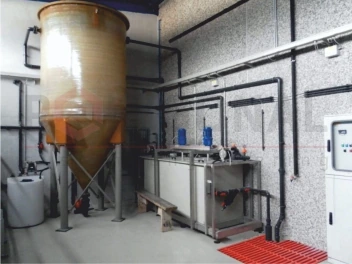 Flux regeneration plantPrecipitates the iron from the flux to prevent excess hard zinc in the bath: the iron is oxidised with hydrogen peroxide, the pH is held automatically, and the decanted flux returns to the bath.Read more →
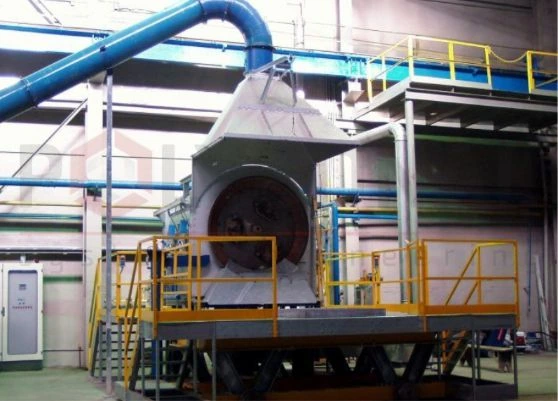 Zinc ash recovery plantSeparates the metal from the oxide and remelts it in a controlled atmosphere, recovering 99.2 % of the zinc. The recovered zinc can be reused, and the remaining zinc oxide can be sold.Read more →
Galvanising plant for fasteners and small parts
Hot-dip galvanising is the most reliable corrosion protection for fasteners. For small parts we design a unit based on a reverberatory gas furnace with a ceramic kettle: the zinc does not touch metal parts, so the plant can work at up to 460–480 °C, giving better quality and reducing the need to clean the parts after centrifuging.
The chemical preparation section is a built-in plant designed for working with drums and with material on crossbeams; special chemical additives, fully compatible with each other, remove the need for rinsing between degreasing and pickling. The tanks have a load-bearing steel structure and an inner polypropylene tank 10 mm thick (pickling acid: 15–17% hydrochloric acid); the degreasing and fluxing tanks are heated by titanium coils carrying hot water heated by the flue gases of the galvanising furnace. Motorised polypropylene drums turn as parts are lowered and lifted so that liquids drain evenly. The drying oven is heated by the furnace flue gases. The furnace has refractory and insulating brickwork, burner ramps, a gas-air premixing section, an electrical cabinet with PLC control and thermocouple temperature control, and a flue with a fan.
The centrifuge plant is rated for baskets 500 mm in diameter and up to 500 mm high, loaded up to 200 kg, at up to 2000 kg/h: a centrifuge with a hydraulic lid and a system for collecting zinc drops, a tipper and a cooling cradle that unloads small parts into boxes after cooling in water.
Flux regeneration plant
The flux regeneration plant precipitates the divalent and trivalent iron contained in the flux, to prevent excessive formation of hard zinc in the galvanising kettle. Because divalent iron dissolves readily in the flux, it is first oxidised to trivalent iron by dosing hydrogen peroxide into the solution; the amount needed is monitored continuously by the REDOX potential. Because trivalent iron partly dissolves in the flux at low pH, the pH of the flux is kept at 4–4.4 by automatic dosing of ammonia water; its advantage is that the by-product of its reaction with hydrochloric acid is ammonium chloride, a component of the flux, so the flux is not contaminated with extra salts. Pickling solution rich in zinc chloride can also be used in the plant, and its iron is precipitated in the reactor. The reactor is the central device of the station: in it the iron is oxidised, the pH is regulated and the sludge settles (a set of lamellae in the centre of the tank speeds settling), and the decanted flux is returned to the tank.
Zinc ash recovery plant
Hot-dip galvanising produces two zinc-bearing wastes: zinc ash (discarded material from the surface of the melt) and hard zinc (dross). The zinc ash recovery plant consists of a section that separates the metal from the oxide and a melting section under a controlled atmosphere; it is designed for producers with large, continuous output. It processes zinc ash waste and recovers 99.2% of the zinc; the recovered zinc is fit for reuse in the same process and any remaining zinc oxide can be sold. This reduces zinc purchases, galvanising waste and the need for disposal, and improves operator safety.
Updated:
Hot-dip galvanising plant equipment: frequently asked questions
What is the working temperature of the galvanising kettle?
The melt is kept at about 450 °C; the kettle is built to withstand up to 480 °C.
How much zinc does the ash recovery plant recover?
99.2% — the recovered zinc is fit for reuse in the same process, and any remaining zinc oxide can be sold.
How does the small-parts plant differ from the line for large structures?
It is built on a gas-fired reflective furnace with a ceramic kettle: the zinc doesn’t touch metal parts, so it can run at up to 460–480 °C, giving better coating quality for small parts.
Related products: Turnkey factory engineering · Hot-dip galvanising
More on this topic: Operations on a Hot-dip Galvanising Line
Get a quote for your requirements
Send us your requirements — we will calculate the price and lead time.