
Home / Services / Sheet metal bending / Bending Sheet up to 12 m Long on a 2000 t Press: Capabilities and Examples
Sheet metal bending
Bending Sheet up to 12 m Long on a 2000 t Press: Capabilities and Examples
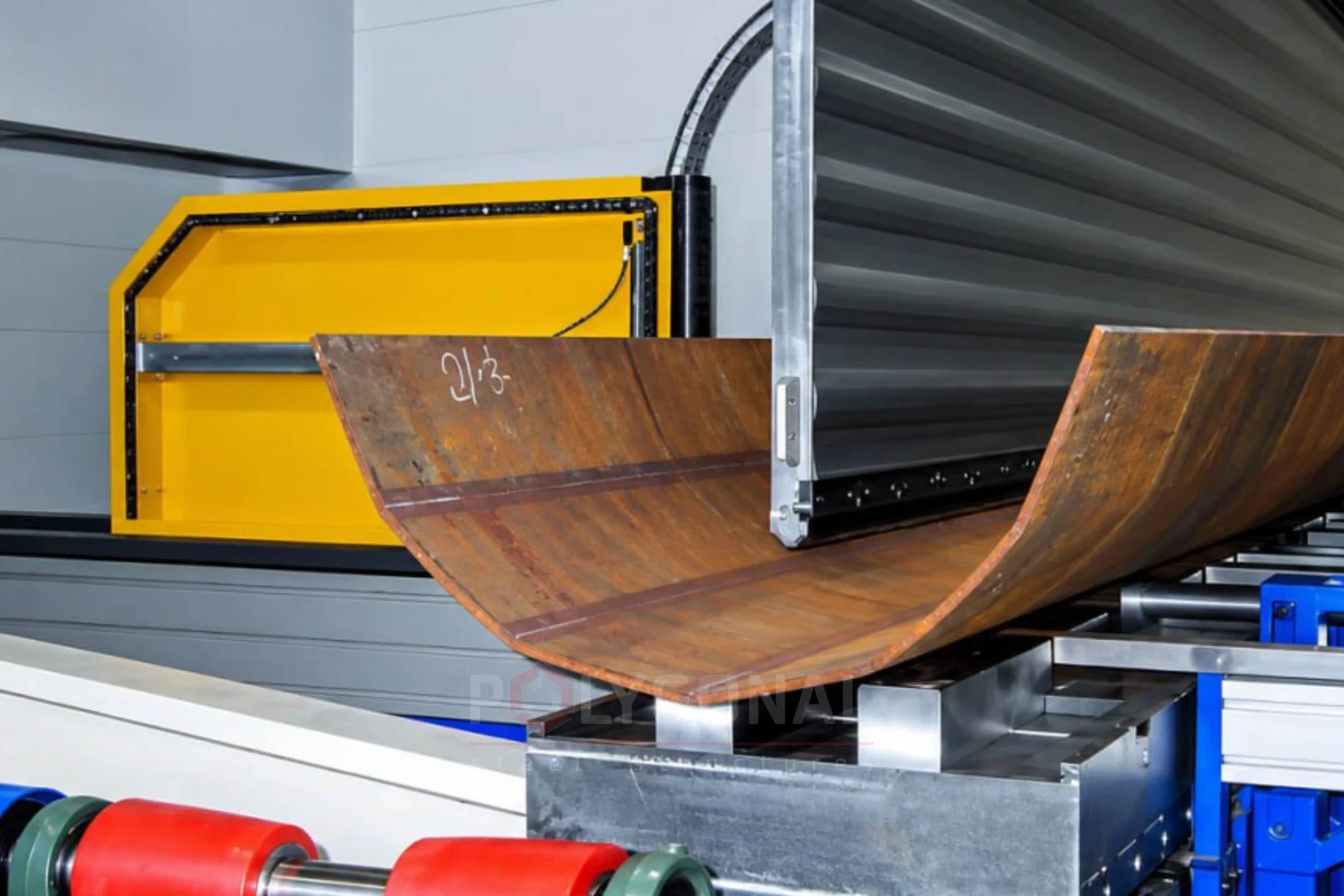
A 2000 t hydraulic press with a 12-metre bend length bends thick, long sheet in a single pass. Parts that used to be welded up from several pieces come out as a single piece. Below: what the press can do, which parts we bend on it, and what to prepare before ordering.
Contents
- Press parameters and capability table
- What parts we bend
- Examples of parts: shafts, profiles, cross-arms, sections
- How to prepare the drawing and material
- What to state in the order
- Springback and minimum bend radius
- Tolerances, accuracy, lead times
- Long parts: lifting and transport
- Price
- Sheet metal bending calculation: blank length and the K-factor
- Worked example: an L-shaped part from 10 mm sheet
- Sheet metal bending chart: minimum radius by thickness
Press parameters and capability table
A specialised hydraulic press rated at 2000 t, with a 12-metre bend length, bends sheet up to 25 mm thick and up to 12 metres long in a single pass. Linear sensors and servo adjustment under CNC control keep the upper table parallel, with a parallelism error of 1%.
| Parameter | Value |
|---|---|
| Force | 2000 t |
| Bend length | 12,000 mm |
| Press throat | 2000 mm |
| Cylinder stroke | 250 mm |
| Maximum sheet | up to 25 mm thick, up to 12 m long |
The full press specification is on the service page Sheet Metal Bending.
What parts we bend
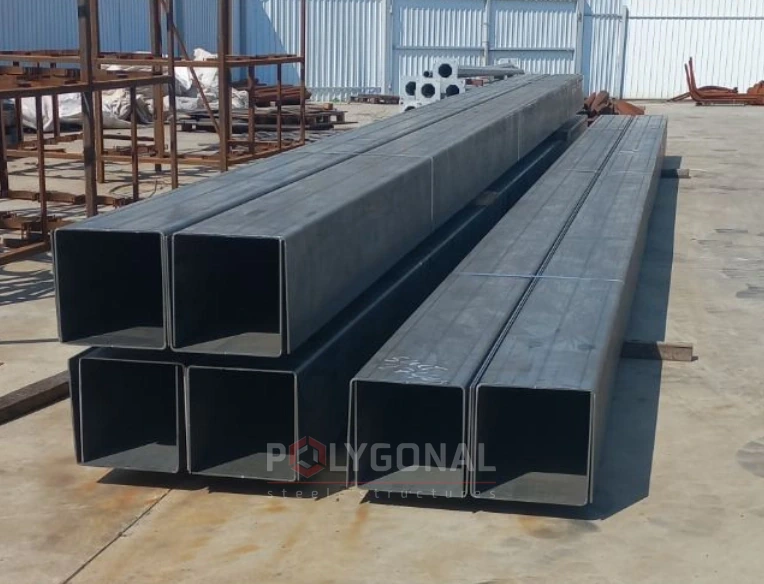
We bend parts for heavy engineering, mining, power and defence industries: long housing parts, tank and vessel components, frame and chassis parts of heavy equipment. They used to be welded from several pieces, as standard machines were limited in length and thickness. A bent part is usually stronger and longer-lasting: stress and fatigue cracks tend to start at a weld seam and its heat-affected zone, and a continuous bent profile has fewer such zones.
Examples of parts: shafts, profiles, cross-arms, sections
The press can bend blanks for products such as:
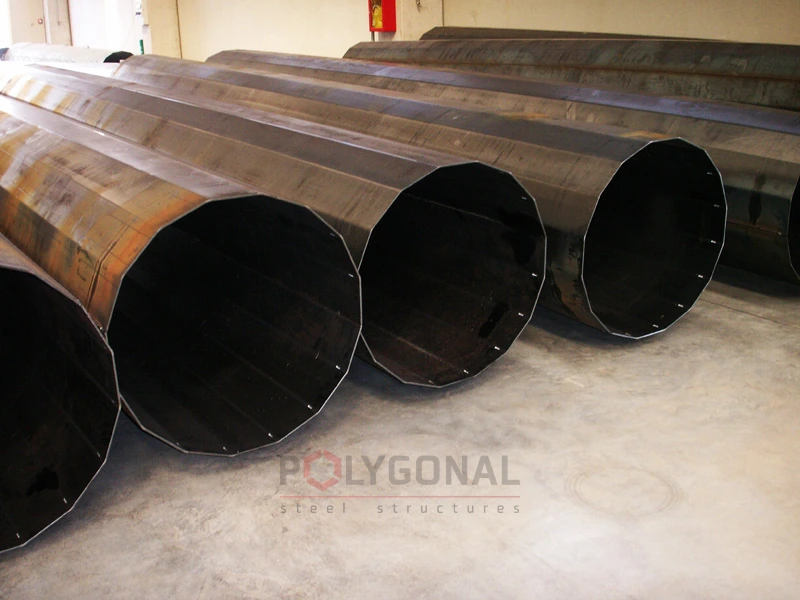
- shafts of multi-sided poles and masts: a trapezoidal blank is bent along its whole length, the bends form the faces, and the longitudinal seam is then welded (manufacturing process);
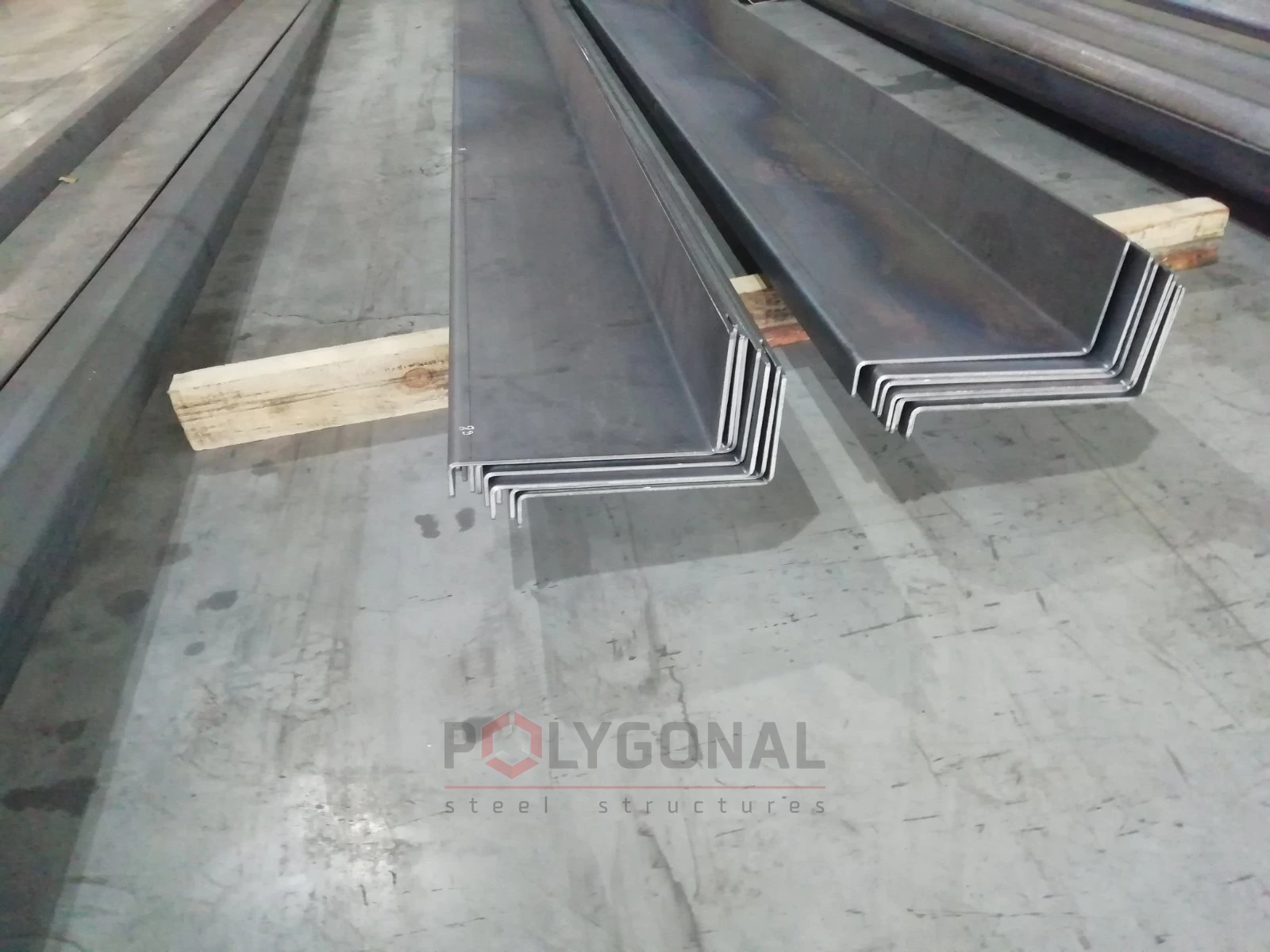
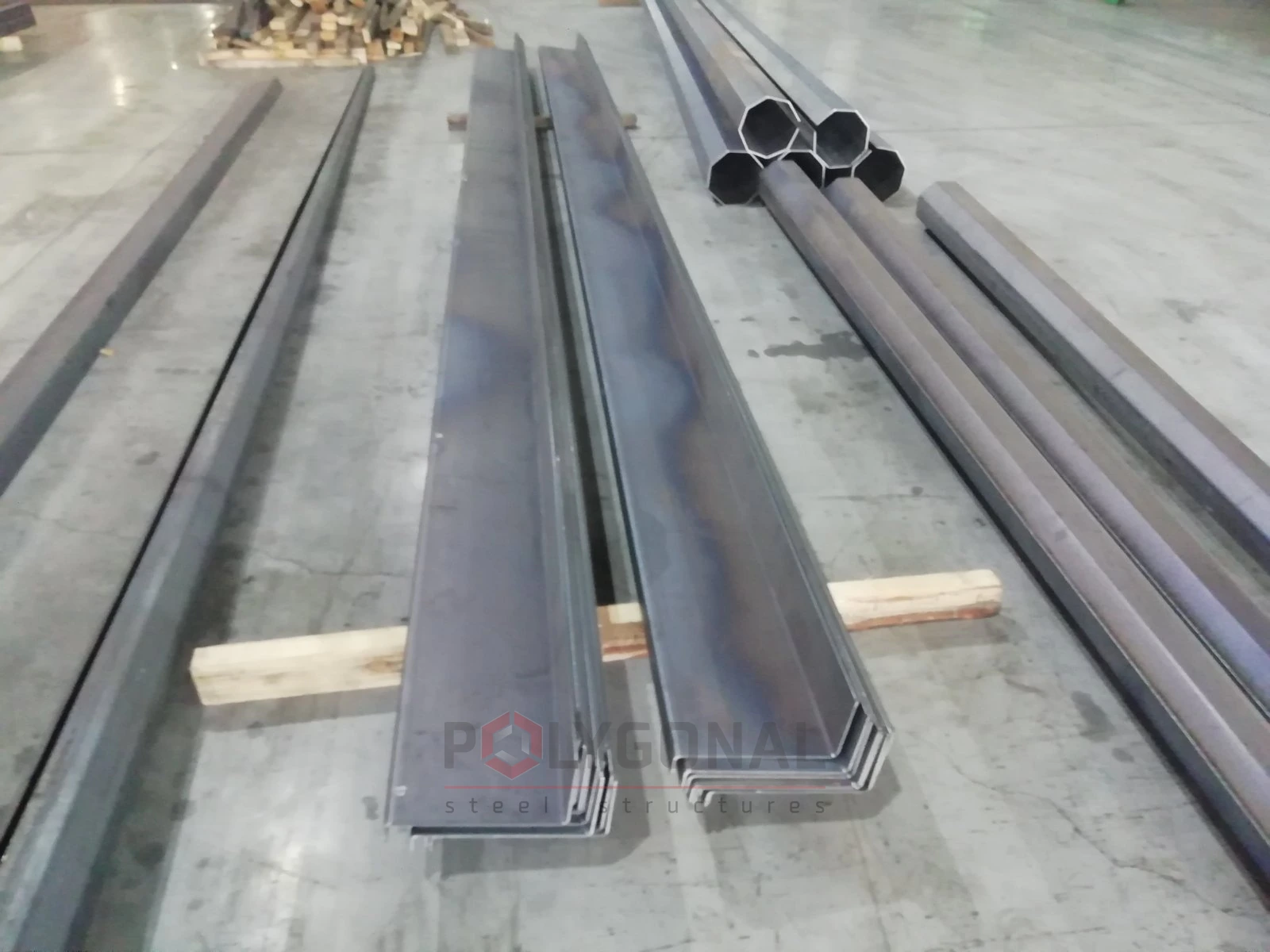
- open profiles (channel, angle, Z-shaped) for frames, platforms and brackets;
- cross-arms and cantilever arms: a profile bent from sheet is stiffer than a flat strip of the same mass;
- pole sections, when a pole is taller than the sheet is long, joined by flanges or a telescopic joint.
Welding and galvanising follow if needed: Custom steel fabrication, Hot-dip galvanising.
Bending service examples
How to prepare the drawing and material
If you have no drawing yet, send a sketch: our engineers can help work out the design, for example by suggesting bends in place of some welded joints so the part comes out lighter, stronger and cheaper. The bending programme is checked on screen in 2D or 3D before work begins; a wrong parameter, or one beyond the press’s capabilities, triggers an error and the operation will not run.
What to state in the order
Send the data from the table and the quantity: the calculation goes faster and there are fewer queries.
| Data | What to state and why |
|---|---|
| Sheet thickness and length | thickness in mm, length (up to 12 m) and width of the blank: they determine the force and how the sheet is handled |
| Steel grade | for example St3, S245, S345, 09G2S: yield strength affects the force, springback and radius |
| Bend angle and radius | angle and direction relative to the drawing, inside radius or ‘smallest possible’: the press stroke is set from them, with a springback allowance |
| Tolerances | on the angle, leg lengths and straightness along the part |
| Flat pattern | flat-pattern dimensions or overall size of the finished part; we agree the final blank length when preparing the order |
For parts to be galvanised: our 13,000 × 1,600 × 3,200 mm bath usually takes a part up to 12 m long if the cross-section fits the width and depth. Dimensions can be checked in the galvanising cost calculator; on vent and drain holes, see Designing for hot-dip galvanising.
Springback and minimum bend radius
After the load is removed, the sheet springs back partly and the angle ends up larger than under the punch. This springback is compensated by overbending, that is, a slightly deeper stroke; it grows with steel strength, with the ratio of radius to thickness and with the die opening.
The minimum bend radius is the limit below which cracks appear on the outer surface of the bend. It grows with steel strength and thickness, and is larger when the bend line runs along the rolling direction, as it usually does in long parts. The old rule was a radius of at least two thicknesses; the table at the end of the article refines it by grade, thickness and rolling direction. The exact radius is agreed for each order.
Edges in the bend zone must be clean: burrs are removed, and the hardened zone left by thermal cutting is best ground off, because a crack can start from it.
Tolerances, accuracy, lead times
Tolerances for a specific part are agreed against the customer’s drawing and the press’s capabilities. Lead time depends on the complexity of the part, the number of bends and the production load; we give an exact figure once we have seen the drawing and know the quantity.
Long parts: lifting and transport
A sheet up to 12 m long and 25 mm thick can weigh several tonnes, and a long part sags under its own weight. It is lifted at several points, laid on supports at one level and secured along its whole length in transit. Mass and cross-section decide the choice of vehicle, so delivery is agreed before manufacture. Provide for lifting lugs on the drawing.
Price
The price depends on the material thickness and grade, the length and number of bends, the sheet size and the quantity in the order. Send a drawing or sketch and we will work out the cost and lead time.
Sheet metal bending calculation: blank length and the K-factor
The blank is cut to the length of its flat pattern, that is, of the sheet before bending: the sum of the straight segments of the part and the arcs of all bends, measured along the neutral axis. For one bend: L = a + b + (π · θ / 180) · (R + K · t), where a and b are the straight segments up to the start of the radius, θ is the turning angle of the sheet in the bend (180° minus the angle between the legs, so 90° at a right angle), R is the inside radius, t the thickness and K the neutral-axis factor.
The neutral axis is an imaginary surface inside the sheet whose length does not change in bending: the outer fibres stretch, the inner ones compress. K is its distance from the inside surface divided by the thickness; it lies roughly between 0.3 and 0.5 and grows with R/t. The arc along the neutral axis, (π · θ / 180) · (R + K · t), is the bend allowance. Indicative K values for mild steel are in the table.
| R/t (inside radius to thickness) | K (mild steel) |
|---|---|
| below 1 | 0.38–0.42 |
| 1 to 3 | 0.42–0.46 |
| over 3 | 0.50 |
Reference figures from open technical sources. K also depends on the bending method, the die opening, the tooling and the steel grade, so for precision parts it is confirmed with a trial bend. Springback hardly changes the blank length.
Worked example: an L-shaped part from 10 mm sheet
Sheet t = 10 mm is bent through 90° with an inside radius R = 25 mm (R/t = 2.5); the legs, measured on the outer surfaces to the apex of the angle, are 200 and 300 mm. The radius is not smaller than the table minimum below for 10 mm sheet. We need the blank length.
| Step | Calculation | Result |
|---|---|---|
| K-factor | R/t = 25 / 10 = 2.5; the table gives 0.42–0.46, take the middle | K = 0.44 |
| Bend arc along the neutral axis | (π / 2) · (25 + 0.44 · 10) = (π / 2) · 29.4 | 46.18 mm |
| Distance from the apex to the start of the radius | (R + t) · tan(θ / 2) = 35 · tan 45° = 35 | 35 mm |
| Straight segments | 200 − 35 and 300 − 35 | 165 and 265 mm |
| Blank length | 165 + 265 + 46.18 | 476.18 mm, about 476.2 mm |
Cross-check: the bend deduction BD = 2 · 35 − 46.18 = 23.82 mm comes off the sum of the outside leg dimensions: 200 + 300 − 23.82 = 476.18 mm. With K = 0.42 and 0.46 the result is 475.9 and 476.5 mm, about ±0.3 mm.
Sheet metal bending chart: minimum radius by thickness
There is no single minimum radius for all steel: this is a reference for S235 and S355 only, not a universal chart. The figures follow the EN 10025-2 table as sheet manufacturers reproduce it, for sheet ordered for cold forming (the grade designation carries the letter C, for example S235JRC or S355J2C). At the upper thickness limit of each row, the minimum radius is roughly 1.2 to 2.3 times the thickness for S235 and 1.5 to 3.2 times for S355.
How to read the table:
- an 11 mm sheet falls in the row ‘over 10 to 12’, whose radius is calculated for 12 mm, so it is a margin;
- ‘across’ and ‘along’ give the bend line relative to the rolling direction; in long parts it usually runs along the sheet, so use the ‘along’ columns, where the radius is 10–33% larger;
- if the part is galvanised after bending, leave a margin: cold-bent zones are more prone to micro-cracks (Designing for hot-dip galvanising).
Recommended minimum inside radius, mm:
| Sheet thickness, mm | S235 across | S235 along | S355 across | S355 along |
|---|---|---|---|---|
| over 3 to 4 | 5 | 6 | 6 | 8 |
| over 4 to 5 | 6 | 8 | 8 | 10 |
| over 5 to 6 | 8 | 10 | 10 | 12 |
| over 6 to 7 | 10 | 12 | 12 | 16 |
| over 7 to 8 | 12 | 16 | 16 | 20 |
| over 8 to 10 | 16 | 20 | 20 | 25 |
| over 10 to 12 | 20 | 25 | 25 | 32 |
| over 12 to 14 | 25 | 28 | 32 | 36 |
| over 14 to 16 | 28 | 32 | 36 | 40 |
| over 16 to 18 | 36 | 40 | 45 | 50 |
| over 18 to 20 | 40 | 45 | 50 | 63 |
| over 20 to 25 | 50 | 55 | 65 | 75 |
The minimums apply to bend angles up to 90° and to S235 and S355 supplied for cold forming; for a specific batch the figures may differ. For St3, S245, S345 and 09G2S the table gives only an order of magnitude; we agree the radius from the sheet manufacturer’s data.
Updated:
Bending sheet on a 2000 t press: frequently asked questions
What is the minimum bend radius you can achieve?
It depends on the grade and thickness. For sheet over 8 to 10 mm, the EN 10025-2 table (as sheet manufacturers reproduce it) gives 16 mm across the rolling direction and 20 mm along it for S235, and 20 and 25 mm for S355. We confirm the radius for your part when preparing the order.
What should I send to get a bending price?
A drawing or sketch with dimensions and bend angles, the material grade and thickness, the sheet length and the quantity. Leave blank whatever you do not know and we will clarify.
How do I calculate the flat pattern of a bent sheet metal part?
Add up the straight segments (each leg minus the distance from the apex to the start of the radius) and the arc along the neutral axis of each bend: L = a + b + (π · θ / 180) · (R + K · t). In the example above that gives about 476.2 mm.
What is the K-factor and which value should I use for steel?
K is the distance from the inside surface of the sheet to the neutral axis divided by the thickness. For mild steel it is about 0.38–0.42 for R/t below 1, 0.42–0.46 from 1 to 3 and 0.50 over 3; a trial bend gives a more exact value.
Can I bend to a smaller radius than the one in the table?
Better not: below the minimum, the risk of cracks on the outer surface rises. If the drawing calls for a smaller radius, send the grade, thickness and bend angle, and we will look at whether it is possible for your sheet.
Related products: Sheet metal bending · Steel structure design (structural and detail drawings)
Read also: Installation of Multi-sided Poles and Masts · Solar Street Lighting · Power Line Pole Types by Purpose: Suspension, Tension, Angle, Terminal · Cross-arms for 0.4–10 kV Lines: TM and TN Types, Reading the Designation
Get a quote for your requirements
Send us your requirements — we will calculate the price and lead time.