
Home / For Designers / Solar Street Lighting
Knowledge base
Solar Street Lighting
How solar street lighting poles work, their strengths and weaknesses, what the installation consists of and what a typical kit includes.
Contents
How autonomous street lighting works
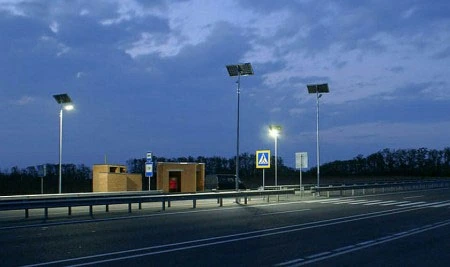
We design and manufacture poles for solar street lighting. The panels bring electricity costs down and light areas that have no mains supply. The cost of running a power cable, building a substation and a metering point, and obtaining permits and approvals falls sharply as well.
Photovoltaic cells turn sunlight into electric current, which is stored in a battery. At night the battery feeds a luminaire, usually an LED one (LED luminaires are the most economical light sources). A control unit switches the luminaire on and off at the right time and keeps track of battery charging.
Extra functions are possible. In standby the luminaire can run at 20–40% of its power and go up to 100% as soon as motion is detected in the monitored zone, which stretches the battery’s run time. A timer can be added too, to switch the lighting on at the required time.
Panel power and battery capacity decide two things: whether the system works reliably, and what it costs. The larger the panel and the battery, the longer the luminaire shines, but the installation also becomes significantly more expensive.
Advantages and disadvantages of solar lighting
Advantages:
- no electricity bills;
- lighting works in remote places that have no mains supply or are far from it;
- installation is simple and quick;
- fully safe and environmentally friendly in use and at disposal;
- long service life;
- runs automatically.
Disadvantages:
- significant installation cost;
- low vandal resistance;
- dependence on the weather;
- moderate light output.
If needed, we run the lighting and illuminance calculations, select the equipment, agree the kit with the customer and fix the pole locations.
Design of an autonomous lighting installation
Solar lanterns are used along footpaths, at pedestrian crossings and at public transport stops. A system consists of:
- a photovoltaic panel that converts sunlight into electricity;
- a pole with an anti-vandal cabinet that houses the control unit and the battery;
- a battery: a sealed, maintenance-free storage unit;
- a controller, which runs the luminaire and monitors battery charge;
- a luminaire with an LED lamp or panel.
Operating characteristics
The installation has to run without interruption through the hours of darkness under the specified wind and ice loads. The pole is built around these requirements:
- easy installation and operation;
- like-for-like replacement of consumable parts;
- repairability;
- access to every unit that may need adjusting or replacing in service.
The installations are designed to work at temperatures from +40 °C to −40 °C. The equipment is selected so that the battery feeds the luminaire for 12 hours without a break, and the installation can run on its own for 3–4 days in unfavourable weather.
Pole wall thickness is at least 3 mm, and the calculation is made for the specified wind loads. The type of foundation depends on the ground conditions. The minimum solar panel power is usually 130 W. The batteries are gel type; their capacity is chosen from the run-time and lighting parameters in the technical specification, typically at least 150 Ah.
For corrosion protection the products are hot-dip galvanised to DSTU EN ISO 1461:2024.
SAO-6/4500 autonomous lighting system
What the kit includes:
| Item | Specification | Quantity |
|---|---|---|
| Solar module | polycrystalline, 260 W, 24 V | 1 |
| Battery | 100 Ah | 1 |
| LED luminaire | 25 W, 4500 lm | 1 |
| Controller | charge and lighting control | 1 |
| Wall-mounted enclosure | IP 54 | 1 |
| Cable, terminals | wiring of the system elements | set |
| Multi-sided steel pole | 7 m high, hot-dip galvanised | 1 |
| Luminaire bracket | 1.5 m reach, hot-dip galvanised | 1 |
| Anchor cage | uncoated | 1 |
What we need to size the panel and battery
The panel and the battery are selected for a specific site, so in your enquiry give the town or village, the pole height and the number of luminaires, the lighting time needed per night, and whether you want a reduced-power mode with a motion sensor. Add the wind region and the ice region: the pole is calculated from them.
The longer the night and the less sun in winter, the larger the panel and battery and the higher the cost, so the SAO-6/4500 set above is an example, not a solution for every site. The general ordering procedure is described in How to Order Poles and Masts; the requirements for lighting crossings, where such luminaires are also installed, are in Pedestrian Crossing Lighting.
Updated:
Autonomous solar street lighting: frequently asked questions
How long will the light stay on if there is no sun?
At least 12 hours each night: that is what the battery is sized for. In poor weather the system is meant to run on its own for 3–4 days.
What is the smallest solar panel I can use?
Usually 130 W or more. The exact panel power and battery capacity (typically at least 150 Ah) are chosen from the technical specification.
What comes in the SAO-6/4500 kit?
A 260 W polycrystalline panel, a 100 Ah battery, a 25 W LED luminaire (4500 lm) and a controller. The pole is a 7 m multi-sided one, hot-dip galvanised, with a bracket of 1.5 m reach.
What are the downsides of solar lighting compared with mains?
The installation costs a significant amount. Vandal resistance is lower than with mains lighting, the system depends on the weather, and light output is modest.
Related products: Street lighting columns
Read also: Installation of Multi-sided Poles and Masts · Power Line Pole Types by Purpose: Suspension, Tension, Angle, Terminal · Cross-arms for 0.4–10 kV Lines: TM and TN Types, Reading the Designation · Power Line Protection Zone: Widths by Voltage Class
See also: Area Lighting: Poles, Luminaires, Design
Get a quote for your requirements
Send us your requirements — we will calculate the price and lead time.