
Home / For Designers / Pedestrian Crossing Lighting
Knowledge base
Pedestrian Crossing Lighting
How to light a pedestrian crossing so that a driver sees the pedestrian from a distance: illuminance requirements, light sources, luminaires, installation layouts.
Contents
Photometric requirements
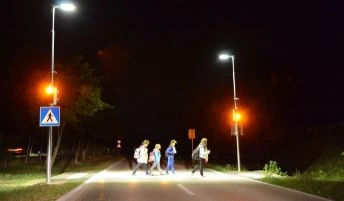
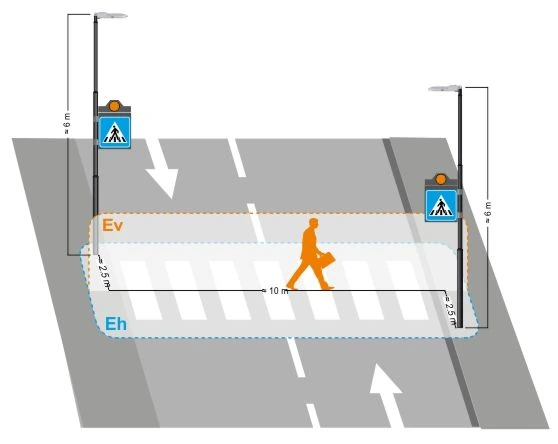
An approaching driver has to see the pedestrian clearly. A luminaire mounted right above the crossing is not the best way to achieve that: what is needed is a visible contrast between the crossing and the road surface. Asymmetric light distribution provides it. The pedestrian gets a high vertical illuminance from the driver’s side, and the crossing itself gets a high horizontal illuminance, so it can be seen from a distance.
International recommendations and standards set no exact requirements for this kind of lighting. What exists is best practice in several European countries; where the road surface luminance is 1 to 2 cd/m², it comes down to these minimums:
- average vertical illuminance on the crossing axis at a height of 1 m: Ev ≥ 40 lux;
- uniformity of vertical illuminance on the road lane in front of the driver: 0.20;
- average horizontal illuminance on the crossing itself, at ground level: Eh ≥ 80 lux;
- uniformity of horizontal illuminance: 0.30.
Photometric requirements
Light sources
The crossing should also stand out from the ordinary road lighting by the colour of its light. If the road is lit by high-pressure sodium lamps, for instance, white light (colour rendering index CRI ≥ 65) works well against that background. We recommend cool white LEDs: combined with a sharply asymmetric light distribution, they give very good results.
Luminaire
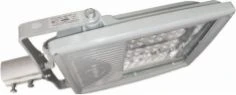
A luminaire for a crossing should be sealed to at least IP 65, so that it keeps its initial performance for as long as possible over its service life. We use special optics with a distinct asymmetric light distribution, which gives visual comfort to drivers and pedestrians alike.
Lighting at pedestrian crossings significantly reduces the number and severity of accidents in critical areas such as school zones and busy roads.
Installation layout
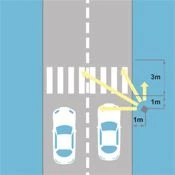
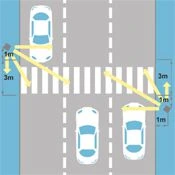
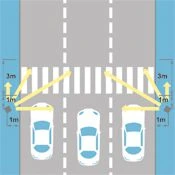
Install the luminaires 1 m from the crossing, at a height of 5 to 6 m.
- one luminaire can light a crossing over a 2-lane road if traffic is one-way;
- with two-way traffic you need at least 2 luminaires, so that the contrast is positive for traffic in both directions;
- a 3-lane one-way road takes two luminaires, one on each side.
Installation layout
Examples of system kits
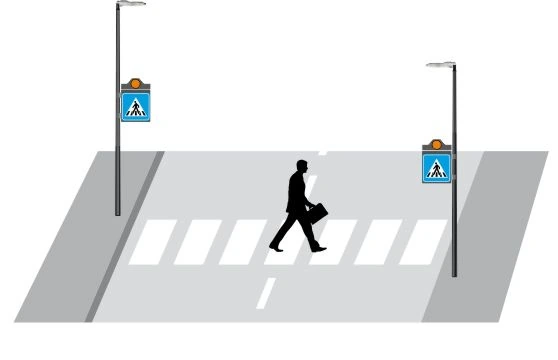
Kit 1: 2 luminaires, 2 road signs 60×60 with LED backlight, 2 yellow flashing signals, 2 galvanised steel poles.
Kit 2: 2 luminaires, 1 road sign 90×90 with LED backlight, 1 yellow flashing signal, 1 galvanised steel pole, 1 galvanised steel pole with a bracket.
Kit 3: 2 luminaires, 2 road signs 90×90 with LED backlight, 2 galvanised steel poles with a bracket.
Kit 4: 1 luminaire, 1 road sign 90×90 with LED backlight, 1 galvanised steel pole with a bracket.
Kits and structures are described in more detail in the catalogue Pedestrian Crossing Lighting Systems.
Examples of system kits
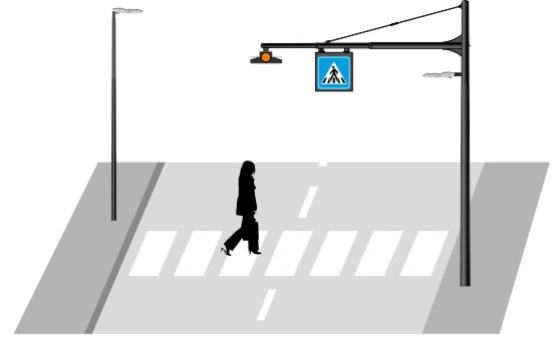
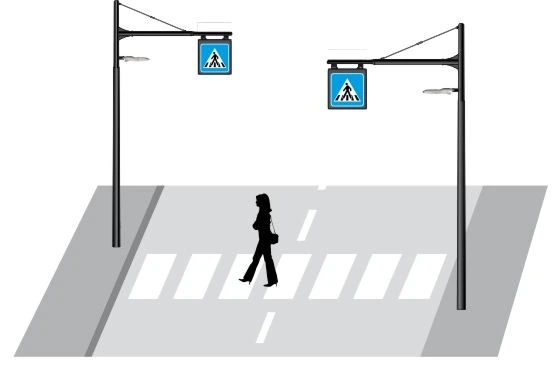
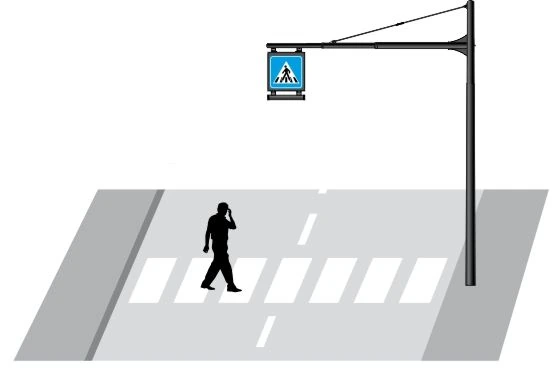
Example: poles at a crossing
Illustrative case: two-way traffic, a crossing 4 m wide with its axis at the 60 m mark along the road, so the crossing edges are at 58 and 62 m. Regular street poles stand at the 30, 60 and 90 m marks. We replace the pole at 60 m with two crossing poles and place them 1 m from the crossing edges. The pole at 57 m serves traffic coming from the 30 m side, and the pole at 63 m serves the opposite direction: each lights the crossing and the pedestrian waiting area from the side the traffic approaches from.
| What we determine | Calculation | Result |
|---|---|---|
| Crossing poles, 1 m from the edge | 60 ± (4 ÷ 2 + 1) | 57 and 63 m |
| Distance between the crossing poles | 63 − 57 = 4 + 2 × 1 | 6 m |
| Gaps to the regular poles | 57 − 30 and 90 − 63 | 27 and 27 m |
The example is illustrative: a lighting calculation determines the final pole positions.
Checklist and common mistakes
- before ordering, establish the traffic direction, the number of lanes, the crossing width, the space for a pole and the position of the regular poles;
- requirements for at-grade pedestrian crossings come from the current text of DBN V.2.5-28:2018 with Amendment No. 1 (street lighting standards);
- mistake: a luminaire directly above the crossing instead of asymmetric optics on the side the traffic approaches from;
- mistake: one luminaire on a two-way road, which gives no positive contrast for the opposite direction;
- mistake: crossing poles added without checking the gaps to the regular poles.
Updated:
Pedestrian crossing lighting: frequently asked questions
How high should the luminaires be mounted at a pedestrian crossing?
5–6 m above ground and about 1 m from the crossing. From there the light reaches the pedestrian at the right angle from the driver’s side.
Is an ordinary street luminaire above the crossing enough?
No. An ordinary luminaire lights the road evenly, while a crossing needs an accent: high vertical illuminance on the pedestrian (Ev ≥ 40 lux) and high horizontal illuminance on the crossing itself (Eh ≥ 80 lux). Asymmetric optics delivers both.
How many luminaires do I need for a crossing over a two-lane road?
It depends on the direction of traffic. One luminaire is enough for one-way traffic; two-way traffic needs at least two, to create contrast for drivers in both directions.
Do I need a road sign and a flashing signal along with the crossing lighting?
They make the crossing easier to see, especially after dark, so they often come in the kit: a steel pole, a luminaire, a 60×60 or 90×90 cm LED-backlit road sign and, where needed, a flashing signal. Example kits are given above; more detail is in the catalogue Pedestrian Crossing Lighting Systems.
Should the light at a crossing be warm or cool?
Cool white (CRI ≥ 65). It contrasts better with the typically yellowish light of sodium lamps on the adjacent road, where those are used.
What if a regular street lighting pole stands right at the crossing?
It is better not to leave the luminaire above the crossing: replace the pole with crossing poles with asymmetric optics (for two-way traffic, one for each direction) and check the gaps to the neighbouring poles by calculation.
What is the distance between the crossing poles along the road?
If the poles stand 1 m from the crossing edges, the distance is the crossing width plus 2 m: 6 m for a crossing 4 m wide. In the diagram in the catalogue the poles stand about 2.5 m from the crossing axis, so about 5 m apart, which matches a crossing roughly 3 m wide. These are guide values: the exact figure depends on the crossing width and comes from a lighting calculation.
Related products: Street lighting columns · Traffic signal poles with cantilever arm
Read also: Installation of Multi-sided Poles and Masts · Solar Street Lighting · Power Line Pole Types by Purpose: Suspension, Tension, Angle, Terminal · Cross-arms for 0.4–10 kV Lines: TM and TN Types, Reading the Designation
Get a quote for your requirements
Send us your requirements — we will calculate the price and lead time.