
Home / Services / Hot-dip galvanising / Hot-dip, Electro- or Cold Galvanising: Which to Choose
Hot-dip galvanising
Hot-dip, Electro- or Cold Galvanising: Which to Choose
Zinc can be applied to steel in three ways, and the results differ in coating thickness and service life. Below is a comparison, and the reason poles and steel structures are hot-dip galvanised.
Contents
- Three galvanising methods
- Comparison by key characteristics
- When we use each method
- Example: how many years the coating lasts
- Which method to choose: a situation-by-situation guide
- What to state in your enquiry so the method can be chosen
- How many uncoated areas can be repaired with paint: an example
- Typical mistakes when choosing
Three galvanising methods
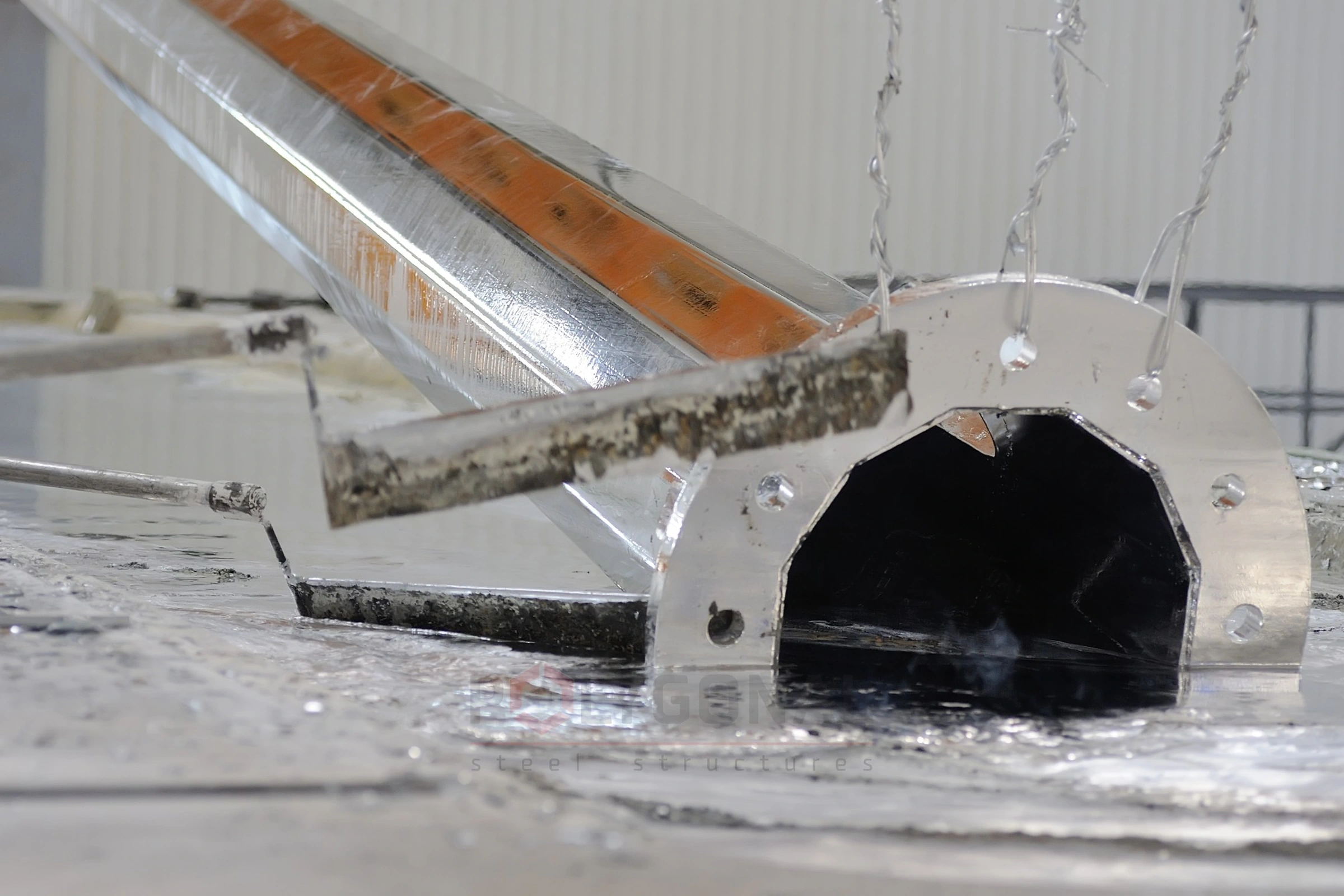
- hot-dip galvanising: the article is dipped in a bath of molten zinc at about 450 °C, the zinc diffuses into the surface layer of the iron, and the result is a thick coating firmly bonded to the steel;
- electro-galvanising: zinc is deposited on the surface by electrolysis from an aqueous solution of zinc salts. The coating is thinner than hot-dip but more even in thickness;
- cold galvanising: a paint with a high zinc-dust content, applied like ordinary paint with a brush, roller or spray. The layer is thin and does not last as long as a true metallic coating.
Comparison by key characteristics
These are general differences, not tied to a specific article: actual thickness and service life depend on operating conditions.
| Parameter | Hot-dip galvanising | Electro-galvanising | Cold galvanising |
|---|---|---|---|
| Coating thickness | greatest, depends on steel thickness (see the article on coating thickness) | thin, even in thickness | thin, uneven |
| Protection mechanism | barrier and anodic | mostly anodic (thin layer) | mostly barrier |
| Outdoor durability | highest (decades) | lower than hot-dip | lowest, needs periodic renewal |
| Article size limit | size of the galvanising bath | size of the electrolysis bath | none — can be applied on site |
| Typical use | structures that work outdoors for decades: poles, fences, frames | small fasteners and precision parts, where a thick layer would hinder assembly or threading | repair of hot-dip coating damage after installation or welding on site |
For critical outdoor steel structures (poles, masts, gantries) the industry standard is specifically hot-dip galvanising to DSTU EN ISO 1461:2024.
When we use each method
We hot-dip galvanise poles and steel structures in our own bath to DSTU EN ISO 1461:2024. For structures that stand outdoors for decades, this is the usual protection. Cold galvanising (zinc-rich paint) is used for repairs: welds and damage caused during installation on site. The hot-dip standard itself provides for repairing small defects this way.
Example: how many years the coating lasts
Take a pole with a 4 mm wall in an urban atmosphere. That is corrosivity category C3 under ISO 9223, where zinc loses 0.7–2.1 µm a year. Divide the coating thickness by that rate, as in the article Hot-dip Galvanising Service Life. For hot-dip we use 70 µm, the minimum mean thickness for such a wall in the DSTU EN ISO 1461:2024 table. Electro-galvanised layers under ISO 2081 are usually specified at 5 to 25 µm, so we take the upper limit of 25 µm and a common 12 µm.
| Coating | Thickness, µm | Indicative life in C3, years |
|---|---|---|
| Hot-dip galvanising | 70 | 33–100 |
| Electro-galvanising, 25 µm | 25 | 12–36 |
| Electro-galvanising, 12 µm | 12 | 6–17 |
The calculation (thickness ÷ zinc loss rate) is indicative, not a guarantee. It does not account for passivation of the electro-galvanised layer, and it is not applied to zinc-rich paint.
Which method to choose: a situation-by-situation guide
Start with where the article will work and whether it fits in the bath (ours is 13,000 × 1,600 × 3,200 mm). Compare costs only after that.
| Situation | What to choose | Why |
|---|---|---|
| A pole, mast, gantry or fence in the open | hot-dip galvanising | the thickest coating: for a 4 mm wall the mean thickness is at least 70 µm |
| Bolts, nuts, washers | indoors — electro-galvanising; outdoors — hot-dip galvanising to ISO 10684 (M8–M64) | a hot-dip layer is always over 40 µm, so threads are made to special limits: the nut is tapped after galvanising (or the bolt thread is cut undersize before galvanising) |
| Scratches, chips, welds after installation | cold galvanising (zinc-rich paint) | applied on site with no bath; it repairs a spot and is not the main protection |
| Industrial zone, coast (C4–C5) or a colour is needed | duplex: hot-dip galvanising plus paint | protection can be roughly twice as long as galvanising alone |
What to state in your enquiry so the method can be chosen
So that we do not have to come back with questions, put this in your enquiry:
- where the article will work: indoors or outdoors, and if outdoors, in a city, an industrial zone or near the sea (this sets category C3 or C4–C5);
- the wall thickness of each part, since the minimum hot-dip coating thickness depends on it;
- the size of the largest element: hot-dip galvanising is limited by the size of the bath;
- whether it will be painted or a particular colour is needed. If so, ask for a duplex system straight away;
- for bolts and nuts: diameter, property class and service conditions;
- whether there are threads or mating surfaces where a thick layer is not acceptable.
How many uncoated areas can be repaired with paint: an example
Uncoated areas found after galvanising and before shipment are repaired with zinc-rich paint under DSTU EN ISO 1461:2024, provided each one is no larger than 10 cm² and together they take up no more than 0.5% of the surface. Take an article with a surface area of 10 m² (100,000 cm²): 0.5% of that is 500 cm², so up to 50 areas of 10 cm² each. The mean thickness of the repair layer is at least 100 µm unless another is agreed. With more areas, or larger ones, the article is normally re-galvanised (see thickness checks and acceptance).
Typical mistakes when choosing
- choosing cold galvanising for new poles “to be quicker”. It is less durable than a metallic coating and will have to be renewed, which is awkward on a tall mast;
- choosing electro-galvanising for an outdoor structure just because it looks smooth. The layer is roughly 3–6 times thinner than hot-dip (25 and 12 µm against 70 µm in the example above), so in the same environment it lasts much less;
- patching uncoated areas with paint beyond the permitted limits, meaning over 10 cm² each or over 0.5% of the surface together: under the standard, that is already a reason to re-galvanise;
- forgetting to mention painting after galvanising: surface preparation for a duplex system is agreed in advance.
Before you send an enquiry, check the design against Designing for Hot-dip Galvanising and Preparing for Galvanising. The cost can be estimated in the calculator.
Updated:
Galvanising methods: frequently asked questions
What is the difference between hot-dip and electro-galvanising?
Mainly the thickness of the layer and how long it lasts outdoors. Hot-dip gives a much thicker coating with both barrier and anodic protection, while electro-galvanising gives a thinner, more even layer that is more often used on small fasteners and precision parts.
Can I use cold galvanising instead of hot-dip?
Not for the main protection of outdoor steel structures. Cold galvanising gives a thinner, shorter-lived layer, so it is used to repair damage to a hot-dip coating, not as a stand-alone replacement on new structures.
Which type of galvanising lasts longest?
Hot-dip. Its layer is the thickest, and it protects both as a barrier and anodically. That is why it is the standard choice for poles, masts and structures that stay outdoors for decades.
Can I tell hot-dip, electro- and cold galvanising apart by eye?
Start with the surface, but what reliably separates hot-dip from electro-galvanising is thickness. Electro-galvanising is thin, smooth and most often bright. Hot-dip is thicker and less even, anything from bright to matt grey depending on the steel, sometimes with drips near the edges. Cold galvanising looks like matt grey paint with brush or roller marks. Thickness is measured with a magnetic gauge: under DSTU EN ISO 1461:2024 the minimum mean thickness of a hot-dip coating is 45 to 85 µm depending on the steel thickness, while electro-galvanising as a rule does not exceed 25 µm. Zinc-rich paint can have a similar thickness, so it is told apart by appearance alone.
Can high-strength bolts be electro-galvanised?
Only with extra treatment. For parts made of steel with a tensile strength of 1,000 MPa or more, and for surface-hardened parts, the standard for electroplated zinc coatings, ISO 2081, provides for a heat treatment after plating. It drives out the hydrogen that entered the steel during galvanising and makes it brittle. Fasteners are also covered by ISO 4042, where the need for such a heat treatment (baking) depends on hardness. So state the property class of the fastener in your enquiry. Hot-dip galvanising of bolts under ISO 10684 covers property classes up to and including 10.9 (nuts: up to 12).
Related products: Hot-dip galvanising
More on this topic: Hot-dip Galvanising Process: Steps and Requirements · Hot-dip Galvanising Defects: Causes and Prevention · Zinc Coating Thickness under DSTU EN ISO 1461:2024 · Zinc Coating Defects: Runs, Grey Coating, Detachment and Black Spots · How to Prepare a Steel Structure for Hot-dip Galvanising: Checklist · Designing Steel Structures for Hot-dip Galvanising: Holes, Welds, Stress
Get a quote for your requirements
Send us your requirements — we will calculate the price and lead time.