
Home / Services / Hot-dip galvanising / How to Prepare a Steel Structure for Hot-dip Galvanising: Checklist
Hot-dip galvanising
How to Prepare a Steel Structure for Hot-dip Galvanising: Checklist
The quality of hot-dip galvanising depends not only on the plant’s process but on how the structure was designed, welded and prepared before shipping. We collected the main requirements into one checklist.
Contents
- At the design stage
- Choosing the steel
- Before sending for galvanising
- Distortion, hanging points and delivery to the plant
- What happens at the plant
- What pickling removes and what must be cleaned off before shipping
- Example: checking the thickness ratio in an assembly
- What to do before galvanising and what to tell the plant
At the design stage
- avoid closed cavities and pockets: every internal volume needs holes for liquids, molten zinc and gases to enter and exit — a structure with a fully closed cavity may not be galvanised (risk of explosion on immersion in the molten metal);
- round sharp corners and edges to a radius of at least 0.3 mm, unless the part’s technical requirements say otherwise;
- design welded joints as butt joints, double-sided welds, or single-sided welds with back-welding — lap joints (plate on plate without welding through the edge) cannot be galvanised;
- for hollow parts of complex shape, plan a trial galvanising of a sample before the full batch.
Choosing the steel
- most structural steels can be galvanised: carbon steels, fine-grained steels, hot- and cold-formed hollow sections; stainless steel and steels with a raised sulphur content are not suitable;
- silicon and phosphorus influence the look and thickness of the coating most: with silicon below 0.03% and phosphorus below 0.02% the coating is thin and bright, at 0.14–0.25% silicon it is bright or matt, and in the ranges 0.03–0.14% and above 0.25% it comes out thicker, darker and rougher;
- keep to a single steel grade within one structure — this gives a more even coating appearance.
Before sending for galvanising
- the surface must be free of paint, grease, metal shavings, welding slag, foundry sand and graphite residue (for cast parts) — all of this is removed before pickling, otherwise the coating may show defects;
- welds must be even, dense and continuous along their full length, without pores or inclusions;
- cast parts must have no pores or shrinkage cavities;
- include drawings or photos with your order — we check the structure for closed cavities and problem spots before galvanising.
Distortion, hanging points and delivery to the plant
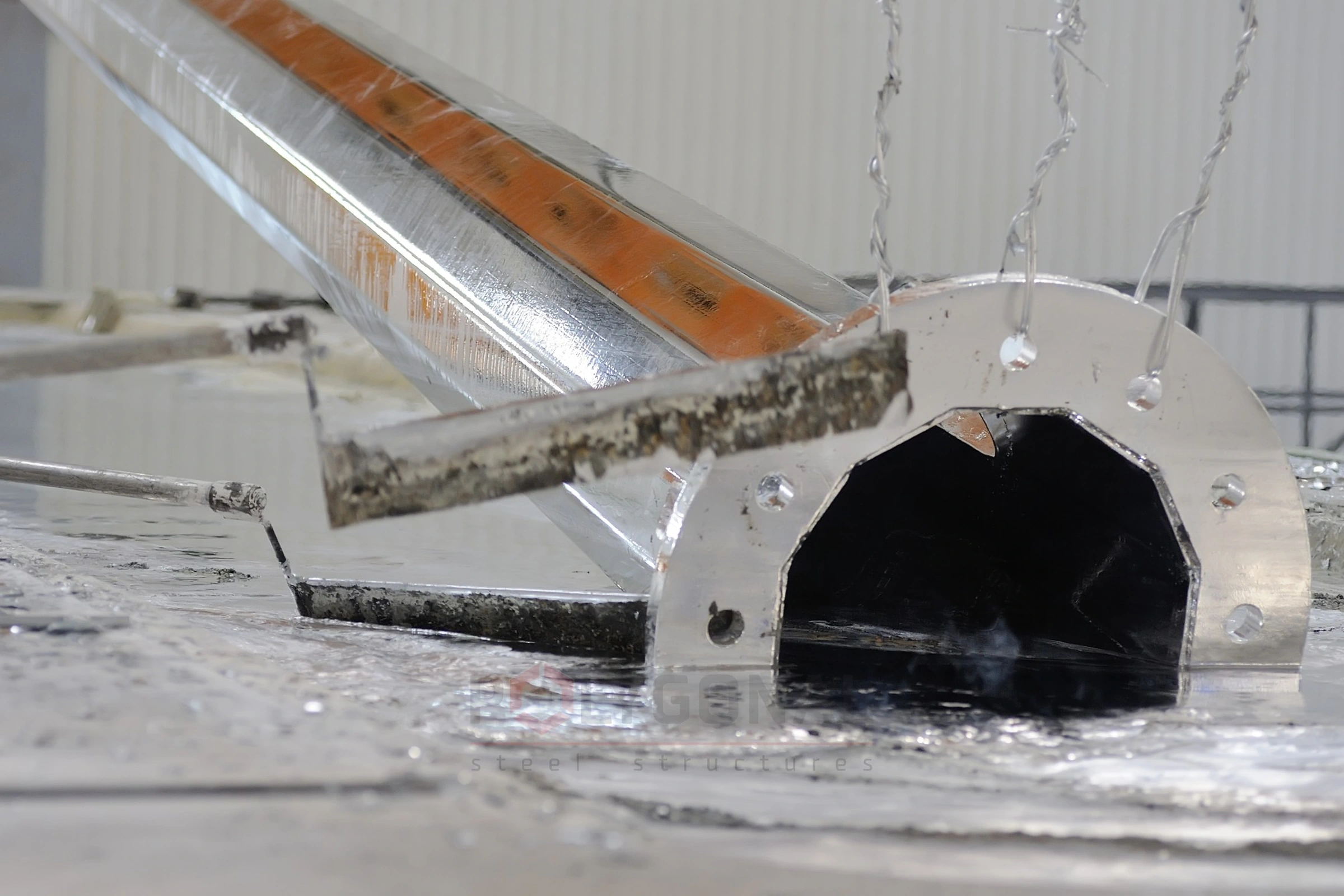
- plan the hanging points: in the bath the part hangs from slings or hooks, so holes or lugs must sit where the part will not sag under its own weight;
- leave pipe branches and stubs open: a cap blocks the path of the zinc and traps air or liquid inside;
- welding, stamping and rolling leave residual stress in the metal; in the hot bath it relaxes and the part may twist, so such parts are best stress-relieved by heat treatment before galvanising;
- do not combine very thick and very thin metal: the bigger the thickness difference in a welded assembly, the more unevenly the metal heats and cools in the melt, and the higher the chance of warping; for welded assemblies we ask for a ratio of the greatest to the smallest thickness of no more than 5:1;
- tell the steel supplier that the finished structure will be galvanised — they can choose rolled steel with a suitable chemical composition;
- we unload and load vehicles with a crane or a loader; unloading by hand is not acceptable.
What happens at the plant
Degreasing, pickling, rinsing, fluxing, drying, immersion in molten zinc at ~450 °C, cooling, passivation, and a check of coating thickness and appearance. For details on every step and the full technical requirements, see the article Hot-dip Galvanising Process.
What pickling removes and what must be cleaned off before shipping
In the pickling bath the acid removes rust and mill scale (iron oxides) but does not dissolve paint, slag or thick grease. So check the surface against this list before shipping:
| On the surface | Does pickling remove it | What to do before shipping |
|---|---|---|
| Rust, mill scale | yes | usually no need to clean it separately; remove rolled-in scale and burrs |
| Paint and lacquer, marks made with a wax crayon or an oil-based marker | no | remove completely: abrasive blasting, grinding or a special paint stripper |
| Welding slag and spatter | no | chip off and clean |
| Thick grease | no (degreasing takes off a thin film) | remove the thick layers |
| Silicone anti-spatter sprays, labels, glue | no | use water-soluble sprays free of silicone and oil; remove labels and glue |
Residues on the surface leave uncoated areas, even when they are only barely visible films of slag or spray. Surfaces left by flame, laser or plasma cutting should be ground, and sharp edges removed, before shipping: cutting changes the composition and structure of the steel near the edge, so the minimum zinc thickness is harder to reach there and the coating may adhere less well.
Example: checking the thickness ratio in an assembly
Divide the greatest metal thickness in a welded assembly by the smallest: we ask for this ratio to be no more than 5:1. Illustrative examples:
| Assembly | Thicknesses, mm | Ratio | Conclusion |
|---|---|---|---|
| Rib on a pipe wall | 12 and 3 | 12 ÷ 3 = 4:1 | within 5:1 |
| Plate bracket on a pipe wall | 15 and 3 | 15 ÷ 3 = 5:1 | at the limit, no margin |
| Plate bracket on a pipe wall | 20 and 3 | 20 ÷ 3 ≈ 6.7:1 | over 5:1: agree with the plant |
| Cover plate on an angle | 8 and 6 | 8 ÷ 6 ≈ 1.3:1 | small difference |
The numbers are illustrative. The 5:1 ratio is our practical guide for welded assemblies, not a numerical requirement of any standard: the ISO 14713-2 guidance only advises avoiding large differences in thickness, for example a thin sheet welded to thick angles, and favouring symmetric sections. Even within 5:1, a thin element welded to a thick one remains an area of higher warping risk. If the ratio exceeds 5:1, consider before fabrication a more symmetric section, a smaller difference in thickness, or splitting the assembly into parts that are galvanised separately and bolted together.
What to do before galvanising and what to tell the plant
Carry out welding, cutting and hole-making (vent holes included) before galvanising: these operations damage a finished coating, and the spot would then need repair. The plant repairs uncoated areas with zinc-rich paint or paste, zinc spraying or a zinc alloy stick, but the standard limits their size: each area up to 10 cm², no more than 0.5% of the article’s surface area in total; otherwise the part is galvanised again unless agreed otherwise. More detail is in the article Zinc Coating Thickness under DSTU EN ISO 1461:2024. Together with the drawing, tell the plant:
- the steel grade and, if you have one, the quality document for the rolled steel: the appearance and thickness of the coating depend on the steel composition;
- whether the part has surfaces left by flame, laser or plasma cutting;
- the significant surfaces, meaning those where the coating matters most for service or appearance: it helps to mark them on the drawing;
- the places where hanging marks, drips and runs of zinc are unacceptable: these are discussed in advance so that the hanging points can be chosen;
- whether the part will be painted after galvanising: the surface requirements are then agreed separately;
- the three overall dimensions, flanges and brackets included: the bath is 13,000 × 1,600 × 3,200 mm (length × width × depth), and longer products are galvanised in sections or, by separate agreement, in two dips; the allowance for hanging is checked against the drawing.
Updated:
Preparing for galvanising: frequently asked questions
Can a painted or greasy part be galvanised?
No, paint, grease and any other surface film must be removed beforehand — they interfere with pickling and fluxing and cause coating defects.
Can a closed pipe without holes be galvanised?
No. A fully closed cavity may not be galvanised — air and moisture trapped inside can cause an explosion on immersion in the molten metal. Holes are needed for liquids and gases to enter and exit.
Which steel is best for galvanising?
Most structural steels are suitable. A thin, bright coating comes from steel with silicon below 0.03% and phosphorus below 0.02% (or with silicon at 0.14–0.25%); at 0.03–0.14% and above 0.25% silicon the coating is thicker and rougher. Stainless steel and steels with a raised sulphur content should not be galvanised.
Can lap-welded joints be galvanised?
No, lap joints (without welding through the edge) are not suitable for galvanising — butt, double-sided, or single-sided welds with back-welding are needed.
Why might a part warp after galvanising?
The causes are residual stress left by welding or stamping, and uneven heating of elements of different thickness in the melt (about 450 °C). That is why stress is relieved by heat treatment beforehand and in welded assemblies the ratio of the greatest to the smallest thickness is kept to no more than 5:1.
Do I need holes for hanging the part?
Yes. The part is dipped into the bath on a hanger, so provide holes or lugs in places that keep the part from deforming under its own weight.
Can a lap joint be galvanised if it cannot be replaced with a butt joint?
Yes, but only under certain conditions. A small overlap area (up to 100 cm²) is closed with a continuous weld around the contour, with no breaks or pinholes, and the parts must be dry and fit together without gaps; a larger area needs vent holes. The answer “no” to the question about lap-welded joints applies to a joint without a closed weld or holes: liquid from the pre-treatment baths stays between the plates and turns to steam in the molten zinc. The number and size of holes for each area are given in the article Designing Steel Structures for Hot-dip Galvanising; it is best to agree the exact solution with the plant.
How do I mark parts so they can be told apart after galvanising?
Do not use oil-based paint, lacquer, a wax crayon or an oil-based marker: the acid does not remove them, and uncoated areas remain under them. For a permanent number it is more reliable to stamp it with a centre punch or a marking stamp (on critical members, agree this with the designer), or to wire a steel tag with a stamped number to the part: the tag must hang loosely so that the coating also forms beneath it. Water-soluble markers wash off during preparation, so they suit only temporary marks made before galvanising and cannot be used to tell finished parts apart. Agree the marking method with the plant.
Related products: Hot-dip galvanising
More on this topic: Hot-dip Galvanising Process: Steps and Requirements · Hot-dip Galvanising Defects: Causes and Prevention · Zinc Coating Thickness under DSTU EN ISO 1461:2024 · Zinc Coating Defects: Runs, Grey Coating, Detachment and Black Spots · Hot-dip, Electro- or Cold Galvanising: Which to Choose · Designing Steel Structures for Hot-dip Galvanising: Holes, Welds, Stress
See also: Hot-dip Galvanising
Get a quote for your requirements
Send us your requirements — we will calculate the price and lead time.