
Home / Services / Hot-dip galvanising / Hot-dip Galvanising Process: Steps and Requirements
Hot-dip galvanising
Hot-dip Galvanising Process: Steps and Requirements
The steps of hot-dip galvanising, the requirements for articles to be galvanised and how the chemical composition of the steel affects the look of the coating.
Contents
The hot-dip galvanising process
So that articles can be moved during galvanising, they are fixed to special crossbeams. Before galvanising the articles are chemically treated: the surface must be clean. The steps are:
- degreasing: before pickling (chemical removal of oxides, without which galvanising is impossible), oily and greasy substances are removed from the surface;
- pickling: iron oxides are removed with an acid containing a corrosion inhibitor, which stops the metal from dissolving once the oxide is gone;
- rinsing: the acid solution is fully removed in a water bath;
- fluxing: treatment in a hot liquid solution of zinc/ammonium chloride to prepare the metal for the reaction with molten zinc and to prevent oxide forming during drying;
- drying: the articles are placed in a chamber with circulating hot air at about 100 °C; the material dries and warms up, which reduces thermal shock on immersion in zinc;
- galvanising: immersion in zinc with a pure zinc content of at least 98.5% at about 450 °C; additions of aluminium or other elements are allowed depending on the requirements;
- cooling: by immersion in hot water, only for articles of a design that will not deform or fail;
- passivation: treatment with a chromium-free solution of organic salts prevents the white deposit of zinc oxide that forms when articles are stored in damp, unventilated rooms; drying at 70 °C before packing;
- inspection: the thickness and appearance of the coating are carefully assessed with simple physical and laboratory tests (thickness, uniformity, adhesion, appearance).
The requirements for the coating are set by DSTU EN ISO 1461:2024.
Hot-dip galvanising
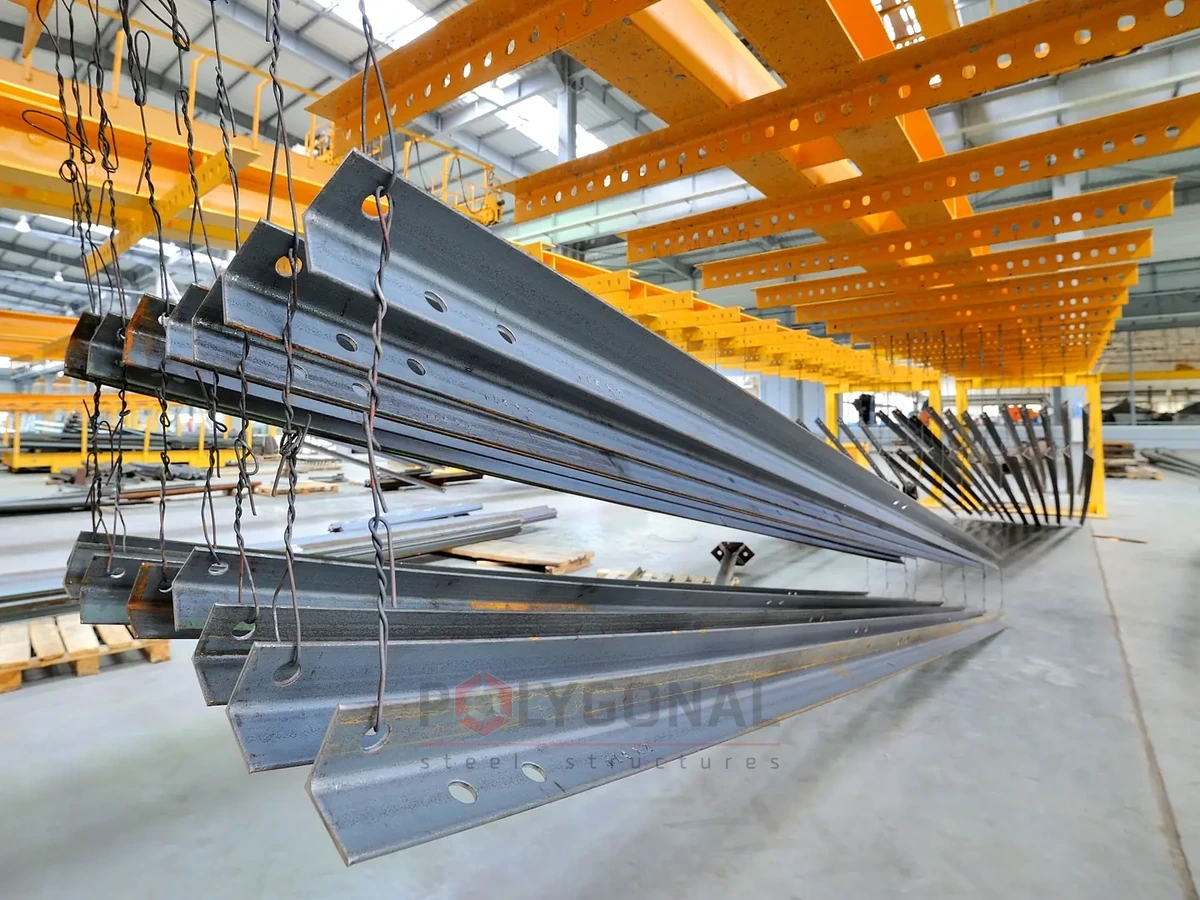
Products hanging on the hot-dip galvanising line
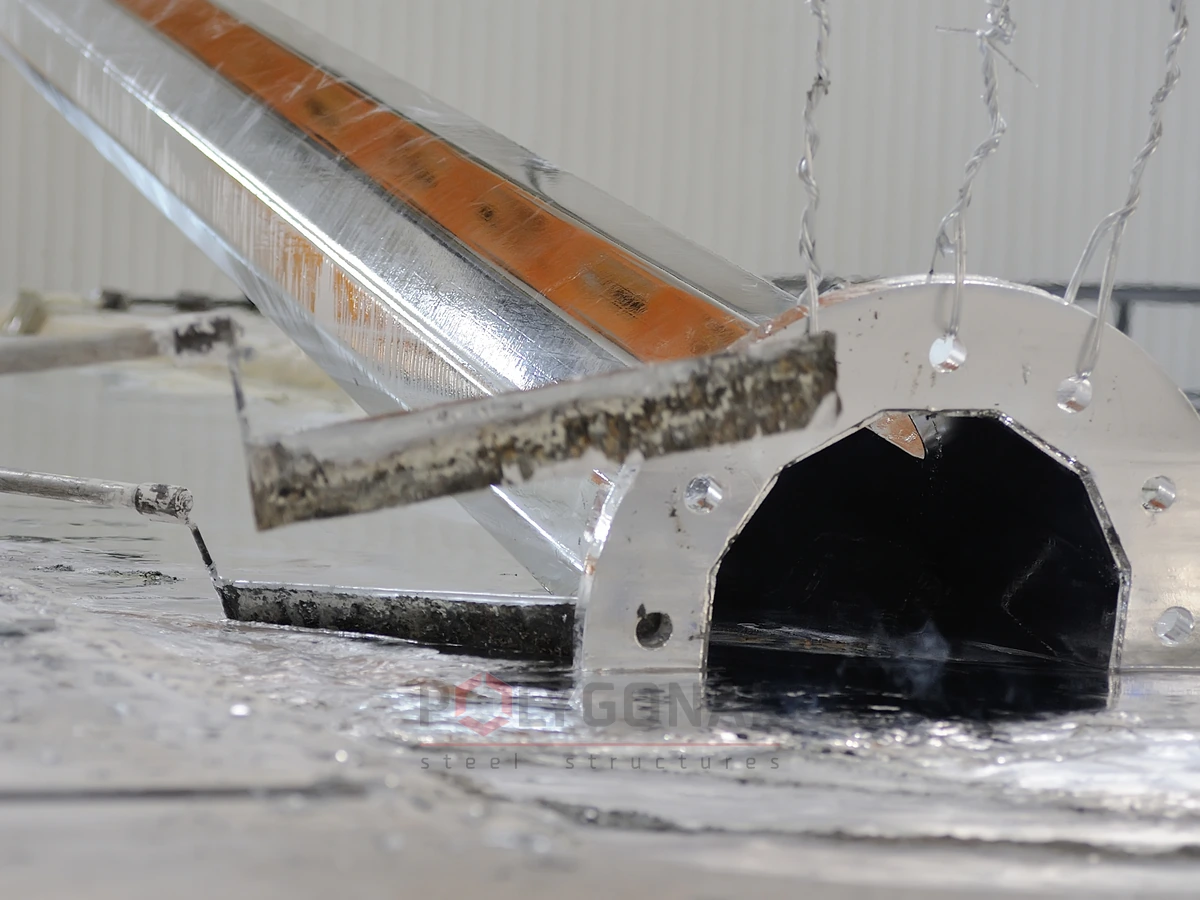
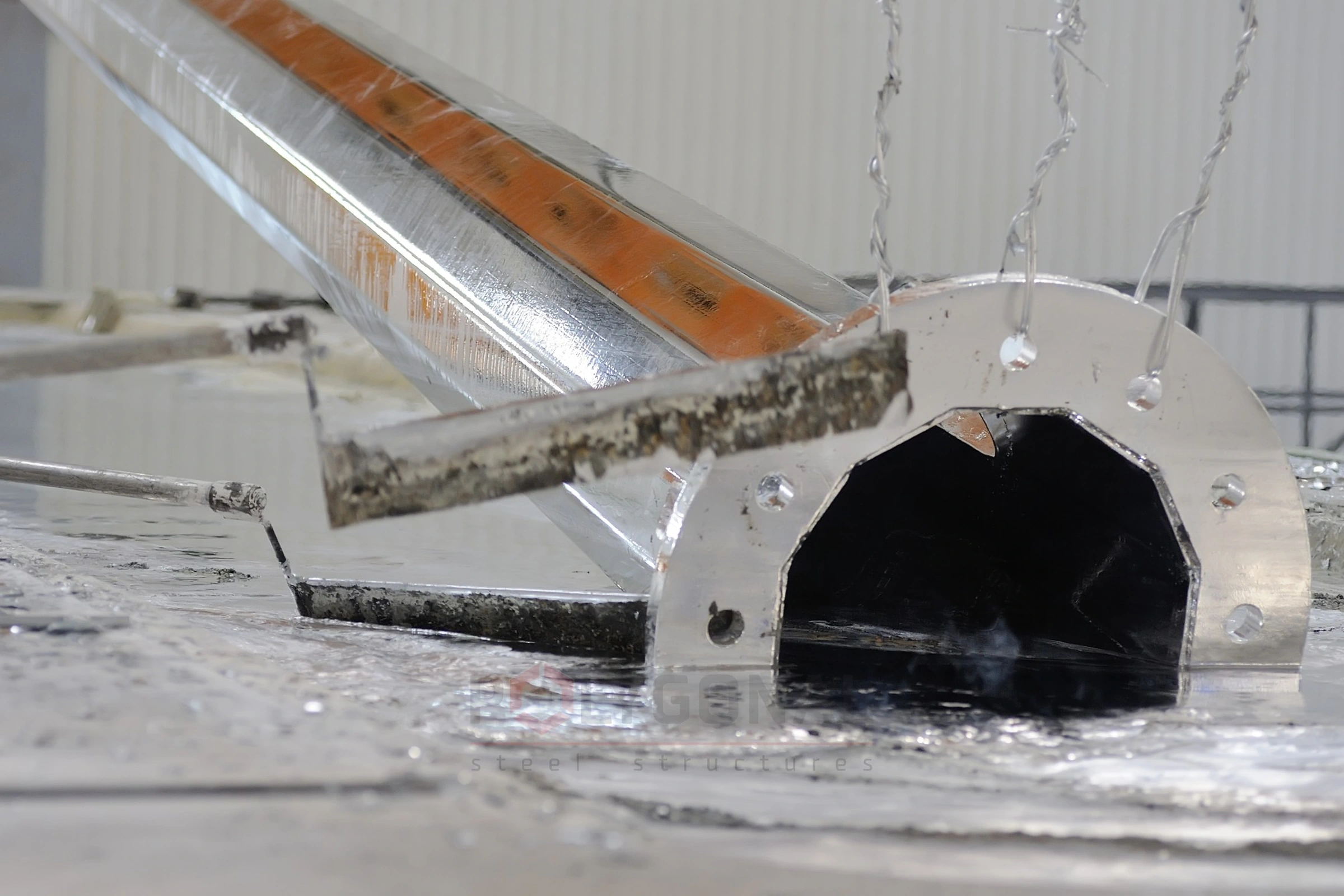
Hot-dip galvanising: products above the molten zinc bath
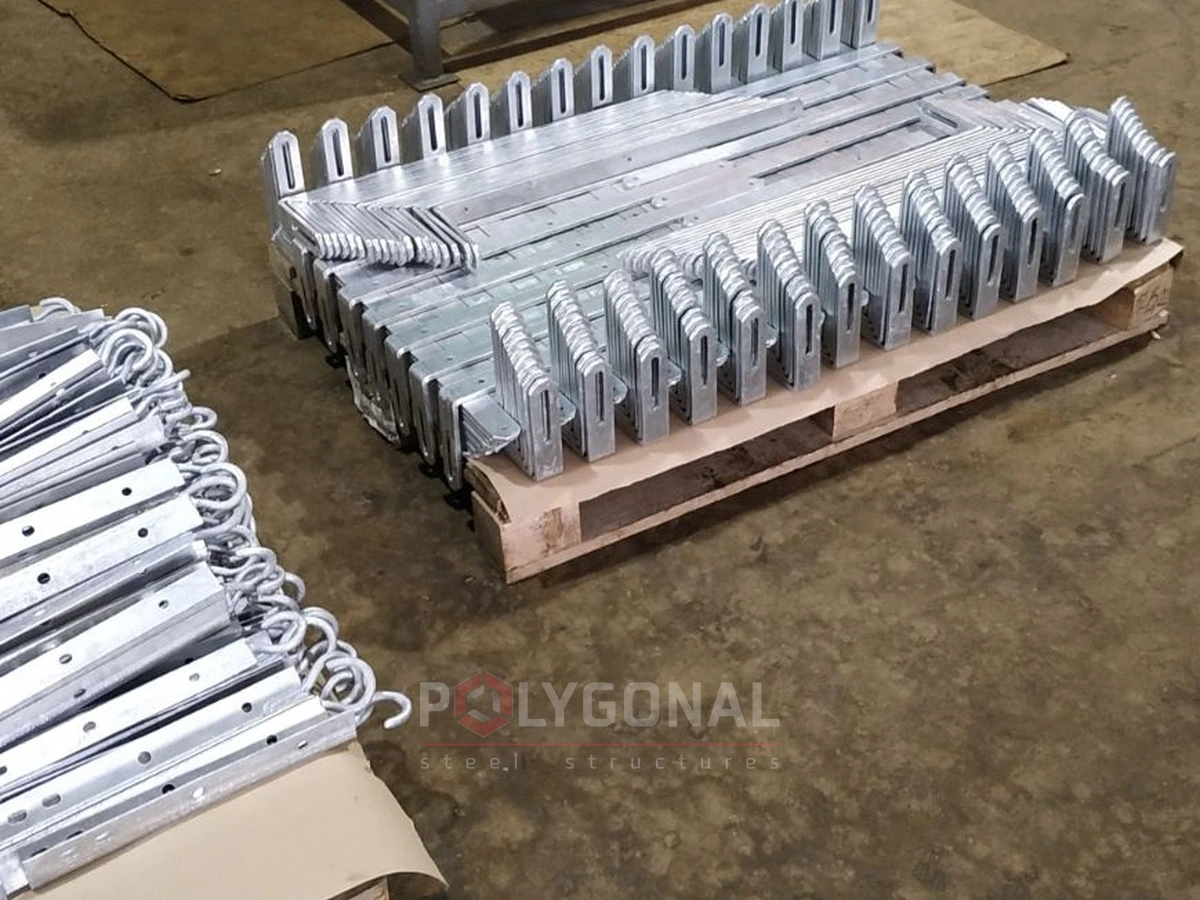
Galvanised products prepared for shipment
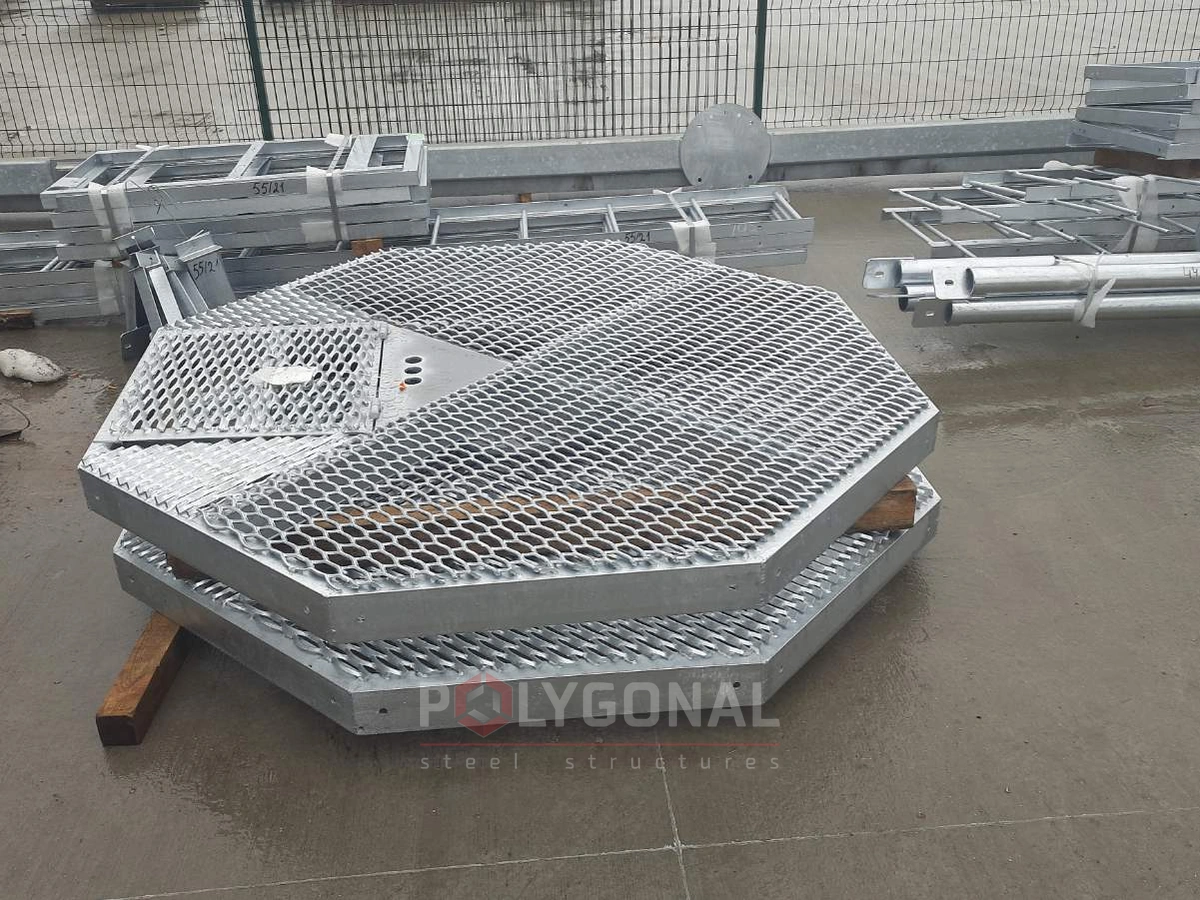
Galvanised steel grating
Requirements for articles to be galvanised
The structures must have no pockets, closed cavities or air pockets: all cavities must be open for the free entry and exit of liquids, molten zinc and gases. Hollow articles and articles of complex shape are given a trial galvanising. To avoid explosion, articles with closed cavities must not be galvanised.
Structural elements are welded butt, with double-sided welds or with a one-sided weld with a backing run. Lap-welded joints are made with a closed seam round the contour (for a small overlap area) or with vent holes; an open lap must not be galvanised, because liquids from the preparation baths stay between the plates. See Designing for hot-dip galvanising. Requirements for the surface of the parent metal:
- no folded scale, burrs, pores, inclusions, welding slag, residues of moulding sand, graphite, grease, metal swarf or marking paint;
- cast articles must have no pores or shrinkage cavities on the surface;
- welds must be even, dense and continuous along their whole length;
- sharp corners and edges are rounded to a radius of at least 0.3 mm, except in technically justified cases;
- the surface is cleaned by degreasing and pickling and then fluxed.
Chemical composition of the steel
For the best coating, blanks of low-carbon steel are used. Steel composition, above all silicon and phosphorus, affects the appearance and thickness of the coating: with silicon below 0.03% and phosphorus below 0.02% the coating is thin and bright, while at silicon of 0.03–0.14% or above 0.25% it is thicker, darker and rougher. It is best to use steel of one grade to get a better appearance. Alloy steels can be galvanised too; see the preparation checklist for choosing the steel.
How the appearance of the zinc coating depends on the chemical composition of the steel:
| Si, % | P, % | Steel reactivity | Appearance |
|---|---|---|---|
| 0–0.04 | 0–0.025 | normal low | no defects, glossy smooth coating |
| 0–0.04 | 0.025–0.035 | normal | some defects possible |
| 0–0.04 | > 0.035 | high | roughness, tendency to flake |
| 0.04–0.135 | < 0.01 | moderate | normal or with minor defects |
| 0.04–0.135 | > 0.01 | high | small defects |
| 0.04–0.135 | < 0.03 | high | normal or with minor defects, thicker coating |
| 0.04–0.135 | > 0.03 | very high | tendency to flake |
| > 0.35 | > 0 | very high | tendency to flake |
A short practical checklist for customers covering all these requirements: How to Prepare a Steel Structure for Hot-dip Galvanising.
Steel grade: why the same grade can give different coatings
The composition of steel within one grade varies, and silicon strongly affects how zinc reacts with it. Approximate silicon content from reference data (the effect of silicon and phosphorus is described above, in the section on the chemical composition of the steel):
| Grade | Silicon, % | What to expect from the coating |
|---|---|---|
| St3kp (rimmed) | up to 0.05 | the lowest silicon-related reactivity of these grades; the coating is usually the thinnest |
| St3ps (semi-killed) | 0.05–0.15 | increased reactivity; the coating is usually thicker and darker |
| St3sp (killed) | 0.15–0.30 | the coating is bright or matt; above 0.25% silicon it is thicker and rougher |
| 09G2S | 0.5–0.8 | high reactivity; the coating is usually thicker, darker and rougher, and when it is very thick the risk of flaking rises |
The values are for reference; check the actual composition, including for S245 and S345, in the quality documents supplied with the steel. For St3kp in rolled sections, the standard for the steel grade allows a silicon content of up to 0.07%. Phosphorus also raises reactivity. The coating standard allows differences in appearance, so if appearance matters, agree it with the galvanising plant in advance.
How much mass the coating adds: an estimate
The coating adds mass to an article, which matters when choosing a crane and transport. DSTU EN ISO 1461:2024 sets a minimum mean coating thickness and the matching coating mass per unit area: 55 µm corresponds to about 395 g/m², 70 µm to 505 g/m² and 85 µm to 610 g/m². An example for plate coated on both sides (steel density 7,850 kg/m³, area of both faces of 1 tonne of plate ≈ 255 ÷ thickness in mm):
| Steel thickness, mm | Area per tonne, m² | Min. mean thickness, µm (g/m²) | Coating mass per tonne, kg | Approx. mass gain, % |
|---|---|---|---|---|
| 3 | 84.9 | 55 (395) | ≈ 34 | ≈ 3.4 |
| 4 | 63.7 | 70 (505) | ≈ 32 | ≈ 3.2 |
| 6 | 42.5 | 70 (505) | ≈ 21 | ≈ 2.1 |
| 10 | 25.5 | 85 (610) | ≈ 16 | ≈ 1.6 |
The calculation is approximate and does not take edges, welds and flanges into account. The actual thickness may exceed the minimum, especially on reactive steels, so the real gain may be higher. At the same time, the alloy layers of the coating contain iron from the steel, so the mass gain of the article is slightly less than the coating mass. The thinner the metal, the greater the coating’s share of the total mass.
What the coating standard covers and what it does not
DSTU EN ISO 1461:2024 applies to articles that are galvanised by dipping in molten zinc after fabrication. It does not apply to sheet, wire and mesh galvanised continuously, to tube and pipe galvanised in automatic plants, or to products for which specific standards exist, such as fasteners (ISO 10684): those standards may carry additional or different requirements. After-treatment and additional coatings, including painting over zinc (a duplex system), are also outside its scope.
So for welded structures, specify galvanising to DSTU EN ISO 1461:2024 in the design documents, cite the fastener standard for bolts and nuts, and agree any painting separately. For the thickness values, see the article Zinc Coating Thickness under DSTU EN ISO 1461:2024.
Updated:
Hot-dip galvanising process: frequently asked questions
What temperature does galvanising happen at?
About 450 °C, in a melt with a pure zinc content of at least 98.5%; additions of aluminium or other elements are allowed depending on the requirements.
Why is passivation needed after galvanising?
Treatment with a chromium-free solution of organic salts prevents the white deposit of zinc oxide that forms when articles are stored in damp, unventilated rooms.
Why can’t an article with a closed cavity be galvanised?
It is forbidden because of the risk of explosion: every cavity must be open for liquids, molten zinc and gases to enter and exit during immersion.
How does the steel composition affect the coating’s appearance?
The higher the silicon and phosphorus content, the higher the steel’s reactivity and the greater the chance of roughness or flaking — the detailed relationship is given in the table above.
How much heavier is a galvanised article than the same article before galvanising?
For plate galvanised on both sides at the minimum mean coating thickness, the mass gain ranges from roughly 1.6% for 10 mm steel to 3.4% for 3 mm steel (see the table above). The actual gain depends on the real coating thickness, which on reactive steels can be much greater than the minimum.
Can 09G2S steel be galvanised?
Yes, it can. It contains 0.5–0.8% silicon, so the coating is usually thicker, darker and rougher than on steel with little silicon. Darker areas are not in themselves grounds for rejection under DSTU EN ISO 1461:2024, but a very thick coating calls for more careful handling during transport, loading and unloading, and the risk of damage or flaking rises. It is therefore best to tell the galvanising plant the grade and composition of the steel in advance.
Related products: Hot-dip galvanising · Street lighting columns · Overhead power line masts
More on this topic: Hot-dip Galvanising Defects: Causes and Prevention · Zinc Coating Thickness under DSTU EN ISO 1461:2024 · Zinc Coating Defects: Runs, Grey Coating, Detachment and Black Spots · Hot-dip, Electro- or Cold Galvanising: Which to Choose · How to Prepare a Steel Structure for Hot-dip Galvanising: Checklist · Designing Steel Structures for Hot-dip Galvanising: Holes, Welds, Stress
Get a quote for your requirements
Send us your requirements — we will calculate the price and lead time.