
Home / Services / Hot-dip galvanising / Hot-dip Galvanising Service Life
Hot-dip galvanising
Hot-dip Galvanising Service Life
Hot-dip galvanising is among the most reliable ways to protect steel, but the coating does not last equally long everywhere. Below is what sets its service life and how to extend it.
Contents
How zinc protects steel
Zinc protects steel in two ways. The first is a barrier: the zinc layer keeps moisture and oxygen away from the metal.
The second is anodic protection. If the coating is scratched or damaged, the zinc corrodes in place of the steel, and its corrosion products seal small defects.
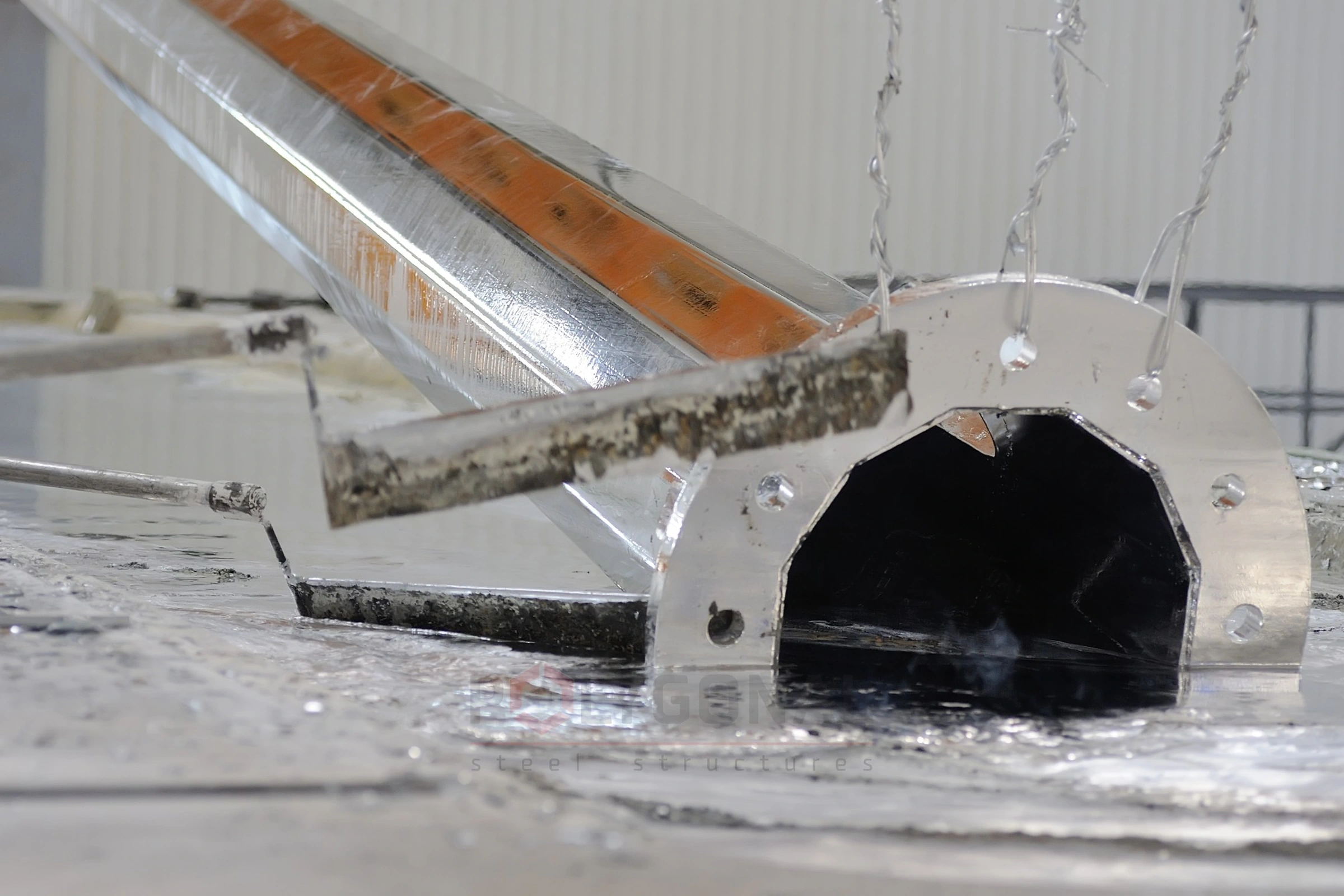
Adhesion comes from the process itself. In the molten zinc bath, zinc diffuses into the iron and builds strong Fe-Zn alloy layers, so the coating is bonded to the steel rather than just sitting on it.
What service life depends on
- environment: in rural air zinc loses thickness slowly, while in an industrial zone, near the sea or beside a road treated with de-icing salts it goes faster;
- coating thickness: under DSTU EN ISO 1461:2024 it depends on the steel thickness of the article, and a thicker layer lasts longer;
- operating conditions: humidity, contact with chemicals, mechanical wear, long-term soaking;
- workmanship: how the surface was prepared, whether closed cavities were avoided, and whether the coating was damaged during installation.
How to match a coating to the corrosivity category of the environment is covered in the international ISO 9223 and ISO 14713 series. For critical structures, ask for a calculation for your conditions.
Indicative service life by corrosivity category (ISO 9223)
ISO 9223 divides the atmosphere into corrosivity categories C1–C5, from the mildest to the most aggressive, and gives a typical annual zinc thickness loss rate for each. Take the coating thickness from the DSTU EN ISO 1461:2024 table (55–85 µm depending on the steel thickness of the article), divide it by that rate, and you get an indicative time to first maintenance. This is our own “thickness ÷ corrosion rate” calculation, not a value from the standard:
| Category | Typical environment | Zinc corrosion rate, µm/year | Indicative service life, years |
|---|---|---|---|
| C1 | dry, heated atmosphere | < 0.1 | over 500 |
| C2 | rural area, clean atmosphere | 0.1–0.7 | 79–850 |
| C3 | urban and moderately industrial atmosphere, low-salinity coast | 0.7–2.1 | 26–121 |
| C4 | industrial zone, moderate-salinity coast | 2.1–4.2 | 13–40 |
| C5 | industrial zone with high humidity, high-salinity sea coast | 4.2–8.4 | 7–20 |
The calculation is indicative: the real service life depends on the actual coating thickness on your article, the site’s microclimate and maintenance. For C4–C5 sites (industrial zones, coastal areas), consider the duplex system — see below.
The duplex system: zinc and paint
For special conditions, a layer of paint is added over the zinc. This combination is called a duplex system: the coating can last roughly twice as long as galvanising alone, and the paint also gives you a choice of colour. The paint goes onto a prepared zinc surface.
Care of galvanised structures
- visual inspection every year and after strong winds, especially for tall masts;
- cleaning off dirt and salts where they build up;
- chips and scratches: touch them up with zinc-rich paint or spray;
- do not leave the galvanised surface in contact with wet lime, cement or other aggressive substances without protection.
How to ensure coating quality
The coating is checked to DSTU EN ISO 1461:2024: thickness is measured, and continuity, adhesion and appearance are assessed. How to prepare articles (no closed cavities, with holes for zinc to enter and leave) is explained in the article Hot-dip galvanising process. Typical defects are covered in Hot-dip galvanising defects.
What to send for a calculation
For a calculation we need a list of products with dimensions, weight and quantity, plus drawings or photos. Tell us the operating conditions too: the region, and whether the sea or a road treated with de-icing salts is nearby. We work out the price and lead time of galvanising from these data. See also hot-dip galvanising.
Why the table is only a guide
The rates in the table are first-year corrosion rates. ISO 9223 warns that they cannot simply be extended over decades.
Under ISO 9224 the corrosion of zinc usually slows down with time. For hot-dip zinc coatings, though, the standard itself cautions that its model may describe their behaviour inaccurately.
And where the air contains a lot of sulphur dioxide, the rate may not fall, so allow a margin.
Inspection checklist
- a matt grey patina appears with time and is normal; what should worry you is red rust, blistering and flaking;
- joints, flanges, the pole base and places where moisture lingers deserve a closer look;
- measure the zinc thickness at the same points each time, so the trend shows the rate of loss.
Common mistakes
- drilling, cutting or welding a galvanised article without protecting the bare steel (holes are best planned before galvanising, see Designing for hot-dip galvanising);
- joining zinc to copper or brass without insulation: in a damp environment the zinc corrodes faster.
Updated:
Service life of the zinc coating: frequently asked questions
How many years will hot-dip galvanising last in a city?
Roughly 26–121 years by the indicative calculation for category C3 (urban and moderately industrial atmosphere). Where it falls in that range depends on the coating thickness on the specific article.
When should I go for a duplex system (zinc + paint)?
On sites in corrosivity categories C4–C5, that is, industrial zones and sea coasts. A duplex system roughly doubles the coating’s service life compared with galvanising alone, and you can also choose the colour.
How often should galvanised structures be inspected?
Once a year and after strong winds, especially for tall masts. Chips and scratches are best touched up right away with zinc-rich paint or spray.
Why has my galvanised pole gone grey and dull?
That is normal: bright zinc gradually becomes covered with a matt grey layer of corrosion products. Red rust is what should concern you. Then inspect the article and measure the zinc thickness, because corrosion may have reached the steel. It can also be something else: brown staining from the alloy layer, or rust carried over from unprotected steel parts.
Can I paint a galvanised structure myself?
Yes. But the zinc must first be cleaned and profiled, for example by light abrasive blasting, otherwise the paint may flake. If a duplex system is planned, tell us before galvanising.
Related products: Hot-dip galvanising · Street lighting columns · Overhead power line masts
More on this topic: Hot-dip Galvanising Process: Steps and Requirements · Hot-dip Galvanising Defects: Causes and Prevention · Zinc Coating Thickness under DSTU EN ISO 1461:2024 · Zinc Coating Defects: Runs, Grey Coating, Detachment and Black Spots · Hot-dip, Electro- or Cold Galvanising: Which to Choose · How to Prepare a Steel Structure for Hot-dip Galvanising: Checklist
Get a quote for your requirements
Send us your requirements — we will calculate the price and lead time.