
Home / For Designers / Corrosion Protection of Power Line and Substation Steel
Knowledge base
Corrosion Protection of Power Line and Substation Steel
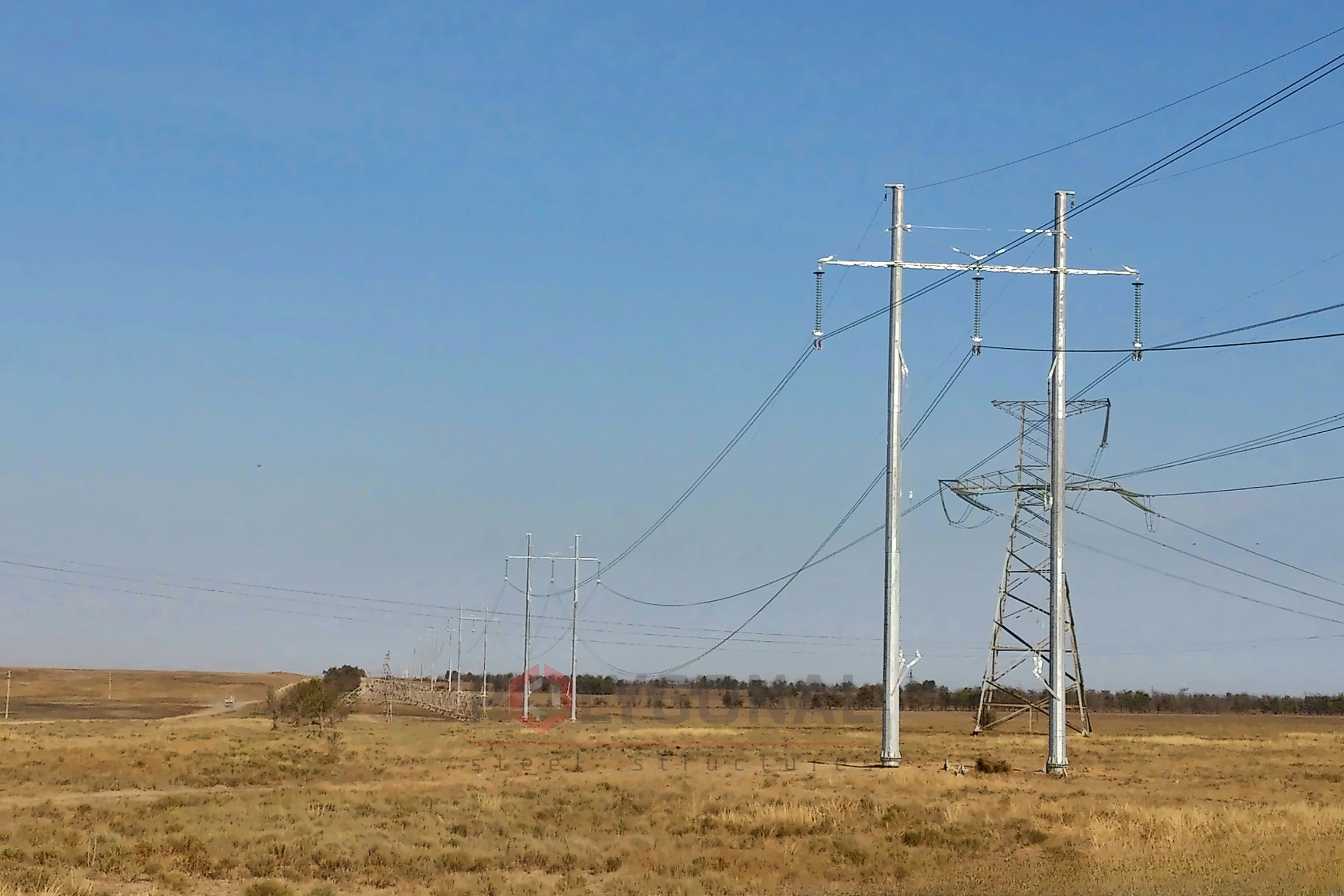
How corrosion reduces the load capacity of poles and gantries and which protection methods are used depending on how aggressive the environment is.
Contents
How corrosion affects steel structures
One reason for the loss of load capacity of steel power line poles in service is the reduction of the cross-section of load-bearing members through corrosion of the metal.
Carbon and low-alloy steels used for steel poles corrode, depending on how aggressive the environment is, at an average rate of 0.01–0.5 mm per year. The rate grows with the concentration of aggressive gases in the atmosphere, salt aerosols and dust, and with the time a moisture film stays on the surface of the structures.
For example, over 40 years in a non-aggressive or mildly aggressive atmosphere in the normal humidity zone, unprotected carbon steel sections lose 1.6 mm of thickness. Low-alloy steels lose less.
Structures are protected either by using steel grades resistant to corrosion in the given environment, or by applying metallic, paint or combined (metal-spray and paint) protective coatings to the surface.
The structural forms of pole elements made of rolled steel (lattice and multi-sided) allow any method of corrosion protection: the surface of the rolled steel is accessible for coating and the dimensions are small.
Corrosion protection methods
When choosing a protection method at the design stage, use the real service life of protective coatings and the need and technology for renewing them in service. Corrosion protection of poles and foundations should be provided in line with the applicable regulations.
1. Mildly aggressive environment
- lattice and multi-sided poles for 220 kV lines and above, steel foundation structures and switchyard gantries are protected for the whole design life by hot-dip galvanising in the factory to DSTU EN ISO 1461:2024 (or, where needed, thermal-diffusion or thermal-spray zinc coating) without renewing the coating in service. Defects in hot-dip galvanising should be avoided;
- if the factory cannot galvanise oversized multi-sided tapered hollow poles, protection by paint systems with a zinc-rich primer at least 70 µm thick is allowed, renewed every 15 years;
- if there are no requirements for decorative appearance, steel with increased corrosion resistance may be used, which needs no protective coating outdoors.
2. Moderately aggressive environment
Steel structures of lines and substations and steel foundation structures are protected by a hot-dip, thermal-diffusion or thermal-spray zinc coating applied in the factory and then painted: a zinc-rich or other primer at least 70 µm thick, with intermediate and top coats of at least 100 µm in total. The coatings are renewed as needed, but no more often than every 15 years.
3. Strongly aggressive environment and the coast
For metal poles of lines above 1 kV up to 750 kV the Rules for the Arrangement of Electrical Installations (PUE), 2026 edition, require protection, as a rule, by hot-dip galvanising to DSTU EN ISO 1461 (cl. 2.5.19). The requirement is the same for every voltage class and is not tied to the distance from the sea. Whether a thicker coating or extra protection, such as paint over the zinc, is needed near the sea is for the design to decide: the PUE only require pole elements to be corrosion-resistant, with regard to the kind and degree of aggressiveness of the environment (cl. 2.5.20), and give no figures.
4. Technology audit
To confirm readiness and ability to follow the surface preparation technology and obtain high-quality, durable protective coatings, manufacturers of steel structures are recommended to pass a technical audit and technology certification.
Damage to the coating during installation
If the protective anti-corrosion layer is damaged during assembly or installation of the poles, it must be restored.
Comparing protection methods
| Criterion | Hot-dip galvanising | Painting | Zinc plus paint |
|---|---|---|---|
| Protection | barrier and anodic | mainly barrier | both, reinforcing each other |
| Where applied | in the factory only | in the factory or on site | zinc in the factory, paint in the factory or on site |
| Renewal | usually not needed in a mildly aggressive environment | as the coating wears | when needed, while zinc remains |
See also galvanising service life.
Selection checklist and common mistakes
Before choosing, establish how aggressive the environment is, whether maintenance at height is possible, whether a colour is needed and whether the article fits in the galvanising bath.
Common mistakes:
- leaving pockets where water and dirt collect;
- making closed cavities without holes for air to escape and zinc to drain — see designing for galvanising.
What the rules say about corrosion: the PUE give no zinc thickness for poles
The Rules for the Arrangement of Electrical Installations (PUE), 2026 edition, require metal poles to be protected against corrosion, but they do not say how many micrometres of zinc a pole should carry. The general requirement is that electrical installations and the structures connected with them must withstand the environment or be protected from it (cl. 1.1.21), and where there is a risk of electrocorrosion or soil corrosion, protection has to be provided for structures, equipment, pipelines and other underground services (cl. 1.1.27).
For overhead lines above 1 kV up to 750 kV the requirement is more specific: metal poles and the metal elements of reinforced-concrete and wooden poles must be protected, as a rule, by hot-dip galvanising to DSTU EN ISO 1461 (cl. 2.5.19). “As a rule” means that a departure from it must be justified (cl. 1.1.16).
In general, the protection of metal poles and footings, of the metal parts of reinforced-concrete and wooden poles, and of concrete and reinforced-concrete structures has to comply with DSTU-N B V.2.6-186, and protection against electrocorrosion must be provided where needed (cl. 2.5.19). For lines up to 1 kV the protection of metal members and parts of poles must likewise meet cl. 2.5.19 and 2.5.21 and the building codes (cl. 2.4.8). The zinc thickness is taken from the standard and the design, and the article on zinc coating thickness covers it in detail.
Earth wires, guy wires and pole elements are to be made corrosion-resistant, according to the kind and degree of aggressiveness of the environment, and protective grease must be applied to the earth wire and guy wires while the line is being built (cl. 2.5.20). The PUE single out aggressive areas, salt flats and salinised sands, the coastal zones of seas, and any place where the metal of insulators, line fittings, conductors, earth wires or earth electrodes may corrode in service. There the design must provide for insulators and line fittings in the tropical version, corrosion-resistant conductors, aluminium-clad earth wires and, for earthing, larger cross-sections of the elements of earthing systems, use of earth electrodes with a corrosion-resistant coating (cl. 2.5.21).
In switchgear and substations above 1 kV, steel structures must have an anti-corrosion coating (cl. 4.2.14). At substations and open switchyards of 330 kV and above, to cut the time staff spend in the electric field, metal structures are to be protected against corrosion by methods that need no regular renewal of the coating (galvanising, aluminising and the like), or structures made of aluminium elements are to be used (cl. 4.2.192). For power cable lines, metal structures that carry cables in the open must be galvanised (cl. 2.3.16, item d).
Earth electrodes: the only zinc thickness table in the PUE
Artificial earth electrodes should not be painted (cl. 1.7.117). Earthing conductors must be protected against corrosion by one of the available methods, for example painting in weakly aggressive soils; in moderately and strongly aggressive soils a heat-shrink tube at least 0.6 m long, that is 0.3 m below ground and 0.3 m above, is additionally recommended where the conductor leaves the soil (cl. 1.7.120).
Across the whole text of the PUE, a coating thickness is given only in the table of minimum sizes for earth electrodes and earthing conductors laid in the ground. For hot-dip galvanised steel the values are:
| Hot-dip galvanised steel earth electrode | Minimum coating thickness |
|---|---|
| vertical round, Ø16 mm | 70 µm |
| horizontal round, Ø10 mm | 50 µm |
| horizontal strip, section 90 mm², thickness 3 mm | 70 µm |
| horizontal profile, section 90 mm², wall thickness 3 mm | 70 µm |
Source: PUE (2026 edition), cl. 1.7.117, Table 1.7.5. The designer takes the final values for a specific object from the current text of the PUE.
Updated:
Corrosion protection of overhead-line and switchyard poles: frequently asked questions
Is hot-dip galvanising alone enough, without painting?
In a mildly aggressive environment, yes — hot-dip galvanising to DSTU EN ISO 1461:2024 protects 220 kV+ line poles, switchyard gantries and foundation structures for the whole design life without renewal. In a moderately aggressive environment, galvanising is additionally painted.
Does the galvanising requirement depend on line voltage and on how close the sea is?
Not in the PUE (2026 edition). For metal poles of lines above 1 kV up to 750 kV they require protection, as a rule, by hot-dip galvanising to DSTU EN ISO 1461 (cl. 2.5.19), the same for every voltage class and with no link to the distance from the sea. Whether a thicker coating or extra protection is needed near the sea is for the design to decide.
What if the zinc coating gets damaged during installation?
A section of anti-corrosion coating damaged during assembly or installation must be restored — otherwise corrosion starts there sooner than on the rest of the structure.
What is a duplex system and how does it differ from galvanising alone?
It is hot-dip galvanising with paint on top. Zinc and paint reinforce each other: the zinc reduces corrosion under the paint film, and the paint protects the zinc from early corrosion. Paint coatings on zinc are described in ISO 12944-5, to which ISO 14713-1 refers. For how to paint a galvanised article, see the article on galvanising service life.
When should the coating be renewed?
Before the steel starts to rust: under ISO 14713-1 it is best done while at least 20–30 µm of zinc remains.
Related products: Overhead power line masts · Substation gantries · Hot-dip galvanising
Read also: Installation of Multi-sided Poles and Masts · Solar Street Lighting · Power Line Pole Types by Purpose: Suspension, Tension, Angle, Terminal · Cross-arms for 0.4–10 kV Lines: TM and TN Types, Reading the Designation
Get a quote for your requirements
Send us your requirements — we will calculate the price and lead time.