
Home / Services / Rotor balancing / Dynamic Rotor Balancing: Method and Stages
Rotor balancing
Dynamic Rotor Balancing: Method and Stages
Why a rotor balanced on a machine still needs balancing in its own bearings, and how the work goes: preparation, balancing and analysis of the results.
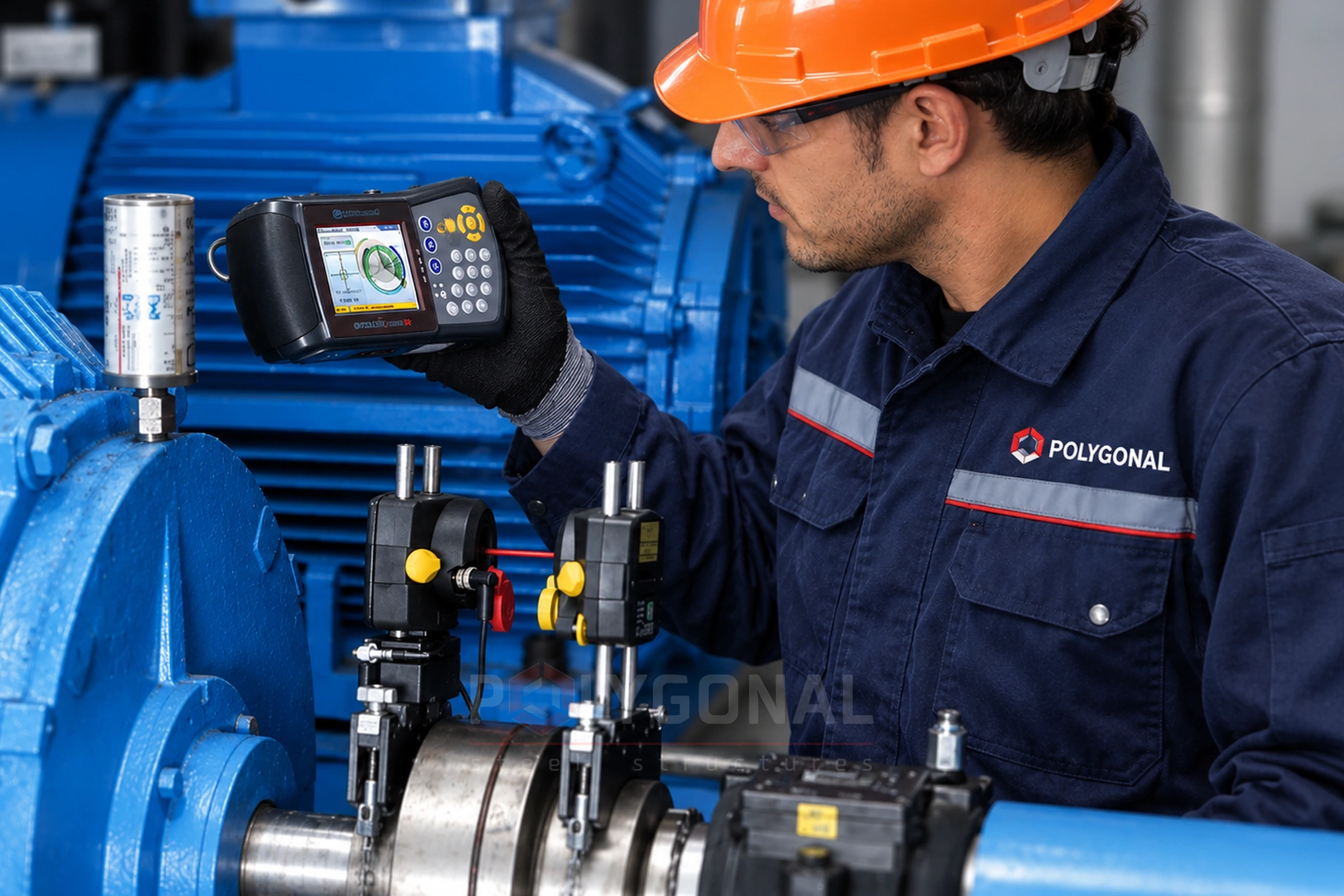
Why balance a rotor in its own bearings
Dynamic balancing of rotary machinery is a necessary and final phase of repair work. The specialists of POLYGONAL will carry out dynamic balancing of rotors, shafts, fans, drums, wheels and crushers in a short time.
Making a rotor at an engineering plant does not always guarantee the quality of its balance: manufacturers often limit themselves to static balancing. Balancing on a machine is a necessary operation in manufacture and after repair, but the conditions of the machine cannot be made close to service conditions (anisotropy of the supports, damping, the effect of process parameters, the quality of assembly and installation and so on). Practice shows that a rotor carefully balanced on a machine must additionally be balanced in its own bearings. An unsatisfactory vibration state of units after installation or repair leads to premature wear of the equipment and loss of the qualities achieved, and transporting a rotor to a balancing machine many kilometres from the plant is not justified in time and money; the extra dismantling and the risk of damage in transport also prove the value of balancing on site. Modern vibration-measuring equipment makes it possible to do it on site and to bring the vibration load on the supports down to permitted limits.
Stages of the work
Balancing in the rotor’s own bearings has three main stages: preparatory, balancing and analysis of the results.
Preparatory stage. Before balancing, all causes of vibration other than rotor imbalance must be found and eliminated: an external inspection is done, the “history” of the vibration is studied, and it is established whether the vibration appears at idle or under load and whether it is constant or intermittent. The main causes of mechanical vibration are: loosened fixing of units; poor shaft alignment; damage to couplings and bearings; wear of seats; wrong lubrication; bent shafts; a match of the rotational speed with the natural frequency of the foundation; ovality of the shaft journals. Before balancing, the impeller is cleaned, threaded connections are tightened, shaft alignment is checked, and loose parts and joints with play are found.
Balancing. Balancing is done at the working speed of the rotor (with an adjustable drive, at the highest working speed). Rotors with a large imbalance are balanced first at low speed and then at a higher one. The speed must not fall in any of the machine’s resonance ranges, and the same speed must be reached during separate starts; the set-up must give repeatable measurements of vibration and phase angle (deviation not more than 10–20%). The measuring points and directions are marked and used the same way at each start. The trial weight is conveniently calculated on the condition that the centrifugal force at the working speed does not exceed 20% of the weight of the rotor carried by the nearest bearing. The balancing sensitivity of the bearings is established from earlier balancing of machines of that type. Adding masses to a rotor is easier than removing them by drilling or grinding; removing material is used only when adding masses is impossible.
It is recommended to analyse how the vibration parameters change at start-up and shutdown of the machine: this makes it possible to assess not only the working mode of the rotor and its stability, but also the condition of the foundation.
Analysing the results
Analysis of the balancing includes assessing how effective the work was: reduced vibration, longer life of parts, less repair work. Raised vibration speeds up wear of shafts, bearings and couplings, destroys the foundation and disturbs alignment and the operation of instruments and automation. According to statistics, about 80% of breakdowns and failures in machines result from unacceptable vibration that causes fatigue failure of assemblies and parts.
Only about half of the cases of vibration are caused by imbalance: about 30% by poor alignment of the shafts, about 17% by various mechanical defects and 3% by electrical faults. So the fight against vibration is mainly done by balancing, and at high speed it becomes a top-priority technical problem. For rotors of the same type a considerable spread of the dynamic influence coefficients (over 10%) is seen: it is caused by errors in measuring vibration, instability of the rotors’ dynamic characteristics (thermal deformation, assembly errors, slipping of discs on the shaft), departures from linearity and errors in fitting trial and balancing weights.
After balancing, the vibration level of the supports is often reduced 10–12 times. The increase in bearing life can be calculated from the reduction in load on the bearing assemblies given by the value of the balanced centrifugal force: for example, a calculation showed a 1.5-fold increase in the calculated bearing life when an imbalance was compensated by a 30 g weight at a radius of 0.45 m at a rotor speed of 2850 rpm and a rotor mass of 600 kg.
Updated:
Balancing rotors in their own bearings: frequently asked questions
Why isn’t balancing on a machine enough?
The conditions of the machine don’t reproduce service conditions (anisotropy of the supports, damping, quality of installation), so even a carefully balanced rotor needs additional balancing in its own bearings.
How much does vibration drop after balancing?
Often 10–12 times. This lowers the load on the bearing assemblies and can extend the calculated bearing life, for example 1.5 times for specific imbalance parameters.
What share of equipment failures is caused by vibration?
About 80% of breakdowns and failures result from unacceptable vibration that causes fatigue failure of assemblies and parts.
How many main causes of vibration are there besides imbalance?
About 30% of cases are caused by poor shaft alignment, about 17% by mechanical defects, 3% by electrical faults; the rest by rotor imbalance.
Related products: Rotor balancing · Technical inspection
More on this topic: Consequences of Late Fan Impeller Balancing · Industrial Equipment Maintenance and Repair · Vibration Diagnostics and Process Accuracy Checks of Industrial Equipment
Get a quote for your requirements
Send us your requirements — we will calculate the price and lead time.