
Home / Services / Rotor balancing / Consequences of Late Fan Impeller Balancing
Rotor balancing
Consequences of Late Fan Impeller Balancing
What happens to induced draft fans and fans when their impellers are not balanced in time: where imbalance comes from, which vibration levels are permitted and what balancing achieves.
Contents
Why impellers are balanced in their own bearings
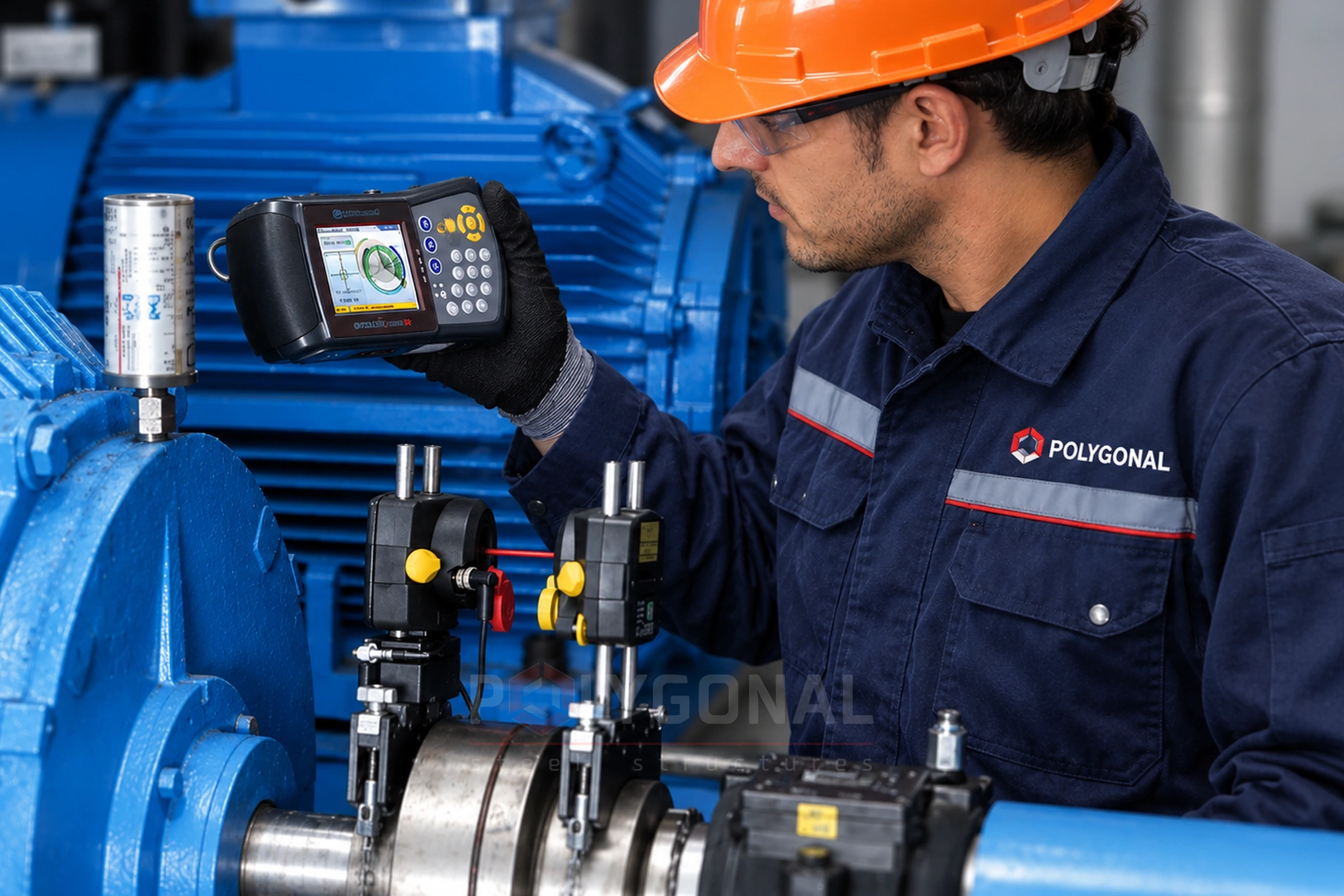
Impellers of induced draft fans and fans are often balanced in their own bearings. The change made to the machine is small and the effect is large, which makes it one of the cheaper jobs in the upkeep of mechanical equipment. An impeller made at an engineering plant is not necessarily well balanced; often only static balancing has been done. A balancing machine does not reproduce service conditions either, so even after the machine the impeller should be balanced again in its own bearings. Hauling it to a balancing machine many kilometres from the plant costs too much time and money.
One of the axioms of serviceable equipment: a machine should run with low vibration. Bearing assemblies then take less damaging load, they and the machine last longer, and the process runs steadily. On induced draft fans and fans, the vibration level depends largely on how well the impeller is balanced. Raised vibration destroys bearing assemblies, bearing seats and foundations, and the drive draws more electricity.
Causes of impeller imbalance
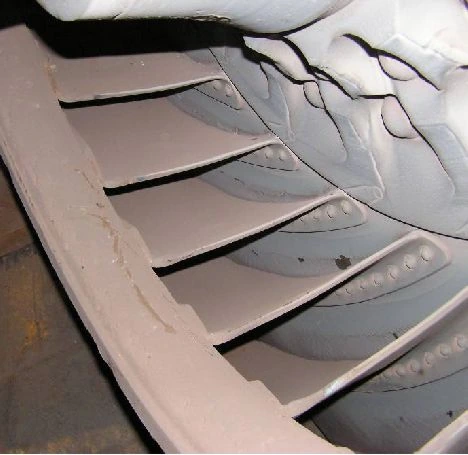
- uneven (erosive) wear of the blades, even though the impeller is symmetrical and runs at high speed. Wear is selective and random, driven by external factors and the properties of the material, so the actual deviations of the blade geometry from the design profile have to be taken into account;
- dust that builds up on the blades (on sinter plant induced draft fans and exhausters, for example);
- blades repaired in place under working conditions, and initial cracks in the discs and blades. Before balancing, inspect the impeller carefully by eye and make sure every element is intact. Cracks that are found can be welded up only as a last resort and for a short time, until a new impeller is made and fitted: welding will not give long trouble-free service, because welds are stress concentrators and become sources of new cracks.
Permitted vibration levels
If the recommendations of the machine vibration standards are followed (ISO 20816-1, which replaced ISO 10816-1), induced draft fans can run for a long time. These vibration velocity values are proposed for judging technical condition:
- up to 1.8 mm/s: operation with no time limit; this is the level to bring the impeller to when it is balanced in its own bearings;
- 1.8–4.5 mm/s: long-term operation, with the vibration checked periodically;
- over 4.5 mm/s for a long time (1–2 months): parts of the equipment may be damaged;
- 4.5–7.1 mm/s: 5–7 days of operation, then a shutdown for repair;
- 7.1–11.2 mm/s: 1–2 days of operation, then a shutdown for repair;
- over 11.2 mm/s: not allowed. The condition is considered an emergency, since control of the technical condition of the equipment has been lost.
For drive motors, 2.8 mm/s is regarded as permissible in service. The strength margin of the machine can tolerate more, but the life of the parts is then sharply shortened.
What balancing gives
Balancing the impellers of induced draft fans in their own bearings reduces vibration, extends bearing life, lowers electricity consumption and makes emergency stops less likely.
An unbalanced rotor puts extra forces on the bearing supports. They raise the resistance to rotation of the fan shaft, and with it the electricity consumed, and at the same time they damage the supports and other elements of the machine. To judge the result of balancing in service you need the following data: set-up parameters (type of machine, drive power, voltage, speed, mass); the initial vibration velocity at the control points (RMS in the 10–1000 Hz range); current and voltage by phase; the repair actions already taken (trial weight, tightening of threaded connections, alignment) and the values after them.
Vibration surveys of fans showed that the raised vibration came mainly from dynamic imbalance of the impellers. After balancing in their own bearings the overall vibration level fell 3–5 times (to 2.0–3.0 mm/s under load) and bearing life increased 5–7 times.
Experiment 1: fan DN-6, 380 V, 960 rpm. Before balancing the vibration was 9.4 mm/s vertical and 5.0 mm/s axial; after, 2.2 and 1.8 mm/s (down 4.27 and 2.78 times). The average current fell from 3.9 to 3.73 A, by 4.55%.
Experiment 2, the same fan. At point 1 (front bearing of the motor) the vector vibration velocity fell from 22.9 to 4.2 mm/s (5.4 times), at point 2 from 14.9 to 2.7 mm/s (6.2 times). The average power consumed fell from 2.74 to 2.59 kW, by 5.8%.
In production, on fan VDN-12, electricity consumption over 30 minutes fell from 33.0 to 30.24 kWh (by 9.1%), and vibration velocity from 10.5 to 4.5 mm/s.
Shaft speed is another sign that balancing has worked. When induced draft fan DN-26 was balanced, fitting the correction weight brought the vibration velocity of the support down (vertical 4.4 → 2.1 mm/s, horizontal 2.9 → 1.1 mm/s), and the motor speed rose from 745 to 747 rpm. By the mechanical characteristic of the motor, that corresponds to a substantial cut in the power consumed. A similar relationship between speed and vibration velocity was recorded on the motors of drying-unit fans: speed can change in steps at different vibration levels, which confirms 1.8 and 4.5 mm/s as the limits between technical conditions.
Signs of imbalance in an induced draft fan
An unbalanced impeller shows up as vibration of the supports. With imbalance it is typically strongest at the rotational frequency of the impeller, and its magnitude and phase hardly change between measurements in the same operating mode. Other faults can give the same picture, though, so a single measurement proves nothing.
Vibration monitoring and condition-based maintenance have an article of their own: Vibration Diagnostics and Process Accuracy Checks of Industrial Equipment.
| Sign | How it shows | What to rule out before balancing |
|---|---|---|
| Raised vibration of the supports | The vibration velocity at the control points is above the indicative levels in the section “Permitted vibration levels” | Loose fixings, damaged bearings and couplings, a match between the rotational speed and the natural frequency of the foundation; poor shaft alignment (often shows up as a component at twice the rotational frequency) |
| Vibration growing over time or after a repair | The readings rise from one measurement to the next, or change abruptly after the blades are repaired or the impeller is replaced | Fixings loosened or alignment changed by the repair, threaded connections left slack, cracks in blades and discs |
Updated:
Consequences of late impeller balancing: frequently asked questions
Up to what vibration velocity can a fan run with no time limit?
Up to 1.8 mm/s. That is the limit for operation without a time restriction. Over 11.2 mm/s the condition is considered an emergency.
How long can a fan keep running at 4.5–7.1 mm/s?
Another 5–7 days, then it has to be stopped for repair.
By how much does balancing cut electricity consumption?
In the experiments described, by 4.5–9.1%, depending on the fan. Vibration also drops 3–6 times and bearing life rises 5–7 times.
Can a crack in a blade just be welded shut instead of balancing?
No. Welds are stress concentrators and become sources of new cracks. Welding is acceptable only as a last-resort temporary measure until the impeller is replaced.
Can imbalance be judged from the motor current?
Not on its own. The current and power of the drive depend first of all on the operating mode, meaning the flow and the position of the damper or guide vane, and not only on how well the impeller is balanced. In the tests described in the section “What balancing gives” consumption did fall after balancing (the average current of fan DN-6, for instance, went from 3.9 to 3.73 A), but that shows only when the values before and after are compared in the same mode. There are few tests, so for a particular induced draft fan such an effect is not guaranteed.
Related products: Rotor balancing
More on this topic: Dynamic Rotor Balancing: Method and Stages · Industrial Equipment Maintenance and Repair · Vibration Diagnostics and Process Accuracy Checks of Industrial Equipment
Get a quote for your requirements
Send us your requirements — we will calculate the price and lead time.