
Home / Products / Traffic signal poles with cantilever arm / Cantilever Traffic Signal Poles: Reach, Height, How to Choose
Traffic signal poles with cantilever arm
Cantilever Traffic Signal Poles: Reach, Height, How to Choose
A cantilever traffic signal pole is chosen to match the width of the junction’s carriageway: the arm reach must cover the lanes that need it, and the height must keep the signal visible to drivers. We explain how to read the size table and what affects what.
Contents
What arm reach is and why it matters
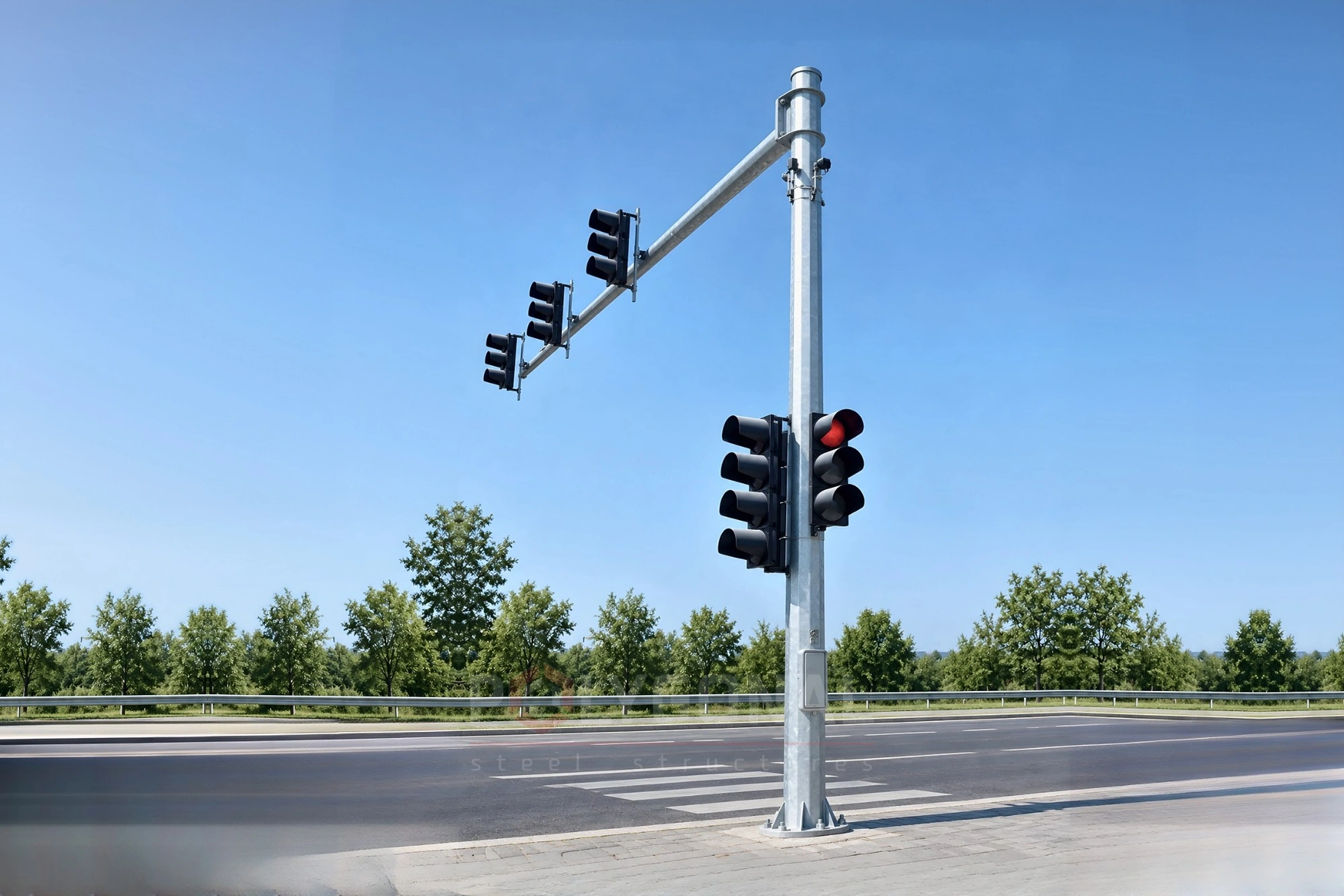
A cantilever pole has one curved arm (cantilever) that carries the traffic signal out over the carriageway, so it is clearly visible to drivers in any lane at the junction, not only the one nearest the kerb. The arm reach is chosen so the signal ends up over the lane it needs to, or over the full width of the carriageway, depending on the junction’s traffic scheme.
How to read the size table
Size tables for cantilever poles use these symbols:
- H — the height of the pole shaft;
- Hs — the pole height including the traffic-signal bracket;
- S — the reach of the signal bracket from the pole axis;
- Hs1, S1 — the same for the luminaire bracket, if the pole is combined (also carries lighting).
The full size table for cantilever poles is on the page Traffic Signal Poles.
What the reach and height depend on
- the carriageway width and the number of lanes the arm needs to cover;
- the junction’s traffic scheme (number of directions, presence of tram tracks);
- the required signal mounting height for good visibility and vehicle clearance;
- whether a combined pole with lighting is needed (then a luminaire bracket with its own reach and height is added).
A heavy-duty example: the SFO-7/14 pole
For junctions with a wide carriageway we also make heavier designs that go beyond the standard size table. An example is the SFO-7/14 pole: a 7 m shaft height, a 14 m arm reach, and a mass of 1,629.7 kg with the zinc coating.
The arm of such a pole carries up to three three-section traffic signals (1200×390 mm, up to 20 kg each), a traffic camera up to 5 kg, and a 700×700 mm road sign up to 10 kg — the exact positions of the equipment along the arm are agreed for the specific junction. The shaft itself carries two more signals and two more road signs.
The pole is fixed to a cast-in-place reinforced concrete foundation through a flange and an anchor cage with 12 M48 anchors (370.2 kg uncoated). The shaft and flanges are made of S345 steel, and all elements are hot-dip galvanised to DSTU EN ISO 1461.
The design is calculated for the specific wind region and terrain type: for example, for wind region 5 (600 Pa) the limit load at the foundation base for this pole is a vertical force N = 22.1 kN, a horizontal force Q = 18.1 kN, a bending moment M = 125.4 kN·m and a torque Mk = 86.5 kN·m. The pole’s design service life is 40 years.
If no catalogue size for a cantilever pole fits your junction, we make an individual design like the SFO-7/14, calculated for the specific load and wind region.
Vertical oscillation of the arm in wind
Cantilever poles with a long reach are prone to harmonic vertical oscillation at the end of the arm in wind. To prevent this:
- equipment on the arm should be positioned as close to the shaft as its function allows, rather than concentrated at the tip;
- after installing the signals and any extra equipment, the pole is visually inspected in an 8-32 km/h wind; if vertical oscillation with an amplitude over 20 cm is seen at the tip of the arm, a damping device is fitted to the arm, its type and parameters calculated individually for the structure;
- this inspection is repeated after any change to the equipment on the pole that could affect its behaviour in wind;
- excessive oscillation must not be left unaddressed for more than two days.
Routine care: bolted connections are re-tightened a week after installation to compensate for the settling of the zinc coating, and the joint between the arm and the shaft is checked and re-tightened every year. The steel structure, welds, anchors and bolt tightness are inspected once a year, and also after strong wind, a vehicle impact, a collision or noticeable vibration.
What to send to choose a pole
Send the carriageway width (number and width of lanes), the junction layout, the number of signals needed, and whether lighting is needed on the same pole. We will choose the arm reach and height for your junction, or calculate individually if no catalogue size fits.
Updated:
Cantilever traffic signal poles: frequently asked questions
What is Hs in the cantilever pole size table?
Hs is the pole height including the traffic-signal bracket — the actual height at which the signal ends up.
How do I determine the required arm reach?
It depends on the carriageway width and which lane (or the full width) the signal needs to be over. Send the junction parameters and we will choose a catalogue size or calculate individually.
Can lighting also be mounted on a cantilever pole?
Yes, a combined cantilever pole carries both a traffic-signal bracket and a separate luminaire bracket with its own reach and height (Hs1, S1).
How many signals and signs can a heavy-duty cantilever pole carry?
For example, the SFO-7/14 pole (14 m arm reach) carries up to three three-section traffic signals, a traffic camera and a road sign on the arm, plus two more signals and two more signs on the shaft. The exact fit-out is agreed for the specific junction.
What if the arm sways in the wind?
If vertical oscillation with an amplitude over 20 cm is seen at the tip of the arm in an 8-32 km/h wind, a damping device is fitted, with its type and parameters calculated individually. The inspection should be repeated after any change to the equipment on the pole.
Questionnaire: technical assignment form
Fill in the form and email it to us: we will prepare the KM-stage design documentation from it and calculate the price. The PDF is handy to print; the DOCX can be filled in on a computer.
Questionnaire: traffic-light console pole
A questionnaire for designing a traffic-light console pole: geometry, mounted equipment (traffic lights, signs, cameras), climatic conditions, foundation.
Related products: Traffic signal poles with cantilever arm
Read also: Installation of Multi-sided Poles and Masts · Solar Street Lighting · Power Line Pole Types by Purpose: Suspension, Tension, Angle, Terminal · Cross-arms for 0.4–10 kV Lines: TM and TN Types, Reading the Designation
Get a quote for your requirements
Send us your requirements — we will calculate the price and lead time.