
Home / Products / Overhead power line masts / Typical Lattice Power Line Poles: Classification and Checks
Overhead power line masts
Typical Lattice Power Line Poles: Classification and Checks
Lattice transmission line poles made of angle steel are still widely used. Here is how they are built, what types there are by purpose and design, and why typical poles are checked by calculation before use.
Contents
Lattice poles made of angle sections
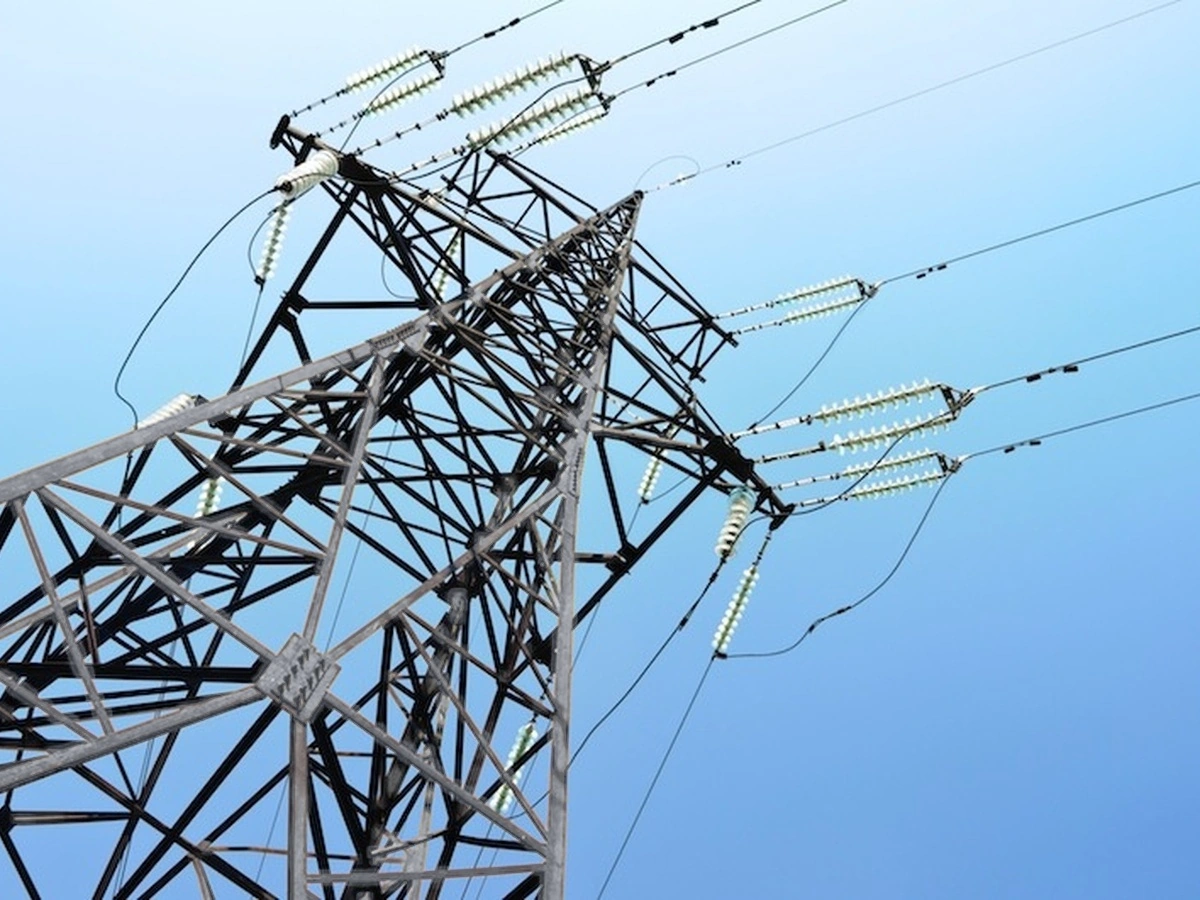
Lattice steel poles made of angle sections are widespread in overhead line construction. This owes most to design organisations’ widespread adoption of typical unified poles, which are a spatial lattice of rolled steel. The members are assembled by bolts or by welding.
Bolted joints cut transport costs thanks to the compact shipping bundles. Hot-dip galvanising of bolted poles is better than of welded ones, which raises durability and widens the range of use. The main drawback of bolted lattice poles is the large number of shipped parts and, as a result, more labour to erect them. Erecting lattice steel poles takes noticeably longer than wooden, reinforced-concrete or polygonal ones.
Lattice poles are used to build overhead lines and operate in areas with air temperatures down to −65 °C. They are made of 09G2S or S345 steel. Corrosion protection is by hot-dip galvanising to DSTU EN ISO 1461:2024 or by painting. Poles are anchored in the soil by standing them on typical foundations, and the spacing between poles is set by the project. Specialised erection organisations and mechanised columns can help put a pole up.
Classification of typical unified poles
By purpose
- Intermediate poles stand on straight sections of the line, only support the conductors and earth wires, and are designed for loads across the route. As a rule intermediate poles make up 80–90% of all poles in a line.
- Tension (anchor) poles stand on straight sections where the line crosses engineering structures or natural obstacles, to limit the tension span, and where the number, grade or cross-section of the conductors changes. A tension structure takes the load from the difference in pull of the conductors and earth wires along the line, so it has increased strength.
- Angle poles are designed for places where the route changes direction and take the resultant of the tension of the conductors and earth wires of the adjacent spans. For small loads, at turning angles up to 30°, intermediate angle poles are used; for angles over 30°, tension-angle poles are used, which are stronger and have tension fixing of the conductors.
- Terminal poles are a kind of tension pole: they stand at the start and end of a line and are designed for the one-sided pull of all conductors and earth wires.
- Special poles: transposition poles, to change the order of the conductors; crossing poles, to take the line over engineering structures or natural obstacles; branch poles, for taps off a main line; anti-wind poles, to strengthen a section of line mechanically; and line-crossing poles, where lines of two directions intersect.
By design
- guyed poles;
- free-standing poles;
- raised and lowered versions.
By number of circuits
- single-circuit;
- double-circuit;
- multi-circuit.
Why double-circuit poles are used — see the article Double-circuit Transmission Poles: When to Use Them.
Checking against current standards
Typical unified poles were designed to standards that have been updated since, so under current requirements they cannot be used without recalculation. POLYGONAL checks typical structures against current regulatory documents and refines their range of use by calculating the pole. Where needed, individual joints are strengthened: there are significant differences between poles that meet the new edition of the standards and those designed to the old one.
The most rational approach when designing a particular line is to modify the unified structures: strengthen individual members, change the design of the earth-wire peak, the length of the cross-arm and so on. To use modified poles in projects, calculations are needed that confirm the modifications meet the regulatory requirements. We recalculate the pole and advise whether it can be used in the line.
We prepare KMD-stage drawings of transmission poles using powerful computers and specialised 3D software, which rules out errors.
Range
Lattice poles are made to typical designs. Prices of structures change; we quote the current price on request. The height to the underside of the cross-arm and the mass of poles (without and with zinc coating) of all typical series for 35–750 kV lines are given on the page “Catalogue of Typical Lattice Transmission Poles”.
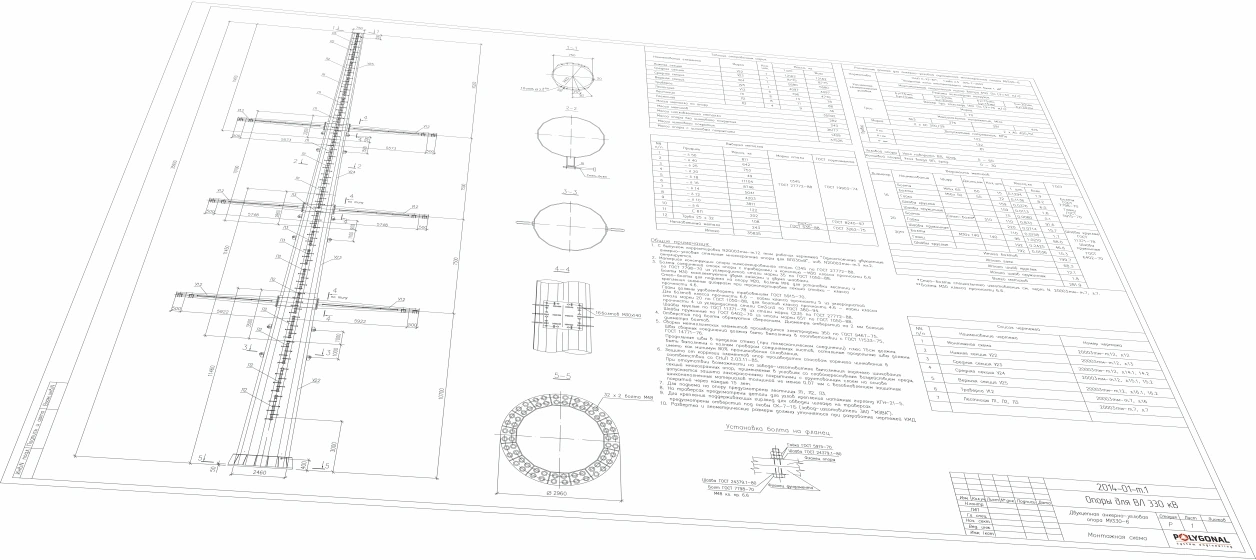
Prices of standard poles
Standard lattice poles are priced per tonne: cost = pole mass under the standard design including the mass of the zinc coating × price per tonne. Indicative prices are on the page Power line pole prices.
Updated:
Reviewed by: V.V. Padalka, Chief Project Engineer
Typical lattice transmission poles: frequently asked questions
Why do typical poles need to be checked before use?
Typical unified poles were designed to standards that have been updated since, so under current requirements they cannot be used without recalculation — POLYGONAL checks conformity with current regulatory documents.
What steel are lattice poles made of?
09G2S or S345 steel, with corrosion protection by hot-dip galvanising to DSTU EN ISO 1461:2024 or by painting.
What conditions are lattice poles used in?
Areas with air temperatures down to −65 °C.
What percentage of a line’s poles are intermediate?
Usually 80–90% of all poles on a line — the rest are tension, angle, terminal and special poles.
Questionnaire: technical assignment form
Fill in the form and email it to us: we will prepare the KM-stage design documentation from it and calculate the price. The PDF is handy to print; the DOCX can be filled in on a computer.
Technical assignment form: overhead line pole
A questionnaire for preparing KM-stage design documentation for a steel polygonal overhead line pole: operating conditions, conductors, earth wires, insulator strings, clearances.
Related products: Overhead power line masts · Steel structure design (structural and detail drawings)
More on this topic: Typical Lattice Transmission Poles 35–750 kV · Steel Multi-sided Poles for 6–10 kV Lines · Power Line Pole Types by Purpose: Suspension, Tension, Angle, Terminal · Power Line Protection Zone: Widths by Voltage Class · Distance Between Power Line Poles: What Determines the Span Length · Steel Multi-sided Poles for 35 kV Lines
Get a quote for your requirements
Send us your requirements — we will calculate the price and lead time.