
Home / Products / Overhead power line masts / Power Line Poles: Multi-sided, Lattice or Reinforced Concrete
Overhead power line masts
Power Line Poles: Multi-sided, Lattice or Reinforced Concrete
Overhead power lines use steel multi-sided, steel lattice and reinforced concrete poles. Each type has its own scope. We explain how to compare them and when each one fits.
Contents
- Three main types of overhead line poles
- Comparison of pole types
- Multi-sided poles: when they are the best choice
- Lattice poles: where they fit
- How to choose the pole type
- Limits of our multi-sided poles by voltage class
- Example: foundations on a 5 km route
- Checklist before ordering
- Common mistakes when choosing
- Tension and intermediate, rigid and flexible: what the PUE says
- What the PUE treats differently by pole type
Three main types of overhead line poles
- reinforced concrete poles: traditional for low- and medium-voltage lines; massive, made of reinforced concrete shafts with concrete or steel cross-arms;
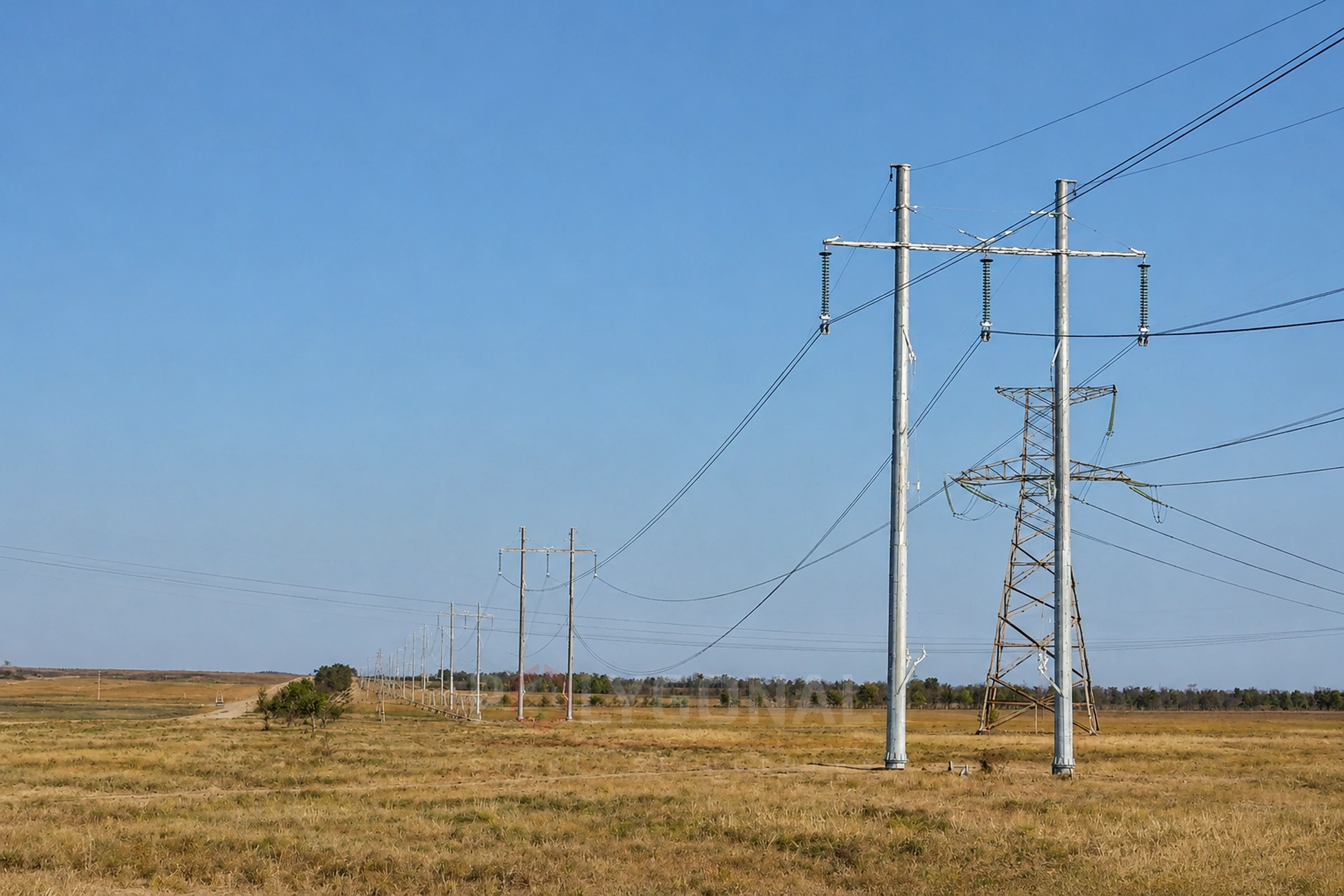
- steel lattice poles: a spatial structure of angle sections; widely used on high-voltage lines;
- steel multi-sided poles: single-shaft poles on bent multi-sided shafts; effective where compactness, fast installation and durability matter.
Comparison of pole types
| Criterion | Reinforced concrete | Steel lattice | Steel multi-sided |
|---|---|---|---|
| Weight | large | depends on voltage class; a prefabricated structure | lower than lattice for similar loads |
| Footprint | small for low voltages | large: a wide base and foundations/guys | small: one shaft and one foundation |
| Transport | heavy, special equipment needed | as sections, assembled on site | in sections, compact |
| Installation | crane installation into a pit | assembly of many elements | sections joined by a telescopic joint or flanges |
| Corrosion and vandalism | depends on concrete and reinforcement | many open joints and elements | closed profile, hot-dip galvanising to DSTU EN ISO 1461:2024 |
| Look in urban areas | massive | lacy but large | compact, aesthetic |
| Typical scope | 0.4–10 kV lines | high-voltage lines in open terrain | 6–220 kV lines in urban, restricted and difficult conditions |
Multi-sided poles: when they are the best choice
- a restricted right-of-way and built-up areas: one compact shaft is needed instead of a wide base;
- complex routes and obstacle crossings, angle and tension poles;
- fast construction or reconstruction when installation speed matters;
- durability: a closed profile with hot-dip galvanising is less prone to corrosion and vandalism.
Examples by voltage class: 6–10 kV lines, 35 kV lines, 110 kV lines, 220 kV lines.
Lattice poles: where they fit
Lattice poles remain common for high-voltage lines in open terrain with long spans, where their spatial structure is efficient. We have reference materials: typical lattice power line poles and the catalogue of typical lattice poles 35–750 kV.
How to choose the pole type
The choice depends on the voltage class, route conditions, loads (wind, ice, number of circuits and conductors), construction and operating cost and appearance requirements. The final decision is confirmed by a technical and economic comparison of options in the design. Send the line data or fill in the technical specification form for a power line pole: we propose the pole type, calculate the design, price and lead time.
Limits of our multi-sided poles by voltage class
| Voltage class | Conductors | Regions: wind / ice | Turn angle of angle-anchor pole |
|---|---|---|---|
| 6–10 kV | AC 50/8 – AC 120/19, SIP-3 | I–III / I–III | up to 60° |
| 35 kV | up to AC 120/27 | I–V / I–IV | up to 79° |
| 110 kV | up to AC 240/32 | I–V / I–IV | up to 45° |
| 220 kV | AC 300/39, AC 400/51 | I–IV / I–IV | up to 60° |
Example: foundations on a 5 km route
Assumed data: span 250 m, all poles intermediate and of one type. Spans: 5,000 ÷ 250 = 20, so 21 poles. A single-shaft multi-sided pole has one foundation, a broad-base lattice pole four, one per leg.
| Item | Single-shaft multi-sided | Broad-base lattice |
|---|---|---|
| Poles along the route | 21 | 21 |
| Foundations | 21 | 84 |
21 × 4 = 84, a difference of 63. This counts only the places where a pole rests on the ground: concrete, steel and cost come from the design, and in open terrain lattice poles may have a longer span. Three-shaft poles (35 kV double-circuit, 110 kV single-circuit tension poles) have three such places each, so their figures differ.
Checklist before ordering
- voltage class, number of circuits, grade and cross-section of conductors and earth wire;
- wind and ice regions (loads);
- poles by purpose and turning angles (pole types);
- soils, pit or flange (foundations);
- right-of-way strip with the protection zone (protection zone).
Common mistakes when choosing
- comparing only the price per tonne, without foundations, transport and installation;
- taking a standard pole without recalculation: the codes were updated after the standard designs were drawn up;
- calculating only intermediate poles: they are 80–90% of the line, but tension and angle poles carry more load.
Tension and intermediate, rigid and flexible: what the PUE says
The Rules for the Arrangement of Electrical Installations (PUE), 2026 edition, cl. 2.5.134, divide line poles into two main kinds. A tension (anchor) pole takes the full tension of the conductors and earth wires in the adjacent spans; an intermediate pole takes none of it or only part. Intermediate and tension poles can be straight or angle poles, while terminal and transposition poles can be built on the basis of tension poles. By number of circuits, poles are single-, double- or multi-circuit; by installation, free-standing or guyed.
An intermediate pole may be flexible or rigid; a tension pole must be rigid, except on lines up to 35 kV, where flexible tension poles are permitted. A pole counts as rigid if its top, under the design loads of the second group of limit states (without allowing for rotation of the foundation), deflects by no more than 1/100 of the pole height. If it deflects more, the pole is flexible.
Other PUE requirements for poles:
- a tension pole is designed for the difference in tension of the conductors and earth wires that unequal equivalent spans create, a terminal pole for the tension of all conductors and earth wires on one side only; for double- and multi-circuit poles every mode must also allow for the case with only one circuit erected (cl. 2.5.77);
- guyed poles on lines up to 330 kV inclusive may not be used on cultivated land without protecting the guys from farm machinery; on such sections, in built-up areas and in cramped approaches to power plants and substations, double- and multi-circuit free-standing poles are recommended (cl. 2.5.15);
- in areas inhabited by large birds, poles with pin insulators are not used, and bird barriers are provided on the cross-arms of 35–220 kV poles and on earth-wire peaks (cl. 2.5.17);
- permanent markings, including the serial number (required on every pole), go at least 1.5 m above the ground (cl. 2.5.18);
- steel poles must be protected from corrosion, normally by hot-dip galvanising to DSTU EN ISO 1461 (cl. 2.5.19).
What the PUE treats differently by pole type
The PUE (2026 edition) handles two questions differently depending on the pole type: whether to count ice on the structure itself (cl. 2.5.36) and how to arrange climbing for the crew (cl. 2.5.137).
| Question | Lattice (rolled-section steel) | Multi-sided | Reinforced concrete |
|---|---|---|---|
| Ice on the pole itself | Counted for heights over 50 m, in ice regions 5–6 or in mountains with a high ice load (over 30 N/m) | Not counted | Not counted |
| Climbing | Step bolts on a leg: up to 20 m depending on the spacing and slope of the lacing, always on 20–50 m poles; over 50 m, ladders with fencing and platforms every 15 m | On bent multi-sided shafts of poles up to 50 m high, fixed ladders without fencing up to the earth-wire attachment height | To the lower cross-arm from telescopic aerial lifts, with portable ladders or with special portable lifting devices; above it on a centrifuged 35–750 kV shaft, fixed climbing steps |
Ice on conductors and earth wires is counted for any pole type: for a multi-sided pole only the load from ice on the pole structure itself drops out. For a specific line the designer takes the final values from the PUE text in force. The design cases are covered in Loads on Overhead Lines and Ice, Rime and Wet Snow on Power Lines.
Updated:
Power line pole types: frequently asked questions
Which pole is best for urban and restricted conditions?
Steel multi-sided — it needs just one compact shaft and one foundation instead of a lattice pole’s wide base, and its closed profile with hot-dip galvanising is less prone to corrosion and vandalism.
When do lattice poles make sense?
On high-voltage lines in open terrain with long spans, where their spatial structure pays off and a large footprint is not a constraint.
Why are reinforced concrete poles still used?
They are traditional and economical for low- and medium-voltage lines (0.4–10 kV), where the footprint is small and the compactness and fast installation of multi-sided poles matter less.
Does a multi-sided pole always have one shaft?
No. 6–10 kV poles and 220 kV angle-anchor poles are single-shaft, while 35 kV double-circuit poles and 110 kV single-circuit tension (anchor) poles have three shafts, although a single shaft can be designed for special conditions.
Can a lattice pole in an existing line be replaced with a multi-sided one?
Yes, after calculation: the design checks the loads from the existing conductors, the attachment points, the clearances and the foundation.
Is ice counted on a multi-sided pole itself?
No. Under PUE (2026 edition), cl. 2.5.36, ice deposits on the structure are not counted for multi-sided, reinforced-concrete and wooden poles, or for steel poles with members made of tubes. Ice on conductors and earth wires is counted for any pole type.
Related products: Overhead power line masts · Hot-dip galvanising
More on this topic: Typical Lattice Power Line Poles: Classification and Checks · Typical Lattice Transmission Poles 35–750 kV · Steel Multi-sided Poles for 6–10 kV Lines · Power Line Pole Types by Purpose: Suspension, Tension, Angle, Terminal · Power Line Protection Zone: Widths by Voltage Class · Distance Between Power Line Poles: What Determines the Span Length
Get a quote for your requirements
Send us your requirements — we will calculate the price and lead time.