
Home / For Designers / Technical Requirements for Lighting Poles
Knowledge base
Technical Requirements for Lighting Poles
The requirements for steel street lighting poles: manufacture, materials, welded joints, corrosion protection, completeness, marking and packing.
Contents
Requirements for street lighting poles
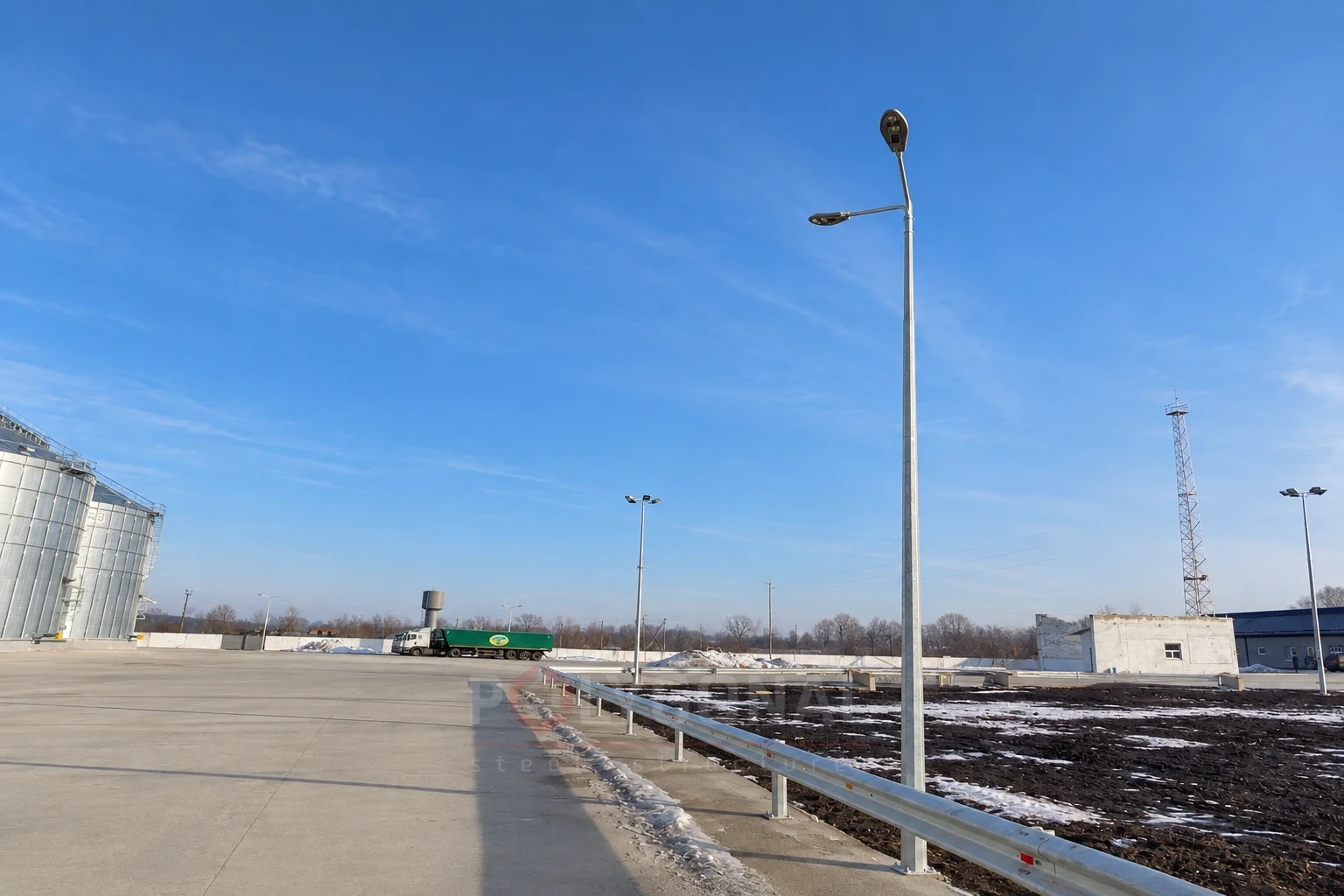
Street lighting poles are made to KMD drawings based on KM drawings prepared by a design organisation. Lighting poles are classified by:
- material: steel;
- purpose;
- type of joint: bolted, welded;
- degree of factory readiness: made at the factory as shipping elements (packed in bundles) and assembled into larger units on site;
- type of force action: they carry permanent, variable and occasional loads;
- aggressiveness of the environment: for use in non-aggressive, mildly aggressive and moderately aggressive environments;
- presence of a hinge device: mobile and fixed;
- number of sections: single-section and multi-section;
- shaft profile: round and multi-sided;
- how the shaft is set: on a foundation or in the ground.
A mobile pole has two parts, fixed and movable. A hinge device lets the movable part rotate freely relative to the fixed one.
A shaft up to 12 m high inclusive is a single section, and then the whole shaft is the shipping mark. A shaft over 12 m high is made of several sections; in that case the section is the shipping mark.
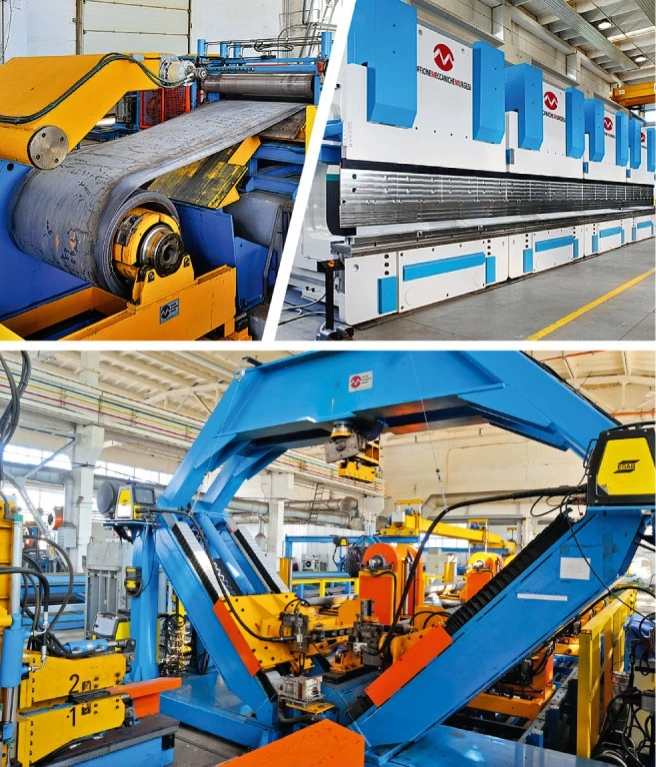
A lighting pole must be a truncated pyramid of multi-sided (six or more faces) or round section, made by bending sheet and then welding it longitudinally. The pole must have a place for fixing an earthing bolt.
Poles are installed in one of two ways: the shaft is fixed to the foundation through a flanged joint, or it is set in a pre-dug pit and concreted in. The foundation must be steel, from round pipes, or reinforced concrete with an embedded set (a template plate with anchor bolts). The buried parts of shafts are waterproofed with bitumen varnish or another coating agreed with the customer. Waterproofing is not included in the delivery of poles and foundations.
The relevant European standards for steel lighting columns are the DSTU EN 40 series (EN 40-2 covers general requirements and dimensions, EN 40-5 the requirements for steel columns).
Limit deviations of linear dimensions from nominal, and deviations of shape and position of surfaces, are set by the working design documentation and the standards in force. The overall curvature of sheet parts must not exceed 0.2% of the length; parts with greater curvature must be straightened. Rolled steel is straightened cold on rolls and presses, and after straightening the surface must be free of dents, nicks and other damage. Bolt holes are made by punching, drilling, or punching to a smaller diameter followed by reaming to the design diameter.
Holes may be punched straight to the design diameter in two cases. For poles used in regions with a design temperature of minus 40 °C and above, this applies to carbon and low-alloy steel elements up to 20 mm thick. For poles used in regions with a design temperature below minus 40 °C, it covers carbon steel elements up to 12 mm thick and low-alloy steel up to 10 mm. In all other cases the holes are drilled.
Pole requirements
What street lighting poles are made of
All pole elements are made of the steels specified in DBN V.2.6-198:2014 and in the working design documentation:
- shaft sections and shaft flanges: steel S245 or S345, or the grade specified in the working documentation;
- foundation pipes: steel specified in the working documentation (usually structural pipe steel);
- foundation flanges: steel S245 or S345, or as specified in the working documentation;
- brackets: steel specified in the working documentation.
The steel grade is stated in the design documentation. Steel grades and rolled products may be replaced by equivalent-strength ones as agreed with the design documentation.
Requirements for welded joints
Welding of steel poles follows a developed process set out in cards or standard process instructions. Manual arc welding with electrodes and semi-automatic welding in shielding gas with solid wire are used for the welded joints. The mechanical properties of the welding wire must be no lower than those of an E42A electrode for carbon steels and E50A for low-alloy steels.
Other welding methods can be used as well: in carbon dioxide, in a gas mixture, under flux, or with flux-cored wire. Longitudinal welds of poles should be made by semi-automatic or automatic welding in shielding gas. For sheet up to 8 mm thick, the longitudinal weld is made without edge preparation.
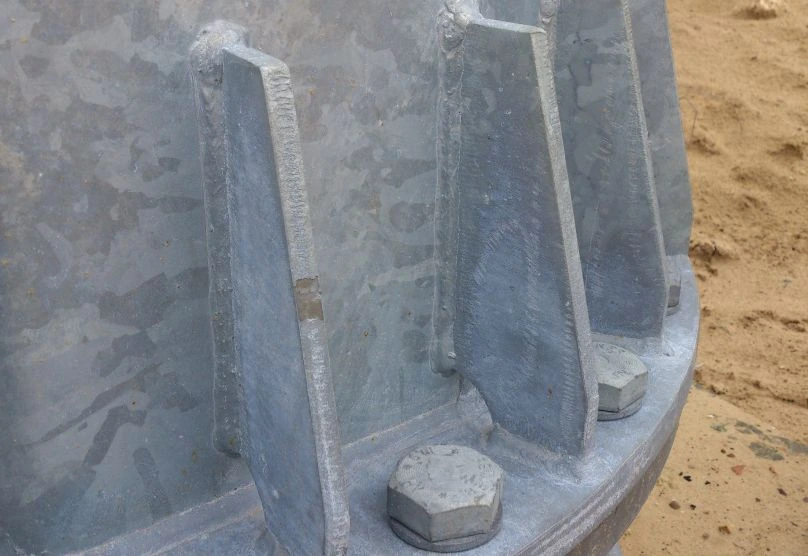
After welding, the welds are cleaned of slag, spatter and metal build-up; they must be free of undercuts and leg sizes beyond what the standards in force permit, slag inclusions and cracks. The weld leg equals the smallest thickness of the elements welded or is given in the working documentation. In appearance the welds must meet these requirements:
- a smooth surface with no build-up, narrowing or gaps and no sharp transition to the parent metal;
- dense deposited metal along the whole length of the weld, with no cracks;
- undercuts of the parent metal permitted up to 0.5 mm deep for steel 4 to 10 mm thick and up to 1 mm deep for steel over 10 mm thick;
- all craters filled.
Requirements for the anti-corrosion coating
Hot-dip galvanising to DSTU EN ISO 1461:2024 is used for corrosion protection of the poles. The average zinc coating thickness must be at least 55 µm (3 mm wall) or 70 µm (4 mm wall) per ISO 1461. The protective quality of the coating does not deteriorate if it is thicker than nominal. Foundations are coated with bitumen in two layers unless the contract says otherwise.
The zinc coating must adhere firmly to the parent metal and have an even, continuous smooth or rough surface with no cracks or chips. Local zinc build-up is acceptable where it does not interfere with the fit of elements at joints and in bolted connections.
Welded joints of structures to be hot-dip galvanised must not have “pockets” or cavities where acid or molten zinc could pool, or lap joints without closed welds.
Fasteners without a protective coating are treated with a preservative. Bolts, nuts, studs and washers used to assemble galvanised structures must be galvanised, with a coating thickness of at least 42 µm. The threads in nuts are run through again after coating so that they screw onto the bolt, and after calibration the nuts are preserved with grease.
Poles can also be made without a zinc coating. If corrosion protection is then needed, a paint coating agreed with the customer is used.
Completeness and marking
The set of poles prepared for dispatch to the customer must include:
- shipping marks (elements) of the poles: the shaft, brackets and fasteners as per the packing list;
- the foundation or the shipping marks (elements) of the foundation, and the installation set as per the supply contract;
- installation diagrams: 1 copy per batch;
- packing lists: 1 copy per batch;
- a certificate: 1 copy per batch;
- other documents provided for by the contract;
- an operating manual.
A designation matching the drawings is applied to each shipping mark by stamping or another method (paint, tag). The marking must be clear, durable and indelible. A tag with transport marking is firmly attached to each shipping element (bundle). The tag gives: the name and/or trademark of the manufacturer, the type of pole, the designation of the technical specifications, the manufacturer’s serial number, the date of manufacture (month, year), the words “Made in Ukraine” and the order number. Poles for export are marked as required by the contract.
Shipping marks too small to be marked are put in a box or tied in bundles, with a tag showing the mark and quantity.
Packing
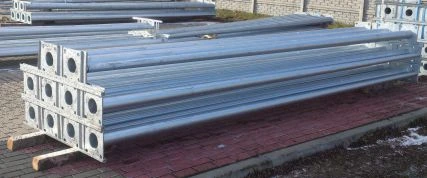
The poles are supplied as separate elements provided for by the design, unpacked; the elements are assembled into bundles according to the manufacturer’s packing list. A bundle must not weigh more than 5 t unless the contract says otherwise; by agreement with the customer the mass can be changed.
Small shipping elements and fasteners are sorted by size and packed in a container (to the manufacturer’s drawings) or boxes; a box must weigh no more than 80 kg. Metal packing parts of the bundles are painted or galvanised depending on the protective coating of the poles. Packing of poles for export must meet the contract; by agreement with the customer, other kinds of packing are acceptable if they keep the load safe all the way.
Updated:
Reviewed by: V.V. Padalka, Chief Project Engineer
Technical requirements for lighting poles: frequently asked questions
What is the minimum zinc coating thickness on a pole?
The average thickness must be at least 55 µm for a 3 mm wall and at least 70 µm for a 4 mm wall (per ISO 1461). If the coating is thicker than nominal, its quality does not suffer.
What zinc thickness is needed for fasteners (bolts, nuts)?
At least 42 µm. Nut threads are run through again after galvanising so that the nuts screw onto the bolt.
What is the maximum bundle mass for shipping poles?
No more than 5 t unless the contract says otherwise. A box of small elements must not weigh more than 80 kg.
What are the tolerances on sheet part curvature?
Overall curvature must not exceed 0.2% of the part’s length; parts with greater curvature must be straightened on rolls or presses.
Questionnaire: technical assignment form
Fill in the form and email it to us: we will prepare the KM-stage design documentation from it and calculate the price. The PDF is handy to print; the DOCX can be filled in on a computer.
Technical assignment form: floodlight mast (lighting pole)
A questionnaire for preparing KM-stage design documentation for a steel polygonal floodlight mast: crown type, floodlights, platforms, ladder.
Related products: Street lighting columns · Hot-dip galvanising
Read also: Installation of Multi-sided Poles and Masts · Solar Street Lighting · Power Line Pole Types by Purpose: Suspension, Tension, Angle, Terminal · Cross-arms for 0.4–10 kV Lines: TM and TN Types, Reading the Designation
See also: Area Lighting: Poles, Luminaires, Design · Design of Lighting Poles and Floodlight Masts · Pedestrian crossing lighting systems 2026
Get a quote for your requirements
Send us your requirements — we will calculate the price and lead time.