
Home / Products / Substation gantries / What Is a Substation Gantry: Purpose and Voltage Classes
Substation gantries
What Is a Substation Gantry: Purpose and Voltage Classes
A substation gantry is the steel support structure at the open-air switchyard of a substation. Below: what it is for and which types there are.
Contents
- What an open-air switchyard is and why a gantry is needed
- What else is on an open-air switchyard
- Multi-sided or standard gantries
- Gantry shapes: single-column, portal-frame, angle
- Voltage classes of gantries
- PUE requirements for gantries
- Corrosion protection and installation
- What to provide for a gantry calculation
- Common mistakes
- Gantry types by purpose: busbar, bay, jumper, line
- Which gantry types exist at each voltage class
- Multi-sided and standard gantries: what differs
What an open-air switchyard is and why a gantry is needed
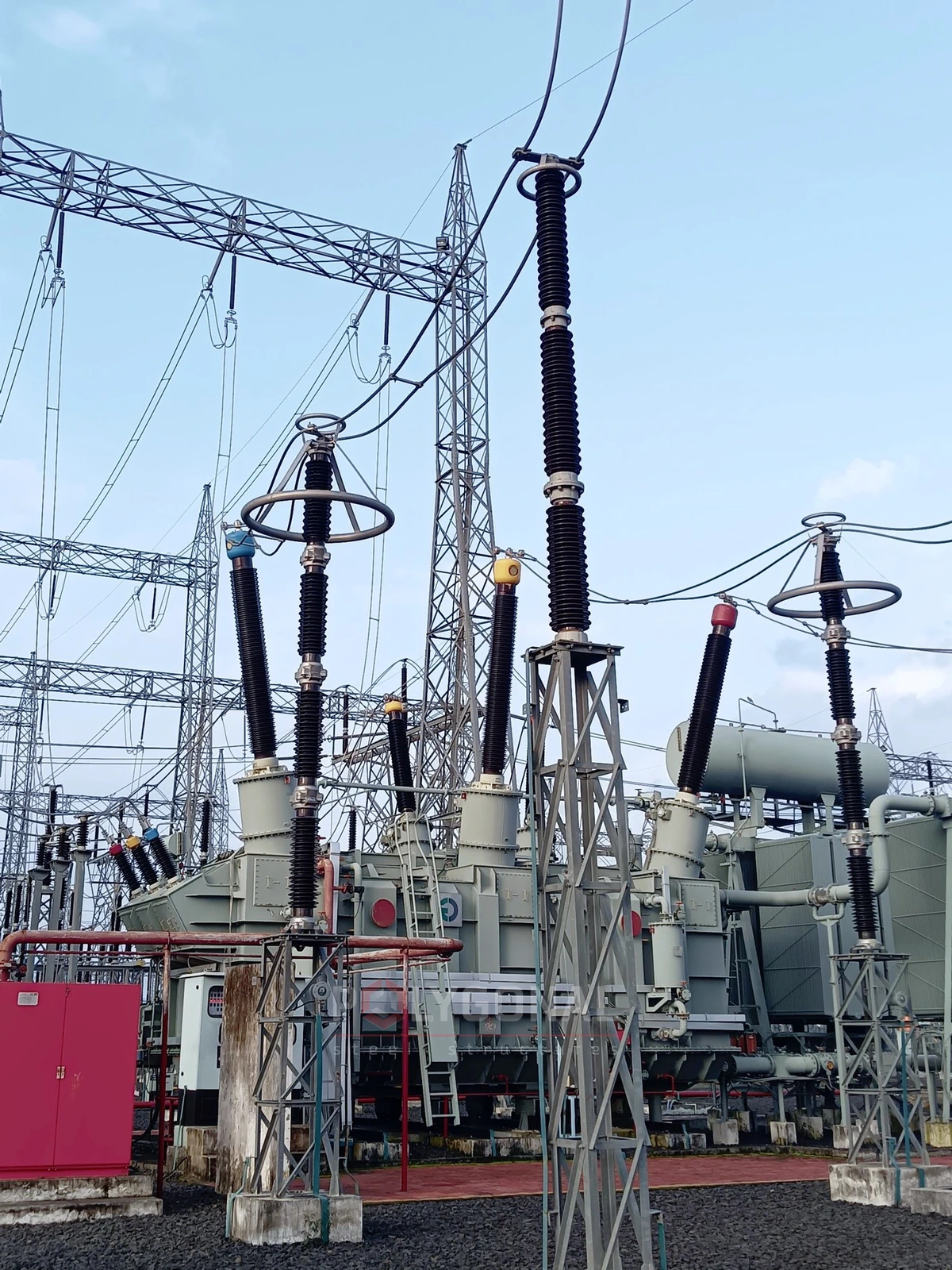
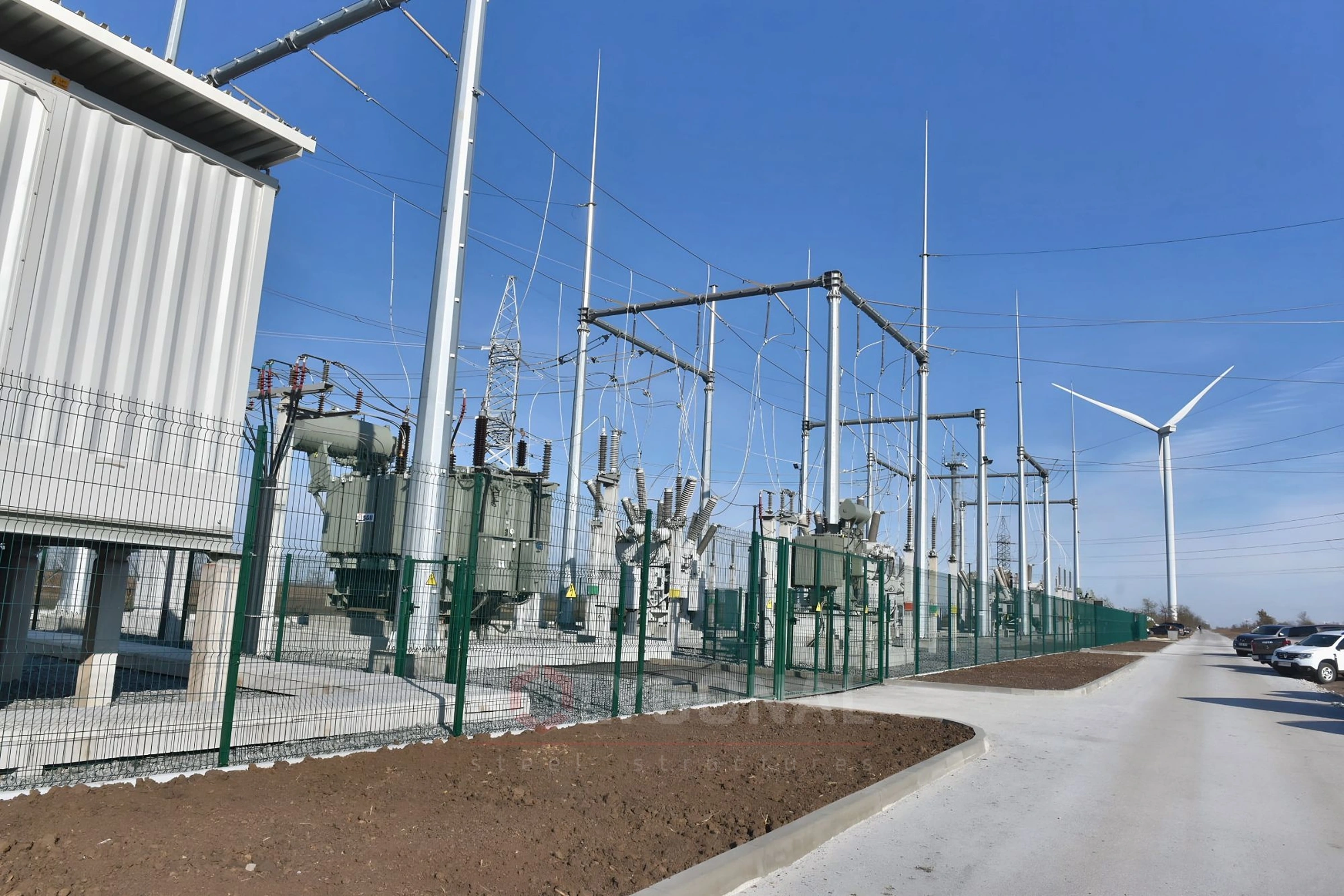
An open-air switchyard is the part of a substation that stands outdoors. It holds the equipment that receives and distributes electricity: busbars, disconnectors, circuit breakers, current and voltage transformers.
A gantry is a steel frame of two or more columns and horizontal beams. It holds the busbars, the insulator strings and the ends of incoming overhead lines at the height they need to be.
What else is on an open-air switchyard
A switchyard has more than gantries. Busbar supports carry the busbars between the gantries, the equipment (circuit breakers, disconnectors, current and voltage transformers) stands on its own support structures, and there are also surge arresters and a grounding loop.
Even so, the gantry takes the heaviest load: the weight of the busbars, the pull of the incoming overhead lines and the wind acting on the whole span.
Multi-sided or standard gantries
- multi-sided gantries: columns made of bent steel sections, each one designed for a specific substation project;
- standard gantries: built to unified albums of older design solutions. We check them against current codes and recalculate or modify them if needed.
Marks and sizes of standard gantries are tabulated in full on the page Typical Substation Gantries 35–500 kV.
Gantry shapes: single-column, portal-frame, angle
A single-column gantry has one column and takes a light load, for example a single device or the end of a line. A portal-frame gantry has two columns and a horizontal beam; it is the most common type for a busbar or line span. Angle (anchor) gantries are reinforced and are used where the route turns or the wires are tensioned.
Each type is calculated for its own loads: the number and cross-section of the wires, the turning angle and the voltage class.
Voltage classes of gantries
We make gantries for substations from 35 to 750 kV. The higher the voltage, the greater the clearance required between live parts and the ground, so the gantry has to be taller and heavier.
PUE requirements for gantries
The Rules for the Arrangement of Electrical Installations (PUE, 2026 edition) set the minimum clear distances from bare live parts to the ground, to earthed structures and between phases, and these depend on the voltage class (Table 4.2.1). Supporting structures for equipment, apparatus, live parts and insulators must be designed for weight, tension, switching operations, wind, ice, short circuits and seismic actions; steel structures must also carry an anti-corrosion coating (cl. 4.2.14). Wind and ice loads on the busbars and structures are to be determined from the climatic zoning maps and from chapter 2.5 on overhead lines (cl. 4.2.46); supports that hold busbars are to be designed as intermediate or end supports (cl. 4.2.48). At substations and switchyards of 330 kV and above, the Rules call for metalwork protected against corrosion by methods that need no regular renewal of the coating (galvanising or aluminising, for example), or for structures made of aluminium elements, so that staff spend less time in the zone of the electric field (cl. 4.2.192).
That is why every gantry is calculated for its own project. The exact clearances and loads depend on the voltage class and on the wind and ice region of the site; the designer takes the final values for a specific installation from the current text of the PUE.
Corrosion protection and installation
Multi-sided gantries are made from a closed bent profile and hot-dip galvanised on both sides, outside and inside, to DSTU EN ISO 1461:2024. This is what gives them a much longer service life than standard lattice gantries: those often have lap-welded joints without a closed seam, which the galvanising rules do not allow.
The column is fixed to the foundation by a flange, through a tubular anchor cage that also has a flange. The advantages of multi-sided gantries over standard ones are covered in Multi-Sided Substation Gantries: Design and Foundations.
What to provide for a gantry calculation
Skip anything you do not know, and we will clarify it ourselves. The calculation needs:
- a switchyard layout drawing: the number of columns, the span and the height to the beam;
- the voltage class and the single-line diagram of the switchyard;
- loads: the number and type of wires, the wire tension, and the turning angle for an angle gantry;
- the wind and ice region and the soil under the foundation;
- for a standard gantry, its mark and design number from the documentation.
Common mistakes
- choosing a gantry by voltage class alone, with no wire loads taken into account;
- an angle or anchor gantry not marked as such, although that type has to be reinforced;
- the foundation and soil left unchecked;
- the column height given, but not the height to the beam, which the clearances to the ground depend on.
Gantry types by purpose: busbar, bay, jumper, line
Besides the shape (single-column, portal-frame, angle), the standard albums tell gantries apart by purpose. It shows in the mark: the letter after the voltage class. Ш (Sh) means a busbar gantry, Я (Ya) a bay gantry, П (P) a jumper gantry, Т (T) a transformer gantry and Л (L) a line gantry. The letter С (S) at the end of a mark (ПС-35ШС) denotes the version for northern regions. In marks such as ПСЛ-110Я1 and ПСТ-110Я1 the letters Л and Т stand before the voltage class and do not give the type: in the catalogue these are bay gantries (Я).
| Type | Letter | Marks in the catalogue | Posts | Gantry mass, kg |
|---|---|---|---|---|
| Busbar | Ш | 11 | 2 | 647–6,390 |
| Bay | Я | 80 | 2–6 | 1,076–12,213 |
| Jumper | П | 6 | 2–3 | 6,770–12,197 |
| Transformer | Т | 2 | 2–3 | 7,307–12,266 |
| Line | Л | 12 | 2–3 | 7,153–14,724 |
Based on the page Typical Substation Gantries 35–500 kV: 111 marks in all, including the versions for northern regions. The exact connection scheme comes from the layout drawing of the switchyard.
Which gantry types exist at each voltage class
The higher the voltage class, the bigger the gantry. The heaviest gantry in the catalogue (ПС-500-Л3, 14,724 kg) is more than 20 times as heavy as the lightest (ПС-35ШС, 647 kg); the table of masses and posts by voltage class is on the page Substation Gantries. The table below shows how many marks of each type exist at each class.
| Voltage class, kV | Busbar (Ш) | Bay (Я) | Jumper (П) | Transformer (Т) | Line (Л) | Total |
|---|---|---|---|---|---|---|
| 35 | 2 | 10 | — | — | — | 12 |
| 110 | 2 | 48 | — | — | — | 50 |
| 150 | 2 | 14 | — | — | — | 16 |
| 220 | 2 | 4 | — | — | — | 6 |
| 330 | 1 | 4 | 4 | 2 | — | 11 |
| 500 | 2 | — | 2 | — | 12 | 16 |
Line gantries appear only at 500 kV, jumper gantries at 330 and 500 kV and transformer gantries at 330 kV; at 35–220 kV the catalogue has only busbar and bay gantries. The count includes the versions for northern regions.
Multi-sided and standard gantries: what differs
A standard gantry is taken from an album, a multi-sided one is calculated for a particular substation. The table gives what is not covered above: the post, the calculation and the sizes.
| Feature | Standard lattice | Multi-sided |
|---|---|---|
| Post | lattice, made of welded members | bent from steel sheet, closed multi-sided section |
| Calculation | from the album, recalculated to current codes | individual, for the substation project |
| Sizes | a series of 111 marks for 35–500 kV | for 110 kV 12 types 9–45 m long, for 150 kV 7 types 11.1–33.3 m long, for other classes an individual calculation |
Dimensions and equipment of the 110 and 150 kV types are in the catalogues 110 kV Substation Gantries and 150 kV Substation Gantries.
Updated:
Substation gantries: frequently asked questions
Are VRP and ORU the same thing?
Yes. Both terms mean the open-air switchyard, the outdoor part of a substation. A gantry is the support structure within it.
How is a multi-sided gantry different from a standard one?
A multi-sided gantry is calculated individually for a specific substation project. A standard one is made to a unified album of an older design solution. We check these against current codes too, and recalculate or modify them if needed.
Which voltage classes do you make gantries for?
From 35 to 750 kV. The design and dimensions are worked out by calculation for the voltage class and the particular substation project.
How does a gantry differ from a busbar support on the same switchyard?
A gantry carries line ends or busbars between spans, while a busbar support only holds the busbars. A gantry is a frame of two or more columns spanning a bay. A busbar support is a separate structure, usually with a single column, standing between gantries.
Why are standard gantries from the 1970s–80s still being used?
Mostly because the documentation already exists and designers are used to it. These gantries are heavier, need more land and are harder to hot-dip galvanise because of the lap-welded joints. We check them against current codes and, where it makes sense, offer a multi-sided replacement.
Can a single gantry be replaced at a live switchyard?
Yes, as long as the new gantry matches the existing layout in height to the beam, span, busbar load and foundation. The customer agrees the conditions of work at a live switchyard (taking the section out of service, a permit to work).
What if there are no switchyard drawings?
Send photos, measurements of the existing gantries, the voltage class, the number and type of wires and the wind and ice region. From that we will propose a gantry type, then pin down the dimensions and loads by calculation.
Who installs the gantries?
A licensed construction company that works with us as a partner does the installation. We design and manufacture the gantries.
What do the letters Ш, Я, П, Т, Л in a standard gantry mark mean?
They give the gantry type in the album: Ш (Sh) busbar, Я (Ya) bay, П (P) jumper, Т (T) transformer, Л (L) line. The letter С (S) at the end of a mark (ПС-35ШС) means the version for northern regions.
How much does a standard switchyard gantry weigh?
It depends on the voltage class and type: from 647 kg (ПС-35ШС) to 14,724 kg (ПС-500-Л3). All marks with their masses are on the page Typical Substation Gantries 35–500 kV.
Related products: Substation gantries
More on this topic: Typical Substation Gantries 35–500 kV · Multi-sided Substation Gantries: Design and Foundations · Multi-Sided Switchyard Gantries 35–150 kV: Sizes, Heights, Bays · Installing a Substation Gantry: Slinging, Setting the Shafts and Crossbeam, Tightening the Bolts · Restoring Damaged Substation Switchyard Portals · Protective Structures for Substation Switchyard Equipment
Get a quote for your requirements
Send us your requirements — we will calculate the price and lead time.