
Home / Products / Substation gantries / Restoring Damaged Substation Switchyard Portals
Substation gantries
Restoring Damaged Substation Switchyard Portals
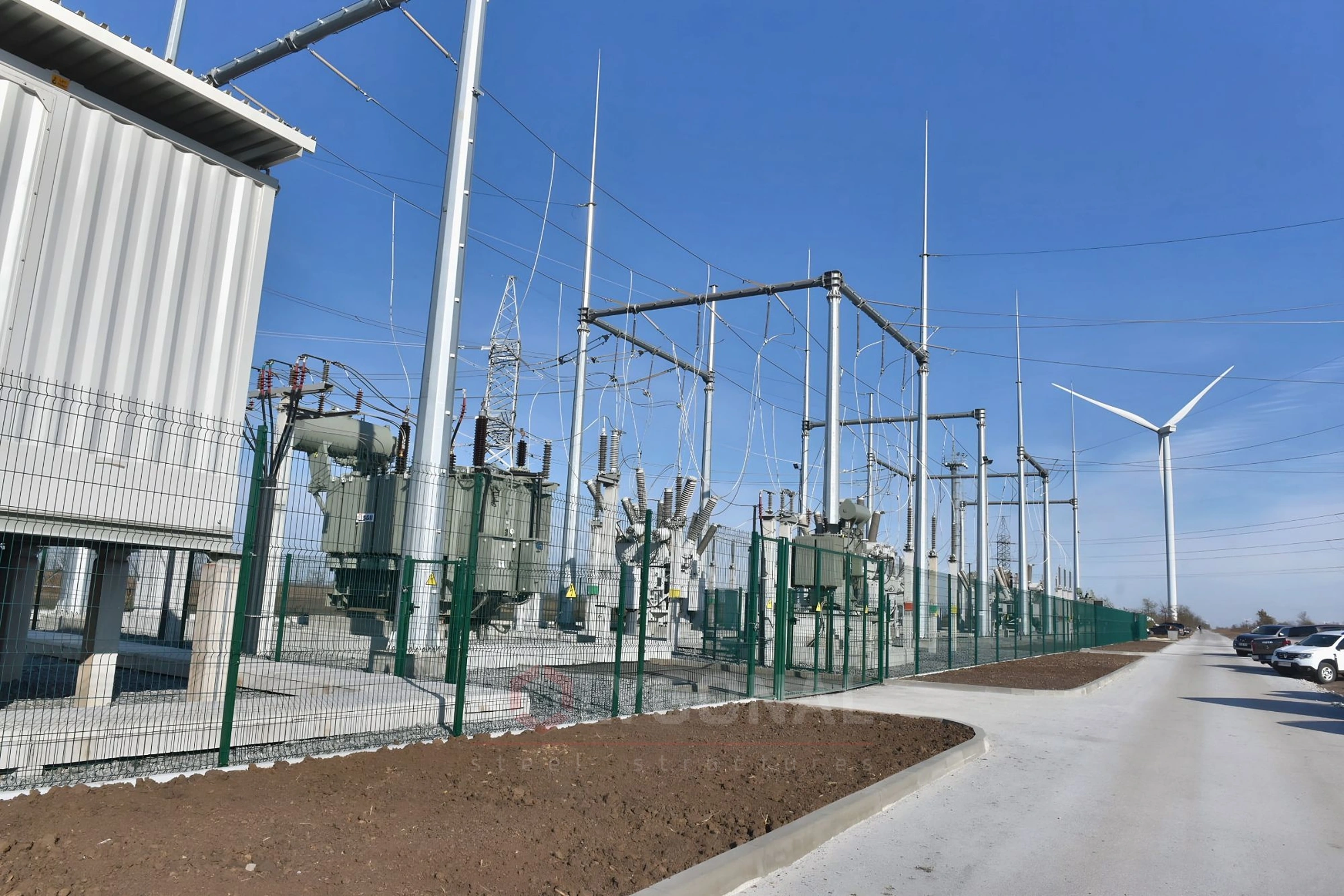
A substation’s switchyard portal is a critical structure: damage to even part of it halts the substation’s operation. We manufacture elements for urgent restoration and dispatch them for installation.
Contents
When urgent restoration is needed
Open switchyard (ORU) portals at substations can be damaged by severe weather, accidents, or combat action. In every one of these cases, the substation needs to be restored as quickly as possible, since the power supply to the facilities and consumers connected to it depends on it.
What we manufacture
We manufacture individual portal elements to replace damaged ones — to typical designs (where the portal matches a standard design, see Typical Switchyard Portals 35–500 kV) or to the actual dimensions and photos of the damaged section, if the portal type is unknown or individual elements are needed. This does not always require a full new design cycle — often the dimensions and photos of the surviving and damaged parts of the structure are enough.
One example from our practice: a substation whose switchyard portals suffered combat damage. We manufactured the damaged structural elements and sent them for installation; the contractor promptly replaced the damaged sections, and the substation was restored to operation.
How to submit an urgent manufacturing request
Send photos of the damaged portal section, any available dimensions or the typical portal mark (if known), the substation’s voltage class and the region. We assess the manufacturing lead time individually, depending on the extent of the damage and the availability of the matching profile in stock.
Besides restoration after damage, we also design preventive protective structures for switchyard equipment.
How to read a portal mark
If the portal mark has survived in the substation documentation, finding the replacement elements becomes much faster: the size is looked up in the typical portals catalogue. The logic of the mark is clear from the catalogue itself.
| Part of the mark | Example | What it means |
|---|---|---|
| Letters before the voltage class | ПС, ПСЛ, ПСТ | ПС — steel portal; ПСЛ and ПСТ are two separate series of 110 kV portals (both of the bay type, letter Я); the letters Л and Т here do not denote the portal type, and for the same size number a ПСТ portal is heavier than a ПСЛ one |
| Number | 110 | voltage class, kV |
| Letter after the voltage class | Я, Ш, П, Т, Л | bay, busbar, jumper, transformer (in the catalogue only at 330 kV), line (only at 500 kV) |
| Number after the letter | Я2 | sequential size within the type |
| С at the end | ПСЛ-110Я2С | version for northern regions |
An example from the catalogue: ПСЛ-110Я2 (bay type, 2 posts) has a mass of 1,926 kg, while ПСЛ-110Я2С has 1,833 kg; the difference is 1926 − 1,833 = 93 kg. The structures are not identical, so an element of one version must not be fitted to a portal of the other without checking.
What we do depending on the data available
The scope of work depends on what is known about the damaged portal.
| What is known | How we restore it | What else is needed |
|---|---|---|
| The mark of a typical portal is known | We take the size from the catalogue and check it against the actual dimensions | Photos of the joints and the dimensions of the foundation connection (flange or base plate) to confirm the match |
| No mark, but part of the structure survives | We reconstruct the geometry of the damaged elements from the dimensions and photos of the surviving parts supplied by the customer | Distances between post axes, height to the cross-arm |
| Almost nothing survives | We calculate the elements as a new structure | Layout drawings, busbar loads, region |
From request to dispatch
- request: photos, dimensions, voltage class and region (see the checklist below);
- we identify the structure type and the set of replacement elements and send the list for approval;
- we check the connection joints: the foundation connection (flange or base plate) and the position of the holes, so that the new elements fit onto the surviving parts and the foundation;
- manufacture; where the protection includes hot-dip galvanising, it is done to DSTU EN ISO 1461:2024: the minimum coating thickness depends on the thickness of the steel; for example, for steel over 6 mm, the mean thickness must be at least 85 µm (see zinc coating thickness);
- marking of the elements according to the installation scheme and dispatch; installation is carried out by a specialised organisation.
Checklist before sending a request
- photos of the damaged section: a general view and a close-up of each joint, plus the surviving neighbouring elements;
- dimensions of the surviving parts: distances between post axes, height to the cross-arm, cross-section size of the post and the wall thickness or section of its members;
- dimensions of the foundation connection (flange or base plate) and the position of the anchor holes;
- the portal mark from the substation documentation, if known;
- voltage class, region and busbar loads.
Common mistakes
- ordering from photos alone: a photo shows neither the dimensions nor the thickness of the metal;
- replacing an element with a similar one from another version (ordinary and northern regions) without checking;
- ignoring the foundation: new elements stand on the surviving anchors, so their condition should be assessed before the replacement;
- calculating to outdated standards: typical portals were designed to standards that have since been updated, and where needed we recalculate them to the current standards;
- forgetting corrosion protection: the requirements for protecting the new elements (including hot-dip galvanising) are worth stating in the request right away, so they can be agreed with the design.
Updated:
Restoring switchyard portals: frequently asked questions
Can you manufacture just the damaged portal elements instead of a whole new portal?
Yes, if you have dimensions or photos of the damaged section and the surviving parts of the structure — we will manufacture exactly the elements needed as a replacement.
What if the portal type is unknown?
Send photos and actual dimensions — we will identify the structure type against our standard designs, or select or calculate the elements individually.
Can you manufacture urgently after damage occurs?
Yes, we assess the manufacturing lead time individually depending on the scope of work and profile availability in stock — contact us as soon as possible after the damage occurs.
How many photos should I send and how should I take them?
A general view of the portal, a close-up of each damaged joint and the surviving neighbouring elements. It helps to place a tape measure or a ruler in the frame, but please still write the dimensions down separately.
Is recalculation needed if only part of a portal is replaced?
For a typical portal, we check it against the current standards, because typical designs were made to standards that have since been updated. The scope of the check depends on what exactly is being replaced, and we agree it with the customer.
Do you install the replaced elements?
We design and manufacture. Installation is carried out by a specialised organisation; we mark the elements according to the installation scheme and agree the connection joints.
Related products: Substation gantries
More on this topic: Typical Substation Gantries 35–500 kV · Multi-sided Substation Gantries: Design and Foundations · Multi-Sided Switchyard Gantries 35–150 kV: Sizes, Heights, Bays · Installing a Substation Gantry: Slinging, Setting the Shafts and Crossbeam, Tightening the Bolts · What Is a Substation Gantry: Purpose and Voltage Classes · Protective Structures for Substation Switchyard Equipment
Get a quote for your requirements
Send us your requirements — we will calculate the price and lead time.