
Home / Products / Street lighting columns / Lighting Pole Height and Mass 3–12 m: Table by Range
Street lighting columns
Lighting Pole Height and Mass 3–12 m: Table by Range
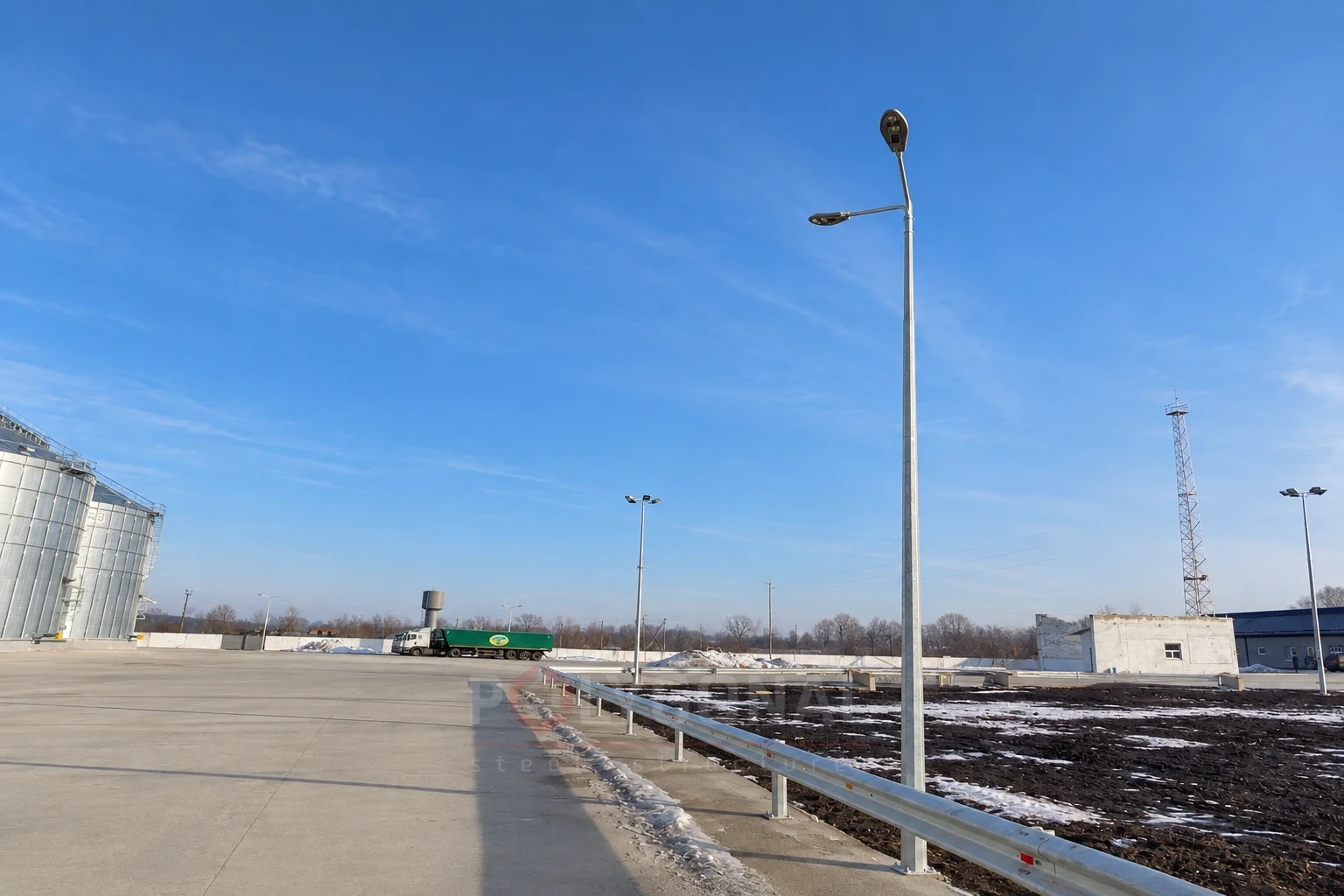
A lighting pole’s mass depends on its height and range: shaft shape (multi-sided or tapered) and duty (park, street or road). The tables below put the actual masses of all our 3–12 m ranges in one place.
Contents
- Which height suits which site
- Park poles: PLO, PMO, PKO (3–10 m)
- Street poles: UMO, UKO (3–12 m)
- Road poles: DMO (7–12 m)
- Pole "height" vs pole "length": what's the difference
- How street category affects the choice of pole height
- Wind region limits
- Floodlight masts — above 12 m
- How to choose the exact height
- How diameter, flange and anchor cage change with height
- Why mass grows in steps
- How much a batch of poles weighs
- Selecting a pole by luminaire area and mass
Which height suits which site
Pole height follows the type of area you are lighting. An approximate match by our ranges:
| Height, m | Typical site | Range |
|---|---|---|
| 3–4 | Courtyards, footpaths, park walkways | PLO, PMO, PKO |
| 5–6 | Parks, squares, small grounds | PMO, PKO, UMO |
| 7–8 | Local streets, apartment-block courtyards | UMO, UKO, DMO |
| 9–10 | District-level streets | UMO, UKO, DMO |
| 11–12 | Arterial roads and highways | UMO, UKO, DMO |
| Above 12 | Stadiums, grounds, industrial sites | Floodlight masts |
This is a practical guideline from how our ranges are used, not a regulatory requirement — the exact height and pole spacing for your site is set by a lighting calculation: see How to Choose the Height of a Lighting Pole.
Park poles: PLO, PMO, PKO (3–10 m)
Parks, squares, courtyards and small sports fields are covered by three ranges: PLO, PMO and PKO, which are the light multi-sided, standard multi-sided and tapered round poles respectively. All three are fixed to the foundation by a flange.
| Height, m | PLO (light), kg | PMO, kg | PKO (tapered), kg |
|---|---|---|---|
| 3 | 29 | 30 | 23 |
| 4 | 37 | 36 | 30 |
| 5 | 44 | 45 | 39 |
| 6 | 52 | 66 | 48 |
| 7 | 60 | 75 | 65 |
| 8 | 67 | 85 | 76 |
| 9 | — | 95 | 89 |
| 10 | — | 104 | 102 |
PLO is made only up to 8 m (a light range for lower loads); PMO and PKO go up to 10 m.
Street poles: UMO, UKO (3–12 m)
Streets, courtyards, walks, boulevards and pedestrian zones: UMO and UKO are the multi-sided and tapered poles. Both work with trench or overhead power supply.
| Height, m | UMO (multi-sided), kg | UKO (tapered), kg |
|---|---|---|
| 3 | — | 29 |
| 4 | — | 39 |
| 5 | 57 | 50 |
| 6 | 84 | 63 |
| 7 | 96 | 83 |
| 8 | 109 | 98 |
| 9 | 121 | 114 |
| 10 | 134 | 132 |
| 11 | 146 | 150 |
| 12 | 159 | 170 |
UMO is made from 5 m up; UKO from 3 to 12 m.
Road poles: DMO (7–12 m)
On roads and highways the pole to use is DMO, a multi-sided design. It can also serve as an intermediate support for SIP (self-supporting insulated cable).
| Height, m | DMO, kg |
|---|---|
| 7 | 131.0 |
| 8 | 148.2 |
| 9 | 177.3 |
| 10 | 194.5 |
| 11 | 211.7 |
| 12 | 228.8 |
Pole “height” vs pole “length”: what’s the difference
In drawings and tables, pole height (H) is the distance from ground level to the top of the shaft, where the luminaire or bracket is fixed. Pole length is the full length of the metal shaft, including whatever goes underground or into the foundation.
A flanged pole stands on its flange at ground level and only the foundation is below ground, so the shaft length is practically the same as the height. A direct-buried pole has a shaft longer than its height by the burial depth. That depth depends on the pole’s height and on the bearing capacity of the soil at the site. How the two mounting methods compare is covered in Flanged or Direct-Buried Lighting Pole Mounting.
How street category affects the choice of pole height
DBN V.2.5-28:2018 doesn’t set a pole height. It sets road-surface luminance by category A, B and C (details in Street and Road Lighting Norms). The higher the category, the higher the required luminance, so you typically end up with taller poles and more powerful luminaires, which keeps the pole spacing economical.
In practice, category C (local streets, courtyards) mostly gets 5–8 m poles, category B (district streets) 8–10 m, and category A (arterial roads) 10–12 m. Where the carriageway is even wider, the choice moves to floodlight masts. This comes from project practice rather than from the standard itself; the exact height and spacing always come out of a lighting calculation.
Wind region limits
A pole designed for one wind region may fail the load check in another. The higher the wind region number under DBN V.1.2-2:2006, the higher the characteristic wind pressure W0 and the lower the maximum pole height for the same wall thickness. For tall poles (10–12 m) in coastal or open steppe regions, run the calculation for the specific site instead of relying on the standard mass table alone.
W0 values for Ukraine’s regional capitals and a worked wind-load example are in Wind Regions of Ukraine: the W0 Table.
Floodlight masts — above 12 m
Stadiums, ports, industrial sites and any area that needs more than 12 m are lit from a floodlight mast, not a lighting pole. The shaft is designed differently, and there is a platform for several floodlights instead of a single luminaire.
How to choose the exact height
The table only shows how much each range and height weighs. The height for your site depends on the width of the lit strip, the pole layout and the illuminance requirements; the article How to Choose the Height of a Lighting Pole covers them in detail.
How diameter, flange and anchor cage change with height
In PMO and UMO the base diameter, the flange and the anchors rise in steps with height, and the anchor cage gets taller. In DMO the flange and anchors are also larger on the tallest poles (400×400 mm and M27 on DMO-12 against 300×300 mm and M24 on DMO-7), while the base diameter is the same in all DMO poles: 238 mm. The table shows several sizes from the pole cards, from the lowest to the tallest in each series.
| Pole | Base Ø, mm | Flange, mm | Anchors | Anchor cage | Mass, kg |
|---|---|---|---|---|---|
| PMO-4 | 168 | 250×250 | 4 × M20 | FPO-800-1 | 36 |
| PMO-6 | 206 | 300×300 | 4 × M24 | FPO-1000-1 | 66 |
| PMO-10 | 206 | 300×300 | 4 × M24 | FPO-1200-2 | 104 |
| UMO-5 | 168 | 250×250 | 4 × M20 | FPO-800-1 | 57 |
| UMO-8 | 206 | 300×300 | 4 × M24 | FPO-1000-1 | 109 |
| UMO-12 | 206 | 300×300 | 4 × M24 | FPO-1200-2 | 159 |
| DMO-7 | 238 | 300×300 | 4 × M24 | FPO-1500-2 | 131.0 |
| DMO-12 | 238 | 400×400 | 4 × M27 | FPO-1500-3 | 228.8 |
Data from the pole cards. The hole spacing in the flange, the hatch dimensions and the other parameters are on each pole’s card.
Why mass grows in steps
The tables show that mass does not grow evenly. Between PMO-5 and PMO-6 the difference is 21 kg (45 and 66 kg), although the poles are only a metre apart in height. The street series does the same: UMO-5 weighs 57 kg, while UMO-6 is already 84 kg (+27 kg).
The reason is at the bottom. At 6 m the base diameter goes up from 168 to 206 mm, the flange from 250×250 to 300×300 mm and the anchors from M20 to M24. After that, while the base stays the same, mass is added evenly: in the PMO series from 6 to 10 m it is 9–10 kg per metre (66, 75, 85, 95 and 104 kg), in the UMO series 12–13 kg (from 84 to 159 kg at 6–12 m).
The second step comes from the wall. At the same 8 m the park PMO-8 has a 3 mm wall and weighs 85 kg, while the street UMO-8 with a 4 mm wall weighs 109 kg. The difference is 24 kg, about 28%.
The spread across the whole table is wider still: the heaviest pole, DMO-12 (228.8 kg), is almost ten times as heavy as the lightest, PKO-3 (23 kg).
How much a batch of poles weighs
It helps to turn table masses into the weight of a batch: it decides what you unload with and how many poles fit on a truck. An example of a mixed order for a street with a footpath and a stretch of road:
- 12 PMO-4 poles at 36 kg: 432 kg;
- 8 UMO-8 poles at 109 kg: 872 kg;
- 6 DMO-10 poles at 194.5 kg: 1,167 kg.
That is 2,471 kg in total, about 2.5 t. Anchor cages, anchors and brackets are not included: they are separate order items, and their mass is added to the sum separately.
Selecting a pole by luminaire area and mass
You do not have to look up the permissible luminaire area and mass for a pole of this height in the tables by hand: the pole selection calculator by luminaire area and mass compares your luminaires with the catalogue data and shows which poles fit by height, wind region and mounting scheme.
Updated:
Lighting pole height and mass: frequently asked questions
How much does a 6-metre lighting pole weigh?
It depends on the range: PLO-6 weighs 52 kg, PMO-6 66 kg, PKO-6 48 kg, UMO-6 84 kg and UKO-6 63 kg.
How tall can a lighting pole be (not counting floodlight masts)?
12 m, which is the upper limit for the UMO and UKO (street) and DMO (road) ranges. Anything taller is a floodlight mast.
Why does a pole of the same height weigh differently across ranges?
Because shaft shape (multi-sided or tapered), wall thickness and design load differ from range to range. Park poles are lighter; street and road poles are designed for higher loads and wind regions.
Why is PMO-6 21 kg heavier than PMO-5?
At 6 m the bottom of the pole changes: the diameter goes up from 168 to 206 mm, the flange from 250×250 to 300×300 mm and the anchors from M20 to M24. From there to 10 m mass is added smoothly, 9–10 kg per metre.
Is the anchor cage included in the pole mass?
The tables give the mass of the pole itself. The FPO anchor cage is a separate order item with its own dimensions and anchors, so its mass, like that of brackets, is added separately.
How much does a batch of 10 UMO-8 poles weigh?
10 × 109 kg = 1,090 kg, a little over a tonne. Anchor cages and brackets are not in that figure, so add them separately.
Which pole in the tables is the lightest and which the heaviest?
The lightest is PKO-3 at 23 kg, the heaviest DMO-12 at 228.8 kg. Among the multi-sided poles the lightest is PLO-3 (29 kg), and the UMO street series runs from 57 kg (UMO-5) to 159 kg (UMO-12).
Related products: Street lighting columns
More on this topic: Street Lighting Norms: Categories A, B, C under DBN V.2.5-28:2018 · Flanged or Direct-buried Lighting Poles: Which to Choose · Steel or Concrete Lighting Poles: Comparison · Lighting Pole Marking: PMO, UMO, DMO, OGK, NFG — Finding an Equivalent · Lighting Column Dimensions and Tolerances under EN 40-2: Heights, Brackets, Hatches, Flanges · Lighting Pole Selection Calculator: Height, Series, Spacing and Number of Poles
See also: 6 m Lighting Poles · 8 m Lighting Poles · 10 m Lighting Poles · 12 m Lighting Poles
Get a quote for your requirements
Send us your requirements — we will calculate the price and lead time.