
Home / Products / Telecom masts / What Is a Mast: How It Differs from a Pole and a Tower, and the Main Types
Telecom masts
What Is a Mast: How It Differs from a Pole and a Tower, and the Main Types
A mast is a tall, slim vertical column that lifts floodlights, antennas, a flag or a lightning rod above the ground. Here is how a mast differs from a pole and a tower, which types there are and what shapes the design.
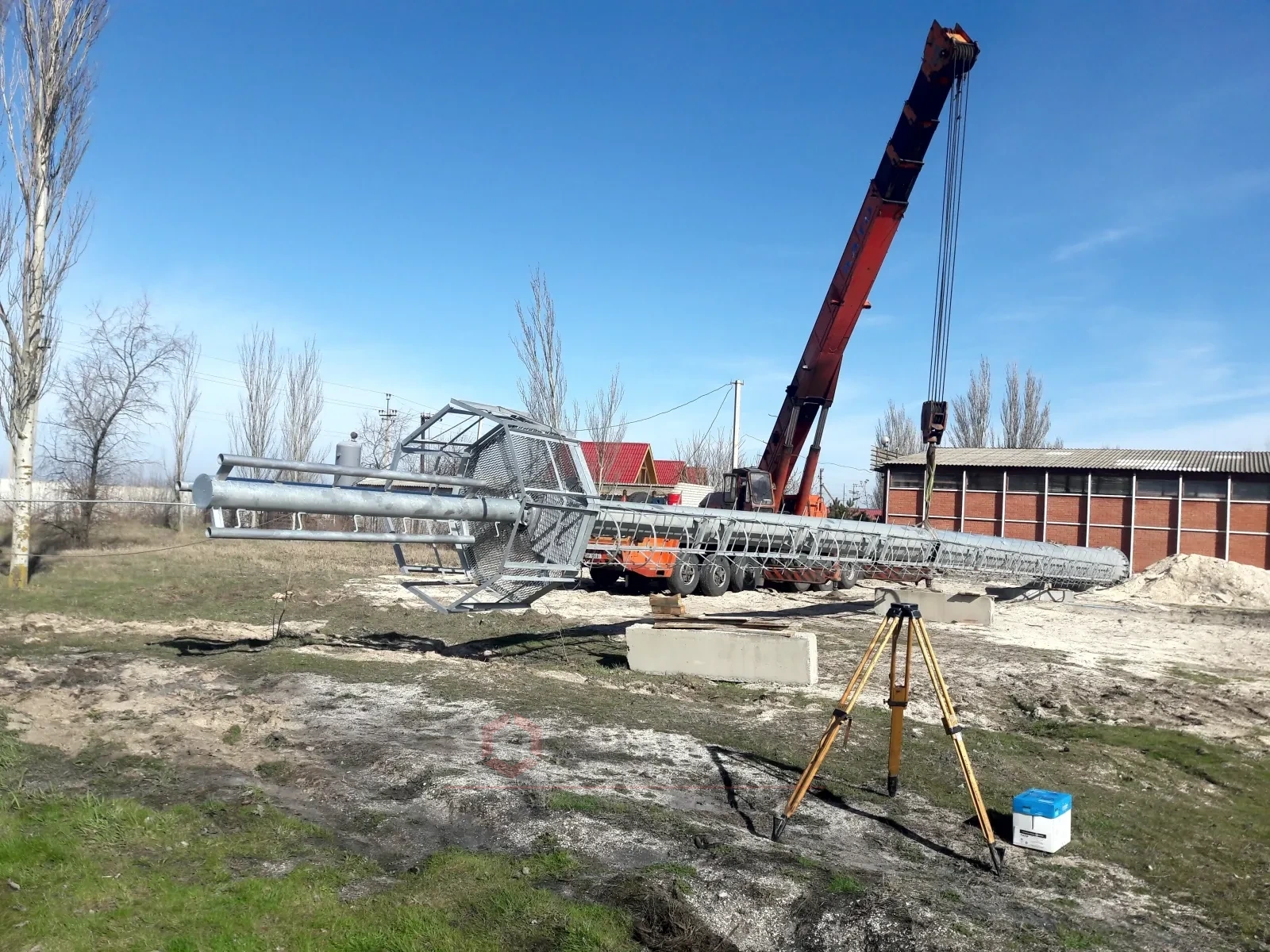
A mast is a tall vertical column (tube or lattice) that carries floodlights, antennas, a flag or a lightning rod. It stands on its own foundation or is held by guy wires, and has no rooms inside.
Contents
A mast: what it is and its main feature
A mast is a tall vertical column that carries equipment: floodlights, antennas, a flag or a lightning rod. The shaft is tubular or lattice, and there are no rooms inside. All a mast does is lift the equipment to the right height and hold it against the wind.
Its main feature is a slim shaft. That is why a mast depends so much on two things: how it is fixed at the bottom and what load it collects at the top. It is fixed in one of two ways, either as a single column on its own foundation or as a column with guy wires.
In everyday speech the word is used loosely. People call a floodlight mast in a port, a telecom antenna mast and even a flagpole a mast, so the exact structure is always clarified by its purpose.
Mast, pole and tower: where the line is
There is no fixed height limit between them, so we tell them apart by build. A mast is a slim column (tube or lattice), often guyed, and the guys need free space around it. A tower is either a spatial lattice structure with a wide base or a multi-sided single-column tower (monopole) on one foundation. For a detailed telecom comparison see Types of Telecom Towers.
“Pole” is a broader word than either: it covers lighting columns, supports for conductors and antenna towers. In product names the line between these words is also loose. Our PMV floodlight masts, for example, have a solid-wall bent multi-sided shaft, while antenna structures on multi-sided columns are called towers or masts.
How shaft profiles (multi-sided, conical, round) differ is shown for lighting poles in Multi-Sided or Conical Poles.
Types of masts by purpose
The type of mast is set by what is mounted on it. The main groups:
- floodlight masts light ports, airports, substations, stations and filling stations. Ours are the multi-sided PM, PMV and PMS-B series. How they differ from the old PMS and PMZh marks is explained in Floodlight Masts PMS, PMZh, PMV, PMK. A general overview is on the Floodlight Masts page;
- masts with a mobile crown (PMK): a winch lowers the crown with the floodlights, so the lamps are serviced at ground level. It is a crown type, not a separate height series, see PMK;
- antenna masts and towers for cellular and radio communications. We make multi-sided towers 25, 30, 35 and 40 m high, up to 70 m for individual projects. See Telecom Towers;
- flagpoles: a mast for a flag, made by us at 6–70 m for commercial and public sites. How to choose one is in How to Choose a Flagpole;
- lightning rods and air terminals: a rod or finial at the top of the column and a down conductor along the shaft.
Mobile telescopic masts for temporary deployment are a separate class of product and are not covered here.
What a steel mast is made of and how
Our masts are bent multi-sided steel columns. For flagpoles we use S245 or S345 steel, and for other products the workshop also works with St3 and 09G2S steels. We bend the sheet on a 2000 t press (up to 25 mm thick and 12 m long), weld the shaft along one seam and join the sections by flanges or telescopically.
A tower section is usually no longer than 12 m, which makes it easy to transport. Sections can be built up vertically or erected whole from a horizontal position.
Hot-dip galvanizing protects the column against corrosion, and our bath measures 13,000 × 1,600 × 3,200 mm. For floodlight masts we specify DSTU EN ISO 1461:2024. Installation is carried out by a licensed construction partner company; a flagpole is usually set up by the customer, and we can arrange a partner on request.
What shapes the design of a mast
The same height can be built in different ways, and the choice depends on loads and location. The main factors are in the table:
| Factor | What it changes in the design |
|---|---|
| Height | The moment at the base grows faster than the height, so shaft diameter, wall thickness, flange, anchors and foundation grow with it |
| Wind | The wind region and terrain type set the load under DBN V.1.2-2:2006; a flag or a large antenna adds sail area |
| Ice | Ice on antennas and cables adds weight and wind area; antenna-mast structures need a combined ice-and-wind calculation |
| Equipment | Number, size and weight of antennas or floodlights, platforms, ladders and cables; for narrow-beam antennas the permitted tip deflection is set by the equipment maker |
| Base | The foundation is designed for moment and axial force, not only for weight; the anchor cage is cast before erection and its anchors match the flange holes |
Guidelines for a first selection. The final sections, flange and foundation are confirmed by a calculation based on the technical specification.
How the height is determined
The height of an antenna mast is not taken from the coverage radius by a formula: the operator’s radio engineer sets the antenna heights, and the designer adds a margin above the top antenna for a lightning rod and lights. How it comes together is covered in Mast and Tower Height.
For a flagpole the height is tied to the flag size, for a floodlight mast to the area being lit.
Lightning, lights and approvals
A mast stands out above its surroundings, so lightning protection has to be planned. Under a separate lightning protection design, a steel column can serve as an air terminal and a down conductor. What the DSTU EN 62305-3 standard requires here is covered in Steel Mast as a Lightning Rod.
Tall masts and towers may carry obstruction lights and marking. Whether they are needed is decided by the aviation rules in force, and approvals are obtained for the specific site.
What to send to select or order a mast
We need only a few things for a calculation:
- purpose: lighting, communications, a flag or lightning protection;
- the required height, or what the mast has to cover or light;
- equipment: number, size, weight and mounting height;
- location (the town, for the wind region) and soil data if you have it;
- site size: is there room for guy wires and for machinery during erection.
If you do not know something, leave it blank and we will clarify. For telecom towers there is a technical specification form, see Telecom Towers.
Updated:
Mast FAQ
What is a mast in simple terms?
A tall slim column that carries floodlights, antennas, a flag or a lightning rod. There are no rooms inside: a mast only lifts the equipment up and holds it against the wind.
How is a mast different from a pole?
“Pole” is a broader word: it covers lighting columns, supports for conductors and antenna towers. A mast is specifically a slim column for equipment, often guyed.
How is a mast different from a tower?
A mast is a slim column (tube or lattice) that often needs guy wires. A tower is a spatial lattice structure with a wide base or a multi-sided single-column tower on one foundation. Details are in Types of Telecom Towers.
Does a mast need guy wires?
Not always. A multi-sided mast stands on its own foundation. A guyed mast takes much more room because the guys are anchored around it.
Can a mast act as a lightning rod?
Yes, under a separate lightning protection design a steel column can serve as an air terminal and a down conductor. The conditions are described in Steel Mast as a Lightning Rod.
Who installs a mast?
Installation is carried out by a licensed construction partner company. A flagpole is usually set up by the customer, and we can arrange a partner on request.
What is needed to calculate a mast?
The purpose, height, equipment (number, size, weight), location and soil data. The list is given above, in the section on what to send.
Related products: Telecom masts · High-mast lighting · Flagpoles
More on this topic: Design of Telecom Towers and Antenna Masts · Height of a Telecom Mast or Tower: How to Determine It and Choose the Structure · Telecom Tower Types: Multi-sided, Lattice, Guyed Masts · Cell Tower Explained: What It Is, How It's Built, Typical Heights
Get a quote for your requirements
Send us your requirements — we will calculate the price and lead time.