
Home / Products / High-mast lighting / Floodlight Masts PMS, PMZH and Our PMV, PMK: What's the Difference
High-mast lighting
Floodlight Masts PMS, PMZH and Our PMV, PMK: What’s the Difference
The marks PMS and PMZH come up in searches; older standard designs use them for floodlight masts. Here is what the letters stand for and how such masts differ from our multi-sided PMV and PMK masts.
Contents
- What PMS and PMZH mean
- How our PMV and PMK differ from PMS and PMZH
- Multi-sided equivalents of PMS and PMZH: the PMS-B series
- How to find an equivalent
- What the number in the mark means: platform or whole mast
- What height your site needs
- Example: do the floodlights fit the mast loads
- Typical mistakes when replacing a mast based on its old mark
What PMS and PMZH mean
PMS is a steel floodlight mast. The shaft is assembled from steel lattice (truss) sections, a space frame of angle profile rather than a solid-wall tube.
PMZH is a reinforced-concrete floodlight mast, built from pre-stressed, centrifugally cast reinforced-concrete legs that are cylindrical or conical in shape.
Both marks belong to one standard design series, 3.407.9-172, approved by the USSR Ministry of Energy in 1991. The drawings are publicly available, so practically every specialised factory makes these masts, us included (for the PMZH we make only the steel fittings and do not supply the reinforced concrete). The number after the letters usually gives the floodlight platform height in metres (for example PMS-29.3 or PMZH-19.3).
How our PMV and PMK differ from PMS and PMZH
We make the standard PMS masts as well, to the same 3.407.9-172 drawings and to order, when a project specifically calls for that mark. The PMZH is the same, but only the steel fittings: we do not supply reinforced concrete. For the PMZH there is also, at the customer’s request, a better version adapted to hot-dip galvanising: the drawings of the standard PMZH masts do not meet the requirements for products that can be hot-dip galvanised, so in this version the fittings (the floodlight platform, the ladder, the lightning rod and other steel parts) are made to the requirements of hot-dip galvanising.
Our main offering, though, is our own PMV mast. Its shaft is solid-wall, multi-sided bent steel made to our own technical specifications (TU U 25.1-39573934-001:2016), instead of a lattice truss or a multi-legged concrete base. In practice that means one compact foundation in place of a lattice or multi-legged base (a smaller footprint and land take), fewer separate parts to assemble and simpler transport.
PMK is not a separate height range. It is a crown type (the head frame with platforms for floodlights) on our PMV masts: a lowering crown that a winch brings down, so the floodlights can be serviced at ground level without special equipment. See the article Floodlight Masts with a Mobile Crown PMK.
We also have direct multi-sided equivalents of the classic PMS and PMZH by platform height: the PMS-B series. Its sizes are in the section below.
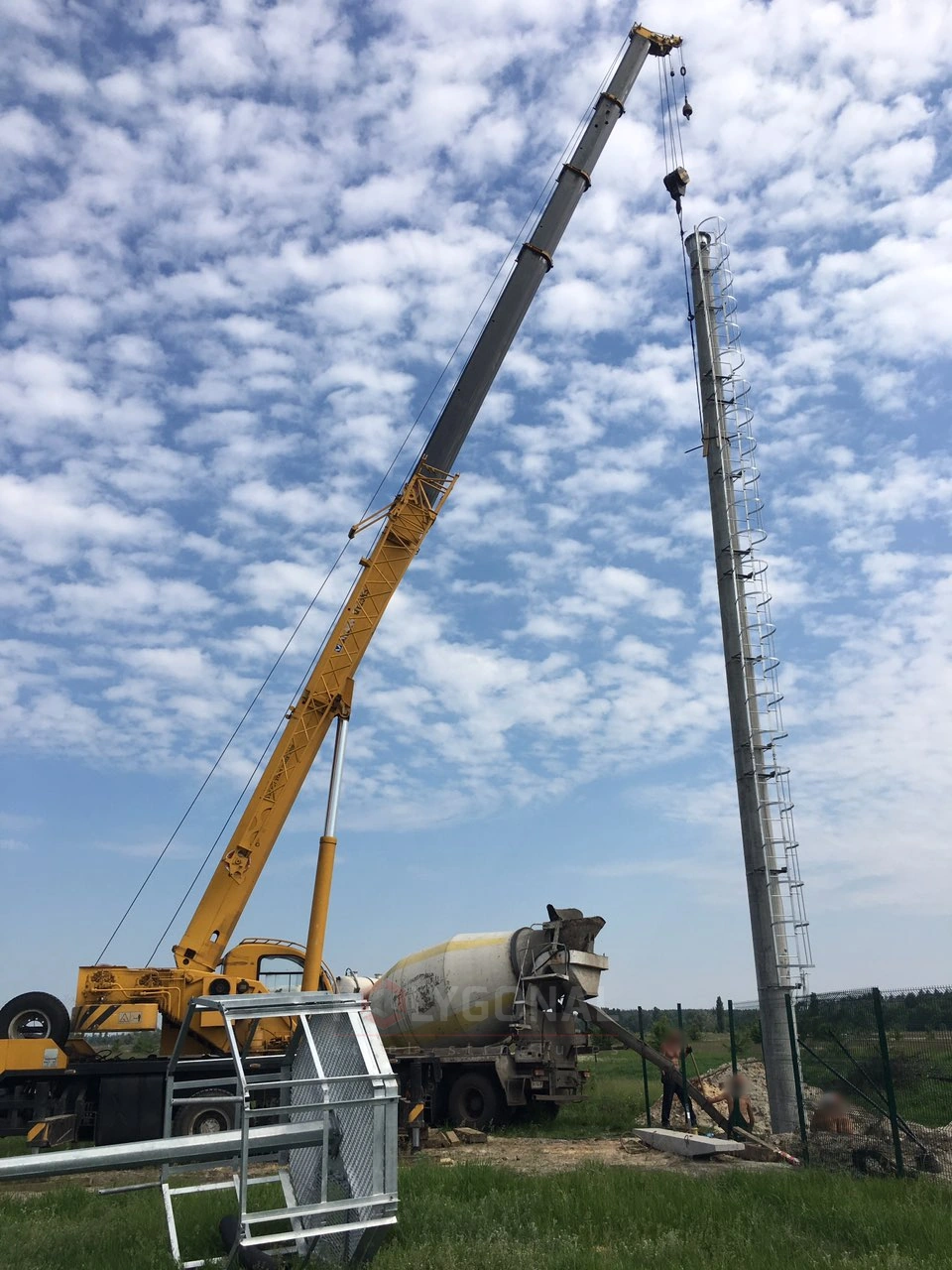
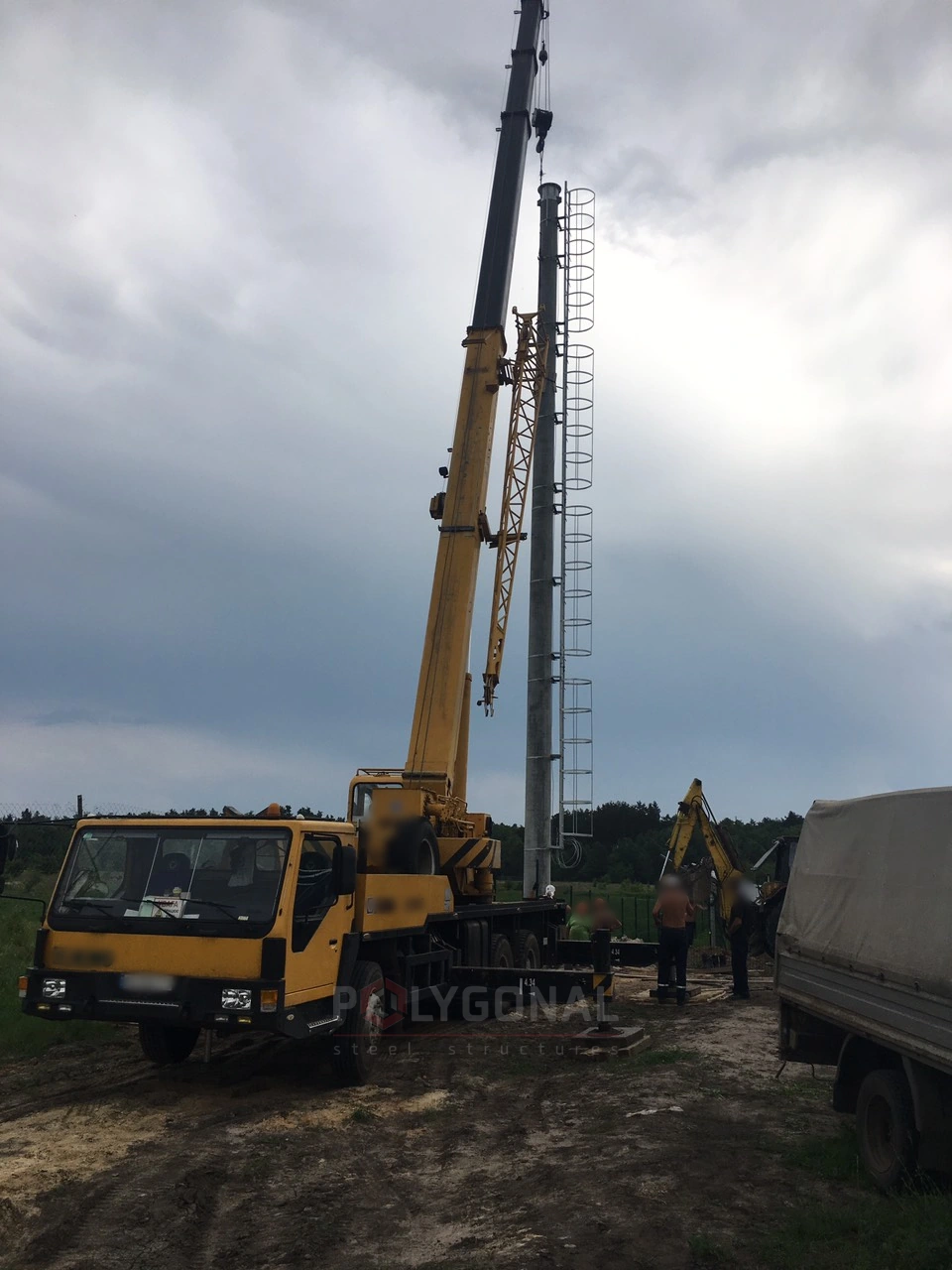
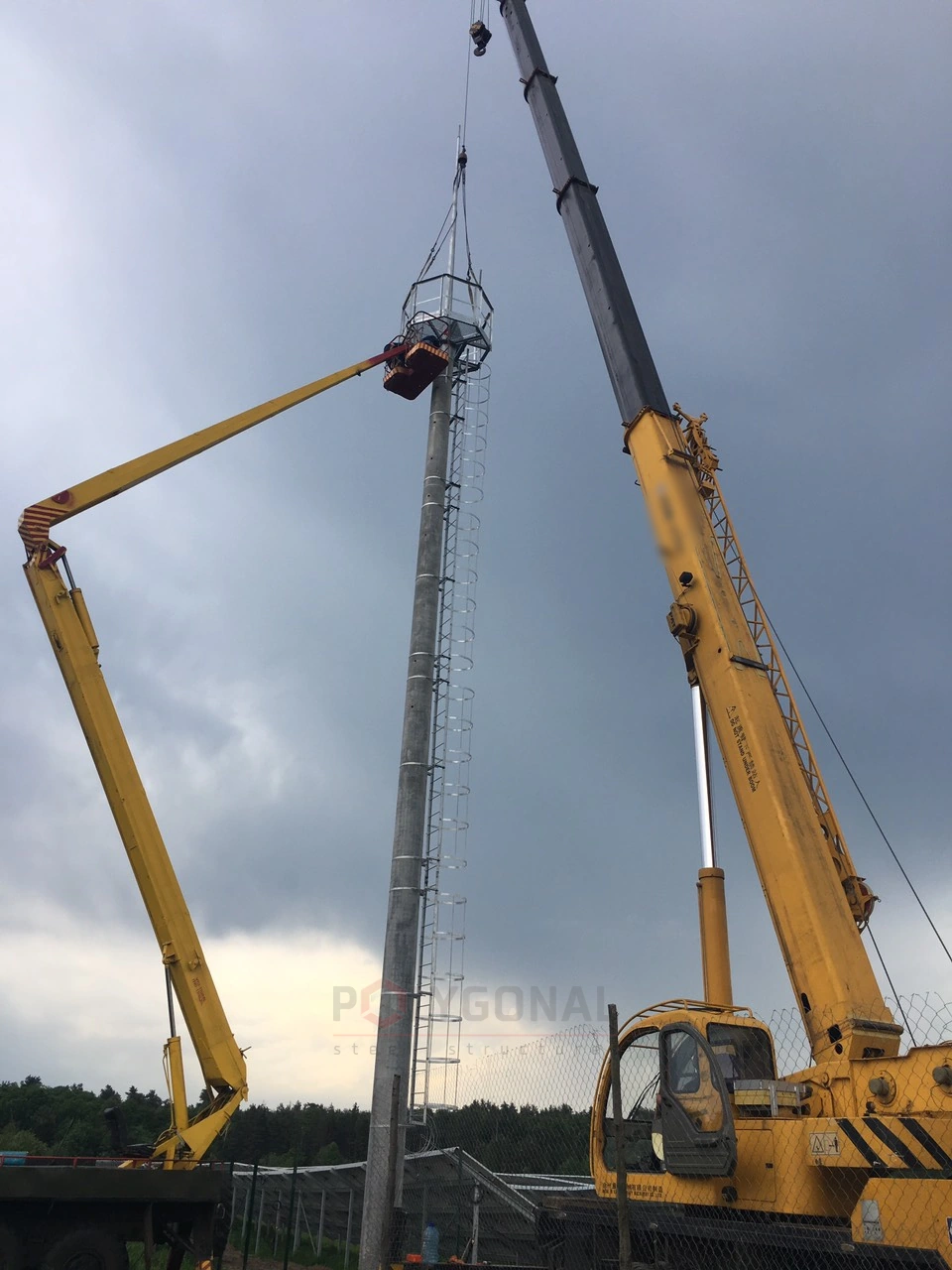
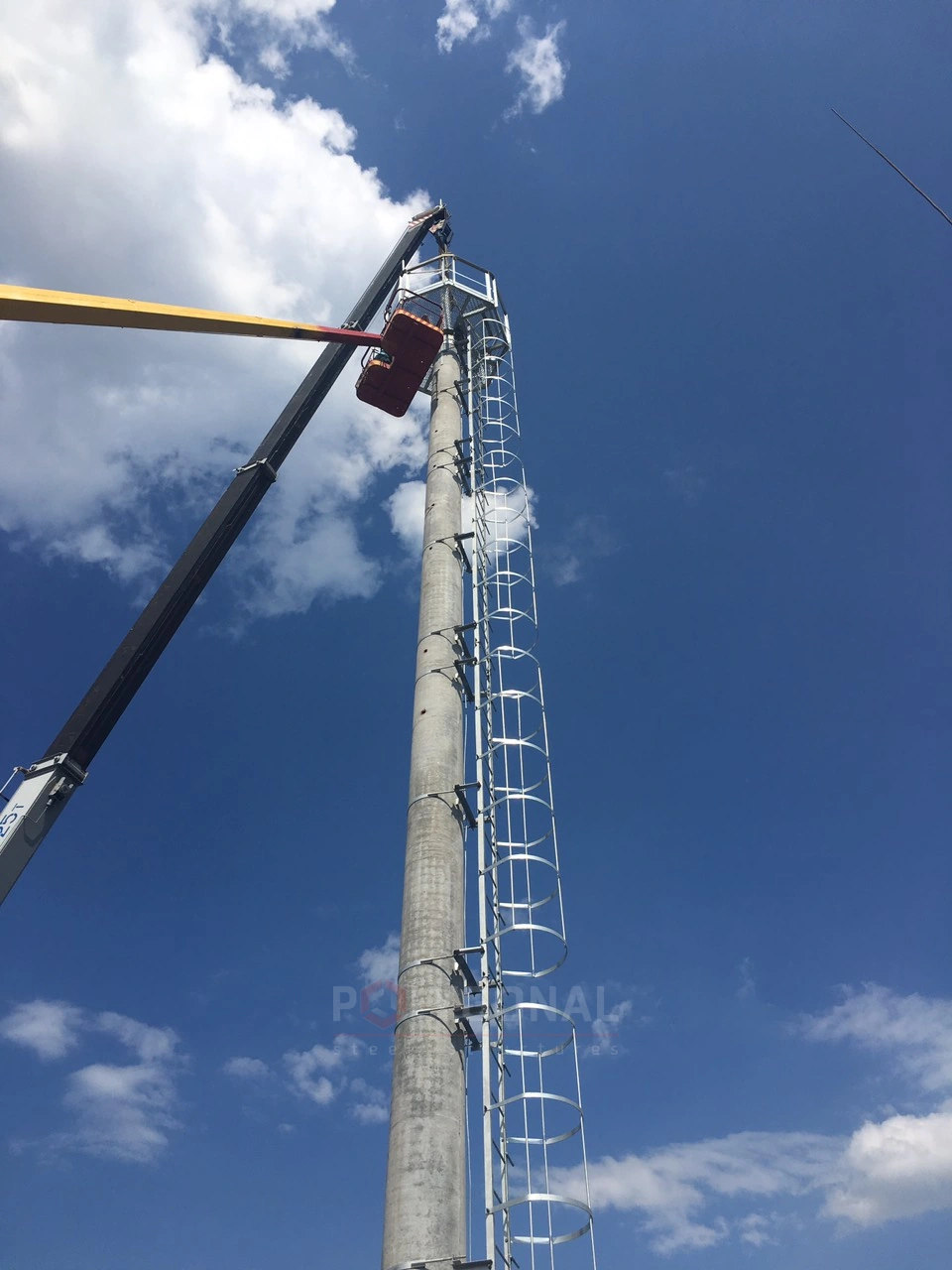
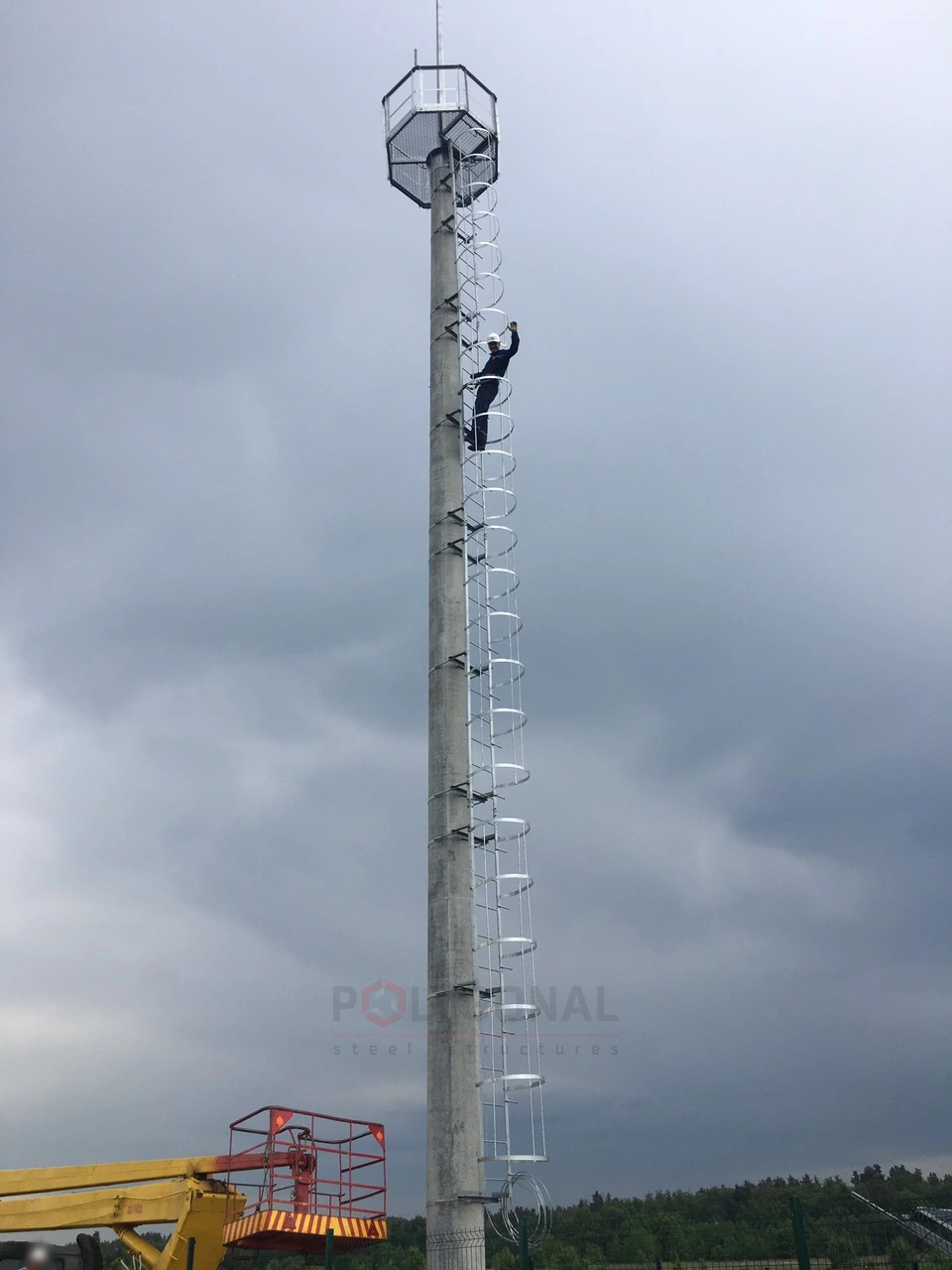
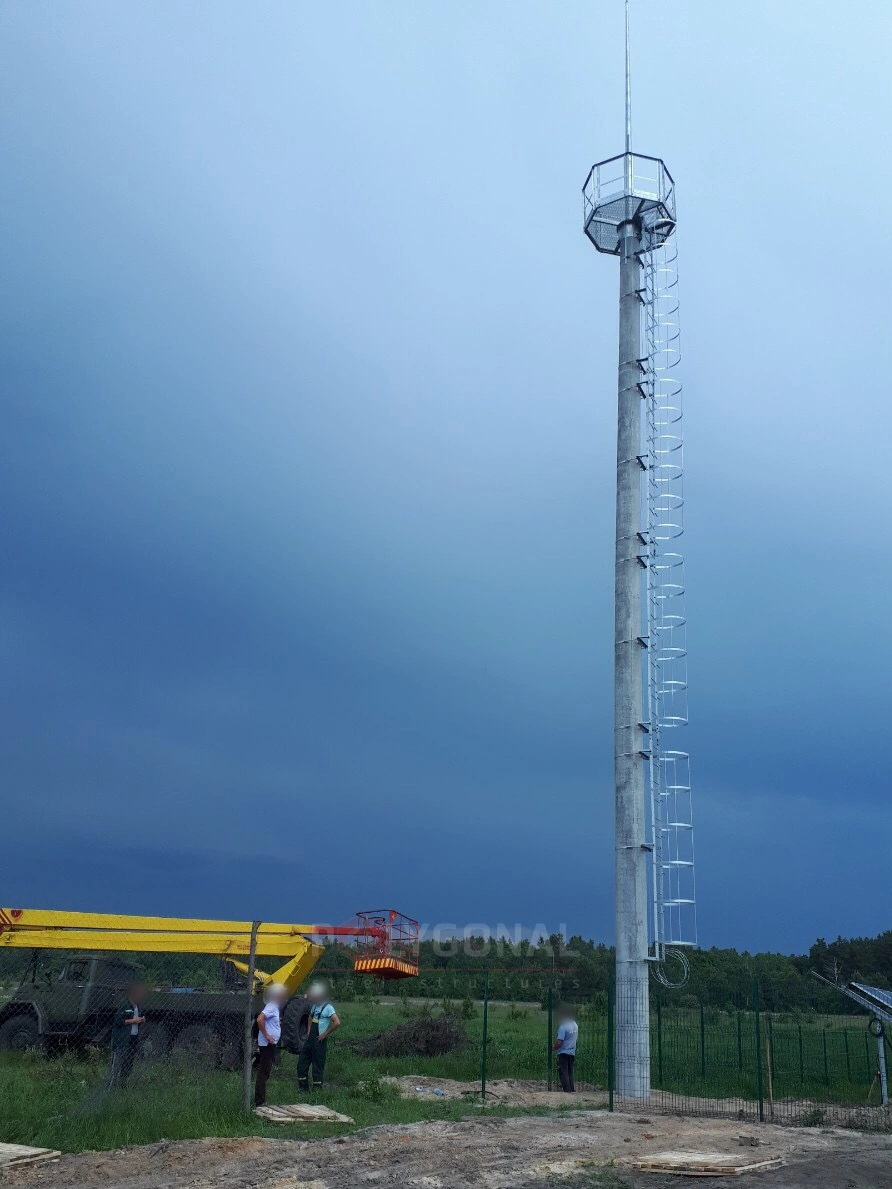
Installation of a PMZH-22.8ts mast of our design
The letter “ts” in the mark denotes a design variant of the mast made for hot-dip galvanising. It differs from the standard design in its construction, while its field of application matches the standard PMZH. The steel fittings (the floodlight platform, the caged ladder and the lightning rod) are made to the requirements of hot-dip galvanising.
Multi-sided equivalents of PMS and PMZH: the PMS-B series
When a project or a replacement calls for a mast with the parameters of a standard PMS or PMZH but with a multi-sided shaft, there is the PMS-B series: six sizes with a platform height of 16.6–32.5 m. All are designed for wind regions 1–4, up to 16 floodlights and a maximum equipment windage area of 3.2 m².
As with the standard PMS and PMZH, the number in the mark is the height to the floodlight platform; the overall height is greater by the length of the lightning rod.
| Mark | Height to platform, m | Overall height, m | Wind region | Max. number of floodlights, pcs | Max. equipment windage area, m² |
|---|---|---|---|---|---|
| PMS-16.6-B | 16.6 | 24.2 | 1–4 | 16 | 3.2 |
| PMS-19.3-B | 19.3 | 27.05 | 1–4 | 16 | 3.2 |
| PMS-22.8-B | 22.8 | 30.55 | 1–4 | 16 | 3.2 |
| PMS-24.0-B | 24.0 | 31.75 | 1–4 | 16 | 3.2 |
| PMS-29.3-B | 29.3 | 37.05 | 1–4 | 16 | 3.2 |
| PMS-32.5-B | 32.5 | 40.25 | 1–4 | 16 | 3.2 |
Overall height is the height of the mast including the lightning rod. Equipment windage area is the total area of the floodlights that the wind acts on. For other heights, floodlight numbers or windage areas we calculate the mast separately.
How to find an equivalent
If you have an old specification or a mast marked PMS or PMZH and need an equivalent, a replacement or a new mast under the same mark, send us the actual parameters: the floodlight platform height, the number and weight of floodlights, the wind region and the terrain type. From these we will make a standard PMS or the steel fittings of a PMZH to the 3.407.9-172 drawings (for a PMZH, if you wish, in the version adapted to hot-dip galvanising; we do not supply reinforced concrete), offer a multi-sided equivalent from the PMS-B series, or select or calculate a modern PMV equivalent.
What the number in the mark means: platform or whole mast
In PMS and PMZH marks the number is the height of the floodlight platform, not of the whole mast. With a lightning rod the overall height is greater: the series manufacturers give 37.05 m for PMS-29.3 and 27.05 m for PMZH-19.3 (the lightning rod itself is 7.75 m). In a PMV designation the number is the height of the mast itself, so PMV-30 is 30 m.
| Designation | What it indicates | What the number means |
|---|---|---|
| PMS-29.3 | steel lattice mast to series 3.407.9-172 | platform 29.3 m; overall, with lightning rod, 37.05 m |
| PMZH-19.3 | reinforced-concrete mast to the same series | platform 19.3 m; overall, with lightning rod, 27.05 m |
| PMS-29.3-B | multi-sided equivalent of the standard PMS (PMS-B series) | platform 29.3 m; overall 37.05 m |
| PMV-20-4.II-3.2 | our multi-sided mast: wind region 4, terrain type II, maximum equipment windage area 3.2 m² | mast height 20 m |
| PMK | crown type (lowering, winch-operated) on our multi-sided masts | the height comes from the mast, not from these letters |
PMS and PMZH heights are given according to data from the manufacturers of the standard series; check them against the drawings in your project.
What height your site needs
The height of a mast for a yard, warehouse or industrial site is not taken from the mark of an old PMS or PMZH: the lighting design sets it. The design accounts for the size of the area, the mounting height and tilt of the floodlights, the required illuminance and glare limits, and the number and weight of the floodlights, which set the load on the mast. The old height is only a starting point: buildings, storage and the floodlights themselves change over time, so check whether it still suits the site.
For sports pitches the height is checked separately, by the angle from the centre of the pitch to the lowest row of floodlights, as described in the guide to stadium and sports lighting.
Example: do the floodlights fit the mast loads
The new mast has to carry the floodlights that are already there, so weigh them first. Suppose the old mast carried 12 floodlights of 18 kg and 0.15 m² each: mass 12 × 18 = 216 kg, windage area 12 × 0.15 = 1.8 m².
The load table for the PM range (multi-sided masts of 12–20 m) in the article PM Floodlight Masts 12–20 m: Dimensions, Anchor Cages and Scope of Application is based on 180 kg of equipment, so 216 kg calls for a recalculation or a move to the PMV range. PMV limits: up to 16 floodlights and a maximum equipment windage area of 3.2 m². The calculation assumes a floodlight of up to 0.2 m² and 20 kg, so 16 × 0.2 = 3.2. The example of 12 floodlights at 18 kg each, 1.8 m² in total, fits within these limits.
Typical mistakes when replacing a mast based on its old mark
- leaving the old foundation in place without checking it (foundation types are covered in Foundations for Masts, Towers and Power Line Poles);
- forgetting to update the loads after the floodlights are replaced, since their mass and windage area have changed;
- not stating the wind region and terrain type (the PMV range is designed for regions 1–4 and types II–IV under DBN V.1.2-2:2006);
- saying nothing about aviation marking when the mast is near an airport.
What to include in an enquiry is listed in the article How to Order Poles and Masts.
Updated:
Floodlight mast marks: frequently asked questions
What does the mark PMS-18.4 mean?
A steel lattice floodlight mast to standard design series 3.407.9-172. The number 18.4 is the floodlight platform height in metres.
Do you make reinforced-concrete PMZH masts?
We do not supply reinforced concrete, but we make the steel fittings of the PMZH (floodlight platform, ladder, lightning rod and other steel parts) to order, to the 3.407.9-172 drawings. At the customer’s request we also offer a better version, adapted to hot-dip galvanising: the drawings of the standard PMZH masts do not meet the requirements for products that can be hot-dip galvanised, so we make the fittings to the requirements of that coating. More often, though, we recommend our own steel multi-sided PMV mast as a replacement: it needs no multi-legged concrete foundation and takes up less space.
Is PMK a different mast height?
No. PMK is a crown type (lowering, with a mechanism to bring it down for servicing on the ground) on our own PMV masts. The height comes from the mast, not from the letters.
Do you have multi-sided equivalents of PMS and PMZH?
Yes, the PMS-B series: six marks from PMS-16.6-B to PMS-32.5-B with a platform height of 16.6–32.5 m. Each is designed for wind regions 1–4, up to 16 floodlights and a maximum equipment windage area of 3.2 m². The table is in the section above.
Can a PMV mast be put on the foundation of an old PMS?
Usually only after the foundation has been checked. A lattice mast has a different base, while a PMV is fixed by a flange to anchors on a circle (for PMV-20, 16 M36 anchors on an 810 mm circle). Whether the old foundation is suitable is decided by the design. We can also supply the design of a new foundation.
Is PMV-30 the same as PMS-29.3?
No. In PMS the number is the platform height, and the overall height with a lightning rod is greater; in PMV it is the height of the mast itself. An equivalent is chosen by the floodlight mounting height and the loads.
Related products: High-mast lighting
More on this topic: Floodlight Masts with a Mobile Crown (PMK) · 30 m Floodlight Mast: Design, Foundation, What Determines the Price · PM Floodlight Masts 12–20 m: Dimensions, Anchor Cages and Scope of Application
Get a quote for your requirements
Send us your requirements — we will calculate the price and lead time.