
Home / Products / Stadium lighting / Sports Lighting: Competition Classes and Requirements
Stadium lighting
Sports Lighting: Competition Classes and Requirements
How to design football pitch lighting: competition classes, where floodlight masts may stand, how to work out their height, and the illuminance levels recommended for matches with and without television coverage.
Contents
What sports lighting of a playing field must do
Football is the most popular spectacle in the world, and television has played a big part in that. Matches are played in the evening, when stadiums draw large crowds, and a good television picture depends on good artificial light.
A stadium lighting design starts from a few basic conditions: neither players nor spectators may be dazzled, and the light must not interfere with vision. Pitches where people play for recreation, with no television coverage, need light too. Illuminance there is lower than for television, but quality requirements still apply: uniformity, visual comfort and as little “light pollution” as possible, particularly in residential areas. People who live next to the stadium should not be bothered by the lighting.
Pitch lighting has to give everyone involved excellent visibility. The standards are built on the needs of several groups of observers:
- officials, referees and players: light that lets them work and play at their best;
- spectators: everything on the pitch must be visible from the stands, even from the farthest seats;
- photographers and camera operators: the best possible image quality;
- television viewers: a good picture;
- advertisers: accurate colour rendering, so that a brand is recognised quickly.
Categories of sports competition
Stadium lighting is divided into five classes, I to V. The classes fall into two categories: events televised in colour, and events and training without television.
A television camera needs more light than an athlete on the field or a spectator at the touchline. From a long way off the ball looks very small, so spectators seated far from the pitch need almost as much light as the cameras. Without television the requirement is more modest: acceptable visibility for the players on the field and for observers along the sidelines.
Televised competitions:
- class V: international broadcasts;
- class IV: national broadcasts.
Competitions without television:
- class III: national competitions;
- class II: league and club championships;
- class I: training and recreational play.
Positions of the lighting poles
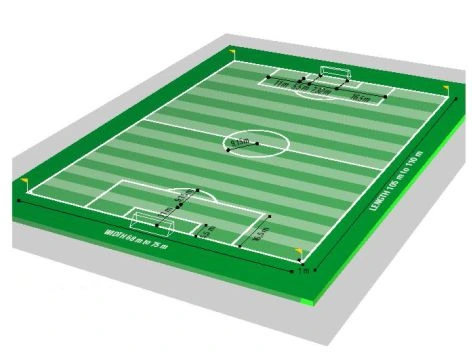
Pitch size. By the rules a football pitch is from 105 to 110 m long and from 68 to 75 m wide.
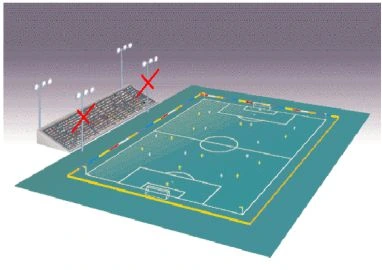
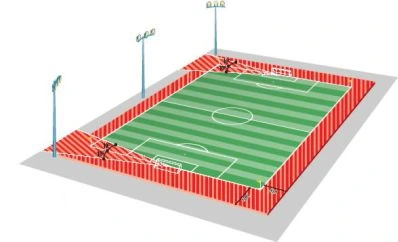
Clear view of the pitch. Where the seating rises in tiers, or the stands are level with the pitch, the poles go outside the pitch and out of the spectators’ line of sight. Keeping the structures behind the spectators means taller poles.
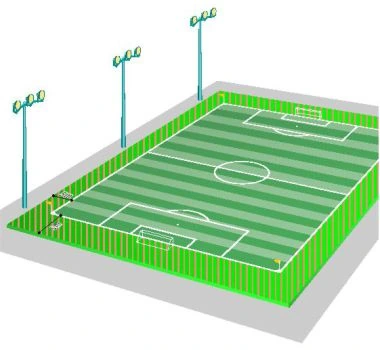
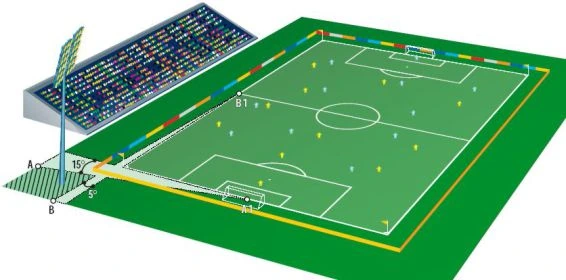
Obstacle-free zone. For the players’ safety, a strip 5 m wide around the playing field must be kept free of lighting poles.
The lighting parameters below are recommended for competitions, so the luminaires need maintenance throughout their service life.
Stadium lighting
Lighting stadiums without television coverage
Venues without television coverage host competitions of class III (national championships), II (lower leagues and clubs) and I (training and recreation). They are usually in residential districts and have few seats.
Whatever layout of floodlight poles is chosen, the design for such fields has to light the horizontal surface of the pitch uniformly.
Corner positions
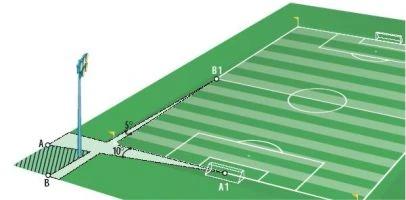
Floodlight masts go in the permitted zones around the pitch, out of the players’ field of view in standard game situations. The zone limits are straight lines drawn at 10° to the goal line and 5° to the touchline.
To keep the light uniform, the floodlights on a mast are aimed at the quadrant of the pitch nearest to it.
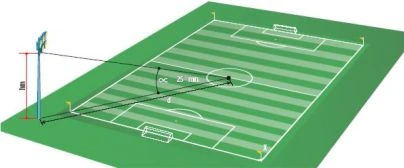
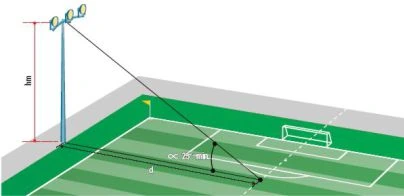
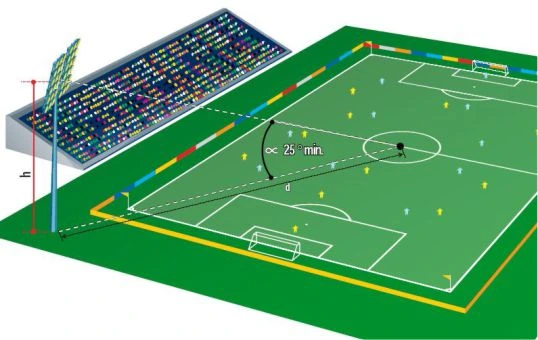
Mast height can be taken as the height at which the angle between the horizontal and the line from the centre of the pitch to the lowest row of floodlights is at least 25° (Hm = d × tan α).
Positions along the touchline
Along the touchline the masts can be lower than at the corners. The height is found the same way: the angle between the horizontal and the line from the longitudinal axis of the pitch to the lowest floodlight must be at least 25° (Hm = d × tan α). Masts under 15 m are not recommended; they add to visual discomfort.
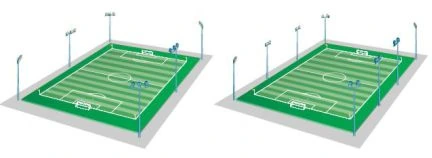
Layouts with four, six or eight masts are the most common. Four masts at the side are an alternative to corner positions, and they usually stand right behind the stands. This layout gives slightly more spill light than the six- and eight-mast ones, which are chosen when spill light has to be cut and the masts lowered at the same time.
Permitted mast positions
Keep masts outside the 10° zone on each side of the goal line, so that the goalkeeper can see well towards the corner flag.
Summary of lighting requirements without television
For each class of competition the table lists recommended horizontal illuminance, uniformity, glare rating and the colour characteristics of the light sources. These are “maintained” values, that is, the level at the end of the maintenance interval; a maintenance factor of 1.25 is recommended for design. Between points 5 m apart the illuminance gradient must not exceed 55%.
| Class of play | Average horizontal illuminance Eh, lx | Uniformity U2 | Glare rating GR | Colour temperature, K | Colour rendering index Ra |
|---|---|---|---|---|---|
| III: national championship | 500 | 0.7 | ≤ 50 | > 4000 | 80 |
| II: lower leagues and clubs | 200 | 0.6 | ≤ 50 | > 4000 | 65 |
| I: training | 75 | 0.5 | ≤ 50 | > 2000 | 20 |
Stadium lighting
Lighting stadiums with television coverage
Venues that broadcast on television are meant for competitions of class V (international) and IV (national). Lighting technology keeps improving, but whether a system meets modern broadcast requirements still comes down to where the luminaires are placed and how high they are mounted.
Corner positions and mast height
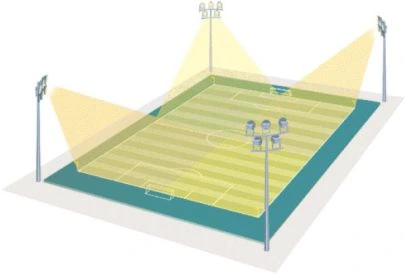
Corner masts stand in the permitted zones, out of the players’ field of view in standard game situations.
Mast height is chosen so that the lighting requirements are met over every part of the pitch for all the cameras in use. For a first estimate, take the height at which the angle between the horizontal and the line from the centre of the pitch to the middle of the floodlight bank is at least 25°. No floodlight’s optical axis may be tilted more than 70° from the vertical: that limits glare and spill light outside the facility.
Designing floodlight banks
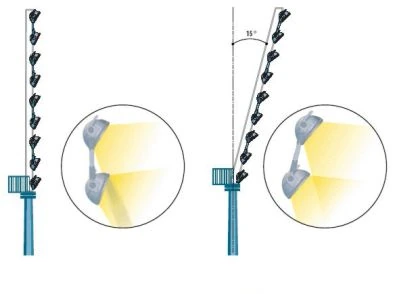
Leave enough space between neighbouring floodlights in a bank, both horizontally and vertically, so that adjacent units do not block each other’s beams. In vertical banks the rows are spaced further apart to avoid shading. Tilting the bank 15° towards the pitch makes it smaller and removes the shading.
Vertical illuminance
Vertical illuminance is taken in planes perpendicular to the lines of sight of the cameras concerned. The values are for the end of the maintenance interval. For all classes the glare rating is GR ≤ 50, and design uses a maintenance factor of 1.25.
| Class of play | Calculated for | Average Ev, lx | Uniformity U1 | Uniformity U2 |
|---|---|---|---|---|
| V: international | high-speed camera | 1800 | 0.5 | 0.7 |
| V: international | fixed camera | 1400 | 0.5 | 0.7 |
| V: international | mobile camera (at pitch level) | 1000 | 0.3 | 0.5 |
| IV: national (continued TV coverage) | fixed camera | 1000 | 0.4 | 0.6 |
Horizontal illuminance and colour of light
Between points 5 m apart the illuminance gradient must not exceed 20%. This article is based on the FIFA guide to artificial lighting of football pitches.
| Class of play | Average Eh, lx | Uniformity U1 | Uniformity U2 | Colour temperature, K | Colour rendering index Ra |
|---|---|---|---|---|---|
| V: international | 1500–3000 | 0.6 | 0.8 | > 5500 | 80 (preferably 90) |
| IV: national | 1000–2000 | 0.6 | 0.8 | > 4000 | ≥ 80 |
Stadium lighting
Illuminance by event class
Guide values of illuminance and uniformity for football pitches without TV broadcasting (the classes are described above):
| Class | Event | Average horizontal illuminance, lx | Uniformity U2 |
|---|---|---|---|
| III | National competitions | 500 | 0.7 |
| II | Lower leagues and clubs | 200 | 0.6 |
| I | Training and recreation | 75 | 0.5 |
Guide values for football pitches without TV broadcasting. Final requirements depend on the level of the event and are set by the lighting design.
Where to place floodlight masts
- Keep a strip 5 m wide around the playing field free of masts.
- The permitted zones are bounded by lines at 10° to the goal line and 5° to the touchline. In typical game situations the masts must not be in the players’ field of view.
- Layouts with four, six or eight masts, at the corners or along the touchline, are the most common. Six- and eight-mast layouts give less spill light and need lower masts.
- For reference, the rules give a football pitch as 105–110 m long and 68–75 m wide.
How to determine the mast height
Choose the mast height so that the angle between the horizontal and the line from the centre of the pitch to the lowest row of floodlights is at least 25° (Hm = d × tan α). Masts below 15 m are not recommended because they add to visual discomfort. Along the touchline the masts can be lower than in a corner layout.
Updated:
Sports lighting for stadiums: frequently asked questions
How many lighting classes are there for stadiums?
Five, I to V, in two categories: events broadcast on colour TV (classes IV–V) and events and training without broadcast (classes I–III).
How even does the light on the pitch have to be?
For televised matches, the illuminance gradient between points 5 m apart must not exceed 20%.
What colour temperature do international broadcasts (class V) need?
Above 5500 K, with a colour rendering index Ra of at least 80, preferably 90.
Where can’t I put lighting poles around a pitch?
In a strip 5 m wide around the playing field, for the players’ safety.
What illuminance does a football pitch need?
It depends on the class of competition. According to the FIFA guide: 75 lx on average for training, 200 lx for lower leagues and clubs, 500 lx for a national championship, and 1,000 to 3,000 lx for televised matches.
How is lighting for TV coverage different?
Much more light is needed (1,000–3,000 lx on the pitch) and the requirements are stricter. Vertical illuminance in the plane perpendicular to the camera’s line of sight is also specified: from 1,000 to 1,800 lx depending on the class and the camera. The illuminance gradient between points 5 m apart is no more than 20%, and for international broadcasts (class V) the colour temperature must be above 5,500 K and the colour rendering index Ra at least 80 (preferably 90).
Questionnaire: technical assignment form
Fill in the form and email it to us: we will prepare the KM-stage design documentation from it and calculate the price. The PDF is handy to print; the DOCX can be filled in on a computer.
Technical assignment form: floodlight mast (lighting pole)
A questionnaire for preparing KM-stage design documentation for a steel polygonal floodlight mast: crown type, floodlights, platforms, ladder.
Related products: High-mast lighting
More on this topic: Football Pitch and Tennis Court Lighting: Typical Mast Layouts
See also: Sports lighting: brochure
Get a quote for your requirements
Send us your requirements — we will calculate the price and lead time.