
Home / Products / Telecom masts / Cell Tower Explained: What It Is, How It's Built, Typical Heights
Telecom masts
Cell Tower Explained: What It Is, How It’s Built, Typical Heights
A cell tower is a steel tower or mast that carries the antennas of a base station. Here is how it is built, which designs and heights exist, what it stands on and how it is made.
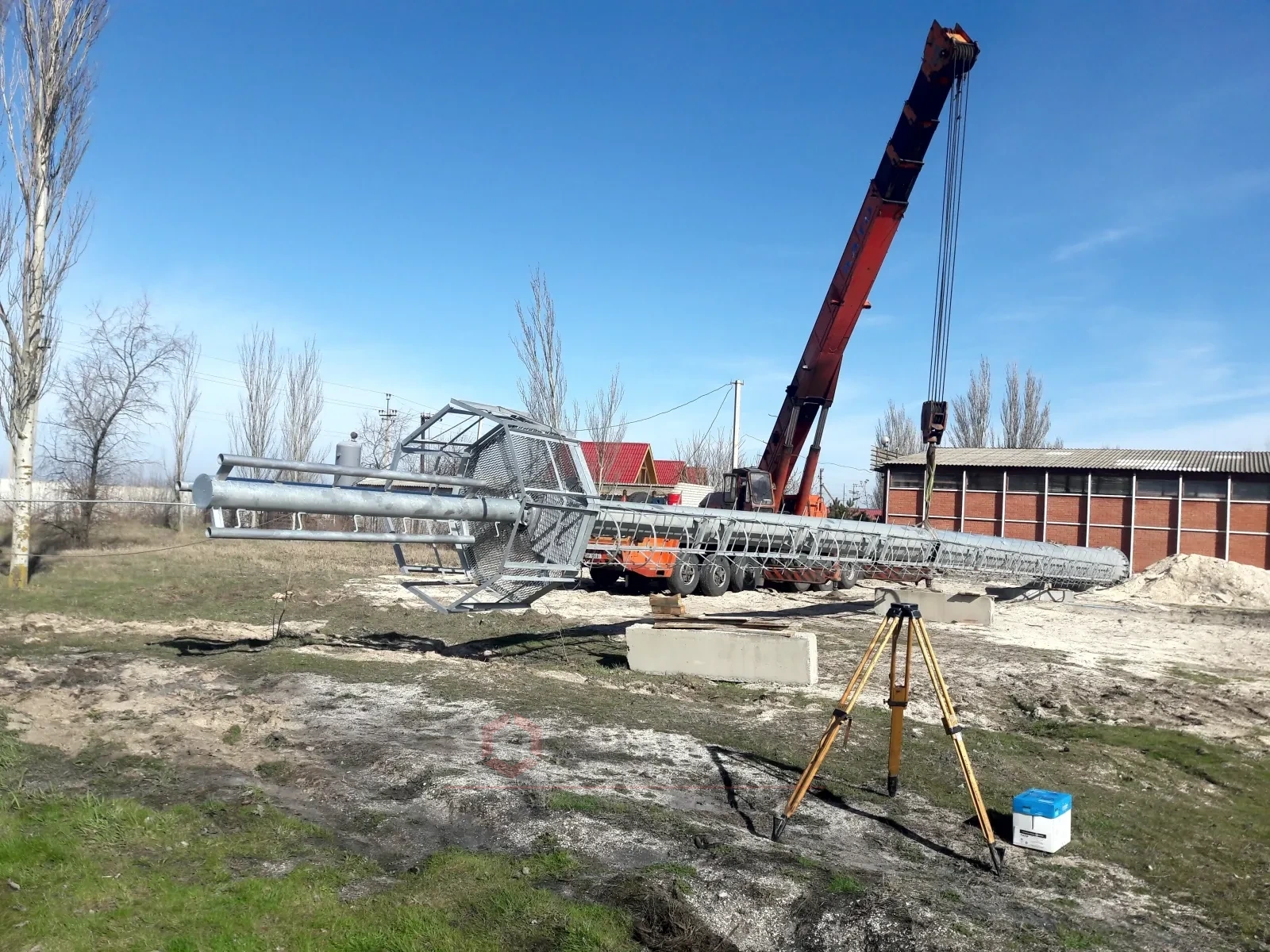
A cell tower is a steel tower or mast that carries the antennas of a base station. In our range the multi-sided cellular towers are 25, 30, 35 and 40 m tall, and individual projects reach 70 m.
Contents
What a cell tower is
In everyday speech a cell tower, or mobile phone tower, is the support structure for base station antennas. Engineers call it a tower or a mast: a tower has ladders and platforms for maintenance, while a mast is a slim column that is often held by guy wires.
The tower itself does not transmit a signal. It lifts the antennas to the height from which the operator covers the required area, and it carries the wind load and the weight of the equipment.
The POLYGONAL company manufactures and designs such structures based on multi-sided bent columns. The product line is described on the Telecom towers page.
What a tower consists of
Antennas and cables are mounted on the tower. Which antennas, how many and at what height is set by the operator; for us these are the input data for the calculation.
A multi-sided tower itself has the following elements:
- a column made of bent steel sections, each usually no longer than 12 m;
- a technological platform for the equipment;
- rest platforms every 10 m with a lockable hatch;
- ladders with a guard for maintenance;
- an anti-vandal hatch.
Lighting, a lightning rod and video surveillance can be added. How lightning protection is chosen is covered in Lightning protection for masts and towers.
Types of towers
Three designs are used for antennas. A comparison by criteria, heights and maintenance is given in Telecom tower types.
| Design | What it is | Footprint of the base |
|---|---|---|
| Multi-sided tower (monopole) | one column of bent sections joined by flanges or telescopically | small: one column and one foundation |
| Lattice tower | a three- or four-sided space structure made of sections | larger: wide base |
| Guyed mast | a slim column, tube or lattice, held by guy wires | large: guy wires anchored far away |
Data from Telecom tower types. We make lattice towers as antenna supports, see the Antenna supports page.
Typical heights
The multi-sided cellular towers in our range are 25, 30, 35 and 40 m tall. For smaller sites there are combined 3G towers of 8, 12 and 27 m. Towers up to 70 m are possible for individual projects.
Coverage radius alone does not give the height. The operator sets where the antennas go, and the designer leaves room above them for a lightning rod and warning lights. A taller tower passes a larger moment to its base, so column diameter, wall thickness and foundation size all grow with height. More in Mast and tower height.
What a tower stands on
A multi-sided tower is bolted by a flange to the foundation through an embedded part. The foundation type depends on the soil and the loads, so geotechnical surveys come first.
The foundation is designed mainly for the moment from wind and ice, not for the weight of the tower. Foundation types and embedded parts are covered in Foundations for masts, towers and line poles; the input data for a design are in Telecom tower design.
How a tower is made and erected
The sections are bent from steel plate on a press and welded, and the finished tower is hot-dip galvanised. All these operations are done in our own production.
The tower travels to the site in sections, so their length is limited: usually no more than 12 m. Erection is carried out by a licensed construction partner company anywhere in Ukraine. The sections are either added up in the vertical position or the whole tower is lifted from horizontal. This kind of erection is possible in mountainous terrain, in densely populated areas and on industrial sites in dense development.
Among the company’s completed projects is a telecom tower 35 m tall. For the installation procedure see Assembly, installation and erection of poles and towers.
What to send for a calculation
For a proposal we need the height, a list of antennas (number, size, weight, mounting height), the site location and survey results, if available. Instead of a letter you can fill in the technical specification form for a telecom tower.
In return we propose a design and calculate the foundation, cost and lead time.
Updated:
Cell tower FAQ
How is a cell tower different from a tower and a mast?
Cell tower is the everyday name. A tower has ladders and platforms for maintenance, while a mast is a slim column often held by guy wires. Both are made for base station antennas.
How tall is a cell tower?
In our range the multi-sided towers are 25, 30, 35 and 40 m tall, and individual projects reach 70 m. The final height is set by the operator’s antennas and the calculation.
How many operators fit on one tower?
It depends on the height, the number and weight of antennas and the wind region. The number of antennas and operators is one of the main input parameters for the tower calculation.
Which tower takes up less space?
The multi-sided one: it needs only a foundation for one column. A guyed mast needs a large area around it, and a lattice tower needs a wide base.
Can I order a tower together with erection?
We manufacture the tower, and a licensed construction partner company erects it. Delivery and erection are priced separately from the product.
What is needed to calculate the cost of a tower?
The height, a list of antennas with weight and size, the wind region, the site location and survey results. A tower price cannot be given without these data.
Related products: Telecom masts · Antenna masts
More on this topic: Design of Telecom Towers and Antenna Masts · Height of a Telecom Mast or Tower: How to Determine It and Choose the Structure · Telecom Tower Types: Multi-sided, Lattice, Guyed Masts · What Is a Mast: How It Differs from a Pole and a Tower, and the Main Types
Get a quote for your requirements
Send us your requirements — we will calculate the price and lead time.