
Home / Products / Flagpoles / How to Choose a Flagpole: Height, Flag Size, Lifting Mechanism
Flagpoles
How to Choose a Flagpole: Height, Flag Size, Lifting Mechanism
A flagpole must be visible, wind-resistant and convenient to operate. Here is how to match the height to the flag size, choose a lifting mechanism and plan illumination and the foundation.
Contents
- Flagpole height and flag size
- Wind resistance
- Height, diameter and wind region
- Flag lifting mechanism
- Illumination, obstruction lights and lightning protection
- Coating, installation and maintenance
- What to find out about the base before ordering
- Where flagpoles are used
- What to send for a calculation
- The design of a tall flagpole with an electric drive: a 42 m model as an example
- How the electric flag lifting and lowering works
- What to consider before ordering a tall flagpole
Flagpole height and flag size
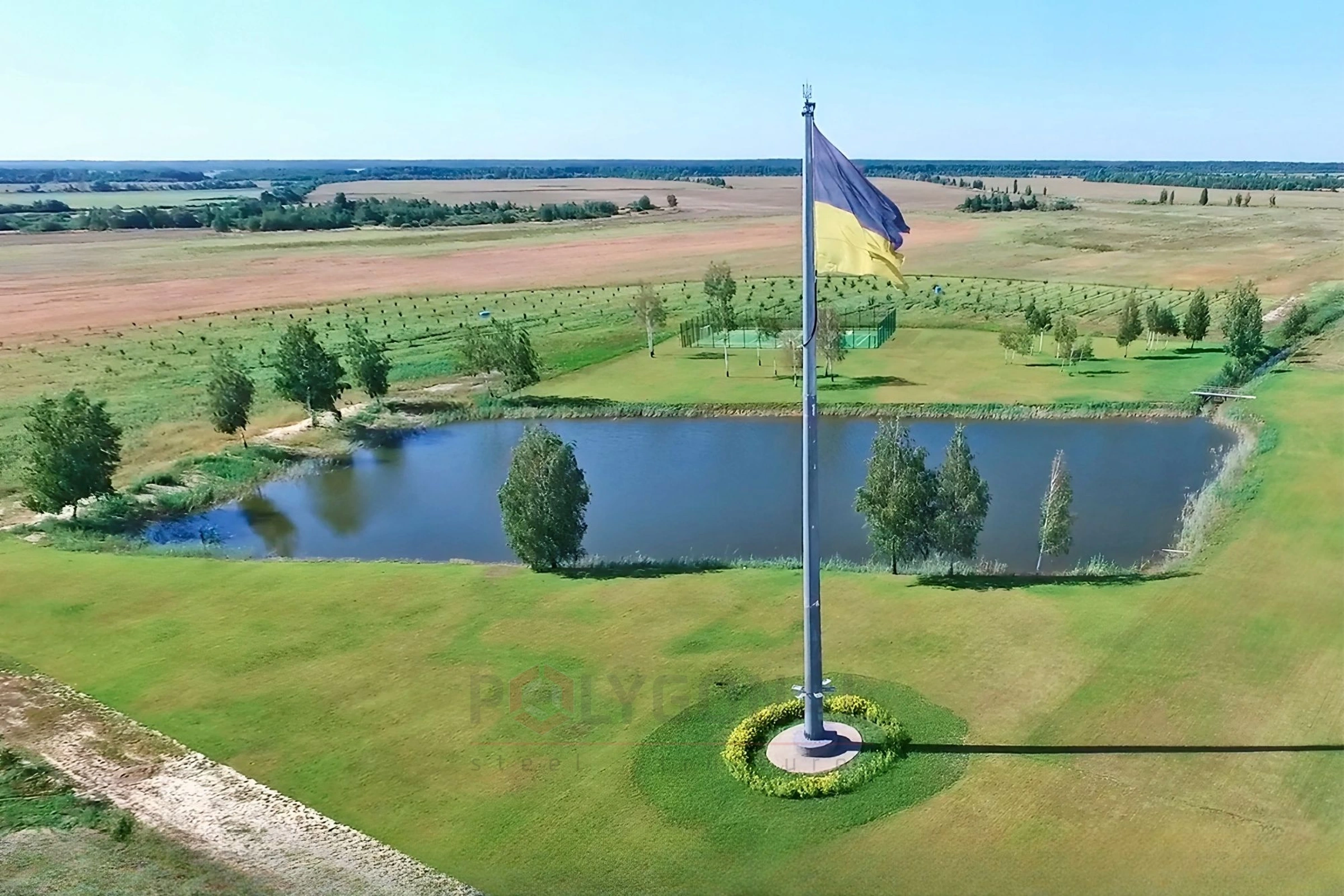
The flag should look proportional to the height: in practice its length is a quarter to a third of the pole height. For example, the 30 m flagpoles we have manufactured use a 6×10 m flag, about a third of the height.
We make commercial and public flagpoles from 6 to 70 m; for private houses we select lower heights.
The quarter-to-third range is a guide, not a rule: on the 42 m flagpole we manufactured the flag is 6×9 m, roughly a fifth of the height. A larger flag or several flags add sail area, so the size is checked against the wind calculation.
| Flagpole height, m | Approximate flag length (1/4–1/3 of height) |
|---|---|
| 6–10 | 1.5–3 m |
| 12–20 | 3–6.5 m |
| 25–30 | 6–10 m |
| 40–70 | 10–23 m |
A guideline based on the ratio of flag length to flagpole height; the exact size is agreed for the project. Completed examples: a 30 m flagpole with a 6×10 m flag and a 42 m flagpole with a 6×9 m flag (smaller than the guideline).
Wind resistance
The flag creates a significant sail load, so the diameter and wall thickness of the shaft are chosen for the wind region and height. The flagpole is made of bent multi-sided shafts from S245 or S345 steel, and sheets of the appropriate thickness are used for heights of 20–50 m. The larger the flag and the taller the pole, the larger the shaft diameter, wall thickness and foundation.
Height, diameter and wind region
There is no “height to diameter” table: the shaft diameter and wall thickness are determined by a calculation based on the height, the flag and the wind region. The region sets the characteristic wind pressure value W0 under DBN V.1.2-2:2006, so for the same flagpole W0 differs from city to city (see Wind Regions of Ukraine).
| City | W0, kPa | Relative to Kyiv |
|---|---|---|
| Kyiv | 0.37 | 1.00 |
| Kharkiv | 0.43 | 1.16 |
| Odesa | 0.46 | 1.24 |
| Lviv | 0.52 | 1.41 |
The ratio is the city’s W0 divided by the W0 for Kyiv. The design load also includes shape, height and dynamic-effect coefficients, so the shaft sizes for your site are determined by a calculation.
Flag lifting mechanism
- no mechanism: the flag is attached to a halyard and raised by hand; simpler and cheaper (as on the 30 m flagpole we manufactured in Bucha);
- manual drive: lifting by a winch or a halyard inside the shaft; protects against vandalism;
- electric mechanism: convenient for large flags and tall poles; the 30 m flagpole we manufactured in Vyshniaky has electric lifting.
The upper section of a “spinning” flagpole rotates on ball bearings, so the flag does not wrap around the shaft.
Illumination, obstruction lights and lightning protection
For night illumination of the flag, floodlights are installed at the base or on the pole. A tall flagpole can also be used as a lightning rod under a separate lightning protection design: see Lightning protection masts and air terminations.
Very tall flagpoles, like tall masts and towers, may carry obstruction lights at the top; the 42 m flagpole we manufactured has them. Current aviation rules and the approval for the specific site decide whether such lights are needed and in what layout; see Height of a Telecom Mast or Tower.
Coating, installation and maintenance
Flagpoles are protected by hot-dip galvanising to DSTU EN ISO 1461:2024 or lacquer; the colour is agreed with the customer. A tall flagpole is usually assembled on the ground and lifted by a crane or an aerial lift; installation is usually carried out by the customer, and if needed we arrange it by a partner; after installation it and its fixings should be inspected at least once a year and after strong winds.
The service life of a galvanised flagpole depends first on the zinc coating and the environment, then on following the operation and maintenance rules; indicative figures by corrosivity category: Hot-dip Galvanising Service Life.
On a storm warning, lower the flag or take the cloth down entirely: strong wind sharply increases the load on both the flagpole and the cloth.
What to find out about the base before ordering
A fixed flagpole stands on a reinforced concrete foundation with an anchor cage of round bar whose anchors match the holes in the shaft’s base flange. The foundation size and depth depend on the height, the flag and the soil, so send the soil data with your request. Before ordering, find out:
- where the underground utilities run;
- whether there is room for the flag to swing and for a crane or an aerial lift;
- whether grounding and lightning protection are needed.
The installation sequence and bolt tightening are described in How to Install a Flagpole.
Where flagpoles are used
Flagpoles are ordered mostly by institutions and businesses; height and illumination are chosen for the site:
- administrative buildings: the State Flag of Ukraine is raised on them, so illumination and easy lifting matter;
- filling stations and roadside businesses: the flag must be visible from the road;
- enterprises and offices, commercial and production sites: the flag of the company or the country at the entrance;
- parks, squares and memorial complexes: the height is agreed with the size of the space.
What to send for a calculation
State the height, the number and size of flags, the location (wind region), the type of base and the lifting mechanism and illumination you need. Leave blank anything you do not know — we will clarify. See also our flagpoles and completed projects.
The design of a tall flagpole with an electric drive: a 42 m model as an example
A tall flagpole with an electric flag lift is made of several components, each solving its own task. As an example, consider a 42 m flagpole (designation FSh-42-3.II-54).
| Component | What it consists of and why |
|---|---|
| Shaft | a galvanised multi-sided steel shaft of four pyramidal sections; in cross-section a regular 16-sided polygon; the sections are joined by telescopic joints |
| Inspection hatch | a lockable door; inside are a crossbeam for the electric mini-hoist and a frame with a removable plate for the electrical panel |
| Flag lifting and lowering | a wire rope system with an electric drive: a mini-hoist, a 5 mm wire rope and a chain with weights for attaching the flag |
| Rotating bracket | turns the flag fully round to follow the wind |
| Obstruction lights | three lights on brackets at the top; fed by a power cable run inside the shaft |
| Lightning rod | at the top of the rotating bracket, made in the form of a coat of arms |
| Fixing to the foundation | a base flange and 16 anchors |
The set of components depends on the design: the height, the site and the customer’s requirements.
How the electric flag lifting and lowering works
The flag is attached to a chain with weights, and the chain to the end of a wire rope: moving the rope raises and lowers the flag. The rope is driven by an electric mini-hoist that stands inside the shaft on a crossbeam near the inspection hatch and is operated from a control unit.
In the top position the lift stops automatically: a limit stop fixed on the wire rope presses the limit switch of the mini-hoist.
Replacing or repairing the mini-hoist is provided for in the design: a safety chain on the frame of the inspection hatch holds the wire rope during dismantling.
The rotating bracket turns the flag with the wind.
What to consider before ordering a tall flagpole
- the obstruction lights and the rotating bracket are serviced at height from a telescopic boom lift, so plan boom lift access in advance;
- the operating mode of the obstruction lights is set by the design for the specific site; if necessary, their power line is backed up with an uninterruptible power supply;
- the electrical panel equipment and a socket are installed in the lower part of the shaft through the inspection hatch; the power cable for the lights is not supplied with this model;
- the assembly of the sections, lifting and installation are carried out to a work execution plan: usually by the customer, and if needed we arrange the installation by a partner;
- damaged areas of the coating found during inspections are restored with materials that protect reliably against corrosion.
Updated:
Choosing a flagpole: frequently asked questions
What is the ratio of flagpole height to flag size?
The flag length is usually a quarter to a third of the flagpole’s height. For example, a 30 m flagpole uses a 6×10 m flag.
Manual or electric flag lifting — which to choose?
Manual (a winch or halyard inside the shaft) is simpler and cheaper, and suits flagpoles up to medium height. Electric is more convenient for large flags and tall poles, where manual lifting would take a long time.
Is a permit needed to install a flagpole flying the State Flag of Ukraine?
The State Flag of Ukraine is described by the Verkhovna Rada resolution of 28 January 1992 No. 2067-XII “On the State Flag of Ukraine”, which concerns the flag itself. Whether a permit is needed to erect the flagpole as a structure is worth checking in advance with the local self-government body.
Can a flagpole double as a lightning rod?
Yes, under a separate lightning protection design (air terminal, down conductor, earthing) a tall flagpole can be used as a free-standing air termination — see Lightning protection masts and air terminations.
What does the service life of a flagpole depend on?
Mainly on the zinc coating and the environment, then on following the operation and maintenance rules; indicative figures by corrosivity category: Hot-dip Galvanising Service Life.
What should be done with the flag during a storm?
When a storm warning is issued, it is best to lower the flag or take it down entirely, regardless of the flagpole’s height.
How do I choose the flagpole height for my site?
Start from the distance at which the flag must be seen and from the size of the site: a flag streaming in the wind must not catch on buildings, trees or wires. The flag length is usually taken as a quarter to a third of the height.
What should I know about the base before ordering a flagpole?
The type of base (a reinforced concrete foundation with an anchor cage), the soil data, the underground utilities and the location (city, town or village) for the wind region. The foundation size is calculated individually; the installation sequence is in How to Install a Flagpole.
Can the flag turn with the wind?
Yes, if the flagpole has a rotating bracket: it turns the flag fully round to follow the wind. An example is the 42 m model FSh-42-3.II-54.
Is replacing the mini-hoist provided for on a flagpole with an electric drive?
Yes. The mini-hoist stands inside the shaft near the inspection hatch, and during replacement the wire rope is held by a safety chain fixed to the hatch frame.
Related products: Flagpoles · Hot-dip galvanising · Lightning protection masts and air-termination rods
More on this topic: How to Install a Flagpole: Foundation, Anchor Cage, Assembly
Get a quote for your requirements
Send us your requirements — we will calculate the price and lead time.