
Home / Equipment & engineering / Road barrier manufacturing equipment / Road Barrier Production Lines
Road barrier manufacturing equipment
Road Barrier Production Lines
Automatic lines for making steel road barriers: what each one consists of, how it works and what its parameters are.
Contents
What we offer
POLYGONAL offers turnkey production lines for road barriers:
- a line for two-wave and three-wave road barriers (beams);
- a line for “C” and “U” support posts;
- a line for stamped components, including base plates (the support plates of the posts);
- a line for diagonal parts and ties.
We cooperate with European companies in this field, so we can apply their technological solutions for steel road barriers. Our approach is to raise capacity through automation, so that one specialist can run a section. The equipment goes straight to the customer together with a maintenance programme and after-sales support. We also train the staff.
The barrier beam line
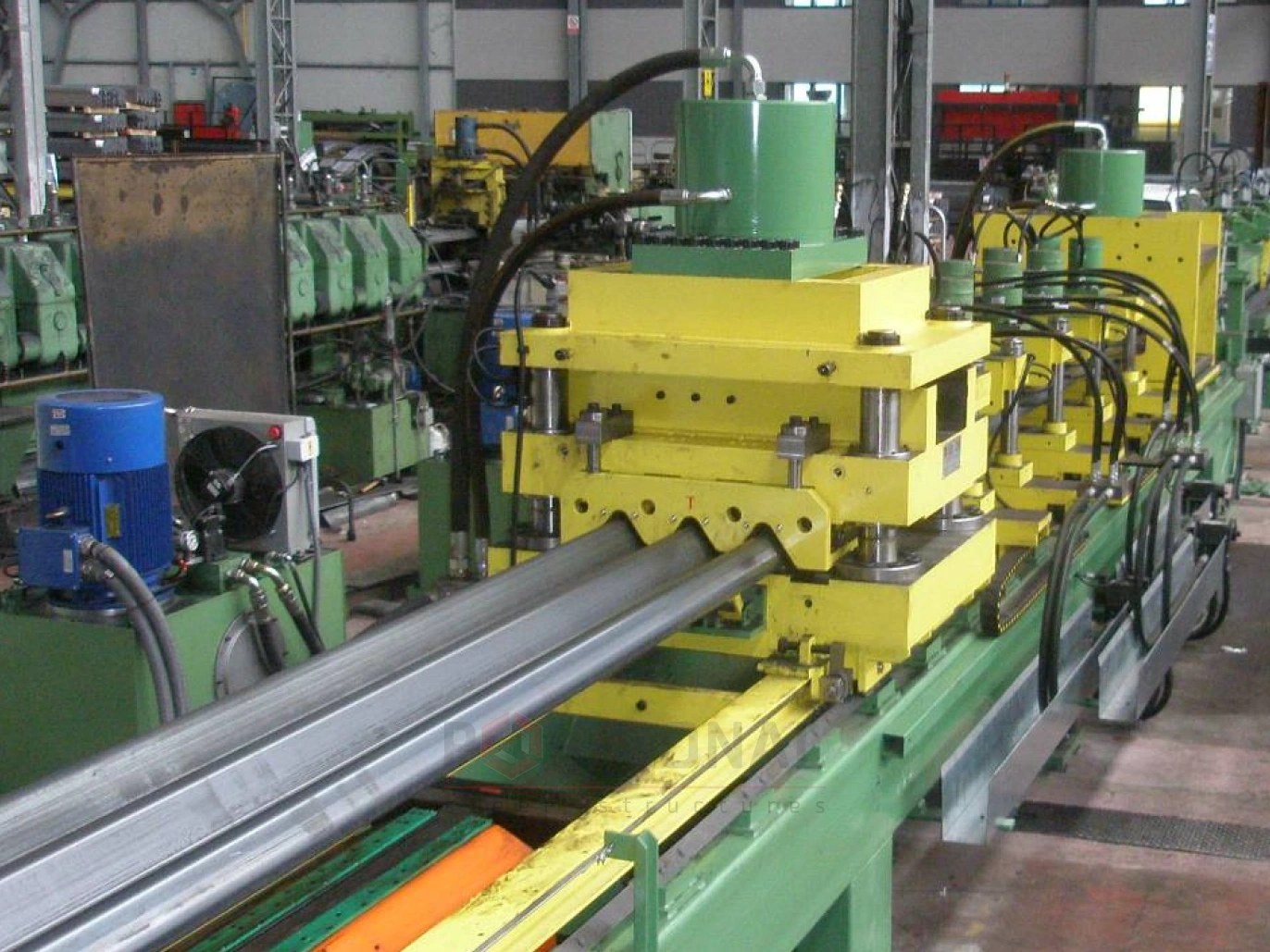
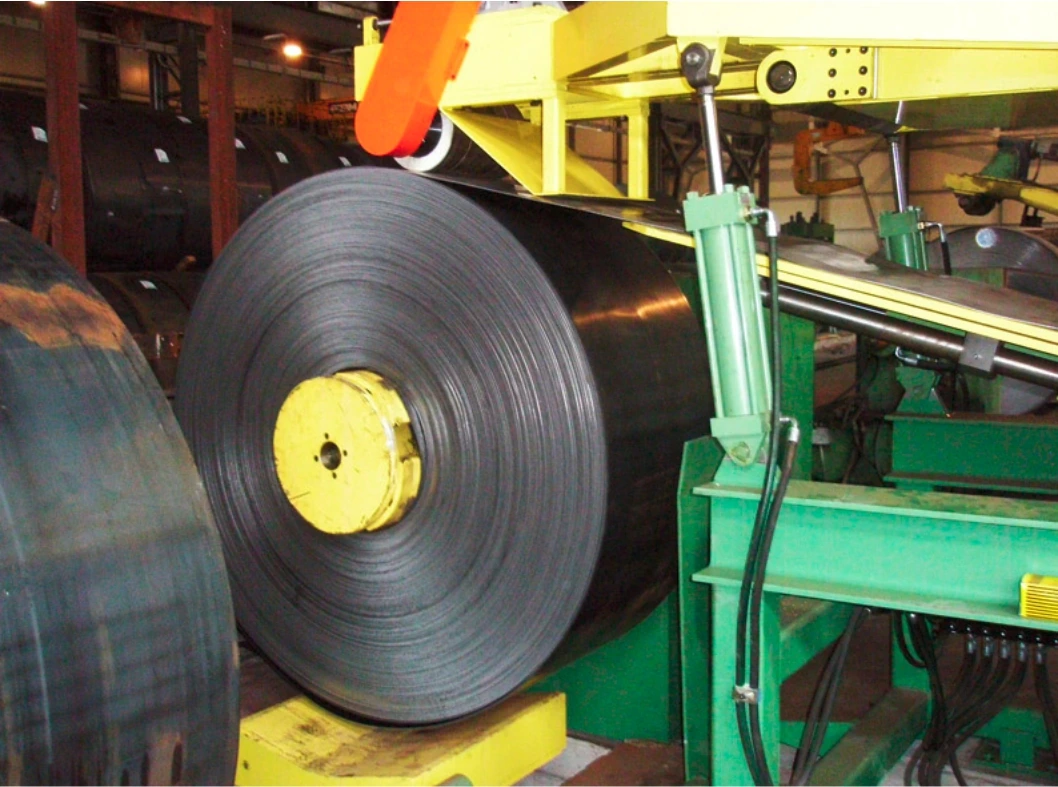
The automatic line makes road barriers and cuts every opening and hole in them by itself. The starting material is a coil of the required width, loaded on the uncoiler drum. The width depends on the barrier type, two-wave or three-wave. One machine profiles both types, so the whole range comes off a single line, which cuts the cost of setting up production considerably.
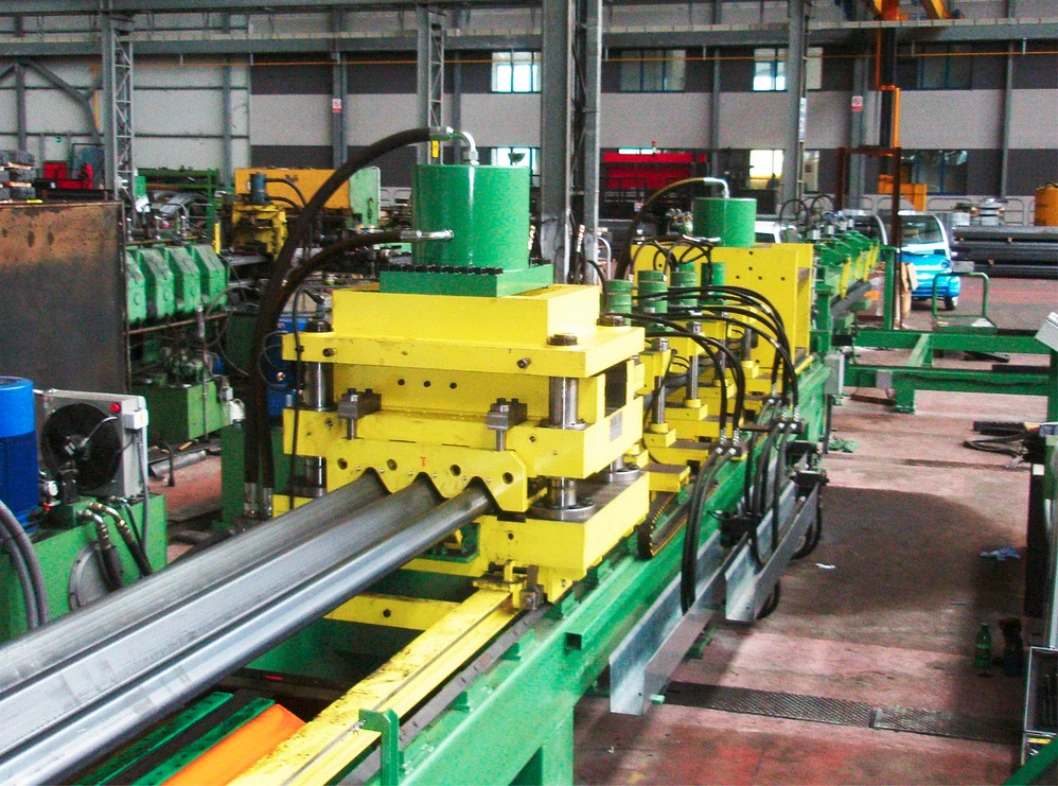
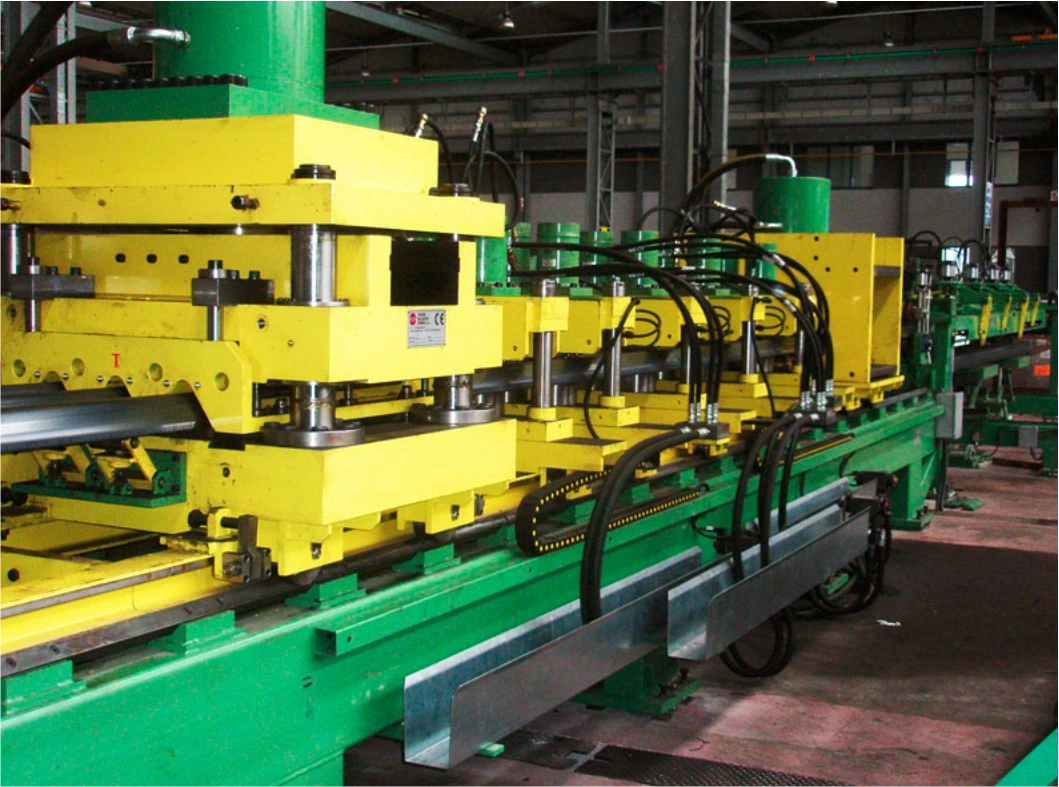
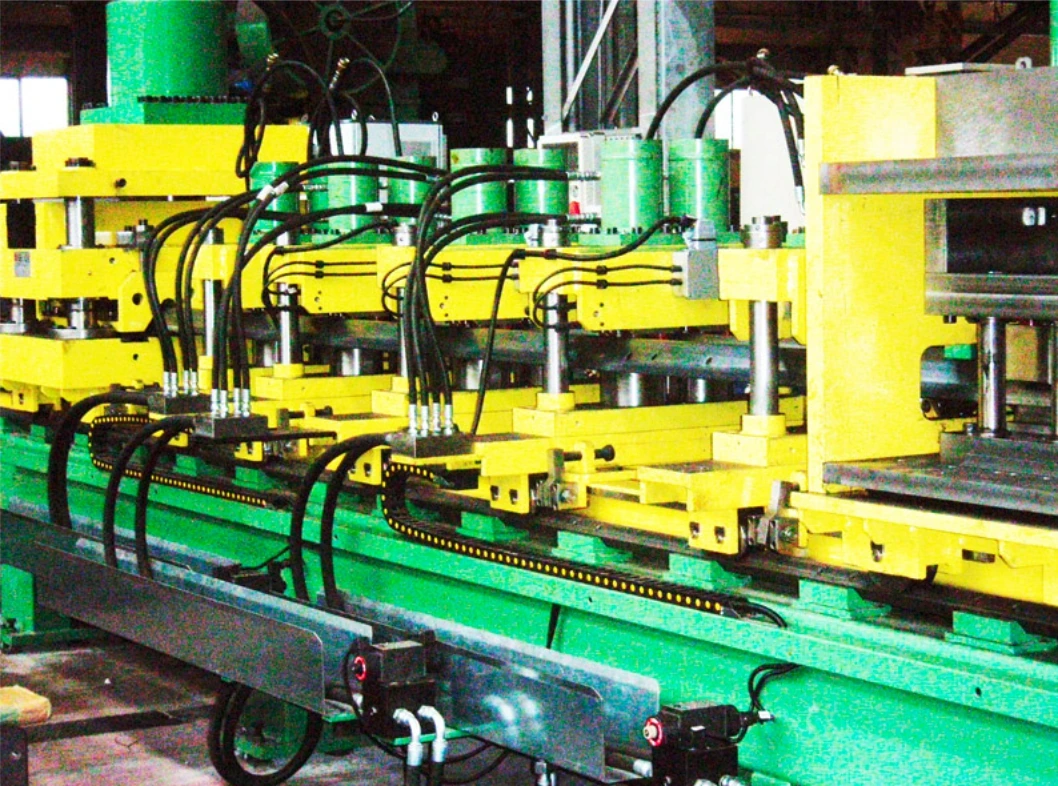
The line profiles the sheet and cold-stamps the barriers at the same time, to AASHTO, RAL A, RAL B and SINA standards. The blank then enters the stamping zone. The stamping blocks slide along guides into position, and in one stroke of the hydraulic cylinders all the holes are punched and the barrier is cut to length. From there it goes to the unloading station for stacking, ready for hot-dip galvanising.
One operator runs the line, with real-time monitoring and tele-service over the Internet or GSM. Output is 22 m/min (5 pieces a minute); one coil yields 120 pieces, and a coil changeover takes 10 minutes. The material is hot-rolled steel with a tensile strength of 480 N/mm² +10%.
Road barrier lines
The support post line
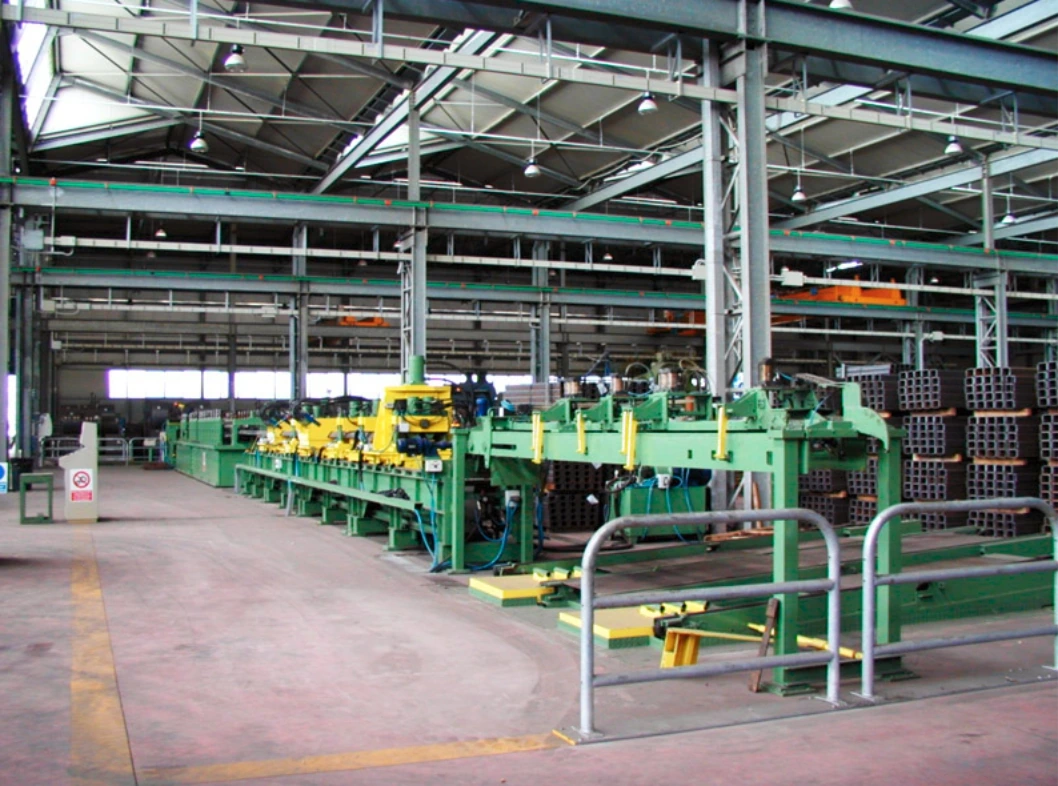
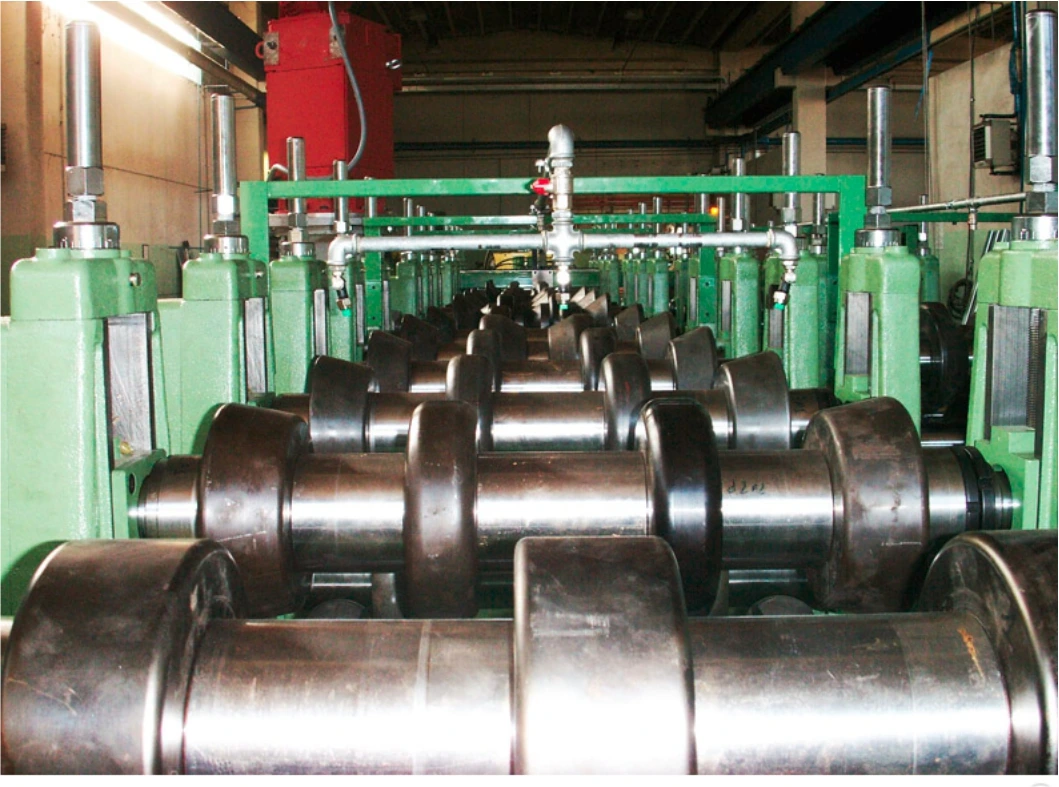
This line makes support posts with “U” and “C” profiles on a “start-stop” principle and carries out every operation, from profiling to punching holes and cutting to length. A coil of a certain width goes on the uncoiler; the strip is fed to the shears, trimmed, levelled and moved to the punch press block (the hole types along the length depend on the model). After punching, the strip is centred and reaches the roll-forming rollers, where it takes its shape. A marking device between the roll-forming heads marks the post with symbols. Next comes the cutting and tapering unit, and the finished post goes to the unloading station, where a neat bundle is formed on a hydraulic platform.
The coil can be 1100 to 1800 mm in diameter, and the posts come out 1500 to 5000 mm long. Output is 18 m/min. Maximum sheet thickness is 6 mm and maximum profile height 140 mm. The material is hot-rolled or galvanised steel with a tensile strength of up to 480 N/mm² +10%. One operator runs the line, with real-time monitoring and tele-service.
The base plate line and the tie line
The automatic base plate line makes the support plates for road barrier posts. Output is 5 pieces a minute, strip width 300 mm, maximum sheet thickness 10 mm. One operator runs it, with real-time monitoring and tele-service.
The tie line makes road barrier ties. It consists of a double uncoiler on guide rails (the second coil is loaded while the first is running, so there is no downtime), a leveller with pressure rollers (which relieves internal stress in the sheet), roll-forming rollers that shape the embossing of the ties, and a marking unit with a hydraulic system. No large foundation is needed: punching and cutting are done by small hydraulic units. Output is 18 seconds a piece, strip width 40–120 mm, capacity 2 t, maximum coil diameter 1700 mm, maximum sheet thickness 5 mm. One operator runs the line.
Road barrier lines
What to check against your products before ordering
Each line works within narrow limits, so a product is checked against the stated data before any calculation. Check three things:
- drawings: the barrier profile (two or three waves), the shape and position of the holes, the length. The profile specification, and the requirements and tests for the finished barrier, are set by the road project and the regulations in force, so confirm them before buying;
- metal: for the barrier and post lines the tensile strength of the coil must not exceed the stated 480 N/mm² +10%; for base plates and ties no value is given on this page, so confirm it with the line manufacturer. The actual tensile strength is taken from the metal supplier’s quality document;
- coil and sheet: the coil diameter and weight must suit the uncoiler (posts: Ø1100–1800 mm; ties: up to Ø1700 mm, stated capacity 2 t) and the strip width must suit the product (base plates: 300 mm; ties: 40–120 mm). The sheet must not be thicker than stated: up to 6 mm for posts, up to 5 mm for ties, up to 10 mm for base plates. For barrier beams the thickness is not given on this page and depends on the profile, so confirm it with the line manufacturer before ordering.
Example: the real pace of the beam line
The stated 5 pieces a minute is the pace while the line is running, and changing the coil takes time. Here is the calculation from the data above, assuming the line is idle for those 10 min:
- one coil yields 120 pieces: 120 ÷ 5 = 24 min of running;
- changing the coil takes 10 min, so the cycle is 24 + 10 = 34 min;
- 120 ÷ 34 ≈ 3.53 pieces a minute, i.e. about 212 an hour instead of the 300 that the stated rate gives (≈ 71%).
The estimate is theoretical and makes no allowance for set-up or breaks. For all the lines the comparison is as follows:
| Line | Stated output | Theoretical output per hour |
|---|---|---|
| Barrier beams | 5 pcs/min; 120 pcs per coil | ≈ 212 pcs with coil changes |
| Base plates | 5 pcs/min | 300 pcs |
| Ties | 18 s per piece | 200 pcs |
| Support posts | 18 m/min | depends on length and number of holes |
Posts are profiled on a start-stop principle, so the number of pieces per hour is calculated from your drawing together with the line manufacturer. Compare each line’s pace with the quantity of that part the set needs, rather than comparing the stated figures with one another.
Beyond the line: galvanising and service
- galvanising: barrier beams leave the line stacked and posts leave it in a bundle. Where parts lie tight against each other, the solutions used in surface preparation (pickling, fluxing) get into the narrow gap but molten zinc does not, so stains later seep out of the gap and spoil the appearance of the coating. Agree the method of loading and hanging with the plant in advance: designing for hot-dip galvanising. Posts up to 5000 mm long fit in our bath, which measures 13,000 × 1,600 × 3,200 mm (length × width × depth);
- service: it is better to plan the maintenance schedule for the line before start-up than after the first stoppage: decide in advance which of your staff is responsible for regular inspection of the units, and on what timetable. More details: maintenance of industrial equipment.
Updated:
Road barrier production lines: frequently asked questions
How many barriers per minute does the line turn out?
22 m/min, or 5 parts a minute. One coil yields 120 parts, and changing the coil takes 10 minutes.
Can one line make both two-wave and three-wave barriers?
Yes, the machine profiles both types. No extra equipment is needed.
How many people does it take to run a line?
One operator per line: barriers, support posts, base plates or ties. All the lines have real-time monitoring and tele-service over the Internet or GSM.
Where can barriers and posts be galvanised if I do not have a galvanising plant yet?
They can be galvanised by an outside plant, including ours: we do hot-dip galvanising with no minimum order. Agree the loading and hanging with us before sending, and check the preparation of the parts against the checklist.
Can galvanised coil be used on the post line?
Yes: according to its stated data the line works with both hot-rolled and galvanised steel (maximum sheet thickness 6 mm). Confirm the coating grade and the available thickness of galvanised coil with the line manufacturer and the metal supplier: that thickness may be less than the line’s maximum. After cutting and punching, the cut edges and the edges of the holes are left without their own zinc layer, and the zinc layer on galvanised coil is, as a rule, thinner than after hot-dip galvanising of the finished part, which also covers the cut edges and the edges of the holes. The choice depends on the client’s requirements and the operating conditions.
Related products: Road barrier manufacturing equipment · Hot-dip galvanising
Read also: Installation of Multi-sided Poles and Masts · Solar Street Lighting · Power Line Pole Types by Purpose: Suspension, Tension, Angle, Terminal · Cross-arms for 0.4–10 kV Lines: TM and TN Types, Reading the Designation
Get a quote for your requirements
Send us your requirements — we will calculate the price and lead time.