
Home / Products / Flagpoles / Assembling a Tall Flagpole with Telescopic Sections: How It Is Done
Flagpoles
Assembling a Tall Flagpole with Telescopic Sections: How It Is Done
A tall multi-sided flagpole arrives on site in sections. They are assembled on the ground into one pole, cables and the rope of the electric flag lift drive are laid, and the pole is lifted by crane and fixed to the anchors. We describe the stages using a 42 m flagpole as an example and what the customer needs to know.
Contents
What a tall flagpole consists of
The pole of a tall flagpole is a galvanized steel multi-sided tube of varying section. It consists of several sections that slide into one another and form telescopic joints. A 42 m flagpole has four sections whose cross-section is a regular sixteen-sided polygon. The sections are not welded together on site: the joint is held by the sections wedging together when they are pulled.
In the lower part of the pole there is an inspection hatch with a door and a lock. Inside the hatch the electrical equipment and the flag lift drive are placed. At the top, brackets for obstruction lights and a swivel bracket on which the flag turns through 360° with the wind are fixed to the mounting flange. The flagpole is connected to the foundation by a base flange on anchor bolts: a 42 m flagpole has sixteen of them.
How to choose the height, the flag and the lifting method is covered in How to choose a flagpole. The foundation and embedded part are covered in How to install a flagpole. Here we look in more detail at assembling the pole itself.
Assembling the sections on the ground
Assembly begins by laying all the sections in one line on timber supports. The supports are used to adjust the alignment and levelness of the sections, and the gap between them is kept to about one metre. The surfaces of the future joints are cleaned of dirt.
The sections are pulled into a telescopic joint by special pulling devices until they wedge. The length of each joint must stay within the limits set by the flagpole designer: the lower joint is the longest and the upper one the shortest. Using a pole with other joint lengths is forbidden unless agreed with the designers. The length is checked against a control mark made on the sections beforehand.
During pulling, the sections are struck with a sledgehammer from time to time, but only through a timber block so as not to damage the zinc coating. The sections are slung just as carefully: with textile straps or steel ropes in rubber-fabric sleeves, by methods that rule out permanent deformation and dents.
The order is as follows: each next section is added to the lower one in turn, starting with the largest, and each joint is pulled separately, moving to the next only when the current one has wedged.
Cables and rope inside the pole
Even before the final pulling, a long rope is passed through all the sections and its ends are tied to the flanges of the lower and upper sections. This rope is needed to pull the power cable and the rope of the lift drive through the shaft after assembly, so nobody has to climb into the finished pole. The ends of the rope are not untied until all the cables and the rope have been pulled through.
The power cable of the obstruction lights goes in first: it is fixed with plastic ties to a thin carrying wire every few tens of centimetres and secured in the pole so that it runs along the inner wall. The main requirement: the cables must not cross the central axis of the pole along which the flag lift rope will run. The cable is led out through cable glands in the upper section to the lights, and at the bottom the switchboard and a 220 V socket are installed through the hatch.
Then the rope of the lift drive is pulled in: it is passed through the swivel bracket, the rollers and the bronze bush, drawn along the whole pole and connected to the electric lift drive, which is installed through the inspection hatch. The flag chain with weights is fixed to the upper end of the rope. The length and tension of the rope are adjusted and the clamps are finally tightened. A cord is tied to the bottom of the chain and kept taut so that the chain does not tangle when the pole is lifted.
The electric drive is operated from a control panel. The position of the upper limiter on the rope is set so that when the flag is raised to its highest point the drive stops automatically. In case the drive has to be replaced or repaired, the hatch has a safety chain that holds the rope while the drive is removed.
Flagpoles
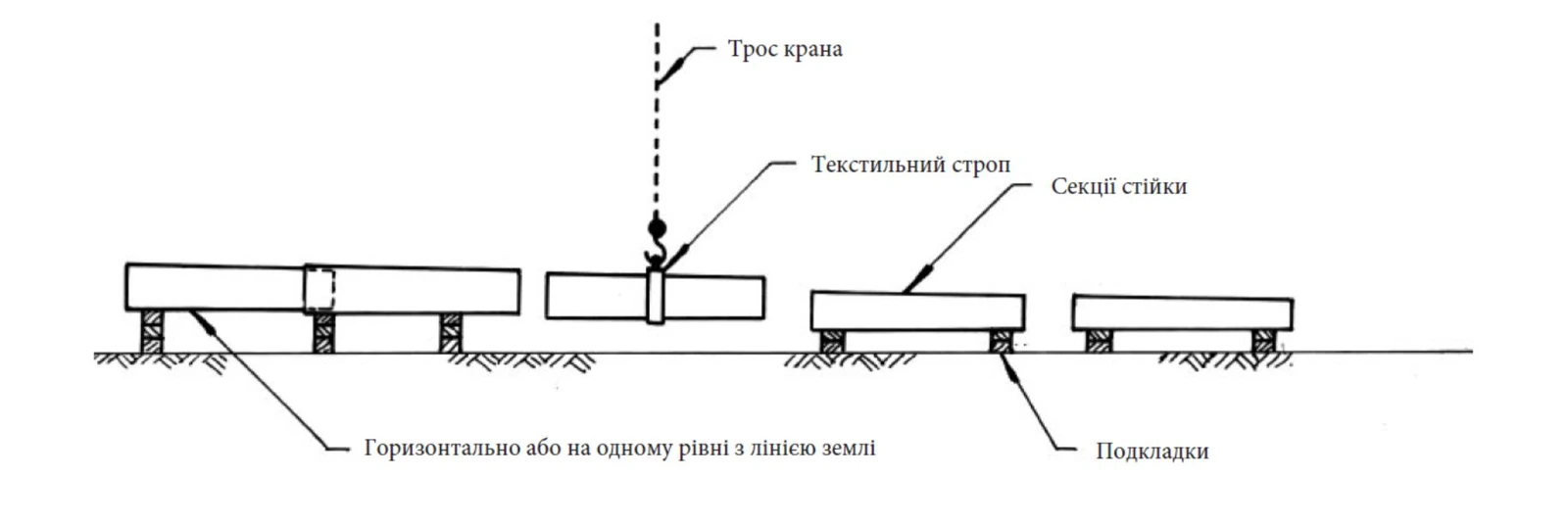
Flagpole sections laid in one line on timber supports: assembly diagram
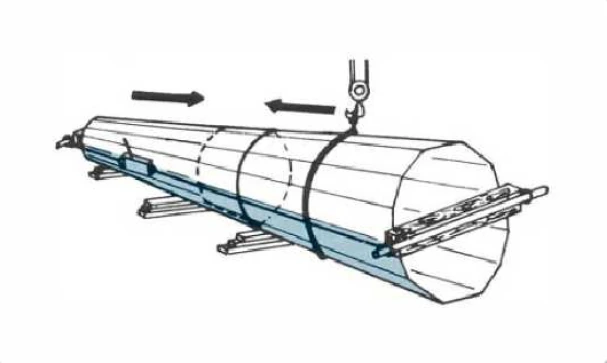
Pulling a telescopic joint of flagpole sections: diagram
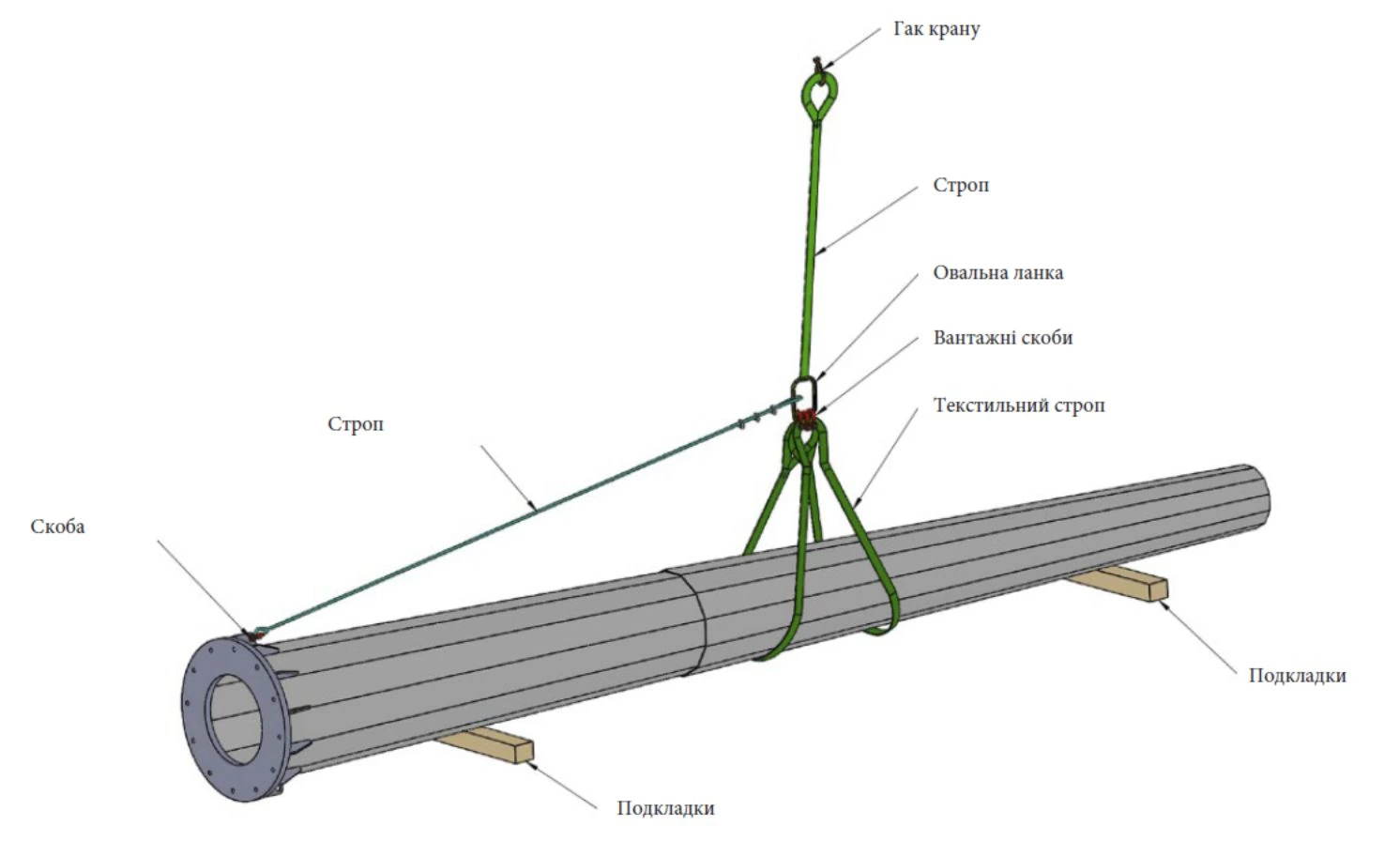
Slinging a flagpole: main sling and second vertical sling, diagram
Slinging and lifting the pole
The pole is slung by the choker method with textile straps or steel ropes passed through rubber-fabric sleeves. The sling must lie well above the centre of gravity of the flagpole. Bare steel ropes must not be used: they cut the zinc. A second vertical sling is attached to special holes in the stiffeners of the base flange of the lower section: it limits the slipping of the main sling and keeps the sections from sliding apart at the telescopic joints.
Lifting and erection follow a work execution plan drawn up by a specialised design organisation. The lifting scheme in the instruction is advisory and must be taken into account in that plan. Before erection the groundwork must be finished, that is the foundation completed.
Mounting on the foundation
The flagpole is set on the foundation so that the control mark on the flange coincides with the mark on the embedded part and is fixed with the nuts of the anchor bolts. The nuts are tightened in pairs. The slings and rigging shackles are removed only after all the nuts are fully tightened. After final fixing, the protective cover is fitted.
The quality of tightening is checked by tapping with a hammer: the bolt must not shake or move, and the tightness of the joint is checked with a feeler gauge. For galvanized structures it is recommended to tighten the nuts again after about a week to compensate for the crushing of the zinc. The tightening parameters are in How to install a flagpole.
The customer supervises the work: checks that the foundation is correct, the assembly accurate, the anchor bolt nuts securely fixed and the anti-corrosion coating undamaged.
Operation and maintenance
The design service life of a steel multi-sided galvanized flagpole is at least 15 years. It is ensured by quality manufacture, correctly chosen steel, anti-corrosion protection, accurate assembly and compliance with the operating requirements. The obstruction lights and the swivel block are serviced from a telescopic lift.
Inspection is done every quarter: the hatch is opened, the contact connections of the switchboard and all bolted joints are inspected, the panel is blown out with dry compressed air if needed, and the electric drive, ropes, carabiners and swivels are checked. Preventive work is done as needed but at least once a year: the tension of the rope, the fixings of the flag chain and the insulation resistance of the live parts relative to the earthing terminal, which must be at least 0.5 MΩ, are checked.
Areas with damaged coating are restored with means that give reliable protection against corrosion. Tall vegetation is removed within 3 m of the outline of the flagpole and the drainage of condensation from the base is monitored. When a storm warning is issued the flag is lowered, or better, the flag is taken down.
What the customer needs to know
The customer is responsible for the foundation and the embedded part, for technical supervision during erection, and for the location and operating conditions. The wind calculation for a specific region is done separately, the operating mode of the obstruction lights is set by the project, and if necessary the power line of the lights is equipped with an uninterruptible power supply.
Assembly on site is usually done by the customer or an organisation they hire. If needed, we arrange erection by a partner. The cost of a flagpole and what it depends on is described in How much does a flagpole cost. To calculate a flagpole for your site, send a request.
Updated:
Assembling a tall flagpole: frequently asked questions
How many sections does a tall flagpole have?
It depends on the height. A 42 m flagpole has four sections joined by telescopic joints.
Why are the sections pulled together instead of welded on site?
A telescopic joint is held by the sections wedging together when pulled, and welding a galvanized pole on site would damage the zinc coating.
What is the rope inside the pole for?
It is passed through the sections before pulling. Afterwards it is used to draw in the light power cable and the lift drive rope without climbing into the finished pole.
What should be done with the flagpole during a storm warning?
The flag is lowered, or better, taken down, so that the wind pressure on the pole does not exceed the design value.
How often should a flagpole with an electric drive be serviced?
Inspect it every quarter and do preventive work as needed, at least once a year.
Related products: Flagpoles · Hot-dip galvanising
More on this topic: How to Choose a Flagpole: Height, Flag Size, Lifting Mechanism · How to Install a Flagpole: Foundation, Anchor Cage, Assembly · How Much Does a Flagpole Cost: Price and What Drives It · Flagpole Series FShR, FShL and FShP: Manual Drive, Hand Winch or Electric Drive · Flagpole Designations: How to Read FShP-40-5.I-54 and Which Standard Marks Exist · What the Flagpole Supply Includes and What the Customer Does
Get a quote for your requirements
Send us your requirements — we will calculate the price and lead time.