
Home / Products / Foundation anchor cages and bolts / Foundation Anchor Cages FPO, FPM, FKM: Sizes and Dimensions
Foundation anchor cages and bolts
Foundation Anchor Cages FPO, FPM, FKM: Sizes and Dimensions
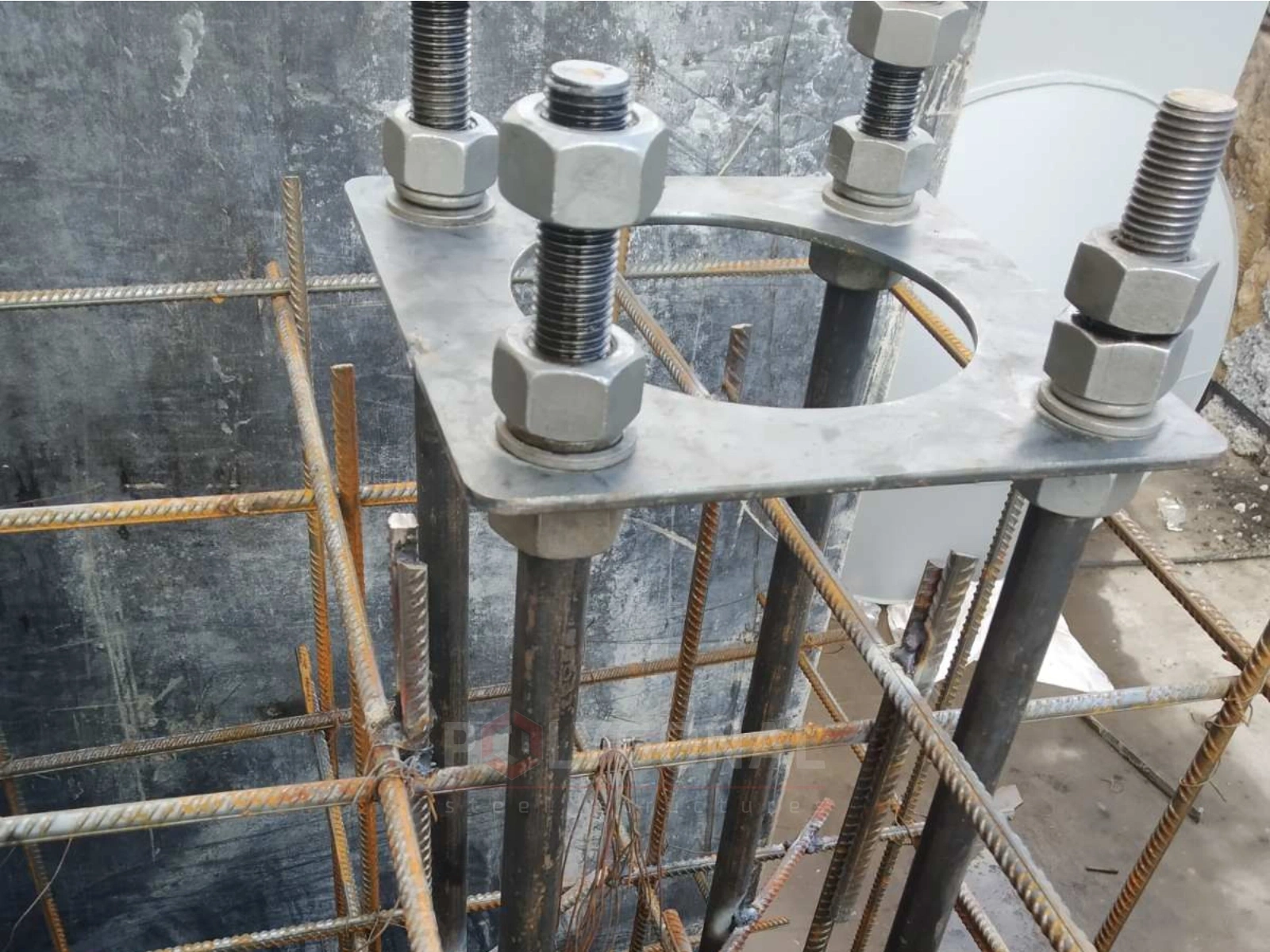
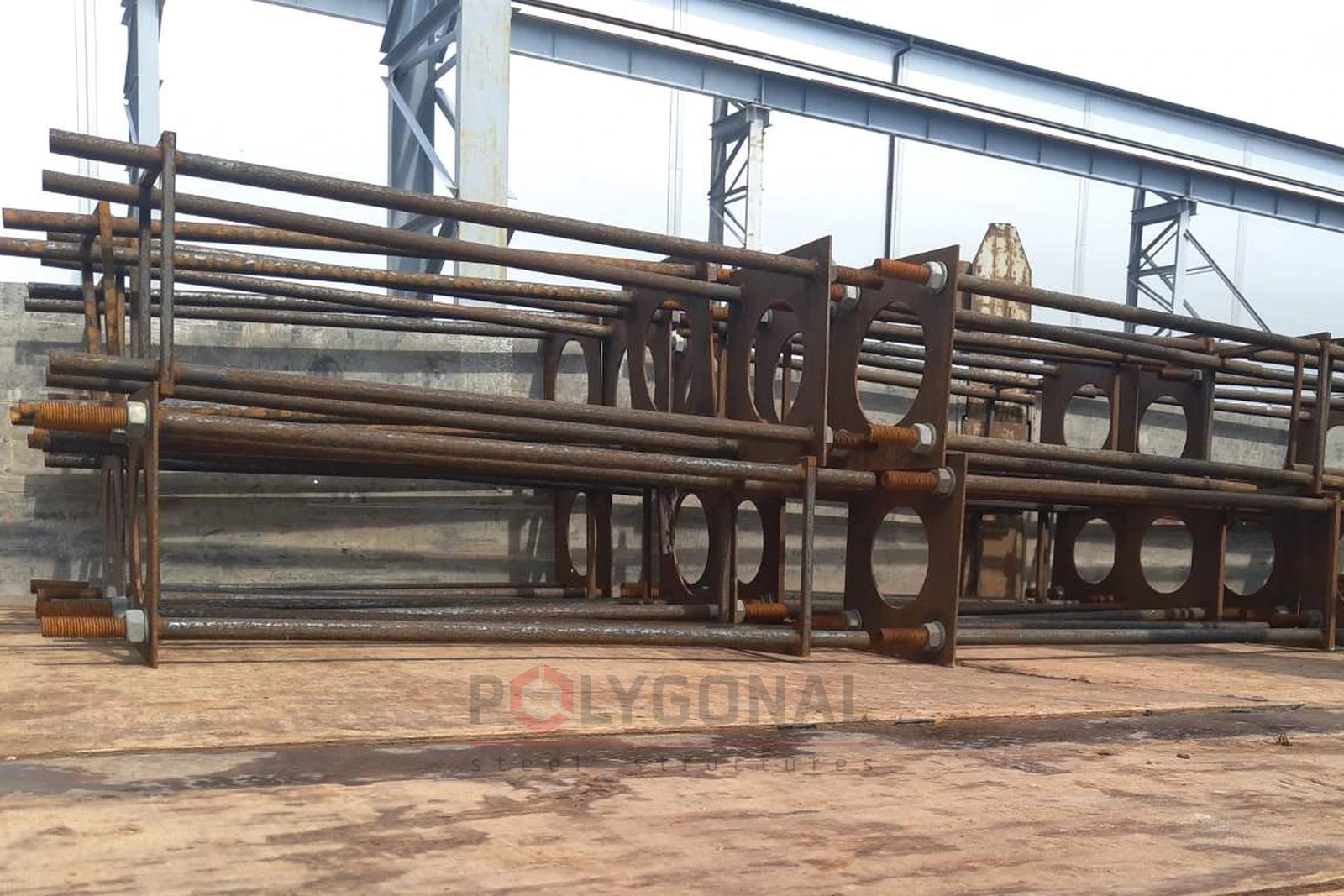
A foundation anchor cage is a steel frame with anchor bolts. It is cast into the foundation ahead of time, and the pole’s base flange is bolted to it later. Below we cover the available sizes and how to pick the right one.
Contents
- What a foundation anchor cage is and why it is needed
- FPO — anchor cages for lighting poles
- FPM — anchor cages for floodlight masts and lightning masts
- FKM — anchor cages for catenary masts
- Material and coating
- Examples: from the pole to the anchor cage
- Park poles PMO: which cage for which height
- FPM or FPMV: masts of the same height, different cages
- Scope of supply: how many anchors in a batch
- Checklist before ordering
- Anchor cage and pole earthing under the PUE
What a foundation anchor cage is and why it is needed
An anchor cage is a frame or plate with anchor bolts (studs). It goes into the formwork and is cast into the foundation concrete before the pole is installed. The anchors are laid out to match the holes in the pole’s base flange exactly, so as soon as the foundation is ready the pole can be set on the studs and tightened with nuts. Nothing has to be fitted on site.
FPO — anchor cages for lighting poles
FPO cages go under lighting poles: park, street and road. The mark carries the cage height in millimetres followed by the design variant number, as in FPO-1200-2.
| Cage type | A, mm | B, mm | C, mm | H, mm | Anchors D/n |
|---|---|---|---|---|---|
| FPO-800-1 | 250 | 190 | 130 | 800 | 20/4 |
| FPO-1000-1 | 300 | 220 | 160 | 1000 | 24/4 |
| FPO-1200-2 | 300 | 220 | 160 | 1200 | 24/4 |
| FPO-1500-1 | 400 | 300 | 160 | 1500 | 24/4 |
| FPO-1500-2 | 300 | 220 | 160 | 1500 | 24/4 |
| FPO-1500-3 | 400 | 300 | 160 | 1500 | 27/4 |
D/n is the anchor bolt diameter in millimetres and the number of anchors (for example, “24/4” means four M24 anchors). Which cage fits which pole depends on the pole’s height and range — we select it together with your order.
Foundation anchor cages
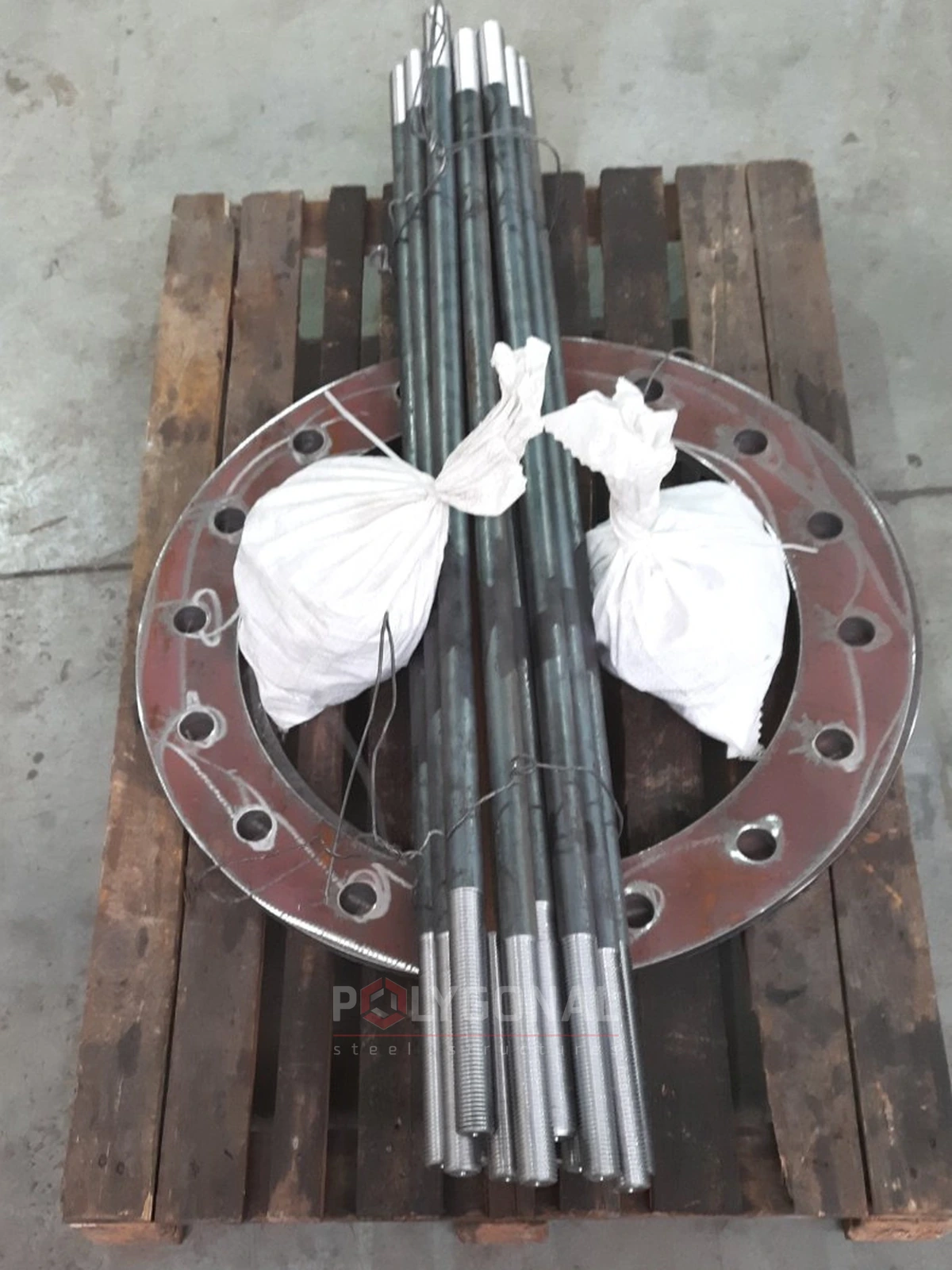
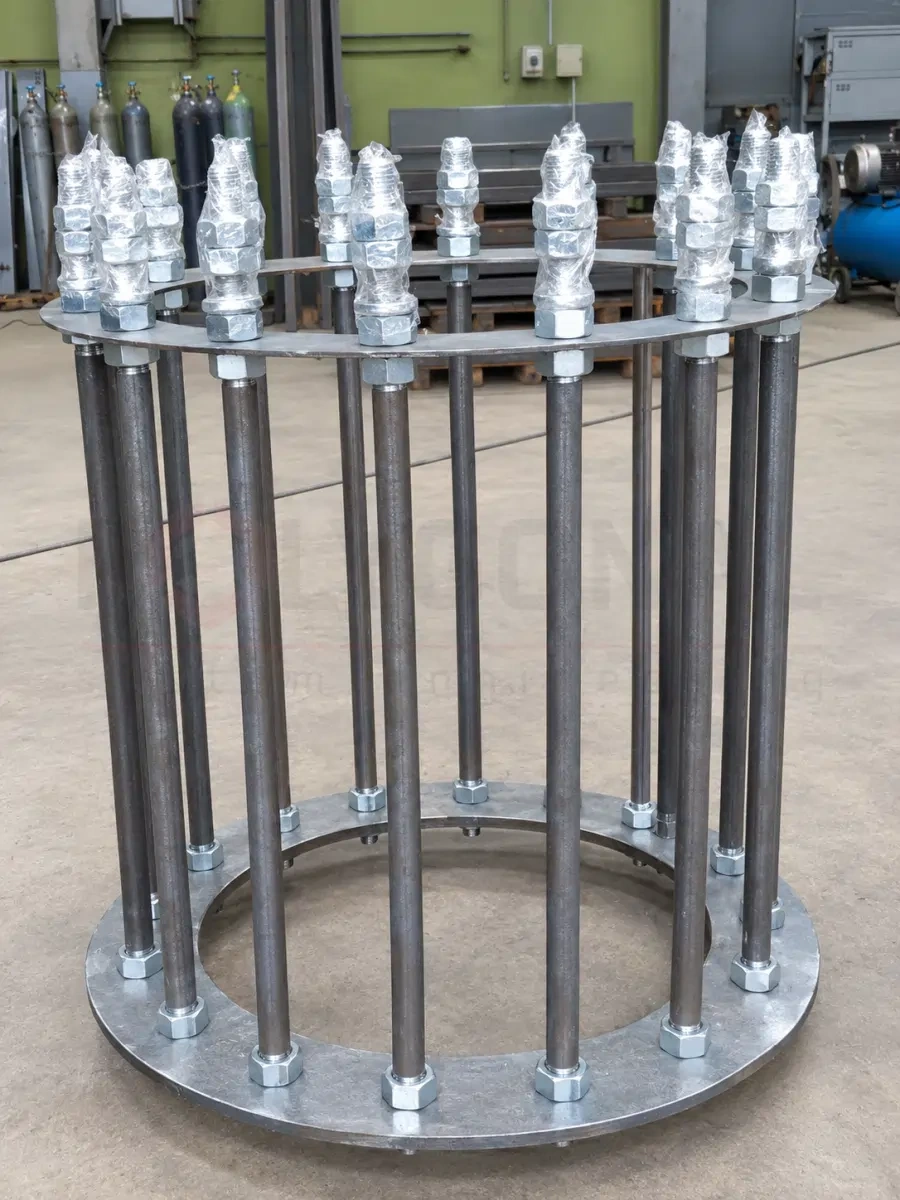
An assembled foundation anchor cage in the workshop: anchor bolts between two rings, the upper ends wrapped in film
FPM — anchor cages for floodlight masts and lightning masts
FPM cages are for floodlight masts of the PM range (12–20 m) and for multi-sided lightning masts. The mark gives two cage dimensions in millimetres, for example FPM-400-950.
| Cage type | B, mm | H, mm | Anchors D/n |
|---|---|---|---|
| FPM-390-900 | 390 | 900 | 30/6 |
| FPM-400-950 | 400 | 950 | 30/6 |
| FPM-440-850 | 440 | 850 | 27/12 |
| FPM-460-1040 | 460 | 1040 | 36/6 |
| FPM-480-850 | 480 | 850 | 27/12 |
| FPM-500-900 | 500 | 900 | 30/12 |
| FPM-520-950 | 520 | 950 | 30/12 |
| FPM-570-950 | 570 | 950 | 30/12 |
| FPM-640-900 | 640 | 900 | 30/16 |
| FPM-710-1040 | 710 | 1040 | 36/16 |
A separate, larger anchor cage is used for the tallest masts of the unified PMV range (20–34 m) — see the page Floodlight Masts.
FKM — anchor cages for catenary masts
FKM cages are for catenary masts with anchor fixing (BKM).
| Cage type | B, mm | H, mm | Anchors D/n |
|---|---|---|---|
| FKM-410-800 | 410 | 800 | 27/8 |
| FKM-450-900 | 450 | 900 | 30/8 |
| FKM-460-1040 | 460 | 1040 | 36/8 |
| FKM-520-1200 | 520 | 1200 | 42/8 |
Which FKM cage matches which BKM mast is shown in the table on the page Catenary Masts.
Material and coating
Anchor cages are made of S245/S345 steel to DSTU 8539:2015 and are supplied without coating.
Examples: from the pole to the anchor cage
Choose the cage from the pole’s dimension table: B, anchor diameter and anchor count must all match. A few pairs from the catalogue:
| Pole | Pole B, mm | Anchors | Anchor cage |
|---|---|---|---|
| PMO-7 | 220 | M24/4 | FPO-1000-1 |
| PM-16 | 480 | M27/12 | FPM-480-850 |
| MO-30 | 500 | M30/12 | FPM-500-900 |
In FPM and FKM marks the first number is the distance between anchors (B) and the second is the cage height.
Park poles PMO: which cage for which height
The catalogue lists three FPO cage sizes for park multi-sided PMO poles 3–10 m high. The 6–8 m and 9–10 m poles share the same B and anchors, yet the cage for 9 and 10 m is taller: FPO-1200-2 (1,200 mm) rather than FPO-1000-1 (1,000 mm).
For multi-sided MO lightning masts the catalogue also names FPO-1000-1 (9–15 m) and FPO-800-1 (5.5–8 m).
| Poles | Pole B, mm | Anchors | Anchor cage |
|---|---|---|---|
| PMO-3, PMO-4, PMO-5 | 190 | M20/4 | FPO-800-1 |
| PMO-6, PMO-7, PMO-8 | 220 | M24/4 | FPO-1000-1 |
| PMO-9, PMO-10 | 220 | M24/4 | FPO-1200-2 |
Data from the catalogue “Structures for outdoor lighting”. The dimensions of the cages themselves are in the FPO table above.
FPM or FPMV: masts of the same height, different cages
PM and PMV masts use different cages, so height alone does not settle it: the range matters too. For 20 m masts:
| Mast | Anchor cage | Anchors |
|---|---|---|
| PM-20 | FPM-570-950 | 12 × M30 |
| PMV-20 | FPMV-810-1200 | 16 × M36 |
An FPM cage will not fit a PMV-20: the anchor pattern is different.
Scope of supply: how many anchors in a batch
One pole, one cage. So the anchor count for a batch is the n in the D/n entry (for example, 12 in M30/12) multiplied by the number of cages.
Six PM-20 masts take 6 FPM-570-950 cages, which is 6 × 12 = 72 M30 anchors. Six PMV-20 masts take 6 FPMV-810-1200 cages, which is 6 × 16 = 96 M36 anchors. Check the delivery against these totals when it arrives.
Checklist before ordering
- pole mark and cage series: FPO, FPM or FKM (FPMV for PMV);
- for FPO, the full mark including the variant number: there are three cages 1,500 mm high;
- B and D/n of the cage agree with the pole’s dimension table;
- template, cable tube and earthing included in the foundation design (see Lighting Pole Foundations).
Anchor cage and pole earthing under the PUE
The anchor cage holds the pole, but in an overhead power line design it can also be a link in the earthing. Below is what the Rules for the Arrangement of Electrical Installations (PUE), 2026 edition, say about it. Contact networks of electrified railways, trams and trolleybuses do not fall under chapter 2.5 (cl. 2.5.1), and contact networks of urban electric transport do not fall under chapter 2.4 (cl. 2.4.1); the earthing of lighting poles is covered separately: earthing of metal poles.
On lines up to 1 kV, metal poles set on reinforced-concrete foundations must have a metallic connection between their metal parts and the foundation reinforcement (cl. 2.4.33).
For poles of lines of 110 kV and above, reinforced-concrete foundations may be used as natural earth electrodes if the anchor bolts are metallically connected to the reinforcement and the concrete has no polymer waterproofing. A bitumen coating on reinforced-concrete poles and foundations does not affect such use (cl. 2.5.128; the general rule for the underground parts of poles is cl. 1.7.115). The exceptions are described below (cl. 2.5.129, 2.5.211).
After that, the soil decides. In clay, loam, sandy-loam and similar soils with a resistivity ρ ≤ 1000 ohm·m, the reinforcement of foundations and poles of lines of 110 kV and above is used as natural earth electrodes, alone or together with artificial ones. Where ρ > 1000 ohm·m, the required resistance must be provided by artificial earth electrodes only (cl. 2.5.129).
Whether to weld the reinforcing bars of the foundation, and whether to weld the anchor bolts to them, must be settled by calculation. The calculation also determines whether a natural earth electrode is acceptable in terms of current density, and whether the foundation may be used in a strongly aggressive environment (cl. 1.7.116).
On 35 kV lines, and on 3–20 kV lines where the resistance is normalised (in populated areas and on poles that limit a crossing span with engineering structures), the value required by Table 2.5.29 must be achieved with artificial earth electrodes, and the natural conductivity of foundations and underground parts of poles need not be taken into account in the calculation (cl. 2.5.130).
On 3–20 kV lines in unpopulated areas, for poles with no lightning-protection cable or other lightning-protection devices and no apparatus on the pole (transformers, disconnectors, fuses and the like), other than poles that limit a crossing span with engineering structures, the resistance is not normalised; it is provided by the natural conductivity of reinforced-concrete foundations and the underground parts of poles, in soils with ρ up to 500, 1000 and 1500 ohm·m for 3 kV, 6–10 kV and 15–20 kV lines respectively, and in soils with higher ρ artificial earth electrodes are needed as well (cl. 2.5.127, 2.5.130). The natural conductivity of the underground part of reinforced-concrete poles of such a line can be used on condition that the longitudinal reinforcing bars in the underground part of the pole shafts, the earthing conductors and the artificial earth electrode (if there is one) are metallically connected (cl. 2.5.130).
At a railway crossing, the reinforcement of reinforced-concrete poles and pole stubs that limit the crossing span must not be used as an earth electrode (cl. 2.5.211).
Everything above describes requirements for the line design. For a specific line, the designer takes the final values from the current text of the PUE.
Updated:
Foundation anchor cages: frequently asked questions
How do I choose the anchor cage for my pole?
By the pole’s range and height: FPO for lighting poles, FPM for floodlight masts and lightning masts. For FKM, go by the load class P of the BKM mast (the table is on the catenary masts page). Send us the pole mark or height and we will pick the cage size.
How do I read a cage mark such as FPO-1200-2?
The first number is the cage height in millimetres; the second is the design variant. Variants differ in the size of the anchor frame and in the anchor diameter.
Can I order the anchor cage separately from the pole?
Yes. We supply cages on their own, for instance when the foundation is prepared first and the pole is ordered later.
What is the difference between FPO-1500-1, FPO-1500-2 and FPO-1500-3?
The height is the same, 1,500 mm; the frame and anchors differ. FPO-1500-2 has A 300, B 220 and M24 anchors. FPO-1500-1 has A 400, B 300, also M24. FPO-1500-3 has A 400, B 300, but M27 anchors.
Can I take a larger cage just to be safe?
Better not. The cage anchors have to match the holes in the pole flange. For example, a PMO-7 pole is fixed on four M24 anchors (B 220), while an FPO-1500-3 cage has M27 anchors (B 300), so the pole would not seat on it without rework.
Related products: Foundation anchor cages and bolts · Street lighting columns · High-mast lighting · Lightning protection masts and air-termination rods · Catenary masts
More on this topic: Lighting Pole Foundations: Types and Construction · Tram and Trolleybus Catenary Masts: Codes and Foundations · Foundations for Masts, Towers and Power Line Poles: Types, Soil, Anchor Cages
Get a quote for your requirements
Send us your requirements — we will calculate the price and lead time.