
Home / For Designers / Rolled Metal Handbook: Sections, Mass of 1 m, Metres per Tonne / Sheet and Flat Bar Sections: Mass of 1 m² and 1 m
Rolled Metal Handbook: Sections, Mass of 1 m, Metres per Tonne
Sheet and Flat Bar Sections: Mass of 1 m² and 1 m
The tables give the mass of 1 m² of sheet for thicknesses from 0.5 to 200 mm, the sizes of hot-rolled, checker-plate and expanded-metal sheets with the mass of a sheet, and the mass of 1 m of flat bar for each “width × thickness” pair. They show at a glance how much a sheet or a length of bar weighs and how many square metres make a tonne.
Contents
Mass of 1 m² of sheet by thickness
A steel sheet 1 mm thick has a mass of 7.85 kg per square metre. So the mass of 1 m² is the thickness in millimetres times 7.85: for 5 mm it is 39.25 kg. The “m² per tonne” column gives the reverse: a tonne of 3 mm sheet covers about 42 m².
The second table lists hot-rolled sheet with its sizes and the mass of a whole sheet. The mass of a sheet is the mass of 1 m² times its area.
Steel sheet: mass of 1 m² by thickness · ГОСТ 19903-74
| Thickness, mm | Mass of 1 m², kg | m² per tonne | Thickness, mm | Mass of 1 m², kg | m² per tonne |
|---|---|---|---|---|---|
| 0.5 | 3.925 | 254.8 | 20 | 157 | 6.37 |
| 0.6 | 4.71 | 212.3 | 22 | 172.7 | 5.79 |
| 0.7 | 5.495 | 182 | 25 | 196.25 | 5.1 |
| 0.8 | 6.28 | 159.2 | 30 | 235.5 | 4.25 |
| 0.9 | 7.065 | 141.5 | 35 | 274.75 | 3.64 |
| 1 | 7.85 | 127.4 | 40 | 314 | 3.18 |
| 1.2 | 9.42 | 106.2 | 45 | 353.25 | 2.83 |
| 1.4 | 10.99 | 91 | 50 | 392.5 | 2.55 |
| 1.5 | 11.775 | 84.9 | 55 | 431.75 | 2.32 |
| 1.7 | 13.345 | 74.9 | 60 | 471 | 2.12 |
| 1.8 | 14.13 | 70.8 | 65 | 510.25 | 1.96 |
| 1.9 | 14.915 | 67 | 70 | 549.5 | 1.82 |
| 2 | 15.7 | 63.7 | 75 | 588.75 | 1.7 |
| 2.5 | 19.625 | 51 | 80 | 628 | 1.59 |
| 3 | 23.55 | 42.5 | 90 | 706.5 | 1.42 |
| 3.5 | 27.475 | 36.4 | 100 | 785 | 1.27 |
| 4 | 31.4 | 31.8 | 110 | 863.5 | 1.16 |
| 5 | 39.25 | 25.5 | 120 | 942 | 1.06 |
| 6 | 47.1 | 21.2 | 130 | 1020.5 | 0.98 |
| 7 | 54.95 | 18.2 | 140 | 1099 | 0.91 |
| 8 | 62.8 | 15.9 | 150 | 1177.5 | 0.85 |
| 9 | 70.65 | 14.2 | 160 | 1256 | 0.8 |
| 10 | 78.5 | 12.7 | 170 | 1334.5 | 0.75 |
| 12 | 94.2 | 10.6 | 180 | 1413 | 0.71 |
| 14 | 109.9 | 9.1 | 190 | 1491.5 | 0.67 |
| 16 | 125.6 | 7.96 | 200 | 1570 | 0.64 |
| 18 | 141.3 | 7.08 |
The mass of 1 m² is calculated as 7.85 kg per millimetre of thickness (steel density 7850 kg/m³).
Hot-rolled steel sheet · ДСТУ 8540:2015
| Thickness, mm | Sheet size, mm: sheet mass, kg | Mass of 1 m², kg | m² per tonne |
|---|---|---|---|
| 2* | 1000×2000: 31.4; 1250×2500: 49.1 | 15.7 | 63.7 |
| 3* | 1000×2000: 47.1; 1250×2500: 73.6 | 23.55 | 42.5 |
| 4* | 1250×2500: 98.1; 1500×6000: 282.6 | 31.4 | 31.8 |
| 5* | 1250×2500: 122.7; 1500×6000: 353.2 | 39.25 | 25.5 |
| 6* | 1500×6000: 423.9 | 47.1 | 21.2 |
| 8* | 1500×6000: 565.2 | 62.8 | 15.9 |
| 8* | 2000×6000: 753.6 | 62.8 | 15.9 |
| 10 | 1500×6000: 706.5; 2000×6000: 942 | 78.5 | 12.7 |
| 12 | 1500×6000: 847.8; 2000×6000: 1130 | 94.2 | 10.6 |
| 14 | 1500×6000: 989.1; 2000×6000: 1319 | 109.9 | 9.1 |
| 16 | 1500×6000: 1130; 2000×6000: 1507 | 125.6 | 8 |
| 18 | 2000×6000: 1696 | 141.3 | 7.1 |
| 20 | 1500×6000: 1413; 2000×6000: 1884 | 157 | 6.4 |
| 25 | 1500×6000: 1766; 2000×6000: 2355 | 196.25 | 5.1 |
| 30 | 1500×6000: 2120; 2000×6000: 2826 | 235.5 | 4.2 |
| 40 | 1500×6000: 2826; 2000×6000: 3768 | 314 | 3.2 |
| 50 | 2000×6000: 4710 | 392.5 | 2.5 |
An asterisk marks thicknesses of 2–8 mm. According to the source of the range, sheet up to 8 mm thick made of S245 steel is allowed in group 1 structures under DBN V.2.6-198:2014, table G.1. The size is given as sheet width × length; the sheet mass is theoretical.
Checker plate and expanded metal
Checker plate has a lentil-shaped pattern on its surface, so it is heavier than plain sheet of the same thickness. For 4 mm plain sheet gives 31.4 kg/m² and checker plate 34.4 kg/m²; for 6 mm the difference is the same 3 kg (47.1 and 50.1 kg/m²). A 4 mm checker plate of 1250×4000 mm weighs 172 kg.
Expanded metal is not solid but a mesh with slits cut into it, so 1 m² is lighter. For the four sizes in the table it is 12.9 to 21.9 kg/m², less than even the thinnest checker plate in the table (26.6 kg/m²). A sheet of size 608 measuring 1000×2000 mm weighs 43.8 kg.
Steel checker plate with lentil pattern · ДСТУ 8783:2018
| Thickness, mm | Sheet size, mm: sheet mass, kg | Mass of 1 m², kg | m² per tonne |
|---|---|---|---|
| 3 | 1000×4000: 106.4; 1250×4000: 133; 1250×6000: 199.5 | 26.6 | 37.6 |
| 4 | 1250×4000: 172; 1250×6000: 258 | 34.4 | 29.1 |
| 5 | 1250×4000: 211.5; 1250×6000: 317.2 | 42.3 | 23.6 |
| 6 | 1250×4000: 250.5; 1250×6000: 375.8 | 50.1 | 20 |
The size is sheet width × length, mm; the sheet mass is theoretical.
Expanded metal sheet
| Designation | Sheet size, mm: sheet mass, kg | Mass of 1 m², kg | m² per tonne |
|---|---|---|---|
| 306 | 1000×2000: 25.8; 1000×2500: 32.2; 1250×2500: 40.3 | 12.9 | 77.5 |
| 406 | 1000×2000: 31.4; 1000×2500: 39.2; 1250×2500: 49.1 | 15.7 | 63.7 |
| 506 | 1000×2000: 32.8; 1000×2500: 41; 1250×2500: 51.2 | 16.4 | 61 |
| 608 | 1000×2000: 43.8; 1000×2500: 54.8; 1250×2500: 68.4 | 21.9 | 45.7 |
The first column is the designation of the expanded metal size.
Flat bar: mass of 1 m by width and thickness
Flat bar is a long flat section. The mass of 1 m is width times thickness (mm²) times 7.85 · 10⁻³ kg/m; it is easier to take the ready figure from the table.
Rows of the table are widths, columns are thicknesses. A “–” means the range has no such size: for a width of 20 mm there are thicknesses of 4 mm and 7 to 10 mm, but not 5 or 6 mm.
Hot-rolled steel flat bar: mass of 1 m, kg · ГОСТ 103-76
| Width, mm / thickness, mm | 4 | 5 | 6 | 7 | 8 | 9 | 10 |
|---|---|---|---|---|---|---|---|
| 20 | 0.63 | – | – | 1.1 | 1.26 | 1.41 | 1.57 |
| 22 | 0.69 | 0.86 | 1.04 | 1.21 | 1.38 | 1.55 | 1.73 |
| 25 | 0.78 | 0.98 | 1.18 | 1.37 | 1.57 | 1.77 | 1.96 |
| 28 | 0.88 | 1.1 | 1.32 | 1.54 | 1.76 | 1.98 | 2.2 |
| 30 | 0.94 | 1.18 | 1.41 | 1.65 | 1.88 | 2.12 | 2.35 |
| 32 | 1 | 1.26 | 1.51 | 1.76 | 2.01 | 2.26 | 2.51 |
| 36 | 1.13 | 1.41 | 1.7 | 1.98 | 2.26 | 2.54 | 2.83 |
| 40 | 1.26 | 1.57 | 1.88 | 2.2 | 2.51 | 2.83 | 3.14 |
| 45 | 1.41 | 1.77 | 2.12 | 2.47 | 2.83 | 3.18 | 3.53 |
| 50 | 1.57 | 1.96 | 2.35 | 2.75 | 3.14 | 3.53 | 3.92 |
| 55 | 1.73 | 2.16 | 2.59 | 3.02 | 3.45 | 3.89 | 4.32 |
| 60 | 1.88 | 2.35 | 2.83 | 3.3 | 3.77 | 4.24 | 4.71 |
| 65 | 2.04 | 2.55 | 3.06 | 3.57 | 4.08 | 4.59 | 5.1 |
| 70 | 2.2 | 2.75 | 3.3 | 3.85 | 4.4 | 4.95 | 5.5 |
| 75 | 2.35 | 2.94 | 3.53 | 4.12 | 4.71 | 5.3 | 5.89 |
| 80 | 2.51 | 3.14 | 3.77 | 4.4 | 5.02 | 5.65 | 6.28 |
| 85 | 2.67 | 3.34 | 4 | 4.67 | 5.34 | 6.01 | 6.67 |
| 90 | 2.83 | 3.53 | 4.24 | 4.95 | 5.65 | 6.36 | 7.06 |
| 95 | 2.98 | 3.73 | 4.47 | 5.22 | 5.97 | 6.71 | 7.46 |
| 100 | 3.14 | 3.92 | 4.71 | 5.5 | 6.28 | 7.06 | 7.85 |
Mass of 1 m in kilograms; width in mm (rows), thickness in mm (columns).
Worked examples
A 6 mm sheet of 1500×6000 mm: 47.1 kg/m² × 9 m² = 423.9 kg. A 10 mm sheet of 2000×6000 mm weighs 942 kg, which is 78.5 kg/m² over 12 m².
A 40×6 mm flat bar weighs 1.88 kg per metre. A six-metre length is about 11.3 kg, and a tonne of this bar is about 531 m (1000 divided by 1.884).
All values are theoretical, for nominal sizes. The actual mass depends on rolling tolerances, so check the supplier’s documents for accounting.
Where sheet and flat bar are used
Plain sheet goes into gusset plates, base plates, cladding and blanks for bending. Checker plate is laid where people walk: platforms, stairs, floors. Expanded metal makes gratings, guards and screens.
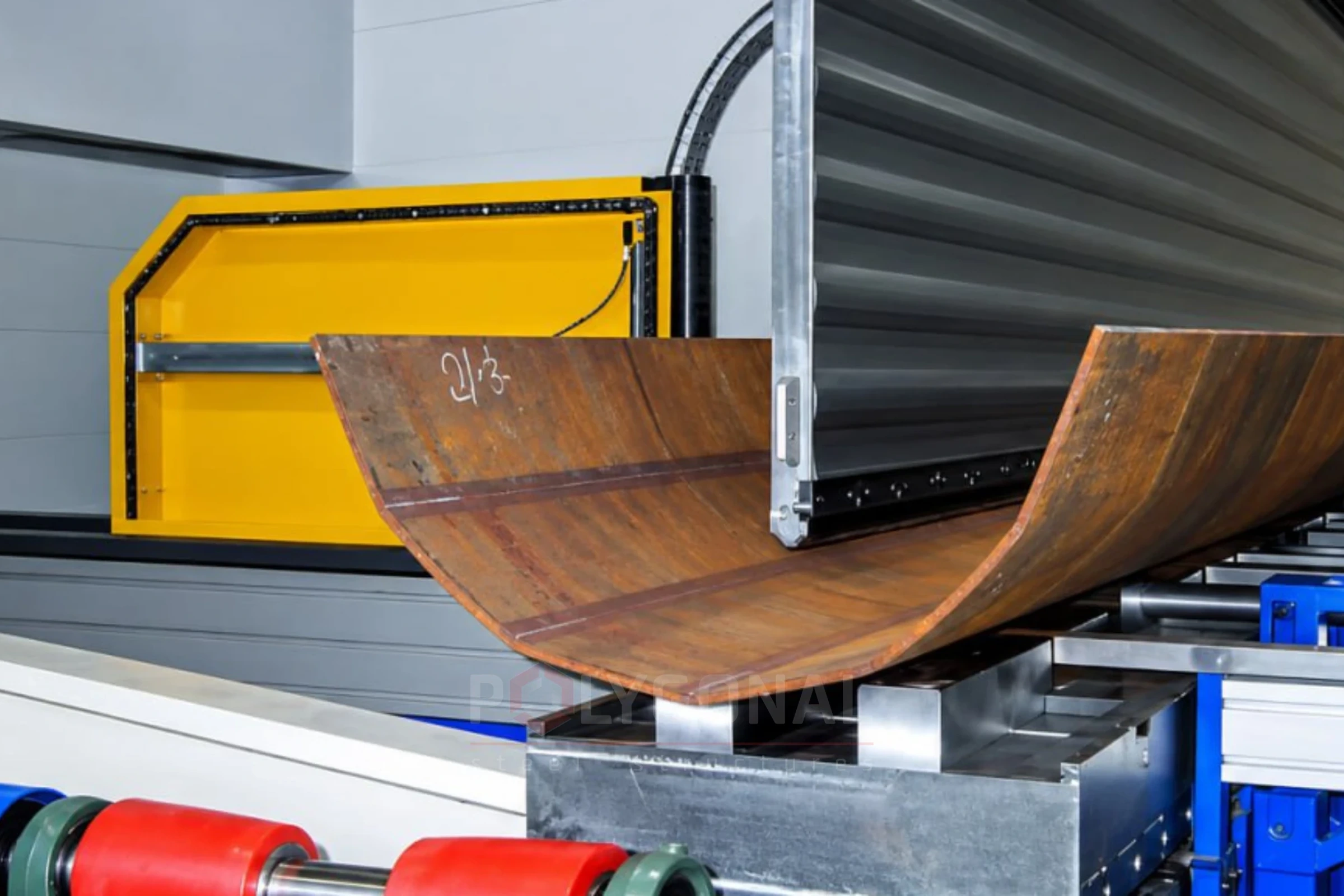
Flat bar frames panels and makes gussets, clamps and cover plates. The POLYGONAL company cuts sheet parts by laser and plasma and bends them on a 2000 t press.
Calculator and ordering
For sizes outside the tables use the rolled metal calculator, and look for other rolled products in the handbook. Need sheet and bar as part of a structure? Send a drawing or a specification: the POLYGONAL company makes steel structures to the customer’s drawings and galvanizes the finished products.
Updated:
Sheet and flat bar sections: frequently asked questions
How much does 1 m² of 5 mm sheet weigh?
A 5 mm sheet weighs 39.25 kg per square metre: 5 mm × 7.85 kg. A tonne of it covers about 25.5 m².
Why is checker plate heavier than plain sheet?
The pattern adds metal. In the tables a 4 mm sheet is 31.4 kg/m² plain and 34.4 kg/m² checker, and a 6 mm sheet is 47.1 and 50.1 kg/m².
How do I work out the mass of flat bar?
Find the width and thickness in the matrix, take the mass of 1 m and multiply by the length. A 40×6 mm bar gives 1.88 kg/m, so a six-metre length is about 11.3 kg.
What does a dash in the flat bar table mean?
A dash means the range has no such width and thickness combination. For a width of 20 mm, for example, there are no 5 mm or 6 mm thicknesses.
Related products: Custom steel fabrication · Steel structure design (structural and detail drawings) · Hot-dip galvanising
More on this topic: I-beam Sections: Mass of 1 m, Dimensions and Section Properties · Rebar Sections: Mass of 1 m, Section Area and Metres per Tonne · Round, Square and Hexagon Bar Sections: Mass of 1 m and Sizes · Channel Sections: Mass of 1 m, Dimensions and Section Properties · Equal-leg Angle Sections: Mass of 1 m and Section Properties · Round Pipe Sections: Mass of 1 m, Welded and Water-Gas Pipes
Get a quote for your requirements
Send us your requirements — we will calculate the price and lead time.